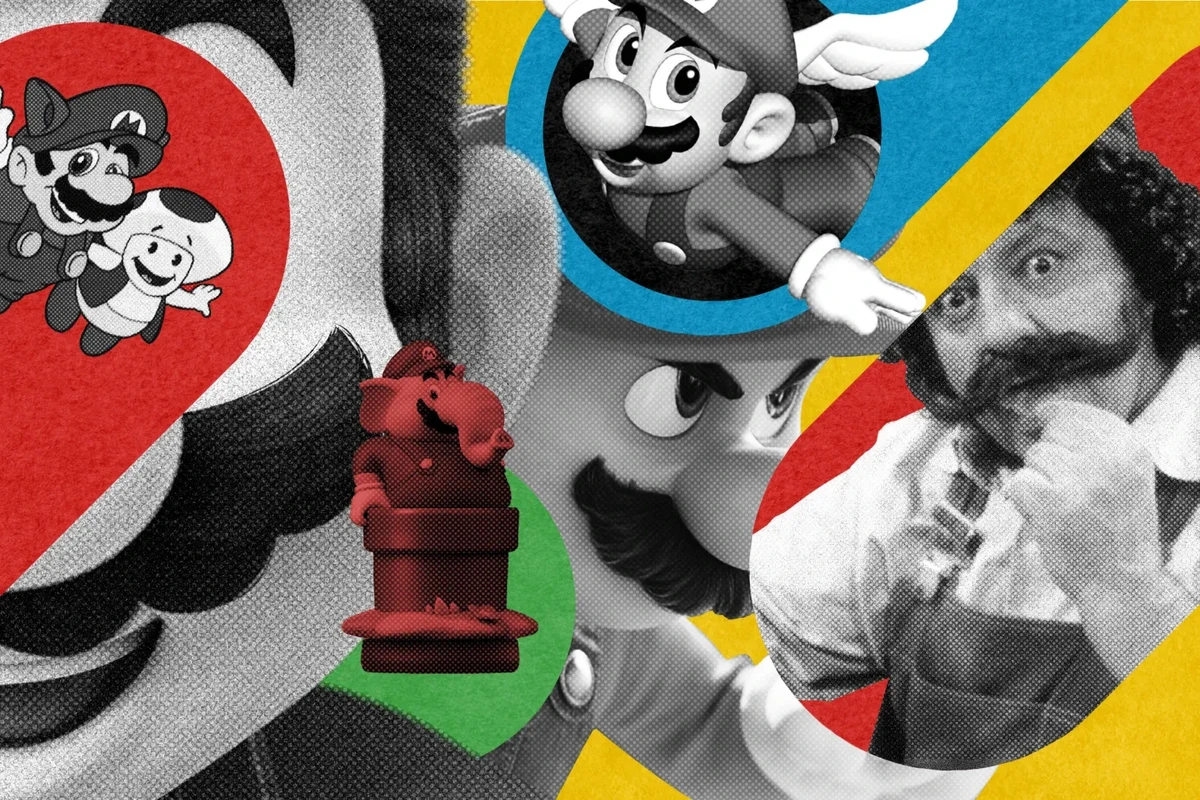

Going into 1981, Japanese game designer Shigeru Miyamoto was facing a problem. Working on one of his first games ever, he hoped to use Popeye, the famed sailor of 1930s cartoons, to serve as the hero. Yet despite the fact that Nintendo held the rights to make Popeye-themed playing cards and handheld games, a full-fledged title wasn’t approved for unknown reasons. The solution was to create original characters: Popeye became a plumber, simply dubbed Jumpman, while brutish antagonist Bluto ended up the titular ape Donkey Kong (a legend in his own right).
Following his impromptu genesis, Mario quickly evolved. By 1982, he had a real name, as well as a set of core elements. Miyamoto didn’t have a lot of specifics for him, but he knew the basics. “Mario’s around 26-years-old,” Miyamoto tells Rolling Stone. “Has a mustache. May not be the brightest, but has guts. He’s got emotion, he’s got heart.”
Since then, the character’s personality has been both cemented and reinvented across over 200 video games, manga and comics, TV shows, and multiple film adaptations (the latest being this year’s The Super Mario Galaxy Movie). His merch crowds the aisles of department stores and he’s a main attraction at not one, but three theme parks. Hell, he’s basically got his own house of worship in the form of Kyoto’s Nintendo Museum. Video game designer Shigeru Miyamoto poses with his creation, Mario.Ralf-Finn Hestoft/CORBIS/CorbisGetty Images
And while everyone may know of Mario, a closer look reveals that there’s more to gaming’s greatest icon than Miyamoto’s first tenets. The very idea of Mario is a paradox; he’s always the same, but can also be anything. And he’s changed many times throughout the years. As Ryan Janes, author of the book The Unofficial History of Mario Games, puts it: “He seems to be a character that you can put in any scenario, and it seems to just work.”
The Golden Years
In the early days, Mario had it rough. A product of the eight-bit age, there wasn’t much to make of him as a character. His signature mustache and overalls helped make his visage pop on a limited pixel grid, but his color scheme changed depending on the game or promotional art. During Donkey Kong’s development, he didn’t even have a distinct name, with options including Ossan (roughly translating to “middle-aged man”) and Mr. Video, before being saddled with the highly literal moniker, Jumpman.
The character’s true name first appeared in 1982’s Donkey Kong Jr. — lifted from Nintendo of America’s landlord, Mario Segale — for a game where he serves as the villain rather than the player’s avatar. Mario might’ve gotten a name, but he still wasn’t quite the leading man.
Mario quickly became a stand-in for Nintendo, an easily recognizable image to drop into gameplay as needed. In 1983’s Mario Bros., he got a sibling, the green-hued Luigi. As with Mario, Luigi’s origin was by necessity; the two-player arcade game needed dual heroes, and a simple palette swap allowed the developers to free up system memory.
Still, many of Mario’s appearances were innocuous cameos in stripped-down sports games like Tennis (1984) and Golf (1985) for Famicom (Japan’s equivalent to the NES), and individually released Game & Watch handheld titles like Mario’s Cement Factory and Mario’s Bombs Away (both 1983). He also frequently changed jobs, setting plumbing aside for other gigs like construction in 1985’s Wrecking Crew and refereeing boxing in 1987’s Punch-Out!!. These early titles set the standard for Mario’s flexibility; he was basically a blank slate.
“Maybe [he] doesn’t wear a suit everywhere, but he has the heart to try all different kinds of professions,” Miyamoto says. “[When] I see something like Dr. Mario, I always tell myself, ‘I don’t know if he’s actually a doctor. He might just be a doctor in disguise.’”
His big breakthrough arrived in 1985 with Super Mario Bros. for the NES — a title so prolific it created a tectonic shift in the games industry. Designed by Miyamoto, Super Mario Bros. established his permanent traits and abilities. He was nimbler and more agile, jumping further and higher than before, and he could collect power-ups like fire flowers and mushrooms, the latter increasing his size. The game saw Mario once again saving a damsel (Princess Peach, then called Toadstool) from his nemesis, Bowser (née King Koopa), which would remain his motivation for countless sequels for decades.
Super Mario Bros. was seminal. Following the post-Atari 2600 industry crash, attributed to oversaturation of low-quality products, there was good reason to believe that virtual gaming as a hobby had seen its day. Nintendo and Mario himself helped immensely with the medium’s cultural rejuvenation. “He could be seen as the savior of gaming,” says Janes. “His games are a masterclass in [design] and creativity. [They were] pushing the boundaries of what the medium can do.” Mario in Super Mario Bros., which changed modern gaming.GamesDB
Quick to capitalize, Nintendo moved firmly into the Mario business, releasing the (until recently) Japanese-only sequel Super Mario Bros.: The Lost Levels (1986), the more Western-friendly Super Mario Bros. 2 (1988), and the all-time great Super Mario Bros. 3 (1988) — on top of spin-offs like puzzler Dr. Mario (1990).
And yet, given the technological limitations of the time, Mario mostly remained one-dimensional throughout this period. Without room to develop in-game, it would take external forces to flesh out the character into something whole.
By the end of the Eighties, Mario’s popularity hit a fever pitch with players, and led to the development of a syndicated television series, The Super Mario Bros. Super Show!, released in 1989. The show was a hybrid of live-action and animation, with pro wrestler Lou Albano and actor Danny Well portraying Mario and Luigi, respectively. While the live-action segments played out as a broad sitcom parody of two brothers struggling in the plumbing business, the animated portion adhered to a Saturday morning cartoon vibe of slapstick adventures within the Mushroom Kingdom.
Super Show! established many of the quirks and lore that North American audiences would cling to for years, despite conflicting with what little existed of the games’ canon. Here, the brothers were two Brooklyn boys speaking with hyperbolic Italian accents — details carried on to other adaptations, with the outlandish voicework eventually making its way into the games. It even locked in Mario’s soon-to-be catchphrase, “Mamma mia!,” early in the pilot episode.
Running for 65 episodes across syndication, Super Show! was followed by two more animated-only series, 1990’s The Adventures of Super Mario Bros. 3 and 1991’s Super Mario World. Both subsequent series adhered closer to the worldbuilding of the games and featured an entirely different cast.
In 1993, though, there was a bit of a setback with the live-action adaptation, Super Mario Bros., starring Bob Hoskins as Mario, John Leguizamo as Luigi, and Dennis Hopper as the hammy “President” Koopa. Hoskins’ take on Mario aligned well with Miyamoto’s original vision of Mario as a capable but slightly dim hero, and Leguizamo made Luigi into a bolder personality than we’d seen before (and since). Like Super Show!, the 1993 movie was created free of Nintendo oversight, it stuck to the Brooklyn-based origins that never played into the games. However, it was otherwise an absolute train wreck.
The troubled production resulted in a bizarre cyberpunk schlock-flick that felt far removed from what most fans understood Mario to be. Directors and then-married couple, Rocky Morton and Annabel Jankel (co-creators of the fictional corporate-satire character, Max Headroom) had little reverence for Nintendo’s property, and clashed with both studio execs and the film’s cast and crew — with Leguizamo himself admitting to drinking on set to deal with the mess. Upon release, the movie was DOA at the box office. Mostly reviled by critics, and Nintendo themselves, it spooked the company from developing any major adaptations for nearly 30 years.
Following the failure of the 1993 movie, Nintendo mostly pivoted away from ancillary media to continue establishing Mario as a personality, instead relying on a diversification in their games that would lend new layers to the character.
In 1991, an American actor named Charles Martinet was cast as Mario (he would later go on to voice Luigi, Wario, and Waluigi, among others). Martinet gave the character his distinctive high pitch paired with an even more exaggerated faux-Italian cadence than before. With voicework still limited in video games at the time, his primary role was representing the character at trade shows next to visualizers and digital puppets. But in 1996’s groundbreaking 3D platformer, Super Mario 64, players would meet the real Mario, brought to life by Martinet.
 Bob Hoskins in 1993’s Super Marios Bros. The movie was such a flop it scared Nintendo off adaptions for 30 years.Buena Vista Pictures/Everett Collection
With 64, Nintendo wanted to reintroduce audiences to Mario. Upon booting up the game, players were met with a traditional title screen paired with his voice for the first-time, declaring, “It’s-a-me, Mario.” The scene then automatically shifts to Mario’s face in luscious 3D. A far cry from the pixelated hero of old, this Mario felt real — blinking, breathing, tilting his head. It felt revolutionary.
Until the mid-Nineties, the rules were simple: Mario was a hero, but deliberately non-violent. Sure, he could stomp on a Goomba’s head or toss his nemesis Bowser by the tail, but rarely did he throw a real punch. That all changed with the character’s first foray into the role-playing genre, 1996’s Super Mario RPG. Developed by SquareSoft (now Square Enix), the company behind the Final Fantasy series, Super Mario RPG was unlike anything Nintendo had done with the franchise before — changing the perception of what Mario could be.
As a turn-based RPG, the most obvious difference is in combat. Mario can still jump and innocuously throw fireballs, but he could also deliberately punch enemies. It might sound crazy for a video game character, but it’s a feature taken for granted, making its way into Super Mario 64 the same year and, of course, in the crossover fighting game franchise Super Smash Bros. in 1999. But outside of these rare exceptions, Mario’s pugilism was quickly retired in lieu of hammer hits and kid-friendly blows.
But the leap to role-playing in Super Mario RPG opened other doors, specifically in how the character interacted with other cast. By definition, an RPG relies on narrative storytelling, so presumably, Mario himself would need to do some talking. True to form for Nintendo, though, Mario remains nonverbal in the game, despite its 20-plus hour length and dialogue-heavy sequences. But there’s a trick to it all, and it’s one that also broke new ground for the hero’s characterization by letting Mario be satirized.
To be fair, the tone of Super Mario RPG puts a comedic spin on everything in the Mushroom Kingdom. Talkative characters like the froggish Mallow and even Bowser himself are motor-mouthed and sarcastic, nigglingly mocking Mario for his inability to speak in anything other than nods and pantomimes.
The irreverent, self-referential writing of Mario’s first RPG would become a staple of subsequent series. When it comes to role-playing, Mario and his friends are given a longer leash to be silly or dumb, leaning further into the comedic dimness first alluded to by Miyamoto that rarely makes it into the mainline games. But then again, there’s an explanation from the creator himself.
In a 2015 interview with Game Informer, Miyamoto addressed the tonal flexibility of Mario characters. “If you’re familiar with things like Popeye and some of the old comic characters, you would oftentimes see this cast of characters that takes on different roles depending on the comic or cartoon,” he said. “They might be businessman in one or a pirate in another. I look at our characters in a similar way and feel that they can take on different roles in different games. It’s more like they’re one big family, or maybe a troupe of actors.”
Mario’s Unshakable Legacy
In 2023, 30 years removed from their first attempt, Nintendo and Illumination (the studio behind Despicable Me and Minions), released The Super Mario Bros. Movie, an animated feature aimed at rehabilitating Mario’s cinematic image by adhering closer to the games in terms of Easter eggs and lore. For the first time since the Nineties, Mario was speaking in full sentences and had a story arc befitting a movie, even if it was a simple one.
Starring Chris Pratt as Mario, Charlie Day as Luigi, and Jack Black as Bowser, the new take on the Mario movie packed more (intentionally) comedic weight and was kid-friendly, weapons-grade plutonium at the box office. Laser-focused on blending multiple generations of Mario lore to appeal to audience nostalgia of any particular era, The Super Mario Bros. Movie accrued over $1 billion in sales, despite its lukewarm critical response.
 The Super Mario Bros. Movie, starring Chris Pratt, got a much better reception than its live-action counterpart.©Universal/Everett Collection
The film’s script plays all the hits, densely packed with visual references, audio cues, and locations from Mario’s full history — and even brings back the brothers’ Brooklyn origins. Mario himself is played mostly straight by Pratt, subduing the exaggerated Italian accent from the games, while retaining the underdog aspect of a blue collar guy burdened with greater purpose.
This year’s sequel, The Super Mario Galaxy Movie is already making bank. Doubly packed with references compared to its predecessor, the Galaxy movie wedges in everything from Mario 2 villains to Star Fox, and marks the first steps toward establishing a larger Nintendo cinematic universe. For many kids today, these movies will be their memory of Mario, but they’re only a small part of the mascot’s ongoing image.
The hook of Mario games is clear: Nintendo prioritizes mechanics and innovation, making the games easy to learn and endlessly playable. But as a cultural figure, what’s the appeal? What gives a being that’s tantamount to a jovial blank slate such staying power? His creator seems to think the anchor is in his demeanor.
“One thing about Mario, he is fundamentally just bright and joyful,” Miyamoto says. “And this might be something that you can say for all Nintendo characters, but I think Mario especially has that fundamental core.”
The joyfulness of Mario could easily be taken for granted, but remember, this is a character that’s prevailed for generations. “What touches me the most about Mario is his essential goodness,” says Illumination CEO Chris Meledandri. “He’s a character filled with heart. I think it’s one of the qualities that audiences cherish about him as well.”
But perhaps the most engaging aspect of Mario is his chameleon-like ability to remain at the same time personable and, ultimately, a blank slate. Sure, he’s an action hero, but he’s also just a plumber — or a doctor or racecar driver. He’s whatever fans want him to be.
“If you were to pick apart who he is, he’s just [this] portly plumber with a mustache wearing a bright red outfit,” says author Ryans Janes. “And you’re thinking, ‘How can that be the star of a franchise — or [the] star of anything, really?’ But what I think people love about Mario, it’s a similar thing to Mickey Mouse, where it’s this character that works in any scenario.”
“When you say it out loud, [that] sounds like absolute nonsense,” he adds. “But in the world of Mario, nothing is nonsense.”





 Nick Wilde from Zootopia greets fans during the Magic Kingdom parade. Kenslie McGuire