
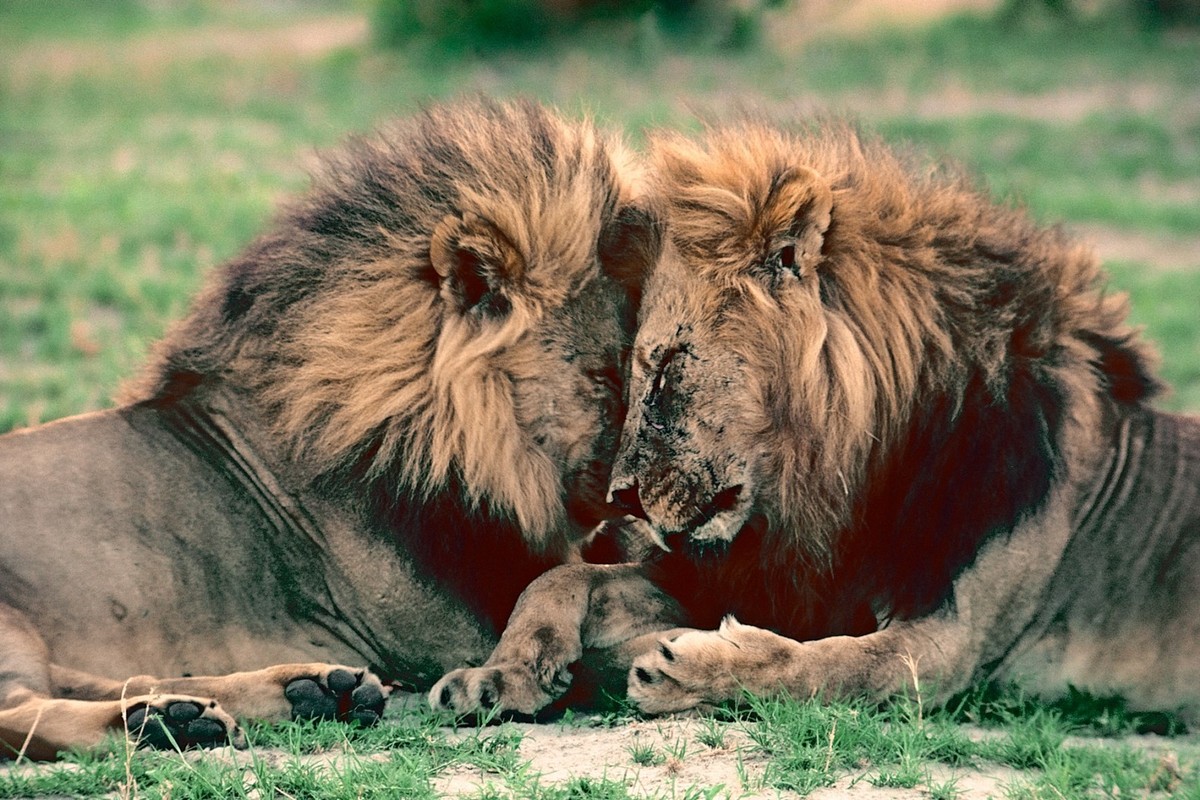

I want to take you back to the year 2008, when New York City’s Museum of Sex launched an exhibit on the sex lives of animals. The exhibit ran for a full decade, and I had the chance to check it out about a year or so before it closed in 2018. The Sex Lives of Animals exhibit is, in fact, where I learned that ducks possess massive, corkscrew-like penises. But duck genitalia aside, the Museum of Sex’s intention, nearly 20 years ago, was to reveal the “astonishing array” of sexual behaviors animals routinely engage in, from kissing to hugging to, well, everything else. And definitely not always male-on-female.
As many props as I give the Museum of Sex for teaching me so much about what goes in broad daylight among the literal birds and bees, I also have to acknowledge what a bummer it is that such an exhibit would probably not be permitted in a place where they don’t sell vibrators and lube in the gift shop. And how disappointing it is that the truth about cats and dogs, if you will, has not become more widely accepted.
When it comes to the gender and sexuality of animals, the truth is not only out there — it’s actually been staring us in the face for years. The problem is, mainstream science and society have been slow to move away from the narrative that all animals copulate only for reproduction, any same-sex activity is purely anomalous (and unnatural), and every species is male-dominated. Now, a new documentary called Second Nature: Gender & Sexuality in the Animal World is working to dispel those myths — and, ideally, popularize them to a greater extent.
Narrated by Elliot Page, Second Nature more than does its homework by interviewing a handful of in-the-know scientists who have built lengthy careers studying the diversity of sex and gender behaviors of a range of species, from primates and birds to fish and reptiles. And there certainly is a lot to unpack. In addition to the facts themselves, Second Nature asks a few important questions: Why isn’t this information taught in basic biology classes or included in zoo books? Why do humans insist on projecting their own binary narrative of gender and sexuality — that males are aggressors, females are coy, and sex is only for procreation — onto our animals neighbors?
The answer is pretty simple: in order to understand the world around us, the easiest and simplest thing to do is to apply our societal framework. Historically speaking, those who research and study animals are prone to projecting their ciscentric, patriarchal ideas into animals, despite lots of evidence to the contrary.
Anyway, now that I’ve watched Second Nature, I can rattle off some very cool facts: Dolphins have homosexual sex — a lot — as do penguins and black swans. Also regarding penguins, those seabirds frequently form pair bonds of the same sex to parent little penguin chicks. Bonobo females frequently use sex to resolve conflicts via “genital rubbing,” and males can have sex with each other via “penis fencing.” Bonobos also operate in a matriarchal society. About half of the sex capuchin monkeys have is homosexual.
Speaking of those crazy-dicked ducks, get this: Female ducks possess vaginas with two to three pouches that may lead nowhere; beyond the pouches lies a labyrinthian spiral. When ducks mate, it’s the female who decides which male she’ll allow to deposit sperm in the spiral, but that’s only if she decides to relax her muscles enough. If and when a male duck tries to force himself on a female — and that definitely happens — her vaginal pouches actually prevent the sperm from getting anywhere.
What else? Well, female golden lion tamarins have harems of unrelated males, all of whom she mates with. And I think we all are pretty familiar with the tale of the seahorse, where males become pregnant and give birth.
A lot of this information initially found an audience in Dr. Joan Roughgarden’s 2004 book Evolution’s Rainbow, which looked at evidence from birds, fish, and mammals to push back against the Darwinian sexual selection theory, which proposed that male-male competition, or intrasexual selection, was a method for successful mating. (Basically, the strongest and most aggressive male gets to mate and pass on their genes.) Charles Darwin also proposed that intersexual selection involved females evaluating and choosing males with whom to mate based on specific traits, such as a colorful peacock plumage.
When Roughgarden, a Stanford evolutionary biologist who is prominently featured in Second Nature, argued against these long-accepted Darwinian theories, she was met with some horrific pushback. The reviews were “nasty,” she recalls in the documentary. Other reviews said that there was a “gay agenda” at work. (Dr. Roughgarden is a trans woman.)
We tend to forget that in Victorian England, when Darwin first proposed the theory of evolution, religious leaders weren’t having it. Generally speaking, religious leaders in the 1800s resisted Darwinism because they felt it contradicted the Genesis creation story (though some were comfortable with the idea of Christian Darwinism, which proposes that God utilized biological evolution to create all life). Catholic leadership felt Darwinism could explain physical biology but threatened the existence of unique human souls. Ultimately, leaders in Christianity felt Darwinism reduced human life to something purely mechanical and soulless, and therefore Godless.
It wouldn’t be until the 1870s — nearly two decades after Darwin published On The Origin of Species — that the scientific community and other educated groups widely accepted evolution as fact.
In Second Nature, scientists theorize that Darwin couldn’t help but impose his own heterosexual ideations on animal reproduction, mainly that animals only copulate for the purposes of reproduction, with males being the aggressors and females fluttering their eyelids behind lace fans, or something.
In more recent years, as the scientific community became more diverse, there came a fresh wave of observations about animal behavior and the evolutionary reasons behind them. For instance, social animals like bonobos and chimpanzees use sex as a means of reconciliation, which allows for a peaceful, cooperative existence. (If sex were primarily achieved through aggression, that would probably result in more volatility, injuries, and death, which doesn’t sound ideal for any community’s survival — animal, human, or otherwise.)
“Humans project ourselves onto nature all the time, and have been doing it forever — just look at any myth,” Second Nature director Drew Denny tells Rolling Stone. “We love creating colorful explanations for natural phenomena, but often do so at the peril of totally innocent people. Remember when all left-handed people were controlled by Satan? I bet you know several lefties who are not, in fact, Satanists.”
Denny thinks it would benefit all of us to take a bird’s eye view (pun intended) of history and remember the myriad stories we’ve told each other over the years in an attempt to explain the unexplainable. If humans and our inventions are inherently fallible, then it’s reasonable to figure that our stories are too. “Our little projections — even our longest standing myths — are nothing compared to the billions of years of evolution that have led us to this moment,” Denny says.
Of course, animals don’t really need us to understand the full spectrum of their gender and sexual experiences — they’re all doing just fine living their lives, fencing penises, same-sex pair bonding, and changing sexes in order to preserve their existence. Really, by peddling outdated narratives about the way animals relate to each other will only hurt one species: our own.


 Griffin Lotz for Rolling Stone





 David Manheim and Hunter Biden Courtesy of David Manheim
We’ve Been Thinking About Animal Sexuality All Wrong
A new documentary, Second Nature: Gender & Sexuality in the Animal World, explores our misconceptions of the animal kingdom