
The blistering noon heat is close to a hundred degrees, but the boys swarming the soccer arena seem to move with extra pace in their step. One-touch passing, feinting and ripping hard shots into a tattered net, each is super-charged by vivid daydreams of glory on the international stage.
Despite the prevalence of armed gangs that control vast swathes of the capital and growing parts of the countryside, the Haitian national football team is playing in its first World Cup in 52 years — an improbable feat of resilience that’s given people something to celebrate amid one of the most relentlessly painful chapters in the country’s history.
“Wow! It is a source of great pride for me to see my country playing in the World Cup,” exclaims Safran Désir, a 15-year-old prospect dripping sweat in second-hand boots. Like most of the 50-odd boys on the field, Désir commutes a long distance several days a week to play in peace at Parc Sainte-Thérèse, an arena with artificial turf in the hillside suburb of Pétionville. His downtown neighborhood soccer pitch is just blocks from a frontline fire zone where police and gangs clash almost daily. “We are not people who live well,” he says. “But through football, I believe that anything is possible.”
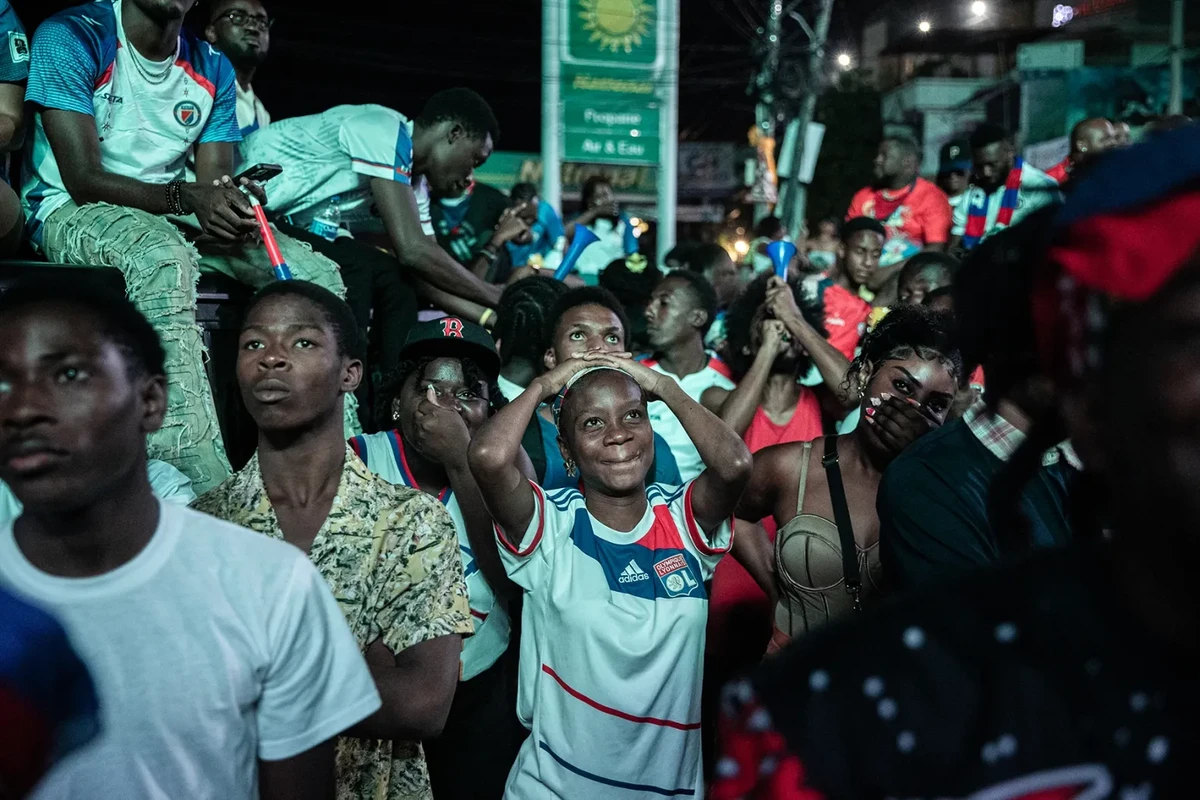
On Friday, thousands of amped-up spectators in blue and red garb gathered in front of a giant screen in Parc Sainte-Thérèse for the Grenadiers’ match against Brazil, chanting the team battle slogan, “Grenadye alaso!” (Soldiers, attack!), and blasting native trumpets. Haitians love beautiful soccer, and Brazil is nearly as beloved here as the national team. Around the embattled city, raucous, beer- and rum-fueled watch parties captivated the public: in plazas, ramshackle alleyway bars, on televisions in camps for the internally displaced that have swollen in recent months due to intensified violence.
Although the team ultimately lost 3-0 in a hard-fought match, the five-week-long World Cup is a sorely needed reprieve from the political chaos that has consumed the country since the July 2021 assassination of President Jovenel Moise. With one more group stage match left to play — against Morocco on Wednesday — legions of soccer-mad Haitians at home and abroad are enjoying a gust of hope, however fleeting it may be. “It’s as if there will be better days for Haiti through what is happening here,” says Philidor Junior, a former professional player turned youth trainer.
Haiti’s success could not come at a more fraught moment. Most Haitians are barred from entering the U.S. to support the team due to a travel ban imposed by the Trump administration; and in the coming weeks the Supreme Court is expected to render a verdict on the fate of Temporary Protected Status for Haitians, a decision that could potentially put tens of thousands at-risk of deportation. Meanwhile, a United Nations-backed Gang Suppression Force is currently scaling up to 5,500 troops with a year-long mandate to evict the gangs from Port-au-Prince, a daunting mission that promises bloodshed. According to the latest UN statistics, 2,300 people have been killed so far this year and nearly 1.5 million have been uprooted by violence. On a visit to the capital last week, UN Secretary-General António Guterres decried global indifference to the crisis. “There is a direct connection between the absence of the international community and the absence of security for the Haitian people.”
 Fans cheer in the streets of Port-au-Prince on Nov. 18, 2025 as Haiti celebrates qualifying for the World Cup.
Clarens SIFFROY/AFP/Getty Images
That Haiti even qualified for this World Cup is a staggering achievement in itself. With its principal national stadium under gang control, none of its “home” qualifying matches in the run-up to the tournament were played in-country. The fracturing of domestic leagues and ongoing instability compelled the team to rely heavily on foreign-based players. Only 10 of the squad’s 26 members were born in Haiti, and just one plays for a Haitian club.
“We are a people of hope, unexplained hope — we have done such unimaginable things throughout our history that we always believe in miracles,” says Himmler Rébu, a former army officer who runs a soccer program for troubled youth. By way of example, he reminds how in the late 18th century Haitians with makeshift weapons launched a revolution that ended 300 years of slavery under colonial France and established the world’s first free Black republic. “We hope for another miracle because what we are doing, which is beautiful, is not rational,” Rébu says.
Members of Rébu’s generation remember the last time Haiti played in the World Cup, in Germany in 1974, like it was yesterday. In their first match of the tournament, forward Emmanuel “Manno” Sanon dribbled around fearsome Italian goalkeeper Dino Zoff to score the opening goal, breaking Zoff’s then-record of 12 straight scoreless matches. Italy, then the two-time world champions, went on to win 3-1, but all these years later the moment remains immortalized in people’s minds, on crumbling murals of Sanon across the capital, and faded team posters plastered on office walls.
“It was the greatest joy,” says Joseph-Marion Léandre, a midfielder who was on the pitch when Sanon scored and is one of 12 surviving team members. Now 81, he recalls how after the game, a German coach who had earlier voiced his doubts that Haiti could score against the Italians declared: “‘If Haiti can score a goal, I can take my rifle, shoot at the moon, and hit the moon.’ It was his way of saying it was impossible.”
Léandre grew up in the northern city of Cap Haïtien, where he started playing at six and climbed to one of top local club teams. In the 1970s, under the Duvalier dictatorship, Haiti had a highly organized soccer apparatus that identified promising talent at a young age and supported it with training, coaches and equipment. In his late twenties, Léandre was invited to play for the national team. The Grenadiers won the 1973 Concacaf Championship to qualify for the 1974 tournament, which only had 16 teams instead of the current 48. “That’s to say, we represented all of the Americas,” he notes. “It was our pride.”
Coming from humble origins, Léandre calls football “a gift” that allowed him to travel the world and raise a family — one he wanted to share with new generations. Since the national team’s epic run a half century ago, he’s devoted his life to preparing other young, disadvantaged players “to keep moving forward,” he adds, “and we did.”
Until things fell apart.
Today, the system that made him is in shambles due to official neglect, disorganization, and insecurity. Were it not for a cadre of well-trained diaspora players living in France, Canada, and the U.S., unified by ancestral links to Haiti, he says the team never could have qualified for the tournament. “Football is madness, it is good — but getting hit by a stray bullet is not pretty at all,” he says. A FIFA-certified coach and game announcer for the national TV broadcaster, he affirms that Haiti still has the homegrown technical expertise and raw talent to compete with the best, “but there has to be a secure field [for players], there has to be peace of mind.”
Gripped by World Cup fever, Haiti’s scrappy future stars practice anywhere they can. In between matches, packs of barefoot boys play street pick-up with a ball shorn of its casing and broken cinder blocks for goal posts. They slide tackle on the blacktop, wearing scrapes as badges. They score and dance with abandon. And when the pro action resumes, everyone gravitates to the nearest TV screen to watch their heroes and refuel their dreams.
At an overcrowded camp off the main road connecting the capital to Pétionville, 26-year old Emerson Delva looks on with a mix of pride and melancholy. As a teen, he says he played for a local junior club alongside national team favorite Louicius Don Deedson, but their lives diverged when Deedson left Haiti to advance his career. Two years ago, Delva was forced to flee his neighborhood of Solino after gangs stormed in and razed much of it to the ground. “They used to compare me to [Deedson], so I’m happy to see him represent us,” he says. “Football is still a path to a better life.”
As soon as the day’s afternoon match between Switzerland and Bosnia-Herzegovina concludes, the solar panel powering the camp TV is cut to save energy for the evening game to come. Seconds later, more than a dozen kids are swept up in a furious game of their own — with a plastic Coke bottle.




 Griffin Lotz for Rolling Stone



 David Manheim and Hunter Biden Courtesy of David Manheim