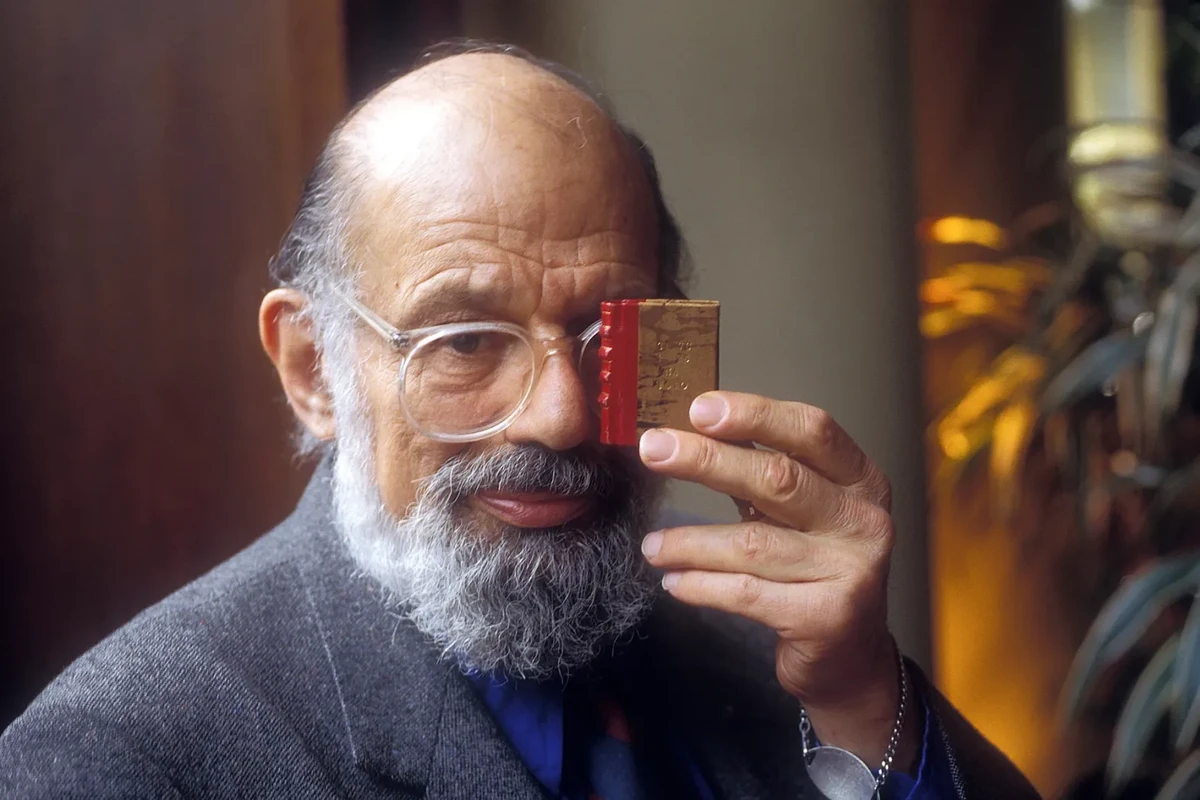

This week is the centenary of Allen Ginsberg, the gay, Jewish, Buddhist, Socialist writer who for decades was America’s most public poet. He used his presence as both an outsider and a celebrity to challenge wars, capitalism, censorship, and the codified marginalization of the underserved in this country. He altered the literary canon by presenting his “new vision,” the Beat Movement, as the artistic manifestation of a discontent post-war culture for whom the American Dream did not exist. He was always a step ahead of the times, cutting across artistic disciplines, trampling taboos, and waging battles that foresaw America’s evolution as a fractured culture built on a shaky puritanical foundation. He is the sterling example of the role poets play as our first responders in the arts.
When his first book, Howl and Other Poems, was put out by San Francisco’s City Lights Publishers in 1956, its founder, poet Lawrence Ferlinghetti, was arrested on charges of disseminating obscene literature. The groundbreaking title poem depicted an unseen America — queers, BIPOC, communists, the differently abled, immigrants, artists, and followers of Eastern religions. We saw them going “on the road” to Mexico and Morocco; altering their consciousness with meditation and plant medicines, “contemplating jazz” and finding themselves “destroyed by madness, starving hysterical naked.”
While he the obscenity charge was overturned the following year, it heralded a period of post-McCarthy era censorship that included attempts to ban books by DH Lawrence, Vladimir Nabokov, and William S. Burroughs. It was a dark time in American publishing, and these attempted bans were based more on discomfort with societal change rather than any depiction of a criminal or immoral act. Ginsberg did not respond to censorship by constraining his vision. Instead, he became the PT Barnum of the Beat Movement, expanding its footprint by encouraging writers to become independent publishers, to break into mainstream media, to collaborate with other artists in theater, film, music, and the visual arts. He set the tone for the 1960s small-press movement that launched new queer, feminist, BIPOC, hispanic, and experimental writers. He also, through love of music — from bebop to William Blake — created a space where the two fields merged in public collaborations that were fresh, spontaneous, and genuinely “hip.” The impact of that Beat scene is captured in a hilarious moment in John Waters’s Hairspray with Rick Ocasek of the Cars playing Bongos while Pia Zadora aggressively reads “Howl” to Rikki Lake. Campy as it is, it’s a tribute to a particular moment in popular culture that wouldn’t have existed without Ginsberg.
His next book, Kaddish (1961), mourned the loss of his mother Naomi, who was institutionalized in psychiatric facilities for much of her life. It confronted taboos for first-generation Jewish families long before they’d ever heard of Philip Roth, and began a broader conversation on humane alternatives to insulin shock therapy and the routine lobotomization of the mentally ill. The irony of Naomi, the Russian immigrant, dying in Pilgrim State Hospital, without Kaddish being said only added to the indignity.
He was perhaps the most revolutionary literary writer in American history. He came out before Stonewall; protested the Vietnam war by chanting “Om” at the 1968 Democratic Convention in Chicago alongside Black Panthers, Yippies, Hippies and Jean Genet; made friends and records with people like Bob Dylan, Joan Baez, and Philip Glass; and taught at Brooklyn College’s MFA program, where his students included Sapphire and Paul Beatty. By co-founding the Jack Kerouac School of Disembodied Poetics, the MFA Writing Program at Naropa, the Buddhist-inspired University in Colorado, Allen furthered his commitment to leave a legacy that supports experimental work in an environment that is allied with his spiritual and poetic practices. By simply being who he was, he empowered those without access to traditional power structures to make their own.
I was an 18-year-old disco/punk kid when I first saw Allen on the stage of a Times Square nightclub in 1981. He came to meet Joe Strummer of The Clash — he was a fan of punk rock, and they shared political sensibilities — and wound up singing his poem “Capitol Air” with him that night. I knew who he was but hadn’t read beyond “Howl.” His Yiddishkeit presence both attracted and repelled me. But I got it, this was major — a radical poet and rock star on stage? History was happening.
We met properly a year later when I joined the Burroughs clan as the boyfriend to the writer’s assistant. In queer family terms, Allen was mishpocha — my blood — Burroughs was my mother-in-law and paterfamilias. I would see Allen in that context regularly, our friendship expanding through additional crossed paths as I began a life in book publishing. He was a diplomat, a flirt, the consummate PR man, and wherever he went his diligence in supporting the history that he was a part of, that he made, was apparent.
I remember the dinner following Burroughs’s induction to the American Academy of Arts & Letters in 1983. Allen had been politicking for William’s admission for five years and strongly suggested that night that William should be an activist member bringing in a more diverse, political, and formally adventurous membership. Burroughs, who found the whole thing comical, paraphrased the Groucho Marx line about not wanting to be a member of any club that would have him, but smiled and muttered, “I’ll vote for whomever you tell me to, Allen.” Allen’s commitment to his cultural responsibility, to honor and teach an alternative history of America and the world, to identify its new heroes, was his hallmark.
Ginsberg’s legacy of collaborations, particularly those with musicians, opened doors at record companies, including Def Jam, who presented Def Poetry on national television for five years, solidifying the connection between rap and performance poetry. Island Records put out his spoken word record The Lion for Real in 1989, with appearances by Dylan, The Clash, Ornette Coleman and Arto Lindsay. Its producer, Hal Wilner, became a close friend. Ginsberg recorded with a broad array of musical talent from Kronos Quartet to Paul McCartney, his work as a recording artist spanning contemporary classical collaboration to traditional spoken word. One of his earliest recordings, a reading of “Howl” in 1959, is being reissued by Craft Recordings on green vinyl in celebration of the centenary.
From the beginning of his career until his death in 1997, Ginsberg maintained deep friendships with a diverse, international, rule-breaking set of people working in the arts, activism, and the alternative reaches of the academy. He continuously managed to bring them together, in groups both small and large, that forged a genuine sense of community and purpose. He was the award-winning, globetrotting, gay, hippie, yenta poet whose uncanny sense of matchmaking in the culture world made beshert unions, and amazing collaborations.
In the new normal of sanitized Pride celebrations — where Gaybies on Trikes outnumber Dykes on Bikes; and when this summer’s federally funded America 250 events will celebrate our country’s founding but not mention slavery or the slaughter of the indigenous — we need to honor the artists who bring people together, whose visions capture what the people of this country actually look like, struggle with, and transcend. Poetry rises up, it doesn’t trickle down. And so did my tears the other day as I was listening to a Philip Glass playlist, and Allen’s voice came on reading from his 1966 poem “Wichita Vortex Sutra”: “I lift my voice, aloud, make Mantra of American language now, I here declare the end of the War! Ancient days’ Illusion! And pronounce words beginning my own millennium.” Indeed, the ur anti-authoritarian queer, the poetic chronicler of the American dream gone awry, my friend Allen Ginsberg, should be emulated not just in this centenary but for the next thousand years. May the Allen Ginsberg millennium begin today.




 Nick Wilde from Zootopia greets fans during the Magic Kingdom parade. Kenslie McGuire