

It’s been 13 long years since that last Grand Theft Auto game, and a lot has changed. Since GTA V launched in 2013 on PlayStation 3 and Xbox 360, there’ve been two full console generations (hell, four presidencies and 30 MCU movies too), but the gaming landscape itself has shifted. While open-world games like GTA were rarer back then, most blockbuster games today have some form of large-scale exploration, and the rise of live-service titles like Fortnite and Call of Duty: Warzone have made big-event games less of a focus as players are sucked into yearslong obsessions and the slow IV drip of seasonal updates.
But GTA never really went away. Although most fans might’ve finished the game’s single-player mode well over a decade ago, GTA Online has thrived, continuing to draw in over 20 million active users monthly. Where many franchises might’ve lost their luster or hype after such an extended wait, the perpetual cultural prominence of the series has ensured that anticipation for Grand Theft Auto VI is at an all-time high.
But what will the game ultimately look like? Despite leaks and a controlled trickle of information from the developers at Rockstar Games, very little is known about how GTA VI will move the series forward or change its tried-and-true formula.
Scheduled to be released on Nov. 19, 2026, GTA VI remains in many ways a mystery. With pre-orders now officially live, more information has come to light. Here’s everything we currently know about Grand Theft Auto VI.
The setting
Officially announced in February 2022 after years of rumors, details about GTA VI became public following a massive leak that September, revealing the game’s location and modern-day setting. Later confirmed by Rockstar in the game’s first trailer in December 2023, GTA VI sees players return to Vice City, the Miami-inspired location first seen in 2002’s Grand Theft Auto: Vice City.
Originally released for the PlayStation 2, Vice City was a prequel to 2001’s Grand Theft Auto III and served as a period piece set in 1986. Its Miami-coded locale and tone was heavily inspired by the TV series Miami Vice and countless films set in the neon soaked, cocaine-fueled 1980s. Any connection to plot or characters from that game is unknown, but returning to Vice City in the modern day allows Rockstar to play in a very different sandbox than before.
The game’s two trailers poke fun at many Florida-isms with insane characters like the dual hammer-wielding woman, a sunburned man watering his lawn in a speedo, and spring breakers and locals partying heavily by posh pools and muddy monster truck rallies. From the looks of it, almost everyone in GTA VI will be some version of a Florida Man or Woman, which suits the tone of the franchise which has routinely parodied American culture from all angles.
 Rockstar Games
Returning to a previous city for a modern-day update is also a recurring trend for Rockstar. The very first game, released in 1997, introduced three unique locations based on real-world cities: Liberty City (New York), San Andreas (San Francisco), and Vice City (Miami). Its immediate expansions and 1999 sequel moved away from these fictional cities, but a full trilogy of early 2000s-era games each centered on one location from the original game apiece with GTA III (2001) set in Liberty City, followed by Vice City (2002) and San Andreas (2004).
Following that, a second trilogy of games doubled back with Liberty City reappearing in GTA IV (2008), Los Santos (GTA’s take on Los Angeles from San Andreas) in GTA V, and now Vice City and the larger Florida-inspired state of Leonida in GTA VI.
Like San Andreas and V, GTA VI will likely expand far beyond the reaches of just its base city, with a massive open world that includes the various regions outside of its primary urban space, depicting the diverse topography and environments of its Florida-like state.
 Rockstar Games
In a batch of images quietly released alongside the second trailer, Rockstar teased multiple newly confirmed locations: Ambrosia County, an industrial region filled with billowing pipe stacks; Grassrivers, a swamp where fanboats zip through gator-filled water; Leonida Keys, a beachfront vacation spot lined with yachts and partiers; the dense forest of Mount Kalaga National Park; and Port Gellhorn, a sleazy backwater haunt that’s home to strip clubs and rancid motels.
The characters
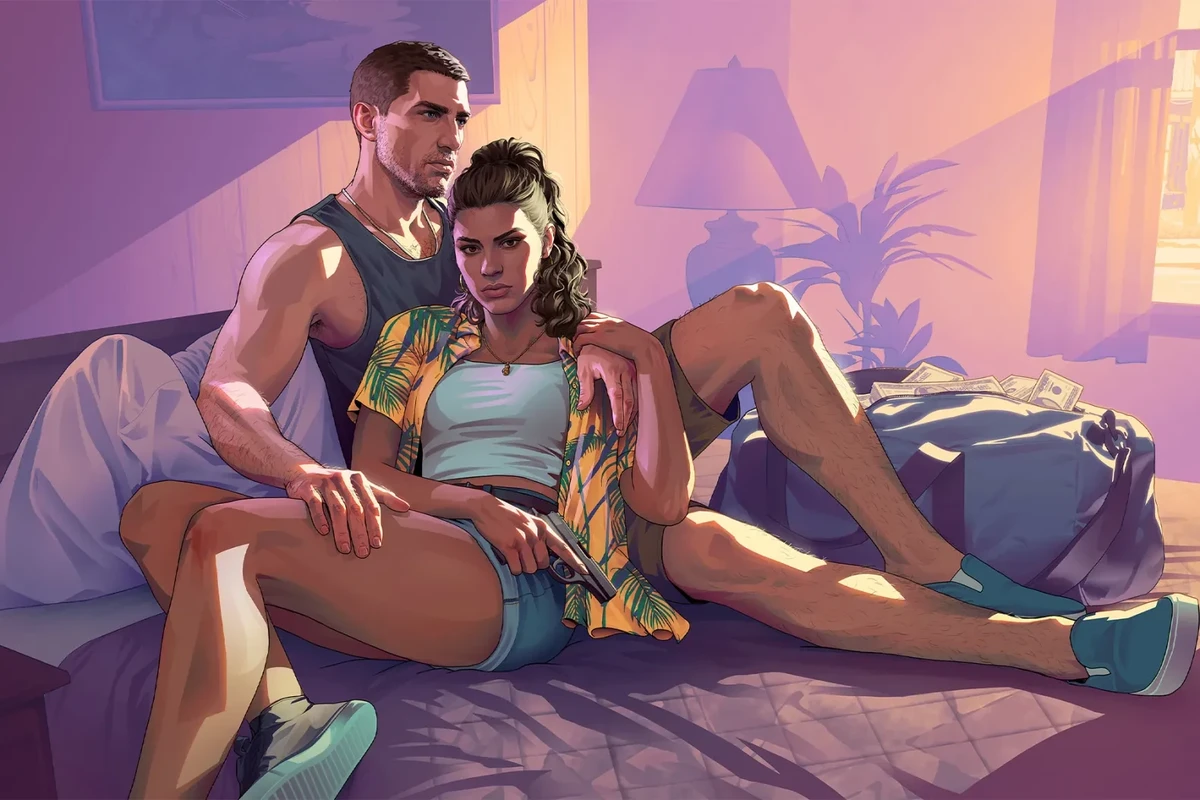
Since its first big reveal, one of the most talked about aspects of GTA VI has been its protagonists. While most games in the series focused on a single main character, GTA V broke the mold by introducing three very different playable leads whose stories wove together. GTA VI is also trying something new with a Bonnie and Clyde-like couple players can control named Jason Duval and Lucia Caminos.
As seen in the trailers, Jason is a muscular type who’s popular with the ladies around Leonida Keys. Doing odd jobs (like, you know, drug running and beating money out of people) for a man named Brian Heder, he’s mostly scraping by, living unambitiously as he waits for Lucia to be released from prison. Rockstar’s website has some details, including that Jason grew up around criminals and grifters and served in the Army. From the looks of their relationship and the flavor text on the website, it’s apparent that Jason’s painted as being a supporting partner to Lucia, although he worries about how their future will play out.
Lucia is shown to be a real badass, with her character bio stating that her father “taught her to fight as soon as she could walk.” The exact reason for her prison stint is unknown, but it’s teased as being related to her family, and that her release was due to “sheer luck.” Although she lives with Jason in Leonida, it’s said in her character description that she originally hails from Liberty City, although it’s unclear if she has any relation to characters from previous games.
The duo’s larger story is still a mystery, but it’s clear that they’re both looking for a big score, or series of scores, that can help them move up in the world. Naturally, that’s destined to go sideways.
 Rockstar Games
The rest of the cast looks to include a broad range of supporting characters from across the criminal spectrum. Cal Hampton is a floral-shirt-wearing schlub who’s a close friend of Jason’s. He’s depicted in the trailers as a goofball, but he’s also a conspiracy theorist who spends too much time online, likely soaking up dubious information.
Boobie Ike is an entrepreneurial type from Vice City, who’s looking to turn his low-level criminal connections into more legitimate business ventures including real estate, strip clubs, and breaking into the music biz. His character bio lays it out nicely: “The club money pay for the studio, and the drug money pay for it all.”
Boobie’s latest move is a partnership with a young music mogul named Dre’Quan, whose label Only Raw Records is beginning to pick up steam. Bae-Luxe and Roxy are a rap duo working under the name Real Dimez and are the first big acts signed to Dre’Quan’s label. Their massive social media presence has garnered attention but could potentially become an issue given that everyone around them is knee-deep in criminal ventures.
Lastly, there’s Raul Bautista, a disarmingly charming bank robber whose recklessness will surely spell trouble for everyone. Every GTA story needs a wildcard, and Raul fits the bill. Bet good money on Raul taking on an antagonistic role as the narrative progresses.
 Rockstar Games
All the characters shown thus far fit right in with the tone of GTA games past, but technological leaps in graphics and motion capture make them all look more realistic than ever. Outside of being another scathing parody of gratuitous American culture, GTA VI looks like it could be a more emotionally mature story from Rockstar more in line with the exceptional Red Dead Redemption 2 (2018) than previous GTA games. Their stories are always fun and outrageous, but there’s potential here for GTA VI to tell a genuinely affecting crime caper.
PC version and online components
For everything fans now know about its setting and characters, there’s much more that remains in question. Although the game is currently available to pre-order on PlayStation 5 and Xbox Series X/S, Rockstar still hasn’t announced a version of Grand Theft Auto VI for PC — a move that’s left many concerned. While GTA V also launched as a console-only release in 2013, it was later ported to PC in 2015 where it took on a second life. While PlayStation and Xbox are huge markets for casual players, PC is where GTA Online has thrived thanks to the large scale modding community. Most diehard fans who engage in online roleplay in the game do so exclusively on PC.
There’s also the question of how the game will actually play. Although Grand Theft Auto excels at crafting some of the densest, most complex open worlds in gaming, its kitchen sink approach to gameplay mechanics has always left much to be desired. Moment-to-moment, GTA offers players unparalleled freedom to what they can do, but its driving and shooting controls are generally just fine.
 Rockstar Games
Whereas Red Dead Redemption 2 felt like a leap forward for Rockstar in terms of mechanical complexity — its gunplay and movement are far superior to the likes of GTA V — there’s been no word on how GTA VI will improve on its predecessor’s style. Although hardcore fans have mastered the game and bent its physics engine to their will, the game itself feels tired in ways that the next one will need to overhaul.
The biggest question players have is how GTA VI will handle its online component. In the years since GTA V was released, GTA Online has become the game’s main selling point. Consistently updated, GTA Online has kept the game in the zeitgeist with growing mod and roleplay communities and a huge install base of casual and hardcore players, as well as major streaming audiences on Twitch.
Previously, Rockstar hadn’t made it clear whether the current version of GTA Online will be rolled into the new game’s, leaving players to worry whether a decade or more of in-game progress will be walled off from the new experience — or worse, sunset entirely. Sadly, the community’s fears may be warranted. On digital storefronts, the game is listed as being “a single-player experience” — a detail later confirmed by Rockstar Games themselves.
The reasoning for the lack of multiplayer integration is currently unknown, but it may be related to the fact that GTA VI will have an entirely new engine behind it, which would require major changes to the existing GTA Online framework for everything to transfer over. But it’s not impossible. MMO games like Final Fantasy XIV and World of Warcraft have seen generational changes in its tech and evolution while allowing the games’ older content to carry over in some instances.
 Rockstar Games
Given the evergreen popularity of GTA Online, it’s all but guaranteed that the new game will eventually roll out multiplayer features but for now it’s looking like a solo-only experience at launch.
Pre-Orders and Pricing
Alongside the announcement that GTA VI is now available to purchase, new information about pricing and different editions of the game have arrived that have fans concerned once more. On PS5 and Xbox, the base version will cost $80 USD — about 10 bucks more than most AAA games have cost this generation, but not entirely unexpected. Since the launch of Switch 2, Nintendo has pushed the cost of specific titles to $80 on a case-by-case basis. The real issue is what features are being excluded from the core experience.
According to Rockstar, the $100 Ultimate Edition offers exclusive in-game items like weapons, vehicles, clothing, and “action,” with that last bit implying that certain missions or playable content will be locked behind the additional paywall of the premium version. Rockstar’s website lists two of those “side activities” as follows: PTT Youngin$ Illegal Goods Store, which serves as an in-game raid mode to gain unique items, and Classic Car Collection Special Commission — which reads as an ongoing side quest wherein players can discover and restore vintage cars.
GTA is well-known for the various side hustles and slice-of-life mini-games to engage in. San Andreas let players hit the gym to reshape their character’s physique over time. But locking potentially hourslong sections of a game behind a paywall isn’t usually the norm; most other AAA titles price this type of content as clear add-ons rather than marketing them as “exclusive” to the higher-tier edition of the product.
The website also lists five distinct shops and services that are only available in the Ultimate Edition, ranging from car mod shops to hair salons. You’ll literally need to pay an extra $20 to get tattoos on your character. While it’s unclear if players will even visibly see these shops as a tease in-game, it’s plausible that they can be stumbled upon with a message that they can’t be accessed without the purchasable upgrade.
The last big omission saddled with GTA VI’s launch is the news that physical editions of the game will not come with an actual disc. Rather, any boxed copy purchased at retailers will come with a download voucher — an extremely rare and anti-consumer decision, meaning it can never be shared or resold. It might seem like a non-issue to some, with some estimates suggesting digital copies make up nearly 85 percent of video game sales, the lack of a physical disc means users with poor internet connections will be faced with no alternatives for accessing a title that’ll likely be hundreds of gigabytes.
Rockstar Games was quick to respond to criticisms, stating that physical editions will include a disc in the months following launch, and given the unparalleled hype surrounding GTA VI, the digital-only scenario is unlikely to impact sales in any meaningful way. Still, the option would be nice. The reasoning for the decision is unclear, although it could be a means to prevent leaks, as brick-and-mortar stores and online retailers often break their street date once shipments are in-hand.
Regardless of how it plays out, it’s a given that when it arrives, Grand Theft Auto VI is going to make a colossal splash. After more than a decade of hype and building on its predecessor’s status as one of the most successful and lucrative pieces of media ever, GTA VI has plenty of runway to make its own mark on pop culture. The hardest part will be waiting; just a few more months go.
Editor’s Note: This story was originally published in May 2025. It was updated on June 26, 2026 with pre-order and new content details.



 Griffin Lotz for Rolling Stone







 David Manheim and Hunter Biden Courtesy of David Manheim
The Last Tour for Our Horny, Mad King