
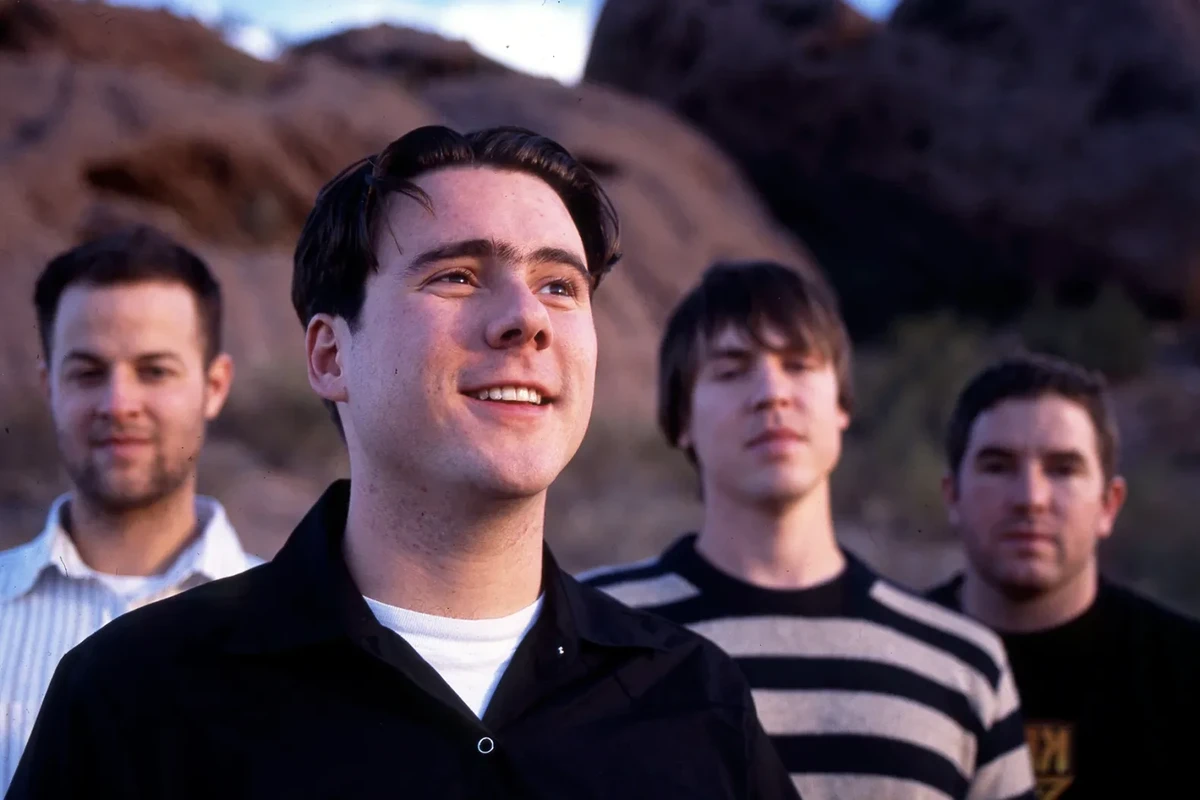

When Jimmy Eat World‘s Jim Adkins wrote one of the greatest-ever musical pep talks, “The Middle,” he might as well have been talking to himself. His Tempe, Arizona band had just been dropped from Capitol Records, and they recorded their fourth album with no new deal in sight. But the 11 lean, hook-packed songs that became 2001’s Bleed American were so strong that they sparked a major-label bidding war, and the band signed to the now-defunct Dreamworks Records.
The album, and the still-ubiquitous “The Middle” in particular, ended up defining Jimmy Eat World’s career. They’re out on tour now marking its 25th anniversary by playing it in full, including at all five dates of the revived Warped Tour. Frontman Jim Adkins jumped on a Zoom with Rolling Stone to talk about making the album, the underwear-party video for “The Middle,” the influence of Bruce Springsteen, and much more.
It’s so crazy to listen to the demo of “Sweetness” that you guys did in the Clarity sessions. You already had that song down. Why did you not put it on that album?
Business affairs at Capitol just added it up and decided, “We can’t spend any more money on these guys.” We were the type of act not doing anywhere close to the kind of business that Capitol was in. The bigger labels in the mid to late Nineties, they knew exactly what to do with an act that was selling, like, 30,000 copies a week. They had no idea what to do with us, who maybe had 3,000 copies sold between all of our releases.
“Lucky Denver Mint” on that album was already pulling towards a tighter pop thing. And if your budget wasn’t cut off before you could record “Sweetness,” that could’ve been a hit for you guys, and maybe the whole course of things might’ve been different. Capitol might not have dropped you.
Who knows, dude? Who knows?
Rock was in such a weird place. We were seeing the death of ’90s alt-rock and the birth of nu-metal, and the rise of whatever people were calling emo on a more underground level. Then in 2001, the cool stuff was the Strokes, which wasn’t you. How did all that affect your thinking?
I was really glad when the Strokes got big, because all of a sudden people stopped asking us about emo [laughs]. Thank you, Strokes. I love the Strokes, but it is funny, after the wave of grunge, media and labels to some degree, everybody wants to take credit for breaking the next big thing. And so there’s a lot of people just trying to frame everything.
That all just happens in the background and it’s something we laugh at, but it doesn’t really affect anything that we do. We’re right alongside you and everybody else who’s consuming it, just watching the show. If you chase that, you’re just gonna turn people off. It’s like, “Oh, wait, this is cool now? Oh, we gotta do that.” There’s nothing more of a turnoff than trying to chase approval. Should we have a DJ in the band? Should we wear masks? Should we collab with Pharrell? What you choose to incorporate and your approach to that has gotta be based on just what is personally rewarding.
“The Middle” is obviously the consensus mainstream winner, but what would be your pick as the actual greatest song on Bleed American?
It’s tough to say ’cause every single song had a thing it was trying to do, and that thing is a very specific target. AC/DC does something really great that Drive Like Jehu doesn’t do. And Drive Like Jehu does something phenomenal that AC/DC could never do. They’re trying to achieve a thing that you don’t understand when you’re really in the flow of creation, but you know when you get there.
“Middle” is definitely something that I’m surprised with in a lot of ways as time has gone on. And I feel “Bleed American,” the song, is in a weird way a really dark version of what “Middle” is saying. This idea of what you’re placing your sense of fulfillment or purpose or self-worth in might be the wrong target, and that’s why it’s not doing the thing you were hoping it would do. In “Middle” you’re talking about comparing yourself to some other, purely wanting to chase approval and how empty that is. In “Bleed American,” you have a similar kind of thing. I’m doing what I think I should do, and none of it is filling that space inside of me that I was told it would. It’s like an angry version versus a “forget about it” version.
What song did for you as a young person what “The Middle” seems to have done for so many people?
I don’t have anything that I can feel like directly spoke to me in that way. But I do feel like coming from being a metal guy and someone that was following a lot of guitar virtuoso players when I was learning how to play, and discovering something like Fugazi, and hearing how the guitar work happened there, and just the epiphany of how you can harness the feelings of angst or disillusionment in such a different way.
It’s just letting go of chasing the kind of player that I would never be. I can start right now and make something that is seven minutes of noise and feel like a complete whole person when I’m done making it. I don’t have to be good enough to do sweep arpeggios at fucking 200 BPM to do that. Just that experience of what punk rock in general showed me — what you’re feeling, and how you express it, no matter what that is, is completely OK as long as you are achieving a sense of reward from it.
The demo of “The Middle” was released a while back and it has a totally different vibe. It could be a Guided By Voices song. I know you were in a bedroom in Arizona. What did you actually record that on?
I think for 50 bucks or something I bought an old drum set off of [Jimmy Eat World drummer] Zach [Lind], and it was just fun. Playing drums is fun. So I had a eight-track digital thing in my bedroom in Tempe, by the college there. And it was just purely chasing any idea I was excited about, regardless of where I thought it was gonna fit in our band or not. I’ve made a lot of music that was just so not supposed to be for our band, but later on elements of it would get cannibalized and put into other songs that the band was working on.
So you had gotten that email from a fan about being put down at school. How long had elapsed between getting that email and sitting down and writing this song with that in mind?
I don’t really remember. We posted the band email at the Static Prevails time. And I don’t remember when that came in or how much time had elapsed for me to use that as a place to address, I don’t know. It just seemed like the music for “Middle” was just calling for something that felt simple, the truth. And trying to leave you with a sense of hope, in the way that really great, simple rock songs can. It was chasing that.
So you had the music first, and then you had to figure out a song around it?
I might jot down ideas that might be cool to develop later on into lyrics, but I don’t write just lyrics. It’s always a musical idea. But usually most of the song has to be complete before I start going down the road of putting in actual words to that kinda scat, and the simpler a song is, the more important that is. ‘Cause I’m not gonna just sit there and play a G chord for 16 bars if there’s not another element that I’m excited about.
How is it that you had a promo standup for the Bruce Springsteen Tunnel of Love album in your bedroom?
I think my seventh grade girlfriend gave it to me.
And you kept it all that time?
It was cool!
And for the “little girl” lyric, you looked at that Bruce standup and said…
Yeah, what would the Boss do? He’d probably say something like this. All right, I guess that’s the lyric now.
You had said that it was really around the time of Bleed American that you were thinking about Petty and Springsteen. How did those influences work?
I work a lot better with restrictions. Like some kind of artistic restriction. Here’s the idea, it’s gotta exist within these arbitrary boundaries, how can I push that? In the past, when we were younger, maybe those boundaries were a lot wider and it was about a whole lot of parts and a whole lot of guitar playing. And then when the material for Bleed American came together, the challenging, rewarding thing for me was what if those restrictions were a whole lot more narrow? What if we were trying to be, like, dementedly conservative in the choices? How far can we go in that? How far can we pervert that?
Like Mike Patton talking about his “Easy” cover — it’s super easy just to go fuck something up, but to go all-in, that’s another level entirely. Within chasing those restrictions, it really is true that the hardest note to play is a rest. And that’s a challenge. Is there a way to make it even more simple? It’s an exciting thing to chase.
Learning about that years later, I realized that the chorus of your song is almost like “Dancing in the Dark.” It has that same kind surge.
“Dancing in the Dark” was a huge one for me. Really listening to “Dancing in the Dark” and seeing and feeling what that can do is like, “Oh, yeah, of course.” It’s like the perfect song.
On “The Authority Song” you’re referring to both the Jesus and Mary Chain and John Mellencamp, which says a lot about the multitudes you guys contained.
It seems crazy, but it’s literal. I would go to my friend’s DJ night, and it’d be playing Velvet Underground and Jesus and Mary Chain. I’d be playing pool and there’d be John Mellencamp on. All the weirdo arcane seemingly head-scratching things are just this the honest documentary of us as kids in the late ’90s in Tempe, Arizona, and the surrounding area.
 Jim Adkins performs with Jimmy Eat World at Warped Tour in D.C.Mike Kimchi for Rolling Stone
I remember you saying that you were getting into Buddy Holly back then.
“Everyday” is one of the greatest songs of all time. If you start really thinking about it, it is mind-blowing. But also, you can ignore it and it’s mind-blowing. How do you do that? I don’t know.
I thought about this a little bit when we were going back and listening to the multi-track of the album. Like a song like “Everyday,” like what’s the verse? What’s the bridge? It doesn’t abide by any of those things. I didn’t learn songwriting. Nothing feels like a chorus to me, but everything is a hook. I don’t know what people call these elements of this song. Each of those parts feels as complete as the most perfectly put-together modern-day verse or chorus or bridge section that you can clearly identify.
As far as the guitar solo, you cite GBV’s “I Am a Tree,” the Doug Gillard solo, as an influence. I don’t know if you heard, but Rolling Stone recently named “The Middle” solo as one of the greatest guitar solos of all time.
I was forwarded that by many family members. Thank you very much. I’m now completely valid in the eyes of a whole lot of my family members.
You can feel your chops on that song. It’s not full shred, but it’s not easy to play either.
It sounds harder than it is. What I’m most proud of is just the arc of it, the structure of it. It has to go somewhere, it can’t just shred. And how you do that is theme, variation, ascension, next theme, variation, some kind of conclusion. It has to have its own little story to it. That’s what I was going for there, and I feel like I got it, so there’s that.
You didn’t have a label, you’d been dropped. Was there any sense of going for broke, that we’re gonna write the tightest, most accessible stuff we can? Or was it mostly the opposite, that freedom?
Oh, no. It really is just the happy accident of what was rewarding for us, what was a challenge, what was exciting to do. What if the bumpers on the lane were a little bit tighter together? A song like “Your House,” it just goes. The fact that chasing that produced really tight, concise songs is really just secondary. It wasn’t a consideration of “This is gonna really work, guys,” it was like, “This is what we want. This is just what we wanna do, and I don’t know who’s gonna like it.”
Was there any cynicism in the video — “look, it’s gonna work really well to have this underwear thing on MTV”?
It’s not the way I was thinking. I thought all videos are just ridiculous, and we’re just gonna put this 100 percent in [music video director] Paul Fedor’s idea — whatever you wanna do, dude. You have an idea, we understand what it’s like to chase an idea. We’re gonna let you chase it, and we’re gonna help you.
Did anyone dare suggest that you guys should be in your underwear too?
No, ’cause we’re like the omniscient narrators in the “Middle “cinematic universe. We’re not participants, so we’re gonna have our clothes on.
With the next album, Futures, it felt like you avoided the trap of following up Bleed American by not trying to do it at all. It’s a much more somber and much less hook-filled album.
When you make an album, it should feel like that’s your best work. And once you do that, and once you go on tour for a year playing it, you really feel like you’ve explored that. So of course, the next thing that you do is gonna be wanting to explore somewhere else. All of our records are like that. It’s like where do we go next? Probably not just where we were.
Was there any label or management grumbling that you didn’t give them one song that was more of a direct follow-up?
No. Futures was really the first album we made where we had anyone really kinda paying attention. So it was a little bit new for us navigating that. We definitely knew that there were some songs that the label was excited about, but at no point were we making decisions to chase that.
For Futures there was an idea for a song called “Jen” that was probably the most “Middle”-sounding idea that we had, and we went through a couple different versions of it, and when it got to the end and played it for the head of promotions and other people at the label, it wasn’t close to the song they were all leaning toward as what they wanted to put out. So we just kinda didn’t put it on the album.
That song has leaked, and it’s great. Didn’t you once say that there was some kind of copyright issue there?
Yeah. There was some musicologist report that came back with this sort of, it nods to in a way a couple other songs that you could have songwriting issues with. And I hadn’t even thought about it. There’s that song “Pop Goes the World,” by Men Without Hats. They go, “You’re gonna have to pay Men Without Hats if you wanna put this on your record.” And no one at the label was coming back saying they wanted it, so let’s just not even mess with it.
There’s bootlegs of it. Maybe it’s time you guys officially release that song.
Yeah, we could. It’s like the fun, nothing-wrong-with-it song that I always thought “Middle” was, except it turned out “Middle” was actually saying a whole lot more than what I thought.
There was a little acoustic cover of “The Middle” in Supergirl, and people were super mean about it. What was your take on all that?
I don’t get it. I don’t get why people are bummed out on it. There’s a lot of covers of “The Middle” out there, and I feel like someone taking the time to learn one of your songs, they connect with what you’re doing in such a way they wanna take the time to learn one of your songs — that’s a huge deal, man. It’s a huge compliment, that especially another musician is looking at something that you did and they think “Oh wow, I wanna do a cover of this song.” So it’s flattering. Maybe people are just attached to our version of it in the way that makes them feel nothing is gonna be as good as that. I think it’s cool to hear someone else’s take on it.
And then finally, what’s going on with your next album?
We’re working on it. Always working on something.
Do you think next year?
I hope so. We’re not gonna put out anything that isn’t exactly right. And I feel like it’s slowly coming together, not there yet. But we’re definitely not gonna stop making music. It might seem that way, but we’re definitely not.




 Steve Cohen*
 Paul Heartfield*
 Ziwe and Roy Wood Jr.Terrell Phelps*
 Michelle Buteau (center) and friends Terrell Phelps*
 Holzman and Hughes at the Lincoln Memorial Reflecting Pool.Courtesy of Ekko Astral
 Holzman and Hughes in Brooklyn, May 2026.Griffin Lotz for Rolling Stone