
The Rolling Stones have been very busy over the past year recording their new LP Foreign Tongues, and promoting it with a large slate of interviews and promotional appearances across Europe and North America. One thing they haven’t done since July 2024, however, is play even a single concert. European stadium dates were on hold in the summers of 2025 and 2026 — the dates even leaked out to the fan community— but they were both canceled at the last minute as rumors spread that Keith Richards wasn’t up for touring.
This has been confirmed by both Mick Jagger and Richards throughout the Foreign Tongues press cycle, but that doesn’t mean they’ve totally closed the book on future Stones concerts. “I don’t know if tours are possible,” Richards told Uncut in June. “It’s the traveling that takes it out of you. But I do see the possibility of us doing a residency somewhere. Wherever it is, London, New York, Paris, anywhere. I’ll play Rome! But I don’t see why they shouldn’t be able to throw some shows together in a new format.”
He elaborated on this in a recent Billboard cover story. “I know that this is all being kicked around,” Richards said. “This year, we just decided, ‘Look, let’s get the record out, and let’s not rush things.’ So I see no reason why next year — I don’t see anything this year, I can’t rush it that much — but I see no reason why next year, good Lord willing, we shouldn’t be able to, as you say, maybe a residency, something. Maybe you find a different way of taking the thing on the road. Bring the road to us. That’s my suggestion.”
It’s a very interesting suggestion, and there are many ways this could play out depending on the number of shows they want to do, and how many cities Richards is willing to visit. Here are some scenarios.
The Stones Only Play New York City
Keith Richards spends the vast majority of the time at his house in Weston, Connecticut. That’s a mere 55 miles from Madison Square Garden. One very obvious move is to take a page from the Harry Styles playbook, book a bunch of shows at the Garden, and have Stones fans simply travel to New York. Keith, meanwhile, can pull a Billy Joel and helicopter back and forth from his home, making it possible for him to sleep in his own bed every night. (Billy Joel even had a helicopter landing pad in his backyard.)
“The only downside [of the residency plan] for people,” Jagger told Billboard, “is that it’s much more expensive for the further-out people that want to come and see the show.” He’s not wrong, but Rolling Stones fans have demonstrated a great willingness to shell out outrageous fortunes to see them play live. The chance to see the group in the relatively intimate MSG for possibly the last time would be an enormous selling point, and they could easily sell out as many nights as they want, even with tickets in the $5,000 range. That may sound outrageous, but people will pay it. Which will make the airfare and hotel accommodations seem cheap by comparison.
They Hit Stadiums (And One Beach) in Four Huge Markets
A downside of our first scenario is that MSG seats only 20,000 people. They haven’t played more than 20 shows in a calendar year since 2014. And 20 is probably the very high end of what Keith is willing to do at this point. That means they won’t come close to meeting demand or maximizing their potential profits with the Madison Square Garden plan. Besides, the Stones have essentially become a stadium-only band. They haven’t done the arena thing since 2013. They’re simply too big.
If Keith is willing to venture out a bit more, while still avoiding the grind of a tour, it would be logical to book mini-residencies in very select markets. This could be done all sorts of ways, but we can imagine three nights, say, at MetLife Stadium right outside of New York City in East Rutherford, New Jersey; three nights at SoFi Stadium in Los Angeles; three nights at Wembley Stadium in London; and maybe one epic blowout at Copacabana Beach in Rio de Janeiro, Brazil.
That’s 10 shows, four cities, and not much traveling. To make it even easier on Keith, this could take place slowly throughout much of 2027, with at least five days off between each gig. It may not be ideal for the people of Australia, Asia, Africa, mainland Europe, or the interior of the United States, but in the words of some very wise men from many years ago, “You can’t always get what you want.”
The Las Vegas Sphere Strategy
On first thought, Sphere in Las Vegas may seem like an obvious destination for a Rolling Stones residency. After all, mega-bands like U2, the Eagles, Phish, and Dead and Company have made vast fortunes playing long stands at the cutting-edge venue. And Keith could be placed into a grandiose presidential suite for the duration at a nearby casino. They could also set him up with a palatial home in the Hollywood Hills of Los Angeles, and fly him into Vegas every afternoon. This is what Rod Stewart does for his Caesars Palace shows.
But like MSG, the Sphere seats just 20,000 people. Dead and Company played there 48 times. U2 did 40 nights. There’s no way the Stones would do anything close to that. They’d also need to create unique visuals for every song, and adjust to playing on a tiny stage with a monitor system unlike anything they’ve used before. There’s also a greater problem that people come to Rolling Stones shows to see the Rolling Stones. They don’t want to be flying through space or rising up a mountain during “Gimme Shelter.” They want to look at the band. We’re sure James Dolan and his crew dream about a Stones residency at Sphere, but we truly can’t see it happening.
A Black Sabbath-Style Farewell Blowout
Keith Richards has yet to articulate exactly why he didn’t feel like touring these past couple of summers. But he has dropped some hints. “Well, I do have arthritis and very large knuckles,” he recently told Guitar World. “They don’t hurt, but it does get in the way sometimes. I’m going for a wider fingerboard for that reason… Honestly, I just look at my hands, and my hands look at me, and we say, ‘Well, let’s see what we can do today.’ And that’s the way I play guitar. I look at it and say, ‘We’ve got nothing else to do. Come here. I love you!'”
If Keith’s condition continues to deteriorate, presuming he doesn’t have any other health issues, it’s very possible he won’t want to even do residencies by the time 2027 rolls around. But with all due respect to the good people of Ridgedale, Missouri, we don’t love the idea that the Stones played their last show July 21, 2024, at the Thunder Ridge Nature Arena.
That’s why the Stones should maybe look toward the late Ozzy Osbourne for inspiration, and book their own Back to the Beginning-style farewell show to end things on their own terms, in their own town. Ideally, this would be a single night at Wembley Stadium with no other band on the bill. But if the Rolling Stones only want to play a few songs at the end, they can fill out the day with other groups playing Stones classics. Would any band on earth say no to this? And yes, it’s very sad to imagine a genuine Rolling Stones farewell concert. But it’s even sadder to imagine not giving the fans a chance to see them one last time.
Mick Does the Unthinkable
Mick Jagger is five months older than Keith Richards, but he’s a genuine freak of nature with boundless energy who seemed to stop aging sometime around 67. His voice is also in remarkable shape. There’s no doubt that he’s 100 percent ready to hit the road. And he’s made that very clear. “I would like to tour,” he told Billboard. “I like touring, like going to people.”
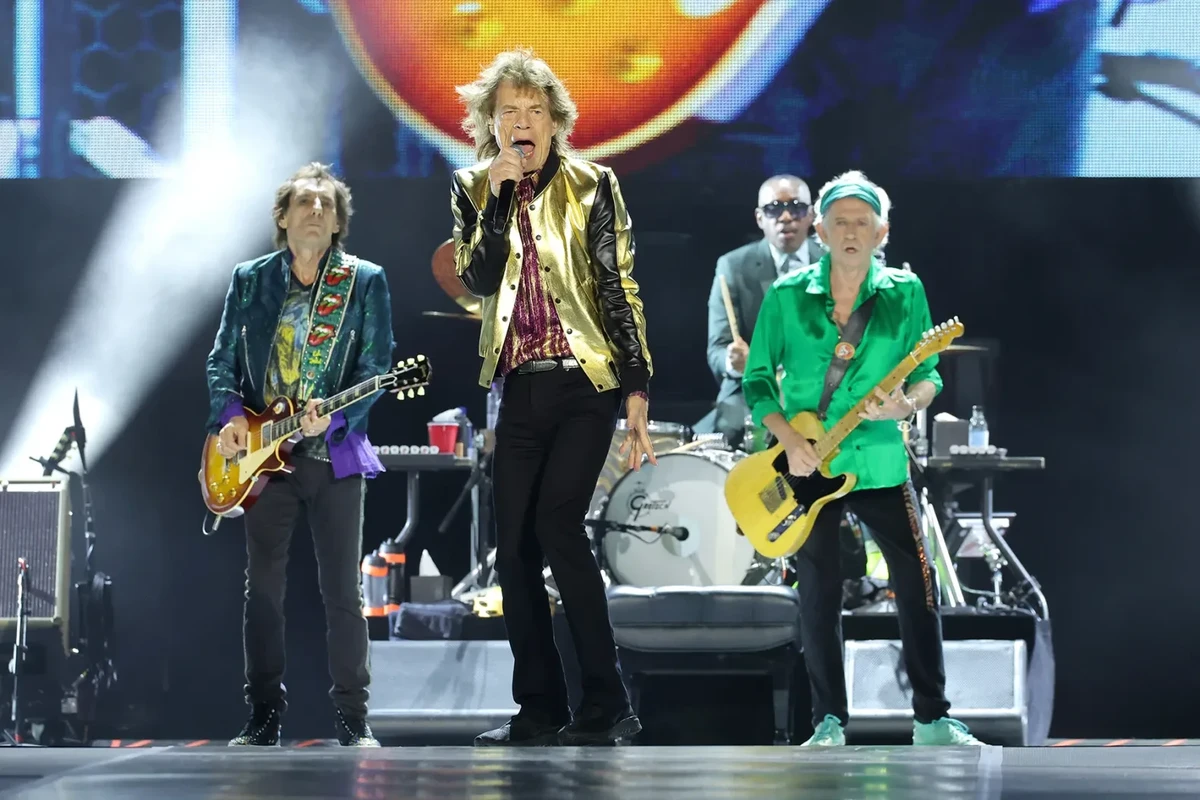
We almost hesitate to suggest this next scenario, but the Stones kept going after Brian Jones was fired in 1969, Mick Taylor quit in 1974, Bill Wyman defected in 1993, and Charlie Watts died in 2021. Mick and Keith are the only founding members left. Is there a universe where Keith voluntarily steps aside and Mick keeps the band going with Ron Wood (still the new guy 51 years into his tenure) and the rest of the touring band, including drummer Steve Jordan and bassist Darryl Jones?
On one hand, that would be crazy. Keith Richards is the heart and soul of the Rolling Stones. Without him, it’s Mick Jagger and Company. On the other hand, there are many bands on the road, drawing enormous crowds, with much less authenticity than a Keith-free Stones. They may not be quite able to play multiple nights at football stadiums with outrageously priced tickets without Keith, but the shows would still be huge events.
We may have even seen a tiny preview of this on July 8 at the St. Clement Hotel in London when Jagger, Wood, and Stones keyboardist Matt Clifford played a surprise three-song acoustic set to promote Foreign Tongues. Background singer Chanel Haynes came out for the finale of “You Can’t Always Get What You Want.” It felt like a glimpse into a possible future for the touring unit, but it’s probably wise to not read too much into it.
(Before anyone panics about this last scenario, we’re just spitballing here. We have no clue what’s going to happen. And if we had to put down money, we’d bet on some version of the New York/London/Los Angeles stadium plan. If that happens, start saving up your cash now. It’s not going to be cheap.)