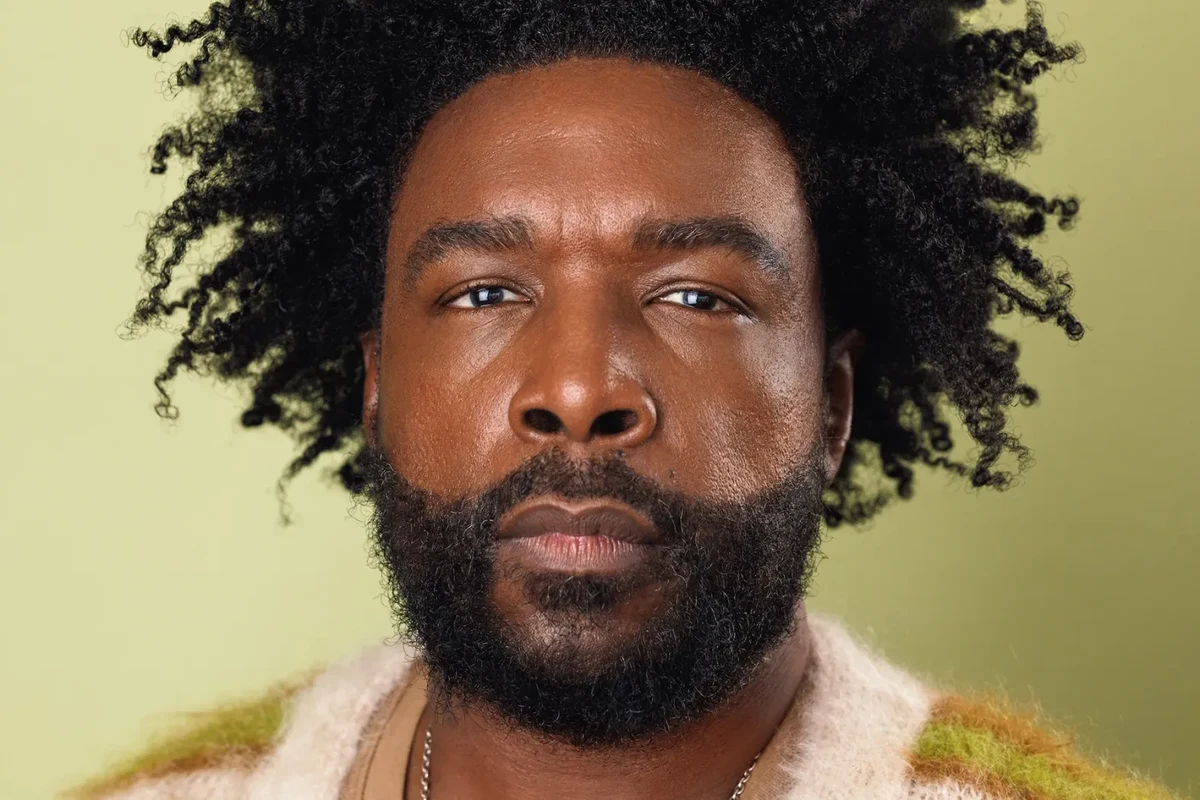

When Questlove is hosting one of his star-studded game nights, which by now have drawn everyone from J.J. Abrams to Taylor Swift, he makes sure to remember a key detail: The tables need to be round. “The rock manager Shep Gordon told me whenever you throw a social event, make sure the tables are circled and not square,” the Roots drummer, producer, DJ, author, and filmmaker says. That way, the guests are always facing each other.
We’re in a tucked-away room on the second floor of a princely Chelsea townhouse that I’m told was once owned by Lady Gaga. Tonight isn’t an official game night, per se; instead, it’s a launch party for the new web series those game nights inspired. The Next Move, which premieres today, takes the popular video interview series concept and introduces something a touch more personal. Where Subway Takes and Hot Ones occupy hallowed ground in the celebrity press tour, Questlove’s new series feels more like a hangout. The show’s slate of guests all come from within the already established game-night orbit, and thus audiences get a view into a more relaxed, convivial perspective on their favorite stars.
Produced by Questlove and Black Thought’s Two One Five Entertainment, the show’s interviews have the natural vibrance of a party in an intimate setting, making for often surprising insights. “Roy Wood‘s episode with the comedians… They were more serious, and somehow fricking Robert Glasper and Michael Che wound up being the comic masters,” Questlove says. “So yeah, you just never know.”
Ziwe and Roy Wood Jr.Terrell Phelps*Even though tonight isn’t an official game night, guests — who include Katie Holmes, Jon Hamm, and Ayo Edebiri — are greeted on each of the home’s six floors with a different variety of board games, from the crowd favorite Uno to lesser-known titles and a few new ones (Janelle Monáe has a game she invented called Kaboom). At one table, Ziwe holds court over a game of Uno as a nearby group plays something I’ve never heard of, but that involves slapping the table every time you land on a certain word. The only guests I recognize in the group are Kilo Kish and someone I met earlier who works in music finance, acquiring artists’ catalogs (business is booming, I hear).
“They’re having more fun than us,” Ziwe jokes, as the other group bursts into laughter and table-slapping.
The whole thing, from the new series to the game nights themselves, even this evening’s celebrations, have the feeling of the late-1970s public access show TV Party, a loose, unpredictable New York salon helmed by Glenn O’Brien. When I mention the comparison, Questlove laughs. “When I interviewed Fab 5 Freddy on my podcast… he led me to the [TV Party] archives, where I saw those shows, and I was like, ‘This happened?'” he says. That’s much of the appeal of this latest project. “It’s like, what could happen if you mix Ryan Destiny with Robert Glasper. It’s people that don’t know each other and have nothing in common.”
Michelle Buteau (center) and friends Terrell Phelps*When Quest thinks about the questions he likes to ask on Questlove Supreme, the podcast that he’s hosted since 2016, he breaks them into two camps. “One, of course, is based on your profession. I got to ask you, ‘OK, tell me about the demo that led to this song, that led to this thing.’ And then there’s a sector that wants to know the nerdy parts like, ‘What mic did you use? Did you use vacuum tubing for this particular compressor?’ Those things,” he says. But his favorite questions are the ones that have nothing to do with music at all. “My favorite ones are mainly about the artist himself… Have you ever gotten fired from a job? What’s your favorite cereal? When was the last time you vomited?… Because people never ask people about things.” That same ethos, he says, is the guiding principle for The Next Move.
As for dream guests, Questlove has one name in mind: Michael Jordan. “Only because I watched The Last Dance twice in the pandemic,” he says.
As the night goes on, and guests mingle between floors like patrons moving through a museum, enjoying the evening’s menu of burgers, pasta, and pizza from a curated set of local restaurant vendors, I think about Questlove’s overall philosophy on starting his now-famous game nights. “I think a shared experience for human beings is music. Either you dance to it, create it, listen to it — we all need to survive,” he says. “And it’s safe to say that every human at one point in their life made space to have fun.”
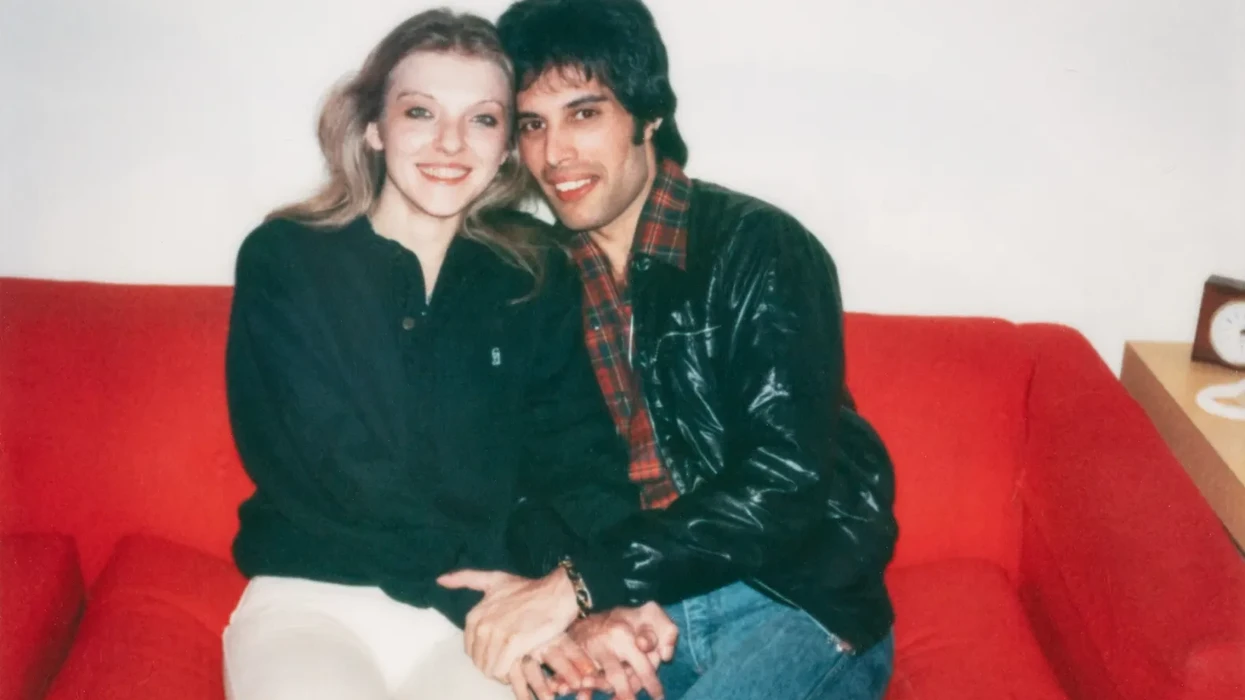



Holzman and Hughes at the Lincoln Memorial Reflecting Pool.Courtesy of Ekko Astral
Holzman and Hughes in Brooklyn, May 2026.Griffin Lotz for Rolling Stone


There’s no immediate resolution in any of this. There’s no surrender either — and a lot of great escape. White’s slide guitar in “Dollar Bill” sounds like a National Steel on steroids until the solo, when it turns into what seems like a theremin gone postal. “I Can’t Believe What I’m Hearing” has a great pop-wise chorus closer to the Pretty Things than Son House. And don’t miss White’s wry aside to the White Stripes’ old creation myth in the second verse of “G.O.D.,” on the way to the real business at hand. “Well, it’s the beginning of the world now,” he declares at the song’s end. “Let’s do it all over again.”

Jay-Z has turned the 30th anniversary of his classic debut album into a major marketing event
Jay-Z Knows the Past Still Pays
There’s a pleasant absurdity to the advertisements for JAŸ-Z30 that are currently found across New York’s subway tunnels. Their dramatic imagery — a stark black backdrop pierced through the center with a pair of hands, presumably Jay’s, fixed into the famous Roc diamond — invites a kind of religious authority that feels a touch ironic for anyone who’s old enough to remember all types of handwringing over those very hand symbols only a few years ago. And maybe that’s the point. By now, nostalgia’s grip extends layers deep. So much so that you could find yourself waiting for the train, reminiscing on the days when people still made jokes about the so-called Illuminati.
Jay-Z’s months-long campaign commemorating the 30th anniversary of Reasonable Doubt and the 25th anniversary of The Blueprint has indeed resurfaced the rapper-turned-mogul’s success story. Reasonable Doubt, released in 1996, positioned Jay as not only a resonant voice in hip-hop but also in the increasingly lucrative business around it. After major labels passed, the album was released independently through Roc-A-Fella Records and Priority Records, setting the tone for Jay’s career as a business…man.
And in the full-court press campaign around this summer’s anniversaries, culminating in this weekend’s trio of performances at Yankee Stadium, Jay’s business acumen is again at center focus. You’d be forgiven for throwing around buzzwords like “multichannel” or “cross-platform” to describe the slate of festivities. There was a Spotify-backed takeover of the J and Z trains; custom JAŸ-Z30 subway maps and a Google Maps guide; commemorative Brooklyn Public Library cards; and most recently Bowery Station and DUMBO pop-ups with archival footage and merch. (That these Yankee Stadium shows come on the heels of Taylor Swift’s wedding at MSG suggests some sort of mega-rich takeover of cultural institutions, but let’s leave that one for another day.)
The moves come as nostalgia continues to drive a considerable chunk of the music industry’s profits. In an era when old songs can circulate infinitely on streaming platforms, gaining new life in the form of everything from samples to memes, and when superfans are willing to spend on physical goods, limited merch, and live experiences, album anniversaries have become their own product launches. Jay-Z’s Reasonable Doubt campaign is only the splashiest recent example.
No wonder, then, that Beyoncé already appears to be setting the stage for her own run of commemorations for the upcoming 20th anniversary of her album B’Day in September. Over the weekend, she released her first new song in two years, titled “Morning Dew (Donk),” to tease the upcoming reissue. According to Luminate, older music still dominates attention, with only 43 percent of U.S. on-demand audio streams in 2025 coming from tracks released in the previous five years. This is also one reason why vinyl and physical formats have seen renewed value in recent years, with the RIAA reporting that vinyl sold 46.8 million units in the U.S. in 2025, compared with 29.5 million CDs. Luminate says superfans are 20 percent of U.S. music listeners and spend heavily on live events and physical merchandise; 73 percent of these fans purchase physical merch, versus 26 percent of general music listeners.
In today’s industry, having a major anniversary is like having a new product to promote, a way to participate in an already thriving marketplace for nostalgia. The demand is visible well beyond official artist stores: Vintage concert tees now trade as collectibles, with one 1967 Grateful Dead shirt selling at Sotheby’s for $19,300 and rare rap tees treated as wearable archives of hip-hop history. Anniversary campaigns give artists and labels a way to reclaim that energy, turning the secondary market’s appetite for old symbols into new, officially sanctioned products.
Jay-Z’s official anniversary store turns that logic into a menu of objects: a $1,500 collector’s crate, a $300 cassette box, $400 Yankees jerseys, and four-figure varsity jackets. Of course, Jay is far from alone when it comes to legacy acts cashing in on nostalgia. He’s more like one salient example of a much larger wave of artists and promoters marketing anniversary products that includes the Smashing Pumpkins’ Mellon Collie and the Infinite Sadness 30th anniversary super-deluxe edition, My Chemical Romance’s Black Parade stadium tour, and the returned Warped Tour, among many others.
Five years before Reasonable Doubt became the occasion for library cards, pop-ups, collector crates, and stadium spectacle, its 25th anniversary was marked by an NFT. In 2021, Sotheby’s and Roc Nation auctioned a one-of-one Derrick Adams artwork tied to the album, billed as the only official Jay-Z-authorized commemoration of the anniversary. Around the same time, Roc-A-Fella was in court over co-founder Damon Dash’s attempted sale of a Reasonable Doubt-related NFT, a dispute that ended with a judgment making clear that no shareholder could sell or dispose of an interest in the album — including through an NFT — without the company’s authorization.
That ownership question is becoming harder to avoid as music enters the AI era, where the archive is not only something to reissue, exhibit, or sell, but something that can be scraped, modeled, and trained on. Last week, SZA took to Twitter to express frustration with AI music company Suno, notably calling out Diplo by name as one of the company’s investors. “DO NOT GIVE AWAY YOUR VIBRANIUM !!! DO NOT TRAIN AI WITH YOUR GENIUS,” she wrote on Twitter. Her complaint was joined by Kenneth Blume, who said Suno’s workers were “stealing from countless struggling musicians.”
For an artist with a legacy as impactful as Jay-Z’s, the current anniversary boom feel like the latest phase of a longer project of deciding who gets to turn hip-hop history into intellectual property. Jay-Z’s legacy deserves preservation; few catalogs have made a stronger case for it. But the more that preservation arrives through limited-edition objects, auction platforms, luxury merch, and authorized experiences, the more it has to answer a harder question: When does protecting the archive become another way of extracting value from it?