
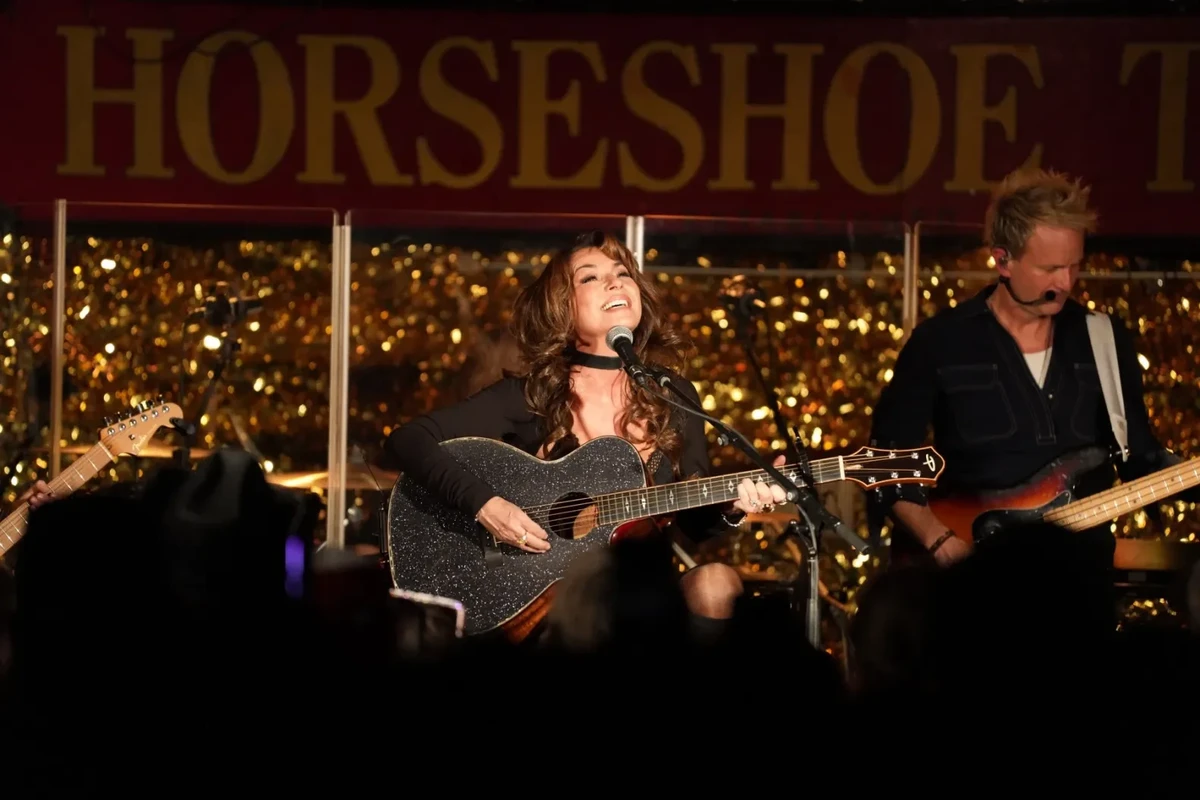

Shania Twain always dreamed of playing Toronto’s legendary Horseshoe Tavern. The Queen of Country Pop, who has long headlined arenas and recently opened 12 stadium shows in London for Harry Styles, finally got to perform at the Queen Street landmark on Friday night, dropping into a venue that holds 500 people, testing out songs from her forthcoming album, Little Miss Twain, and delivering the pop smashes that helped sell more than 100 million albums worldwide.
The evening was filled with stories about growing up in Timmins, Ontario, “the North” — memories about her mother, her father, his truck, driving at age 10, her ripped blue jeans, her fantasy man, and other deeply personal things that became the basis for the new songs. The lyrics meant so much to Twain that several times after performing the song with the band, she sang verses again on her own, just to make sure the crowd heard them.
The $40 tickets (30 bucks in U.S. dollars) for the underplay sold out in minutes and were non-transferrable. A small number were set aside for contest winners, industry, media, and guests. The diehards who couldn’t get in listened from the sidewalk, but were unable to catch a glimpse of the five-time Grammy winner: the stage is located far in the backroom.
“Quick story,” the chatty singer, now 60, said after opening the 75-minute set with two of her biggest hits, “Come On Over” and “Any Man of Mine,” and already declaring this “the best night ever.” Sitting on a stool with her sparkly, silver acoustic guitar, in front of the venue’s glittery backdrop and giant logo, she looked beautiful in a black bodysuit, shrug, tights, and knee-high suede boots, her layered hair styled with loose curls.
“I grew up in northern Ontario. The dream in my little bar bands at the time, all through my youth and my teens, and even into my 20s, was to play the Horseshoe Tavern,” she said. “But we just weren’t established enough, so…this is my first time in the Horseshoe Tavern.”
The 78-year-old music venue, still standing amid the crumbling history around it, including the construction of a subway stop next door, has hosted countless legends on its stage. On the country side alone, Waylon Jennings, Loretta Lynn, Conway Twitty, and Willie Nelson all played there; along with Canadian rising star Josh Ross. Though it’s no longer strictly a country bar — the Rolling Stones, the Ramones, Foo Fighters, and Bryan Adams are just some of the rock acts who’ve graced the stage—original owner Jack Starr built it into the “Grand Ole Opry of the North” in the early days.
Notably, the late Stompin’ Tom Connors — whom Twain talked about last month onstage at another underplay, the Shacklewell Arms pub in London, and imitated his famed foot-stomping — was such a fixture at “The ‘Shoe” that he is immortalized in a mural shared with the Tragically Hip’s late singer Gord Downie on the wall by the stage.
“I’m finally here, and I feel like it’s a very full circle moment,” Twain continued. “This is so historical. It’s a privilege to be here — finally.”
Backed by a six-piece band, that included four women and her longtime music director Brent Barcus, Twain strummed guitar for nearly all the songs. She apologized to the crowd for the “go with the flow” nature of the evening, which included some tiny tech requests, and half-joked that she didn’t know all the lyrics yet because she’d just recorded them.
Teeing up the roots-rocker “Dirty Rosie,” the lead single and opening track from Little Miss Twain, due July 24, she described it as being inspired by “my favorite truck,” which also appears in the music video for the song. “I grew up on the backroads and gravel roads of Timmins, Ontario, deep in the bush, and that’s where I learned to drive,” she told the crowd, explaining that she was 10 years old when she got behind the wheel of her dad’s pickup. “I thought, ‘Someday, if I ever have my own truck, it won’t be shiny and clean; it would be a truck that had purpose.’”
The song “I’d Be Loving Me,” she said, came out of a jam with musicians who had played on Motown records — “It’s my soul side coming out” — and spoke again about her youth and upbringing and what the big city of Toronto meant.
After the lilting soul ballad, Twain performed the harmony-heavy “Stranger Things,” another track off the forthcoming LP. “This is the song that I wrote about the whole Little Miss Twain album. It’s a reflection on my life growing up in the North, in Ontario,” she said. “There’s snow and trees and lakes and rivers and gold in the ground and all the things that we are about Ontario.”
At one point, Twain reminisced about her childhood dream guy who inspired the song — imagining a lumberjack-type partner who could do all the things she could do. “I mean, I can chop wood, I can trap. Ontario girls, I can change tires,” she said, describing a man twice her size who filled up a door frame, like a Daniel Boone figure. “So, I wrote this song all about the fantasy man when I was a kid.”
Twain then went back to the classics, “That Don’t Impress Me Much” and “You’re Still the One,” the crowd excited, phones up in full force, singing along, before she played “Faded Blue Jeans,” a new track that features Queens of the Stone Age singer Josh Homme. There was no metaphor here: The song is about Twain’s hole-filled denim that repeatedly came back into style over the years, and the life moments she had while wearing them.
While Twain talked a lot about her father, it was her mother who loomed largest over the night. “My driver, my manager and my agent,” is how Twain described her. “Her dream was that I would be a childhood country music star. Now, I would never hit that mark, and my mother would not live to see me, ever, have success. But her dream was that I would be the next Tanya Tucker.” (Tucker sings on the album’s title track.)
Twain wrapped up the night with “Man! I Feel Like A Woman!” noting how it’s become a karaoke favorite and holding out the mic for everyone to join in. “We’re flying by the seat of our pants,” Twain said after the song, seemingly unprepared for an encore and listening as fans yelled out suggestions. She settled on 2023’s “Giddy Up!” “Don’t forget to lasso,” she told the crowd, egging them on to dance. “I’ll be broken hearted if you don’t lasso.”
In the end, the concert succeeded on its spontaneity, and Twain looked genuinely happy to be at the Horseshoe, going deep into the new songs that clearly mean so much to her. Outside, a large trailer took up the venue parking lot. She might have always wanted to play the ‘Shoe, but the dive bar’s green room is not fit for a Twain — Little Miss or superstar.





 Courtesy of Martin Garrix
 Louis Van Baar*


Liam Payne (left) and Harry Styles of One Direction onstage during the 2013 American Music Awards at Nokia Theatre L.A. Live on Nov. 24, 2013
Harry Styles Finds the Right Words on Liam Payne Tribute Song
For the past seven weeks, Harry Styles has reserved two minutes at each of his Madison Square Garden shows to reflect on the last time he gathered this many people in this room. Four years have passed since he performed 15 record-breaking nights at the venue during his Love on Tour. Now, every night at the new Together, Together shows, which span 30 nights at MSG, he acknowledges that “a lot of life happened to me and landed on me in ways that maybe it hadn’t before.”
Styles doesn’t usually go into much more detail; he typically just describes those in-between years as “a great reminder for me of just how wonderful and beautiful, difficult and inspiring, and also how fragile a life can be.” He encourages the audience to look around at each other and celebrate the community they’ve built together. Then he dives into “Sign of the Times.” It happens every Wednesday, Friday, and Saturday like clockwork. But when he delivered this speech on Friday, Oct. 16, there was a shift. It didn’t conclude in its usual way.
Instead, Styles turned his attention to the banner commemorating his 15 consecutive nights at the Garden in 2022. “It means a lot to be able to look up there at my name up there from the last tour,” he said. “There are so many people, friends and people that I’ve worked with, that I would’ve never been able to do this without.” Two years ago, he continued, he lost one of those pillars. Friday’s show fell on the same day as the second anniversary of the death of Liam Payne, a loss that time has not made it easier to acknowledge. “I’m sure a lot of you have been through something similar,” Styles said. “I hope you haven’t.”
A frequent assessment of Styles, both among his fans and those who’ve only encountered him at a distance, is that he often talks at length before getting to the point. He recognizes it himself on the Kiss All the Time. Disco, Occasionally song “Coming Up Roses,” where he sings about fumbling his words. But recently, comments about his long-winded way of speaking have started to feel like purposeful misreadings. There are clear and carefully considered thoughts present between his starts and stops. Anyone truly listening will pick up on those threads.
Styles cut himself off a few times during his speech on Friday. He tried to talk for a second about looking after each other, and repeated his point about the banner and the people who’ve supported him. He never mentions Payne by name, instead referring to him as a friend, which somehow became a point of criticism from some fans. The context is clear enough. Still, he seems to know it’s a gamble to expect understanding, especially when the conversation grows more complex and personal.
After about a minute and a half, Styles figured it best to show us what he means rather than tell us. “I’m gonna sing a song I wrote two years ago for my friend,” he said before premiering “Wise Enough.” The sullen tribute to Payne settled the room into a cool near-silence, punctured by quiet gasps and muffled crying. It was beautiful, devastating, and deeply exposing to watch Styles share his grief with 20,000 people in the best, and maybe only, way he knows how.
Earlier this year, Styles told Zane Lowe about the acute dread surrounding the expected performance of his mourning. “Full transparency, even the idea of talking about it, I struggle with that a little bit. There was a period when he passed away where I really struggled with acknowledging how strange it is to have people own part of your grief, in a way,” he said. “I have such strong feelings around my friend passing away. And then suddenly being aware there’s maybe a desire from other people of you to convey that in some way, or it means you’re not feeling what you’re feeling.”
Artists often describe the act of sharing new music as a change in ownership, something that is no longer their own once it has been handed over to an audience. “Wise Enough” feels protected from this. It would be confounding to see Styles ever record and release it in any official capacity. The song is openhearted in a way that exposes deep scars, anxious in a way that worries and fidgets about time and how it passes, and inconsolable in a way that doesn’t make the futile attempt to fight through anger, regret, or sadness.
“I can tell you what it’s like to bury friends on Wednesday nights/Gather in a garden around the fire,” Styles sings in a particularly cutting verse on the song, which concludes with an honest admission: “I’m not wise enough to call for a conversation/And then back it up, right?/Like you’re in the sky.”
Celebrity doesn’t obscure grief. It doesn’t come with a script for what to say when someone is sorry for your loss, or when they recollect their own version of the person you knew. No one really has the right words for these moments. Over the weekend, fans debated whether “Wise Enough” is actually titled “What Is Enough?” Styles introduced the record so briskly it was hard to decipher. The question of adequacy feels similarly impossible to answer.
Grief is so plain in how universal it is, but so complex in how and when it chooses to present itself. It can be policed only as much as it can be predicted, which is to say barely at all. That Styles let us into his now yearslong search for some semblance of understanding — knowing how his words have been picked apart before for far lesser things — shouldn’t be taken for granted.
Styles never acknowledges that banner at MSG. It’s not for lack of gratitude — he cried when it was unveiled. But the point he has reiterated every Wednesday, Friday, and Saturday since the end of August is that the achievement is something that must be shared because he couldn’t have done it alone. He talks about being on stage as if what happens in that room exists far beyond and outside of himself, something that endures even in his absence.
It’s true in a way. There’s muscle memory tied to the music. It’s in the spinning, dizzying way fans dance to “Satellite,” or the way they wildly kick their feet and make the building shake during “Kiwi,” a song he brought back to the set just for New York. It’s just like before, but still so different.
Friday night continued as usual after “Wise Enough.” Styles belted out “Sign of the Times” in the sobering way he always does, then “Aperture” let in a cathartic flood of strobing lights and pulsating beats. The emotional whiplash took physical form as fans consoled one another, holding out their hands to help up friends and strangers who crumbled to the floor at the conclusion of the tribute. Some were crushed by their memories of loving One Direction, and the care they hold in their hearts for Styles. Some were just as wrecked by their own personal losses.
A lot of life and loss can happen in four years, as Styles says each night. For some people who were at MSG on Friday, there are friends present in their memories from the last tour who are missing from the new ones they’re making. The lyric “You dance until you’re tired/No, you don’t, and now you never will/Will you?” surfaces their own devastation completely separate from what inspired Styles to sprawl those words on a page. How do you dance to “Aperture” — the beating heart of this show in its declaration that “we belong together” — after hearing something like that?
You take the hand of the friend or the stranger who pulled you from the ground and use it to lead each other back to the dance floor. When Styles talks about community and stresses the importance of caring for one another each night, he reminds everyone of the fragility of a moment, and urges them to cherish every second they get. To dance wildly and sing loudly and wrap their arms around each other. To hold tight to what’s here right now.
It’s all any of us have, so it has to be enough.