
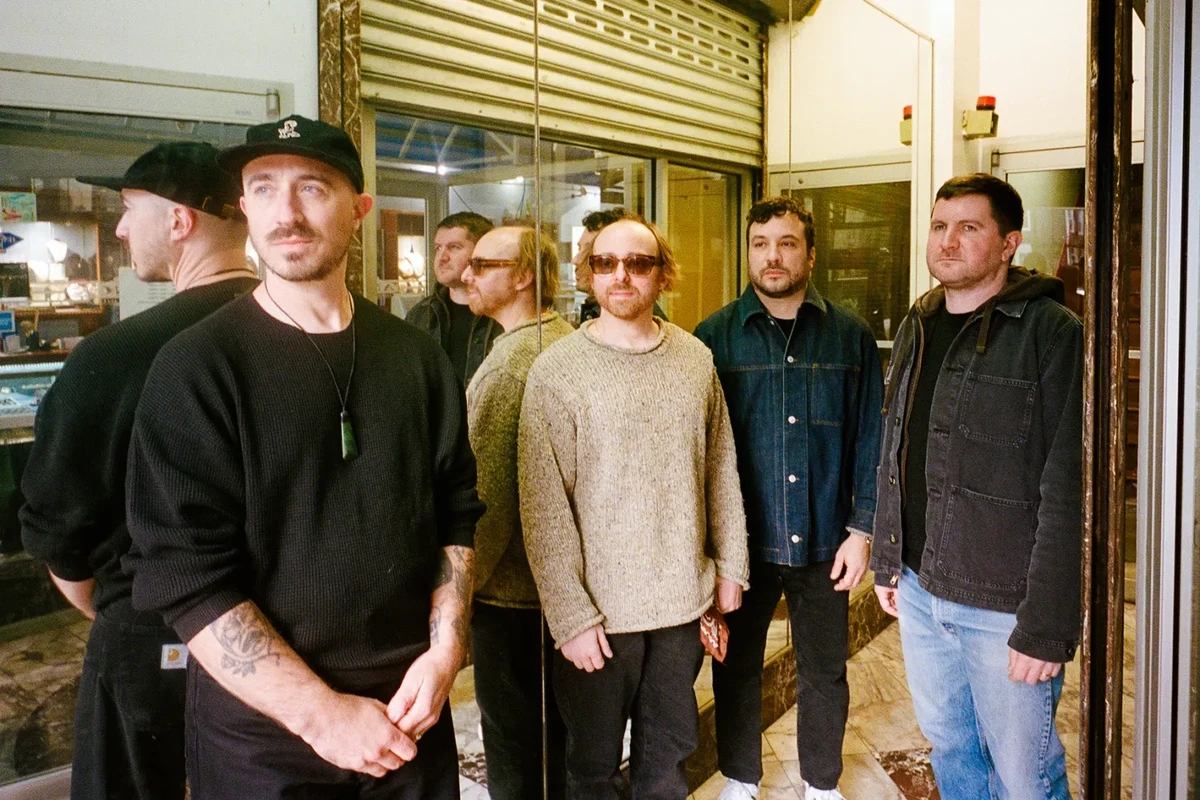

The Menzingers were getting fired up over a couple of beers, talking about their new album when the topic of where to record came up. There were legendary studios and cities, like Los Angeles, that they had never worked in. Then they had one idea: What if they recorded right in South Philly, the neighborhood they’ve lived in for 20 years? Sure, they’ve made albums in Philadelphia before, at studios in Fishtown and nearby suburb Conshohocken, but for their ninth studio LP, Everything I Ever Saw, they kept everything right in their backyard at producer Will Yip’s newly built studio.
“It was cool to be in our neighborhood. We were going out to lunch at all our local places,” lead singer and guitarist Greg Barnett tells Rolling Stone over Zoom.
“It was amazing,” guitarist and vocalist Tom May agrees. “We went to Triangle Tavern, New Wave, all the same places we’ve been going to for almost 20 years.”
Since moving to Philadelphia in 2008, the Scranton-bred band made up of Barnett, May, bassist Eric Keen, and drummer Joe Godino has become a staple of the city’s indie rock scene. They cut their teeth at basement house shows, eventually packing venues like Union Transfer, and even memorialized the city in their seminal mid-2010s punk rock records On the Impossible Past and After the Party. It only makes sense that the Menzingers brought the energy of their adopted city into their new album, a project that finds them exploring different sonic territory without trading in the urgency that makes them such a great rock band.
“The music sounds as fun as the recording process was, which to me is really important,” Barnett says, smiling as he remembers their cocktail hour breaks. “When I listen back to the record, it sounds like we were just having a really great time together.”
As the band spent their days living and working in the same streets that always inspired their music, they found it easier to tap into the whirlwind of emotions that come with life-changing events like a divorce or welcoming your first child, all of which shape Everything I Ever Saw. “We felt more like we were allowed to be vulnerable because we felt so at home and at peace creating there,” Barnett says.
Calling in from different parts of Philadelphia, Barnett in South Philly and May up in North Richmond, the pair talk about working with Yip again, what they hope fans will take away from the music, and what they’ve learned from being a band for 20 years.
Your new album Everything I Ever Saw is officially out July 17. When did you start conceptualizing the project?
May: We’re always writing, which is something I’m sure a lot of musicians say. But we definitely pick a time where we dive into a record and all of our attention’s there and it really starts to take shape. We’re constantly on tour moving and for this album we started writing and we got into this space in April of last year, which is where we really were able to start meeting up four or five days a week and putting it together in the room. We recorded in September into October, so it happened quickly.
You went back to working with producer Will Yip again, who produced two of your past records. What made you guys return to him?
Barnett: When you work with Will, he quickly becomes a family member and that’s how it was for us. Even when we’re not recording, he is a really close friend of ours. We were writing this album and things were developing really fast and at the same time, Will was opening up a studio in South Philly, where we could walk every day. Sometimes if you have to travel to write, you feel like you’re in someone else’s territory or whatever. This felt like being so at home. Sometimes, I think batches of songs gravitate toward certain producers and creative identities. While we were writing, we were like, “We’ve got to work with Will on this record.” Being back with him was a dream come true.
Tom, you said that no one “gases you up” like Will. What moments on Everything I Ever Saw do you remember Will hyping up specifically?
May: Will can gas you up even when he doesn’t like your idea and you’re not going to use it. You know what I mean? He’s so good at massaging that part of the creative process. That was also one of the main reasons that we went with him. We said, “Who’s going to treat the songs the best?” There’s a theme that ran through what we were writing and where we decided to go, and a lot of that was not necessarily a homecoming or a revision of who we’ve been, but an element of trust.
The album finds you guys exploring a different, almost pop sound with the introduction of synths on “Gasoline & Matches.” How did that come about?
May: I don’t want to be cynical about it and be like, “Oh, we’ve been playing guitar for this long and it gets a little bit boring.” It doesn’t get boring. It’s fucking awesome, but there is a desire to incorporate some other instruments. Over the last couple of years, I personally got really into electronic music and I know the rest of the guys, we’ve all been listening to all kinds of things from all decades and we’re like, “Yeah, these sounds actually can be cool.” We just went for it and it’s still relatively subtle. It really helped us expand and it was really satisfying to open up some of those sonic doors that way.
I wanted to talk about “Better Angels,” the album’s third single, which is out today. What inspired that one?
May: When we first started it, it was actually a sleazy indie song. The one image that we would picture is two friends drinking and solving the world’s problems, and how you have those types of conversations with certain people in your life. Then it became the punk song that it is and we really wanted to hit on that optimism. It’s not some hippie shit where it’s like “everybody be peaceful to each other.” It’s really about people healing the divisions in their own family or in their neighborhood and trying to get through somehow.
In a similar vein, “Other People’s Money” feels like a continuation of “America (You’re Freaking Me Out)” from your 2020 album Hello Exile. What do you hope audiences take away from that?
May: Many people feel like what has been working for the current administration, from the presidency down to local elections, is [a part of] this wildly bizarre populist in the wrong way cult of personality grift. I don’t even necessarily believe that these people have a deep ideology that you can argue against or shine light on. Sunlight’s the best disinfectant, but these people are beyond being ideological opponents. They’re just thieves and grifters. So I thought it would be a fun way to write a song that highlights that.
The song comes after videos circulated online about a Nazi who was doing a Nazi salute at one of your shows in Allentown earlier this year. He was promptly kicked out. What happened there?
May: We were backstage and our crew was putting out fires. We were waiting to go on and we were standing there talking to the mayor of Allentown and one of the state reps. He’s explaining to us that he’s Allentown’s first Hispanic mayor and he has all these plans for the future. Meanwhile, a fight had broken out in the crowd and one of the guys that was involved just started throwing up a Sieg Heil. People soaked him with beer and security threw him out and it was a whole fucking thing. We played the show and then the next day somebody sent us an Instagram reel or a Reddit post and was like, “Hey, did you see that there was a Nazi at your show?” We were like, “You got to be fucking kidding me.”
Barnett: That was such an insane experience because we had no idea that it happened until later. We were like, “Huh? There was a Nazi at our show in 2026?” It was completely insane. We felt so embarrassed that we were on stage for an hour and a half and we didn’t get to say anything.
We left that night celebrating such an incredible show. And then the next day we find out that this fucking idiot had to ruin it for everyone there and we had no idea. It was a really unfortunate situation and our fans handled it in an awesome way. It’s just insane that you would come to a Menzingers show. You clearly know what side we’re on. You know that there’s no place at a Menzingers show for that at all.
 POND Creative*
The title track “Everything I Ever Saw” is such a quintessential Menzingers song. What about that it sums up the record and why did you choose it as the title?
Barnett: We were going back and forth with album titles for a while and we were going to call the album Chance Encounters, but we didn’t know if it spoke to every song. The album’s about living in the present, especially during life’s big moments. As musicians in a touring band, we’re constantly looking towards the next thing. I felt like I had been living my life like that for a very long time.
Then Everything I Ever Saw just clicked. It tied in with all the other songs about being here in the moment and being there for the people that need you. The answer was right in front of us all along. People have described us as a very nostalgic band. It’s funny because I never saw it that way, it was more so about looking at the past for the answers to the things that you’re trying to understand now. That’s how I feel like our songwriting has always gone. The chorus, “I don’t want to relive, I just want to remember everything I ever saw” sums that bit up. I want to remember all of this and use it in the future to appreciate my life.
After the Party turns 10 next year. I know you celebrated On the Impossible Past’s 10 year anniversary. Do you guys have any plans to do something similar with After the Party?
Barnett: Nothing’s set in stone yet, but it feels right to do something for it. We got this new album coming out, we don’t know the touring schedule and stuff, but we gotta throw some parties. After the Party was just such a monumental record for us and 10 years of it just feels so important.
This album marks the band’s 20th anniversary. What’s the biggest lesson you’ve learned about being a band for that long?
May: Most things don’t last 20 years, especially being in a punk rock band and doing something that is typically associated with the explosive energy and naivety of youth. It’s incredible to be together for this long, doing the same thing while constantly being able to change with each other as life changes, too. All I can think about is how proud I am of the other guys, of myself, and of our crew for making it this far and being able to learn all the things that we learned and be in this present moment and appreciate it for what it is.
Barnett: If you’re playing a festival, get to the showers before the metal bands do, because they have long hair. There’s so many of those little things, I have many stories like that to just understand this touring life. But the most important thing is to look out for each other and the people around you.
What do you think it is about the Menzingers that has helped with the band’s longevity?
May: I got two main ones that I like to credit it to at this point in my life because it changes. One is that all four of us wanted the same thing, we wanted to make a living as a band. But the new thing that I think of is straight up luck. A lot of people aren’t as wildly lucky as we are. So I’d like to thank the stars a lot more than I used to for those kinds of things.
Barnett: We weren’t able to pay the bills for a very long time after first band practice, but there was just that dedication that we had from the beginning. We believed in ourselves and each other. We’ve also had a very slow gradual rise. It’s been a lot easier that way opposed to just the overnight success that some friends have. Our fans grew up with us as we were growing up and I think that really helped us stick around.
I agree with Tom, we got lucky because on paper, I get why our parents were like, “You guys are insane. You’re a punk rock band from Scranton, Pennsylvania and you think what? You’re going to make a living off of this.” I have a daughter now, if she came to me, I’d be like, “I support it, but you understand this is crazy.” I do think no matter what it is in life, if you’re dedicated and you believe in it, it’ll be successful.



 Steve Cohen*
 Paul Heartfield*
 Holzman and Hughes at the Lincoln Memorial Reflecting Pool.Courtesy of Ekko Astral
 Holzman and Hughes in Brooklyn, May 2026.Griffin Lotz for Rolling Stone