
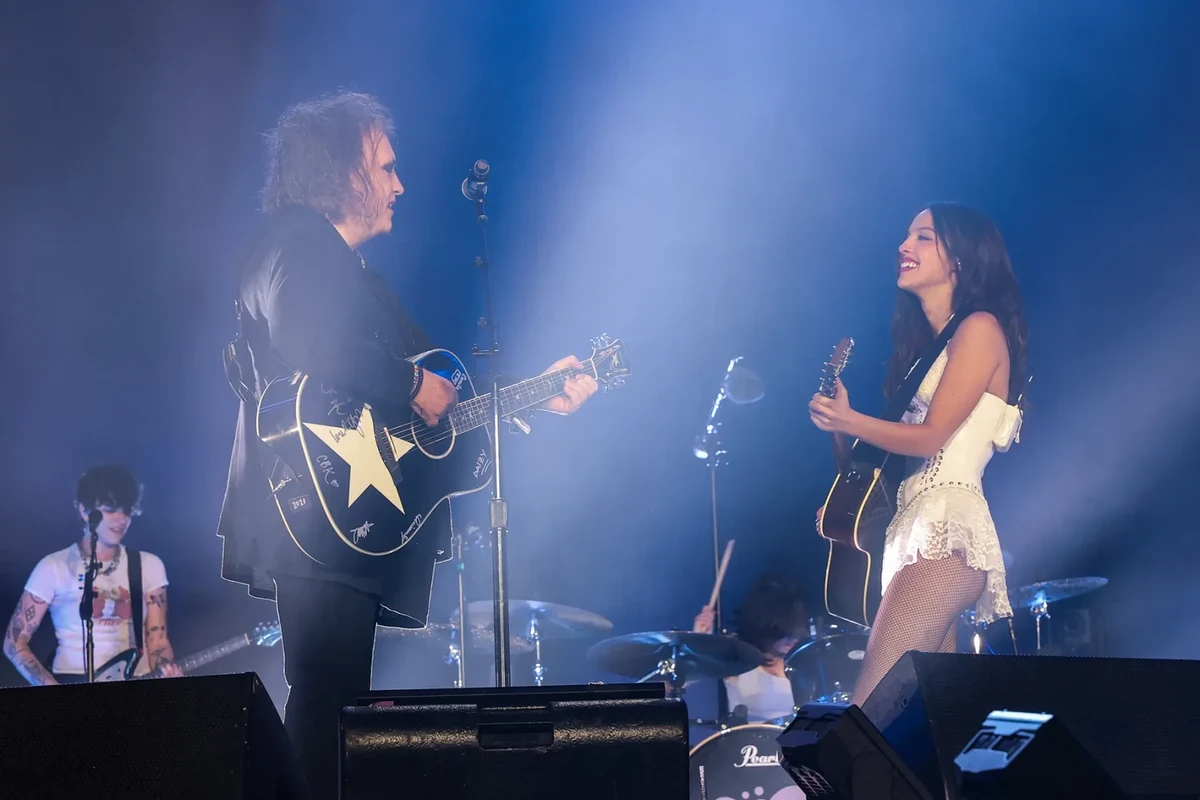

Olivia Rodrigo just lived out the ultimate teenage fantasy: First you sing a song for Robert Smith about how miserable you are, then he gives you a hug. The pop queen and the Cure legend teamed up for a shocker duet at her surprise weekend set at the Primavera Sound festival in Barcelona, doing their collaboration from her new album, with the very Robert Smith title, “What’s Wrong With Me?”
What a beautiful moment of cross-generational goth bonding. The Eighties gloom god was positively beaming with pride and joy, standing beside her to sing this great new tune he helped inspire. Who hasn’t dreamed about making a list of all your problems so you can ask Robert Smith what’s wrong with you? And who hasn’t dreamed of Robert singing your words back to you, assuring you that it’s gonna be okay? Here’s to Olivia for making that fantasy real. You seem pretty sad for a goth so in love.
Olivia obviously wasn’t kidding when she kept saying how deeply her new tunes were inspired by the Cure. At Primavera, she sang her superb Number One hit “Drop Dead,” with the line, “You know all the words to ‘Just Like Heaven,’ and I know why he wrote them,” then she sang a duet with the man who wrote them. And oh yeah — in between, she did another song literally called “The Cure.” What a righteous rock-star friendship this is. It’s the grooviest thing, it’s a perfect dream.
The Robertrigo duet was a sequel to their moment last summer at England’s Glastonbury Festival, almost a year ago. “He’s probably the best songwriter to come out of England!” Liv announced, as Smith strolled onstage, a surprise that nobody saw coming. After they sang, she called him “the coolest, nicest, most wonderful man ever.” They did “Just Like Heaven” and “Friday I’m in Love,” while she wore a t-shirt that said, “You know all the words to ‘Just Like Heaven’…or do you”? It would take everyone nearly a year to figure out where that line was headed, when she dropped “Drop Dead.”
If you’re relatively new to the Cure, it’s key to keep in mind that Robert Smith almost never does things like this. Not in the Eighties, not in the Nineties, not now. It just doesn’t happen. He’s always been generous and gracious with younger artists, but he shies away from public cosigns like this. Seeing him get up at a damn festival and sing somebody else’s song? A shock to behold. But it’s a measure of his respect and admiration for Rodrigo as an artist.
“What’s Wrong With Me?” sounded just right for these two melancholy voices. “I went to the doctor and she said I was fine,” they sang. “Tried meditation with a bottle of wine/It’s like somebody put a weight on my chest/I should talk to a friend, but I can’t get out of bed/My head is spinning and my stomach is sick.” Yeah, this girl has definitely been listening to the Cure. The whole vibe of the song is basically, “You know all the words to ‘Disintegration,’ and I know why he wrote them.”
As always, Rodrigo gets the tiny details right. Love the way she sings about how she can’t leave her bed, which is a very Robert Smith dilemma, since he’s always been so fond of lines like “I wish I’d stayed asleep today” or “must have been asleep for days.” Indeed, her symptoms are so close to his in “Close to Me,” this duet amounts to a consultation with a specialist.
Over the years, Smith has done only a select handful of collaborations with his acolytes, such as Chvrches, the Twilight Sad, Crystal Castles, Gorillaz, and Tweaker. He appeared on a Billy Corgan solo record to sing a bizarre Bee Gees cover; he also did a guest spot for Blink 182, proof of his sense of humor. And Mick Jagger just announced that Smith sings back-up on the new Rolling Stones album, Foreign Tongues — probably the only thing the Stones album will have in common with Olivia’s.
But these Robertrigo duets are a rare and touching sight. She’s a lifelong Cure obsessive — who can forget the footage of her in the car, rocking out to “Boys Don’t Cry”? She’s a worshipful fangirl who’s always looked up to Robert Smith, gazing at him onstage in awe. Yet when they teamed up at Glastonbury, for longtime Cure fans, the strangest part was how happy he was, grinning from ear to ear—not something you see every day. It was so poignant to see him having so much fun. After Glastonbury, she posted a photo of them backstage…downing shots. It was the last sight you’d ever expect, which is why it was awesome.
But a year later, they were back to do her song. “It’s my first collaboration!,” she told the Primavera crowd on Saturday, letting the tension build before revealing her guest. “I am just so proud of it — I can’t believe that this song exists, with the person it exists with. I’m just so fucking overwhelmed!”
Nobody knew it was Robert until he came out to sing the second verse, although we all should have guessed from the in-joke when she sings “I’m staring at the ceeei-ling.” (The Cure’s greatest-hits CD was Staring at the Sea.) It’s the fourth new song she’s teased from the eagerly awaited album she’s dropping this week, You Seem Pretty Sad for a Girl So In Love. It’s a first-time feature for her, but equally unusual for him. Smith was already at Primavera to play — The Cure headlined the festival on Friday, their first show since their 2024 magnum opus Songs of a Lost World, one of their best albums ever. Their Primavera set was full of rarities like the ace 1996 single “Mint Car,” which they haven’t touched in a decade, along with hits like “Pictures of You,” “Fascination Street,” “The Lovecats,” and yes, damn right, “Just Like Heaven.”
One of the many Robert Smith paradoxes is how he was always the ultimate depressive, sniffly Brit-goth moppet, yet he found his truest believers in the Eighties new wave girls of Southern California. His ballads of rainy English angst went over big in the land of sun and surf. “I remember on the Kiss Me tour we were in Los Angeles,” Smith told Rolling Stone in 2004. “And there were girls taking their clothes off and lying down in front of the bus to stop us from driving away. And I remember thinking, ‘This isn’t really what I imagined I would be doing with this band.’”
But Robert always had the most profound respect for this audience, even when it would have been way more fashionable for him to scoff at these fangirls. The Kids in America discovered the Cure with the 1982 synth-pop banger “Let’s Go To Bed,” about a couple staying up all night to argue when really all they need is some chamomile tea and a few hours of sleep. As Smith recalled, “Suddenly ‘Let’s Go To Bed’ was turning into a big hit, on the West Coast particularly, and we had a young, predominately female, teenage audience. It went from intense, menacing, psychotic goths to people with perfect white teeth. It was a very weird transition, but I enjoyed it. I thought it was really funny.”
So it makes sense to see him pass the torch to Olivia, who epitomizes the SoCal new wave fangirl. She’s always had a passion for this music, as you can hear in Eighties-style bangers like “So American,” “Deja Vu,” or “Love Is Embarrassing.” Or “Drop Dead” — that song would fit right on Blue Sunshine, the absolutely perfect goth makeout album from Smith’s side band the Glove. (Bet “Punish Me With Kisses” was on the jukebox at that bar.) Yet Olivia has crossed the line from fan to collaborator, with “What’s Wrong With Me?” It’s quite a vote of confidence, from the teen-angst poet who gave us Seventeen Seconds and The Head On The Door. But he takes Rodrigo and her music seriously, just as he always took his female audience seriously. He really did show her how to do that trick.
He also knows the humor as well as the pain of melancholy sad songs. One of my all-time fave live Cure moments was a couple years ago at Madison Square Garden, when they did “Lovesong,” which had everyone in the room singing along with the chorus, “I will ALWAYS love youuuu!” As soon as it was done, he announced, “This next one is called, ‘And Nothing Is Forever.’” Oh, Robert. Never stop.
Some of us were hoping he might stick around with Olivia on Saturday to sing “Happier” or “Favorite Crime,” but alas, it was not to be. (So…that Sour covers project? Still happening or what? It began auspiciously with David Byrne doing “Drivers License,” then pfffft.) The more Olivia songs he sings, the better. These two should keep on singing together—imagine how great it would be to hear, say, a mash-up of “Drop Dead” and “The Hanging Garden”? (“Pressed up in the bathroom line/Cover my face as the animals cryyyy”?) Olivia’s bond with Robert might have already reached “Why Can’t I Be You?” levels, but more power to her. For most of us who love the Cure, Robert Smith is someone we turn to with our adolescent despair, a confidante and a mentor, and somehow, we believe unto our souls that he understands us. We go to him with our saddest secrets. Seeing him stand side by side with Olivia to sing her secrets to the world? It’s goth intuition. Robertrigo forever.




 A past show produced by The Concert Production for Sidhu Moose Wala.
 The Concert Production founders Sohail Mansuri and Zeeshan Siddiqui. Photos: Courtesy of The Concert Production
 Linda Ramone and John Travolta Sean Sabhasaigh/Getty Images
Everybody Likes Drake Again. That Means We’re Healing