Watching Sasha Jane Lowerson paddle out into the chilly Pacific, it becomes hard to tell her apart from the couple of dozen other surfers waiting for their moment. Lowerson is patient, and it’s a good while before she comes cruising in on a southerly, slow-rolling wave — the kind that takes you all the way in. At this moment, none of her pro titles really matter, nor do the culture-war dramas of being the first out transgender surfer on the competition circuit. The ride is everything.
Until last week, Lowerson had spent months out of the ocean as she recovered from gender-affirming surgeries. Surfing hasn’t felt the same since she came to recognize her true identity.
“It’s easier,” she says with a smile. “I don’t have this fake front up.” Lowerson adds that she tried to catch some waves back in January, though “it was a major fail” — too soon after her procedures. Still, she uploaded footage from that day to her YouTube channel, where she has also chronicled her transition.
It’s a bright, breezy March afternoon at Surfers Point Cafe in Ventura, California. Lowerson is speaking candidly of past struggles and how she almost quit surfing when she began to transition in 2020. (She ended up contacting Surfing Australia, the country’s governing body for the sport, and worked with it to implement a new policy for trans inclusion that allowed her to compete in the women’s division.) Yet her mood matches the sunny calm of this beach town.
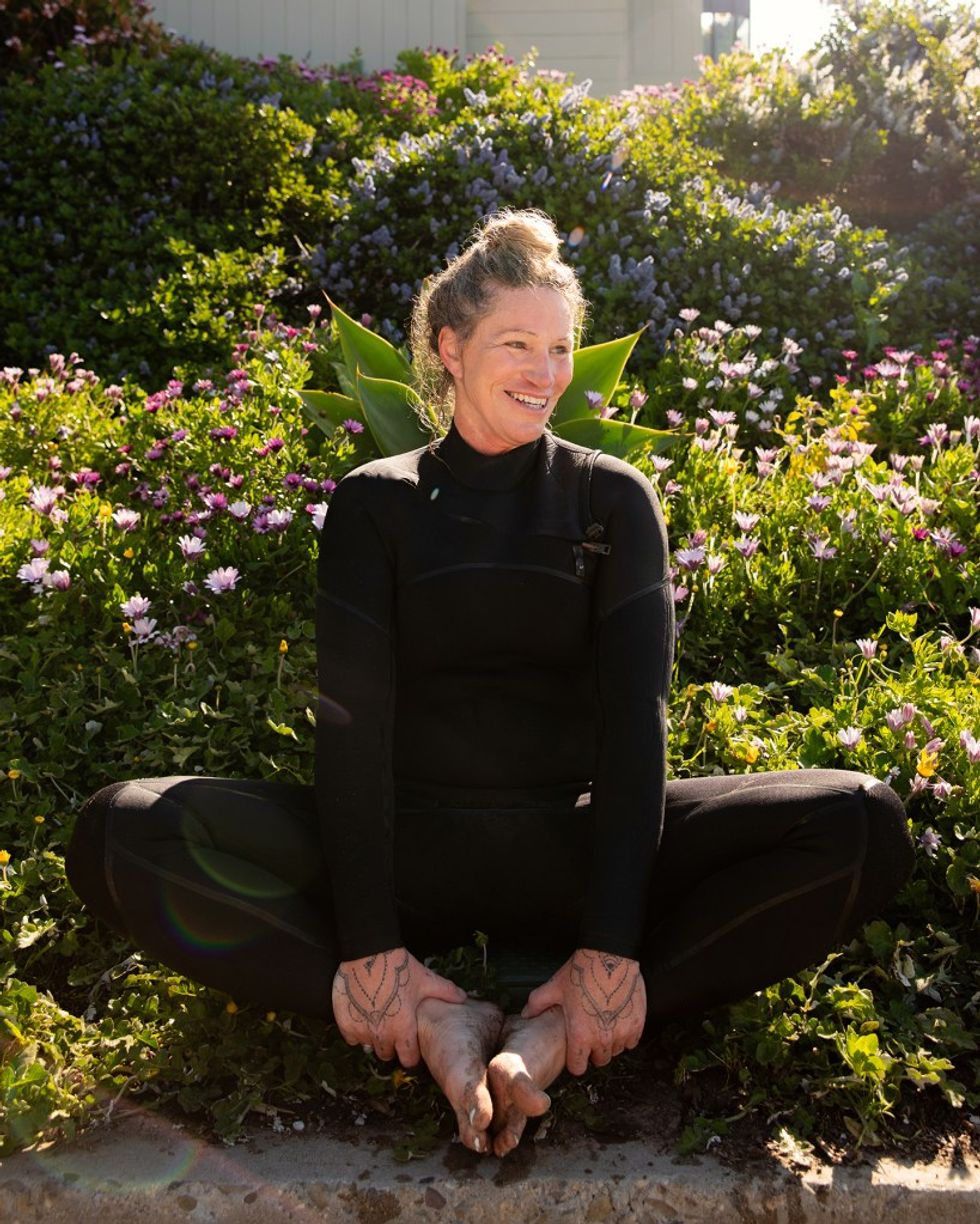
Originally from Southwest Australia, she passes for a local with her bleached hair, ski hat, and cropped T-shirt. Lowerson, 45, has been surfing her whole life, and dominated plenty of men’s events over the decades, claiming a Western Australian state title as recently as 2019. She laughs about acting like an “uber dude” back then, but recalls the difficulty of maintaining a “fake” macho persona: After a couple of weeks on the water, she’d retreat inward, afraid to leave the house for days, and battle thoughts of self-harm. “I’d try and take my life,” she says. Despite her impressive career so far, it seems only now, as a woman, in an adopted country, that she has the life she was looking for.
“I’ve found the Californian community so much better” than the surfing scene back home, Lowerson explains. “Even the middle-aged cis white guy [here] accepts me in the water. Whereas, generally, in Western Australia, it’s the polar opposite. Hopefully it changes.”
Lowerson came to the States in 2023 not just as an accomplished surfer, but also as a craftswoman who started learning the art of board design as a teen. In collaboration with Mando, a nonbinary board shaper from California and owner of Mando Surf Co. in Carmel, she spent five years developing the Sasha Jane signature model longboard, a “nose rider” with a mermaid logo — Lowerson’s is pastel-pink. To become the brand’s official ambassador, Lowerson is applying for a work visa, and she might eventually try for U.S. citizenship.
Mando is an ideal fit for Lowerson thanks to a shared philosophy about expanding surf culture to all kinds of people. We walk to her van so she can show off a Mando model she particularly admires — she’s shaped a few herself — called the “Shrimp Taco.” It’s adorably small, though Lowerson explains that it could support a 250-pound rider and fits in the average car trunk. “The ocean’s for everyone to share and enjoy,” she says, and Mando’s mission is to “make surfing accessible to anyone.”
Of course, not every brand takes that approach. Last January, the Australian surfing-gear company Rip Curl debuted an online ad featuring Lowerson on the water. In a voice-over, she describes surfing as a dance on a moving surface. There is no mention of gender or competition. Soon after the video came out, American pro surfer Bethany Hamilton, who is sponsored by Rip Curl and had already vocally opposed the inclusion of trans women athletes in women’s categories, tweeted, “Male-bodied athletes should not be competing in female sports.” Though she did not name Lowerson, Rip Curl yanked the clip two days later, claiming it was for Lowerson’s safety. “Which was just the biggest load of bullshit ever,” Lowerson says. (Hamilton and Rip Curl did not respond to requests for comment.)
Lowerson’s impulse, when Rip Curl had originally reached out, was to turn them down because of their association with Hamilton. Then she thought the ad could be a win for trans representation and agreed to it. In her view, the company was just “naive” about the trollish responses they’d get, despite her warnings of a rage maelstrom like the one conservatives whipped up over trans influencer Dylan Mulvaney’s endorsement of Bud Light last year.
The same hostility had erupted in 2022, when Lowerson won two women’s divisions at the Western Australian state titles. She’d already made history as the first out trans woman to surf at the pro level two months prior; she just happened to place ninth in that event. It was taking a title that prompted indignant headlines in conservative media. “For trans athletes, it’s OK for us to compete if we don’t do well,” Lowerson laments.
Lowerson drives us back to where she’s staying in Ventura, the home of friend Rachel Lord, another board shaper who operates a business called Lord Bords out of a shed studio in her backyard. We’re greeted by Lord and her sweet, scruffy dog. “Tiny Guy!” Lowerson cries. (It’s not merely a term of affection but the pup’s proper name.) Lord and Lowerson explain that their plans to surf that morning had been derailed after they found another dog loose on the street and combed the neighborhood for hours trying to find the owner, only to discover it lived right across the street.
“The waves are good, hon,” Lowerson tells Lord, who pulls up a streaming camera feed that shows the current surf conditions. The two gossip a bit about the other locals they might encounter on the water today, though there’s nobody Lowerson really worries she’ll run into. “I don’t talk any sort of disrespect or flack here,” she reiterates. “You know, being out in the local bars after surfing, at night, eating and drinking, people are super happy to meet me and chat.” And just existing as herself in the public eye is a victory. “You know, being visible is important,” Lowerson says. “Because you can’t be what you can’t see. That’s important for me, to sort of help the next generation.”
Attaining that positive visibility can be a challenge in itself. The organizers of a May event in Huntington Beach, California — it was meant to be her first following her surgeries — barred Lowerson from participating even though they initially accepted her entry fee. She says their reasoning was based on a misinterpretation of an International Surfing Association rule that she knows inside and out. The California Coastal Commission ruled that the decision violated a state anti-discrimination law and that Lowerson must be allowed to compete, though she ultimately opted to skip the event.
While these setbacks are frustrating, they haven’t diminished her passion. Lowerson received an outpouring of support from other pros, including members of the world-champion Hawaiian longboarding team, who encouraged her to keep competing. Meanwhile, orders are coming in for her new board, and she’s working on a memoir about growing up during the Nineties surf boom. When she and Lord and I arrive back at the beach so they can finally suit up and get their rides in for the day, they end up talking to a few friends just packing up to leave, discussing how unusually cold the water is and swapping stories of gnarly injuries. “This is the lot scene,” Lowerson says cheerfully as she applies sunblock to her face. It’s the warm, welcoming, distinctively Californian community she described earlier, and there’s no doubt she belongs in it.
“I don’t see myself as a trailblazer,” the modest Lowerson says, though she expresses a hope that “there’s one girl out there that opens your magazine and says, ‘She’s doing it. I can do it.’”