
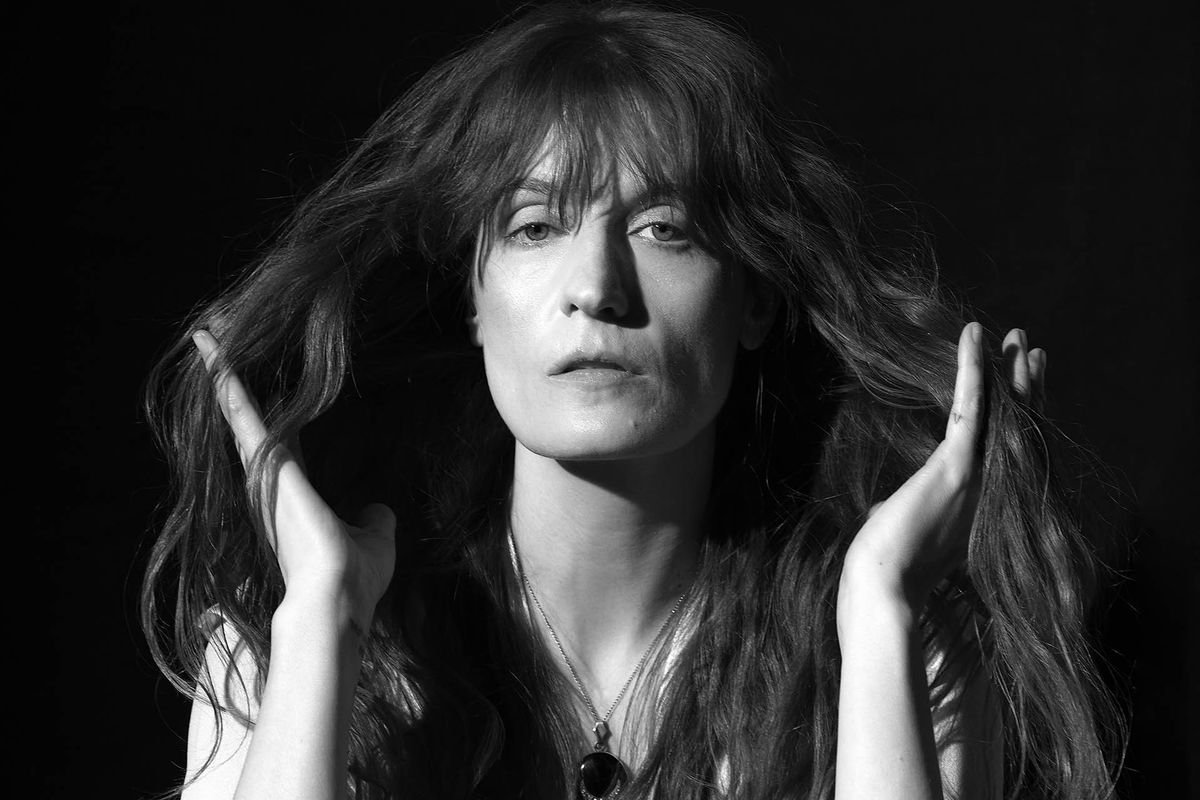

If you talk to Florence Welch on any given day, it’s safe to assume she’s feeling a little anxious. “Anxiety is the constant hum of my life,” she says. “Then I step out onstage, and it goes away.”
Luckily, that’s where she is right now: draped in a long white dress, sitting comfortably in front of a 150-person audience at New York’s beautiful Cherry Lane Theatre, a storied downtown venue known as the birthplace of off-Broadway theater. It’s a week before the release of Everybody Scream, the excellent sixth album she made with her band, Florence + the Machine, and Welch is here for the first-ever live edition of the Rolling Stone Interview, the magazine’s long-running deep-dive conversation series. (The interview is also the first-ever video podcast version of the franchise — check it out on Rolling Stone’s YouTube channel and wherever you get your podcasts.)
During both the interview and a stripped-down, spellbinding performance, the energy in the room is as electric as the new album — even when the subject matter is not necessarily light. Made with collaborators like the National’s Aaron Dessner, Idles’ Mark Bowen, Mitski, and James Ford, Everybody Scream is a visceral and mystical reflection on life and loss, not to mention a showcase for Welch’s remarkable voice, which has proved to be one of the most powerful instruments in popular music since her band debuted in 2009. The songs were spurred by her experiences touring in support of 2022’s Dance Fever, where she suffered an ectopic pregnancy and ruptured fallopian tube that required life-saving emergency surgery.
Throughout the conversation, Welch balances a deep candor with a dry wit while analyzing the ways she’s evolved over the years, and what it’s meant for her music. “The calmer my life got, the wilder I could be in my performance styles and in my videos and in my artwork,” she surmises, midway through our talk. “I found that freedom from shame means that you can explore so many more different things in your work, and I really found that to be amazing.”
 Thea Traff
The story of this album starts with your last tour, for 2022’s Dance Fever. Can you tell me about going into that tour and how you left as a different person after it?
I guess in a way Dance Fever was a record of prophecy and this record is a record of catastrophe. [Dance Fever] dealt with performance as well, and the fact that all the performance had been taken away. There was a period when musicians really didn’t know if live music would come back, and it was a record questioning whether I wanted to keep doing it or whether I would want to start a family. And then on that tour, I had a life-and-death experience that then led me into making this record.
Everybody Scream came out of wanting to go deeper into magic and mysticism. Like, “OK, shit is coming true. I really need to figure out what’s fucking going on here.” It opened up a portal to another place. It was a place of real exploration, and it opened up all these different tendrils of myself going through something like that.
Have you ever had an album or song prophesize what came after?
It was never this literal. I wrote a song [for Dance Fever] called “King,” which was wrestling with whether I wanted to be a mother. There was a line in it that was like, “I never knew my killer would
be coming from within.” The thing that nearly killed me was a complication with a pregnancy loss onstage. It was never that
on the nose.
What brought you to study more magic and mysticism?
When something happens in the body, you feel so powerless. I think I was looking for forms of power and felt very primal. It was very sudden, very violent, [and] absolutely saved my life. When you have to have emergency surgery, the lights are so bright; it’s so clinical. There was a sense afterwards that I needed to be near to the earth. I needed to be near natural things.
Everywhere you look in terms of stories of birth and life and death, I found stories of witchcraft. You couldn’t look into anything about it and not find these folktales or find stories of witches or magic because it is so unknown. No one could tell me why this happened to me. They [told me] “just bad luck.” When no one can tell you why, you’re looking to find meaning. You’re looking to find a way to understand it, and also some kind of control.
You experienced pregnancy loss onstage, while performing in front of thousands of people. How did you navigate that as a performer?
I was in pain. And what do you do as a woman? I just took some ibuprofen [and] went to work. I was in a place that I understood. I was in a place of bodily power and control, and I was experiencing a loss. I didn’t know it was a dangerous loss, but I was like, “I’m going to get through this, and if I can get through this show, at least I haven’t lost another thing.” When I stepped out on that stage, all the pain just went away, and I was free. It was weirdly an incredible show because I didn’t know that I was dying in some way. I didn’t know I had internal bleeding by then. But I felt this kind of presence that’s always been with me onstage take over, and it carried me through the whole thing. It was like love or something. I was in the mud and in a hurricane, and weirdly, it was really beautiful. Does that sound fucked up to say?
Did you start working on or writing the album shortly after, or did it take some time to process?
I’d started making the album already. The first person I worked with was Mark Bowen of the band Idles. When we both had time off from tours, we would get together and start sketching things out. “One of the Greats” had already started to emerge, and then I think we wrote “Everybody Scream.” But, yes, I went straight from the tour to the studio. After everything that happened, there was this need to process it.
I had some trauma therapy afterwards. She was great. Obviously, it was a specialist for people who have gone through things that I went through. And she [said] there can be a need to really fix it immediately and to fix it by trying to have a kid again really quickly. She was like, “The only bit of advice I really can give you is don’t try again until you feel like yourself again.” The only [place] I really feel like myself is making songs, so that’s how I process things that happened.
I don't remember the first six months of making this record, really. Songs like “Witch Dance” and “You Can Have It All,” the first really raw ones that were written pretty immediately afterwards, I don't really remember. What was amazing about doing them with Bowen was he has so much discordance and this punk element to it with the brutality of some of his sounds. I needed that. It was brutal. What happened to me was a discordant event in my life. So it was sort of amazing that we'd already started working together. He was the perfect person to be writing songs like that in the aftermath of it.
There’s a great sense of humor on this album. On “Music by Men,” you sing: “Breaking my bones/Getting four out of five/Listening to a song by the 1975/I thought, ‘Fuck it, I might as well give music by men a try.’ ” Which song by the 1975 were you listening to at the time?
[Singing] “We’re fucking in a car/Shooting heroin/Saying controversial things …”
 Thea Traff
“Love It If We Made It”?
Yes! I was like, “This song is really good.” A big thing with songwriting is it’s often because it rhymes. So you needed a band that rhymed with “five.”
When I broke my foot onstage, I got four out of five stars for that show. I was like, “What more do
I have to do?” I literally bled all over the stage. People were mopping it up and I finished the fucking show, and I think across the board it was like, “Four out of five.” Fuck’s sake. What now?
On “One of the Greats,” you sing, “I’ll be up there with the man and the 10 other women and the 100 greatest records of all time/It must be nice to be a man and make boring music just because you can.”
A lot of the lines in there, I just found them really funny. It was this feeling of “When is it going to be good enough?” I give so much and sometimes I wonder if in that giving and in not having that almost masculine cool of holding stuff back, being obtuse, not saying it all like, “What is he saying? That’s
so cool. What do those lyrics mean?” … I was like, “If I keep giving this much, does that mean people aren’t taking me seriously?”
But then sometimes when I listen to things that have that level of masculine reserve, I'm just like, "Isn't this kind of boring though? What are they saying?” Maybe it would be an easier life to be able to hold things back, to be able to just be hot in a T-shirt and everyone be like, "Wow, it's revolutionary." I'm jealous. If you're insulting someone, it comes from envy, honestly.
Was it that same concert review or a different moment that spurred you to consider the limitations of how women are perceived in the industry?
You get all the lists, and there’s a sense that they have the amount of women they can fill and they’re like, “OK, we’ve ticked that box.”
If I’m being honest, I didn’t even really align with my gender, and I still don’t know what it fucking means to be a woman. I don’t know what that feels like. I don’t ascribe anything to it particularly.... So it meant that I didn’t really feel any barriers to me really because of it. You don’t realize until you get older, that people aren’t taking you seriously because you’re a young woman. I just thought it was because I was annoying. It’s only when you look back and see the same treatment happening over and over again to young women. You’re like, “Wait, I think maybe that wasn’t about me.”
And that does come with wisdom, but that also comes with fury. I think this record really wrestles with the extra sacrifices to commit to this life and to commit to the stage. I was speaking to Mitski about that, and she was like, “Yes, but the intimacy that that also brings you with performance, the intimacy that that brings you with work, is so extraordinary.” I feel that too.
Have you felt underappreciated or underrated as an artist?
It’s not a sense of being underrated. It’s just sometimes you’re looking at the wrong people to validate you. There’s all these people over here who love it and get it, and there’s just one dude who’s like, “Yeah, I’m not into it.” That is something that you grow out of, which is really nice. Also the way that I am appreciated is the only way I would have it. I never wanted to be any more famous than this. This is actually about as much as I can handle.
Eventually, through all the work, I got the career I always wanted. There was this moment where I think there would’ve been huge intentions for me to go very mainstream. On Lungs, there was
a moment where I could have chosen a different path. I don’t have the kind of brain that can handle that amount of attention. I kept making choices that took me away from the spotlight and always back to the work, or that took my personality out of it and always back to the music.
And when you step outside of all the trappings of being a rock star on stage and putting out an album, what does your life look like?
It's really boring. That's the thing, isn't it? Be calm in your life so you can be wild in your work. I think that was really true for me. The calmer my life got, the wilder I could be in my performance styles and in my videos and in my artwork. A lot of self-loathing and shame and everything, I was drinking or taking drugs to figure out. Once I got sober and my life became a lot quieter, I actually found that freedom from shame means that you can explore so many more different things in your work. I really found that to be amazing.
There’s a lot of pacing and reading and watching television. You're on tour and you're like, "I just need to get home." And then I get home, I'm like, "There is a beast inside me that needs to come out. I'm not meant for this life. I am too big for this house." The other bits of fame, I'm not really that interested in. I just find them stressful.
Like what?
There's a line in “Sympathy Magic” about “the vague humiliations of fame.” That's what I basically have found fame being like, just a series of small humiliations. The celebrity side of it has never really appealed. Because I'm shy or anxious and I need a lot of time to daydream, I need a lot of time out of the spotlight. I don't actually like a lot of attention. I don't like a lot of attention in general when it's not about my work. I think I like to lead a very private and quiet life off stage basically.
One of the first people that you called for this album was James Ford, who also worked on your breakthrough hit “Dog Days Are Over.” What do you recall of making a song that would end up changing your life?
I still have the CD with the original “Dog Days” demo on it. We were rehearsing at this studio called Premises Rehearsal Studios, which is still there in East London. [James] had his studio above Premises, and I went and knocked on his door. He says I came in and started banging on the table and singing it at him. The label that I'd been working with did not understand this demo whatsoever. They were just like, "No. Where's another 'Kiss With A Fist?' That was fun, cute, catchy guitars.” And James just understood it.
The first thing he did was he sped it up. It was a couple of BPMs slower. When I needed a lead single for this album, the demo that I had [for “Everybody Scream”] was really wild and quite a confusing song and he just completely understood it. But the first thing he did was sped it up. I was like, "Okay, I trust you. That went well the last time."
 Thea Traff
Have you had any mentors throughout your career?
Nick Cave has been so kind to me. Nick and Susie Cave have just been the most wonderful and kind friends. I sent Nick some of my poetry, and he helped me edit some. [I’d] write him stressed emails from tour, and he would reply and be so kind. As someone who's such a physical performer as well, he understood what I was putting myself through. He’s an incredibly wonderful human being.
You’ve been pretty selective with doing collaborations throughout your career, in terms of being a featured artist, but a big one you did do was “Florida!!!” with Taylor Swift. How did that come together?
She texted me being like, “I’d love to have you in this song.” The way she writes songs is like short stories. She had a whole story around this song, and why she wanted to write it, and the Florida lore. I wanted to bring what I knew of Florida, which is Lauren Groff. One of my favorite short-story collections is called Florida, and [Groff’s] from there. There’s a story in it called “Eyewall,” about a woman who barricades herself in a bathroom during a hurricane and is visited by all of the ghosts of her ex-boyfriends. And she’s drunk, and she’s holding a chicken. It’s an amazing, amazing short story.
Taylor was the most open collaborator. She was like, “Yes. Whatever you want. Do your backing vocals all over it. I want it to be as Florence-y as possible. Go for it.” I was like, “Well, I want to bang a drum, too.” And Taylor was like, “Yes, go for it.” Getting to watch her construct those harmonies that she does was an amazing experience.
On “One of the Greats,” you sing that you felt that you were “burned down at 36.” Do you still feel that way?
I actually think that when I turn 40, I’m going to feel amazing. I really do. It’s like when you are edging the decade, you start to feel worse and worse. So I think that when I turn 40, I’m going to feel incredibly young again. [There] was such a desperate urgency to this record and to get it out. If I hadn’t put this album out now, I don’t think that I would have ever put it out. It is so tied to this moment of the age I am, and the experiences that I’m having.
Had I had more time away from what happened, I would’ve felt differently about it. So I think I feel glad that I got to pull it together, just because it is such a silent and shadowy thing that so many suffer [from]. I was really sad at the idea of this album also not making it somehow. I’m glad that we managed to pull it all together.




Everybody Likes Drake Again. That Means We’re Healing