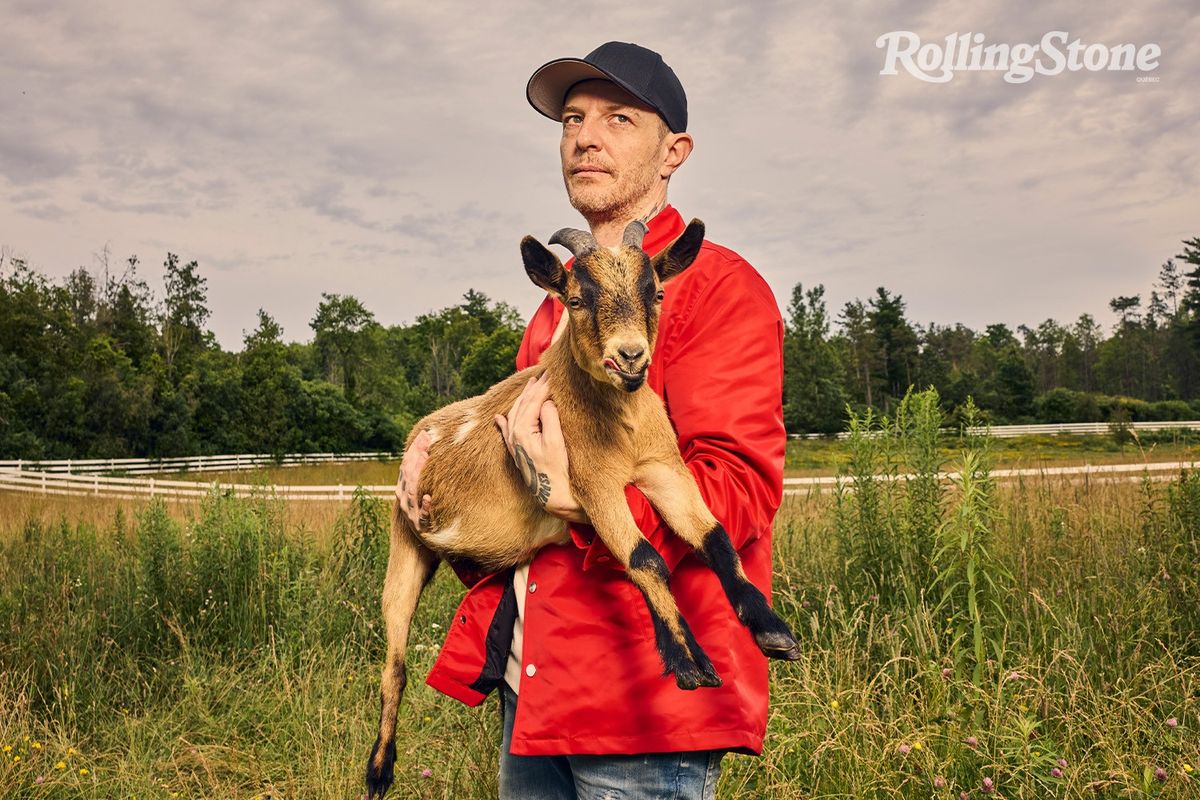

Notoriously guarded with journalists and vocal about his disinterest in interviews, Deadmau5 surprised us by agreeing to be on the very first cover of Rolling Stone Québec. Even more unexpected was his suggestion that the photoshoot take place at the farm on his estate.
Known as much for his hits as for the mouse helmet that has made him instantly recognizable, the Canadian producer and artist is undoubtedly an icon of modern electronic dance music (EDM) – of contemporary music in general, some would argue. Over his 25-year career, Deadmau5 has solidified the concept of the modern EDM artist. Enigmatic and polarizing, he continues to prove that his place in the industry is deserved, even necessary.
In this exclusive interview, he opens up about his journey – from his youth as a raver in Toronto to playing the biggest festivals – his impact on modern music, and his renewed relationship with nature and his animals.
A peaceful farm in a small Ontario town is not where most people would expect to find Deadmau5, as he himself admits. Being one of the most popular (and highest-paid) electronic artists on the planet, one might imagine his life as more of a jet-setter’s, flitting between mega-festivals around the world and lavish bottle service parties in Las Vegas’s most exclusive clubs.
Although that is all still very much a part of his life, these days if he’s not on the road, you’re likely to find him ripping his ATV through his property. After several years spent in a downtown Toronto penthouse – famous for the studio it housed and the parties that were held there – the producer decided to leave the city and settle on a vast estate. This space allowed him to design a new, state-of-the-art studio, hold his extensive and enviable collection of sports cars, and, incidentally, have a farm.
“A few years ago, I bought a property in the suburbs of Toronto, not quite in the countryside but almost,” explains Deadmau5, born Joel Zimmerman. “My assistant still lived in Toronto at the time, and it was kind of hell for her to commute from the city to here every day. She kept complaining about it, and I thought we needed to find a solution.”
As with most things in his life, it seems, it was chance that led him to this new hobby.
“One day, a neighbour came to us saying she had to move,” he says. “She didn’t want to go through the whole process of putting her house on the market and all that, so she asked if we were interested in buying her house, which came with a farm. She asked if we knew how to take care of a horse. I said no, but we watched some videos on YouTube and I eventually decided to buy it. So now my assistant lives there and takes care of most of the animals. It’s literally right next door; she can’t complain about the commute anymore!”
Well-known for his love of cats, which are forever part of the universe of Deadmau5, his little zoo today includes a bit of everything: horses, chickens, goats, a snake…
I ask him if, beyond the cats, there are any animals he’s built a special relationship with. “I think the more time you spend with animals, the more you discover their personalities,” he says. “When you drive by and see a cow, you just think, ‘Oh, it’s a cow.’ But if you spend time with them, you discover their character – which one is cool, which one’s an asshole, or which one is funny.”
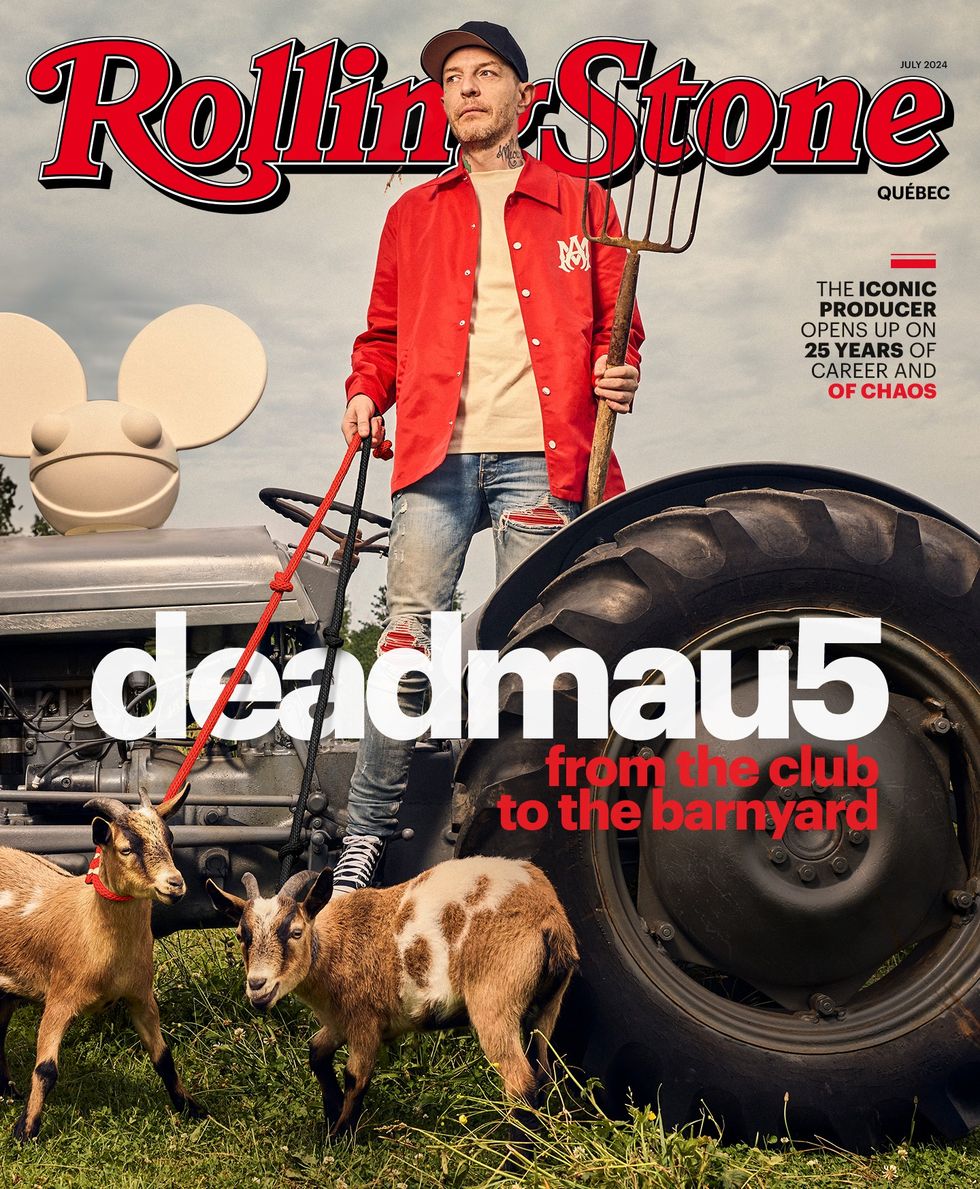 Photographer: Matt Barnes / Executive producers: Elizabeth Crisante & Amanda Dorenberg
Don’t expect him to switch careers to become a farmer anytime soon, though. He admits that it’s mostly his assistant, whose family has farming roots, who takes care of it.
“I’m rarely home as it is, so if it’s about doing cool stuff like jumping on a tractor to mow the lawn, I’m there. But if it’s about shoveling horse shit, not so much!” Fortunately, he adds, there’s no shortage of kids in the neighbourhood willing to take care of those things for a few bucks.
Although he’s one of the most famous residents of his new town, Deadmau5 says he feels zen there. His peace of mind and privacy are very important to him, which was becoming less manageable in Toronto, though he admits that almost no one recognized him there without his mouse helmet. “Moving to the countryside, I realized I could be more secluded. The silence also made me realize I had tinnitus! And I’m still only 45 minutes from the city. If I want to go out in the city, go to a good restaurant, or see friends, I can do it and it’s not too bad.”
If there's one thing that stands out when talking with Zimmerman, it's that he’s a true Canadian, through and through. His country and his city are very dear to him, and when he's not wearing his mask, there's a good chance he's holding a cup of Tim Hortons coffee.
While Toronto's nightlife scene had spent the ‘90s in the shadow of Montreal and its legendary parties, young Deadmau5 didn’t experience it that way at all. He admits that, unlike many young Ontarians, he never came to party in Québec in his youth. Hailing from Niagara, he and his friends started going out in Toronto on weekends while he was finishing high school. “We’d go to Cl9ud, Citrus, Hullabaloo… all places I’m not even sure still exist. It was the era of real raves, in warehouses and everything. It wasn’t half as organized as it is today. There was no real production. There was a DJ, a sound system, and that was about it.”
Those minimally produced parties are drastically different from today. Over his 25-year career, Deadmau5 has seen EDM, a style he and a group of friends were trying to perfect with new technologies, take the world by storm. (“It’s like watching someone get murdered three feet away from you,” he says graphically, noting how quickly the industry evolved.)
He reminds me that back then, there wasn’t this cult of the DJ. “The turntables were often a bit hidden, the DJ too. It was mostly friends of the organizers who agreed to come and mix for a hundred bucks, or free drinks. People went for the music and the vibe, not for the show. No one was filming the DJ. We didn’t even have phones to find each other if someone got lost! It was a bit more holistic and organic.”
If there’s one thing that characterizes Joel Zimmerman, it’s his pragmatism. He’s not one to dwell too much on the past or what could have been different. If he got to where he is, it’s partly by chance, but mostly through hard work and unapologetic nerdiness. Even his name, according to the lore, comes from finding a dead mouse, fried in his computer.
It was in 1998 that he got more serious about music. At the time, he recalls, dance music was fighting for its place in the club. “The DJ would play a Biggie Smalls song, do a transition and then drop a Porn Kings track. Rap was the dominant style, dance music was still alternative.”
At that point, he was working as a busboy in Niagara nightclubs, watching the DJs and befriending the promoters, who eventually gave him a chance. After striking a friendship with the guy who sold him his computer parts, Joel was offered the opportunity to become a producer for his radio show, The Party Revolution, on local Niagara airwaves. For the next few years, he alternated between DJ sets and music production for commercial jingles and video games.
 Deadmau5 performing live in Hollywood.Photographer: Leah Sems
Around that time, he also began to take an interest in what was known as the demo scene, a cultural and artistic movement focused on creating computer demos. Essentially, these were short audiovisual programs designed to showcase the programming and design skills of their creators. These demos combined music, graphics, and complex visual effects, pushing the limits of the computers' capabilities at the time. The demo scene played a fundamental role in the emergence of digital culture, influencing fields such as video games, electronic music, and graphic design.
This early immersion in an environment where creativity and technological innovation were paramount undoubtedly shaped his approach to music and stage performance. His understanding of software, programming, and visual creation enabled him to design shows that go beyond music, incorporating impressive visual elements and providing immersive experiences.
It wasn’t necessarily his intention, but this attention to detail in stage design has become one of Deadmau5's trademarks. Beyond his iconic mouse helmet, he is well-known for his large-scale productions, such as the electronic cubes that sometimes serve as his stage, as well as LED walls, pyrotechnics, and special effects. In dance music, what one might have formerly associated with a rock band in an arena is now fitted to intense, bass-driven party music for an ever-growing and diverse audience.
Zimmerman's impact on EDM festivals, a concept that didn’t even exist when he started, is undeniable. From his early hits, his ability to attract massive crowds drew the attention of major brands, who began to see the commercial potential of the genre. These brands quickly seized the opportunity to sponsor events like ÎleSoniq or Escapade, thereby increasing their scope and prestige.
Over the past fifteen years, the EDM scene has experienced exponential growth, largely thanks to artists like Deadmau5 and his merry band of acolytes and collaborators, including Skrillex, Kaskade, and his young protégé Rezz. His influence has helped popularize the genre on a global scale, attracting a new generation of fans and inspiring many other artists to push the boundaries of stage performance, for better or worse, as he concedes.
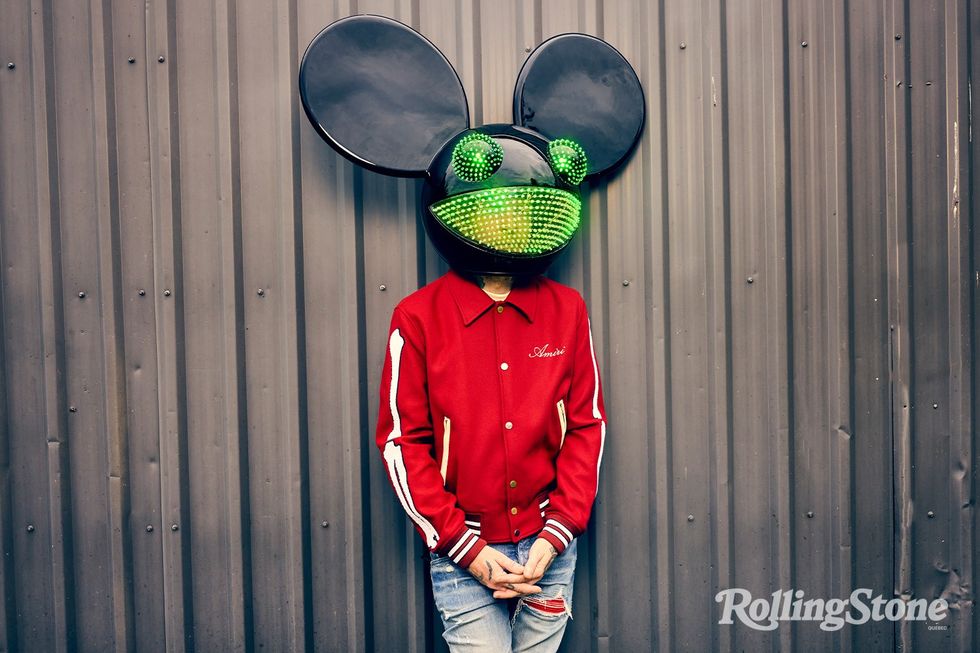 Photographer: Matt Barnes
“Remember, back then, no one cared about the DJ. It wasn’t like watching a movie where everyone’s eyes are on the star. But one day, some clever people decided to turn it into a circus, charging hundreds of dollars or having big spenders in Vegas pay over $700 a head. When you’re generating millions of dollars a night, what are you going to spend it on? Snacks? No, on pyrotechnics, LED walls, a more advanced production!”
We talk at length about the evolution of the genre, how it went from illegal raves in abandoned warehouses to festivals that have become major cultural events, attracting millions of participants each year and generating billions of dollars in revenue in Canada alone. I ask him if he ever thought EDM would become such a profitable genre and that he would be its figurehead.
"Back then, we weren’t thinking about making money. We just charged a cover to have a place where we could play the music we liked for people who were into it. Today, it’s an ecosystem, it’s no longer just an event.” He adds that he is aware of his place in the industry, and the role he has played in developing the careers of many artists, but he refuses to say he was the catalyst for a movement.
“I’m just another cog in the machine,” he says bluntly. “I love making music, I love technology and whatever. Everyone knows that. That’s my passion. Beyond that, I can’t say I particularly enjoy the business of trying to build a machine around my passion for music creation. But I understand my role, I like running my business, I love stage production. But if I’m running a business, it’s not for the pleasure of creating jobs.”
“I never imagined that what I do would become this big, but since it has, might as well enjoy it!”
Once again, he ties it back to his love of technology and production: “If you want to buy an entry-level synth, no problem, play a few shows, save your money, and go get one from a pawn shop. But if you want the modular rack that’s the size of a refrigerator, of which only two were made in Germany years ago, well yeah, you’re going to have to build an empire,” says Zimmerman, laughing.
And that’s exactly what he did. Last month, during Canadian Music Week in Toronto, he was honoured for his 25-year career and inducted into the Canadian Music Industry Hall of Fame. He also recently presented "retro5pective: 25 years of deadmau5," an immersive experience tracing his career, to sold-out audiences in New York and Los Angeles.
Having not released new music under the Deadmau5 moniker since "XYZ" in 2022, he is set to release a new EP, some EP, on July 19. The first single, "Quezacotl," sees the 43-year-old artist returning to the essentials that built his reputation. The instrumental composition transports the audience with majestic symphonic chords and his unique synths arriving in waves. It’s everything that makes up a classic Deadmau5 track.
I ask him how he would describe his musical signature, what he believes makes his compositions stand out among so many others. People on Reddit love to offer answers to this question, without ever actually asking him, he notes. According to him, it's an effective combination of a wide dynamic range and a solid structure of melodies.
“I’m not saying this from a qualitative point of view,” he adds, before launching into one of his (very interesting) diatribes that have forged his reputation. “Young people today, specifically in electronic music, have trouble distinguishing an objective opinion from a subjective one. I don’t know when or how that disappeared. But, thank God, I can listen to a track and tell you it’s objectively bad, and explain why. But a lot of kids stop at ‘this sucks,’ without being able to tell you why.”
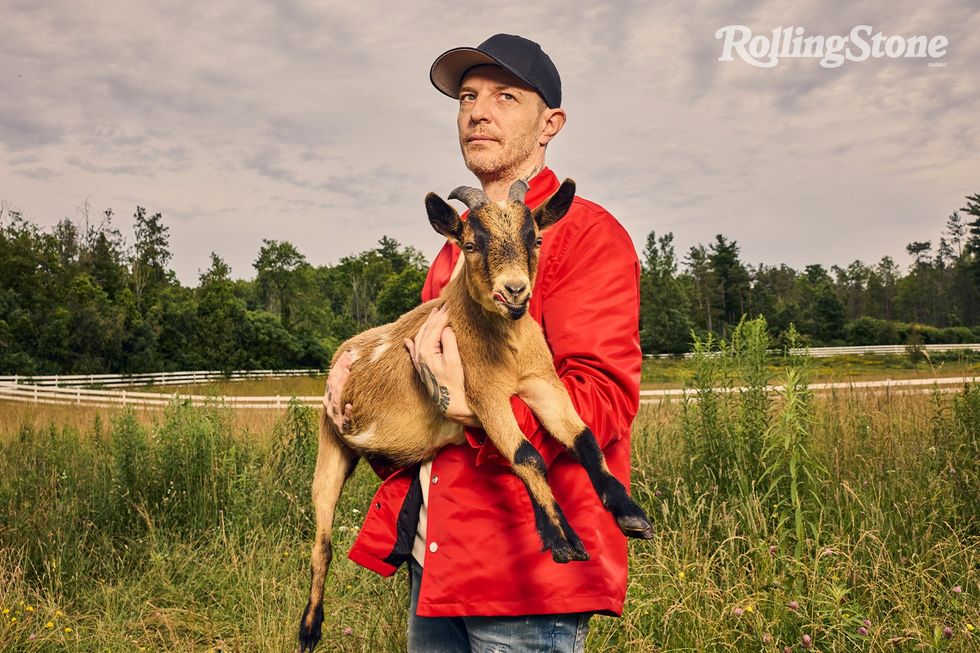 Photographer: Matt Barnes
He continues, “I’ve been doing this for 25 years. That’s a lot of years. And I’ll blow my own horn on this: I might not be Mutt Lange or Bob Rock, but considering the time and achievements it takes to become a master in your field, I’d say I’ve done quite a lot. I can confidently say that most of my mixes are objectively good. I know my standards, I know musical metrics, I understand sound weighting. So, I can create a song and know how to build it well, in an objective way, so that it’s enjoyable to listen to. Sometimes more than others.”
It might be this overflowing confidence that has made him such a polarizing artist. I won’t delve into his controversies, which are well-documented. But one thing you have to concede is that his outbursts come from the heart, from an endless love for the scene that allowed him to become who he is, and an unwavering dedication to musical creation. It’s no surprise, then, that he laments the current state of the music industry. Not only have we lost objectivity, but we’ve also lost quality, he believes.
“The deterioration of music is, in my view, a three-part problem. First, it’s become easy to make, compared to before. That’s not necessarily a bad thing, but it means there’s congestion, because more people are doing it. Second, it no longer has the market value it once had. Third, and in a very insidious way, musical education has declined. Today, many young people have achieved what they have by watching YouTube videos of production tips that come from other kids who also learned on YouTube.”
“There are still a lot of valid and interesting things to be learned online,” he reassures, “but they’re becoming harder to find with the proliferation of these videos.”
To address this, Zimmerman returned to his former high school in his hometown of Niagara Falls earlier this year to announce the creation of a music education program for students. “James Cameron is also from Niagara,” the artist explains. “At one point, he came back there on an honourary visit and announced he was creating a film studies program at his high school. Our two schools were rivals, so I figured I had to do one-up him a little bit.”
As he takes another sip of his Timmy’s coffee, I can’t help but ask him about the time he’s spent in Québec. He’s a regular at ÎleSoniq, but he’s also delivered legendary performances on the Plains of Abraham and late-night sets at Bal en Blanc parties.
His most memorable experience, Zimmerman reveals, involves Tommy Lee (legendary rockstar and drummer of Mötley Crüe), a limousine, and a wheat field in Valleyfield.
It was a little while before he became a star, in 2006, before he had ever toured. At that time, his friend DJ Aero was touring with Mötley Crüe as the DJ for their afterparties, where he mixed while Tommy Lee played electronic drums.
“I met them one night in Hamilton after a concert, and we hit it off so well that Tommy suggested I join them on tour, very unofficially. One night, we got booked for a small festival in Montréal, but it turned out to be just outside the city, in the fields.”
As he begins to tell me about it, I frantically search the internet for details of such a night. It turns out it wasn’t just a bit outside Montréal in Coteau-du-Lac, for a festival called No Speed Limit.
"It was among the very first shows I played," recalls Deadmau5. "Listen, Tommy is a rockstar. Not in the 'he's an asshole' kind of way, but he really lived through that era and has the instincts of a rockstar. So we ended up in a limo, because that's what he decided we needed. At one point, the driver literally started driving through a cornfield. We passed by cows grazing. I remember sitting in the back of the limo and thinking to myself, 'What is happening to me right now? Why am I in a limo with Tommy Lee in a random field in Québec?' It forever changed my perception of tour life and being an artist."
As his new EP is set to be released, Deadmau5 still has work to do on his property. In addition to the farm and studio he already has, he's building a new, smaller studio. Not out of vanity, he reassures, but because he wants to work on a new album and believes a new space will help him discover new sounds and tones. He plans to spend the entire month of August there, even though it means missing peak festival season.
It's for a good reason, though. After 25 years of causing chaos, it seems Deadmau5 has found peace and comfort.
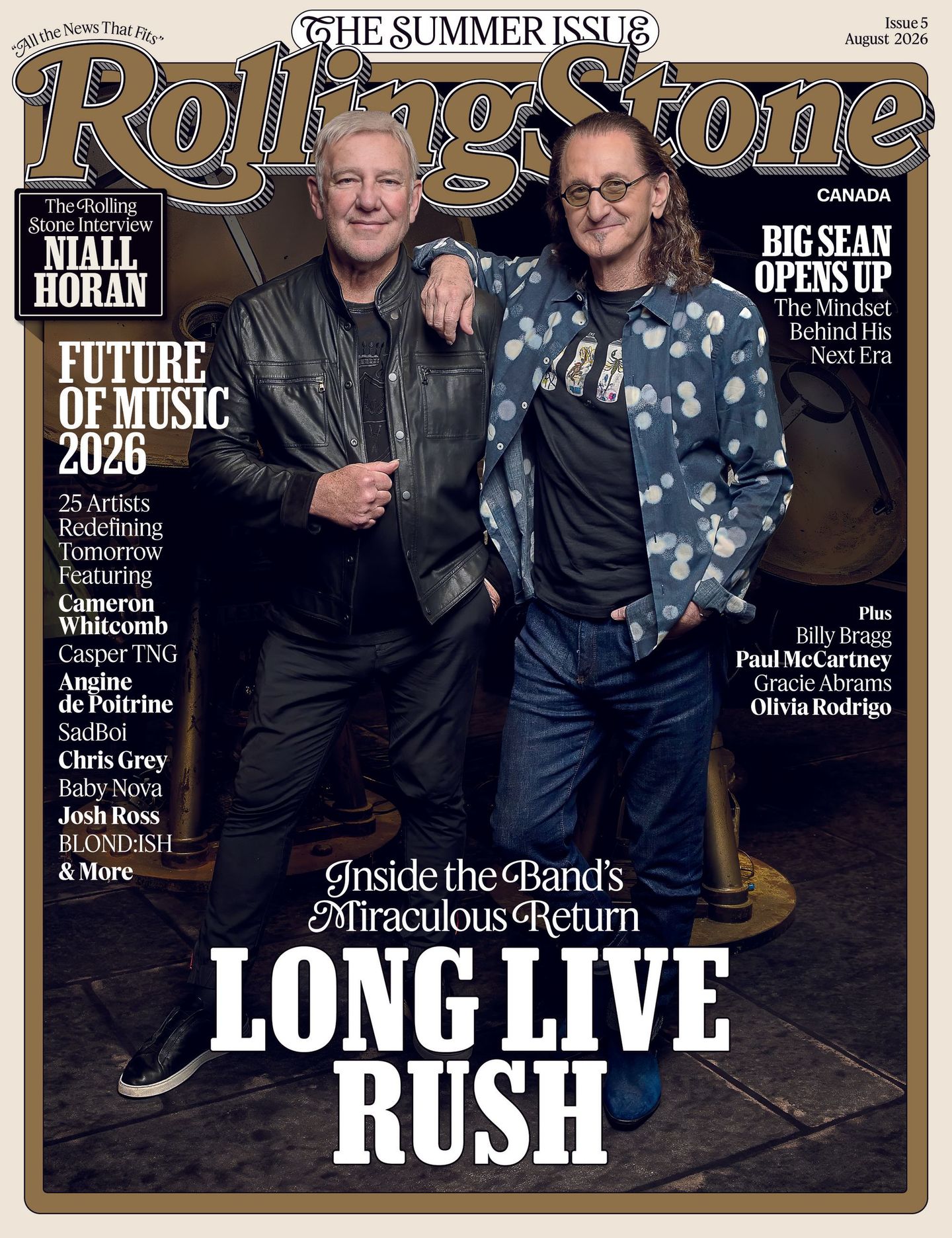
Deadmau5's inaugural cover was aunched at the Festival d'été de Québec in July 2024.