
Just days before the release of Cavale, her seventh studio album, Béatrice Martin, better known as Coeur de pirate, is on edge. Not from the excitement of putting out new work, but from doubt.
For the artist, Cavale became an outlet, a way of working through her persistent anxiety. What worries her on that day would have been celebrated as good news by most artists. The hit series The Summer I Turned Pretty featured the song Corbeau, from her 2008 debut, in its season finale, sparking a wave of new listeners. Her breakthrough hit Comme des enfants is also enjoying a revival, thanks to a TikTok trend.
“Everyone’s really down with the old stuff,” says Martin, who just turned 36. “But now we’re releasing an album that’s really different. I don’t know if it’ll just kind of get lost in the mix… I don’t know how people are going to take it. I’m a little stressed. But I’m so happy to share it.”
Despite a prolific career spanning nearly 20 years, during which she grew up in the public eye, Coeur de pirate sometimes seems unaware of her monumental impact. It is hard to imagine Québec’s musical landscape of the last 15 years without her, the bridges she built, the doors she opened, and her work as head of her own label, Bravo Musique.
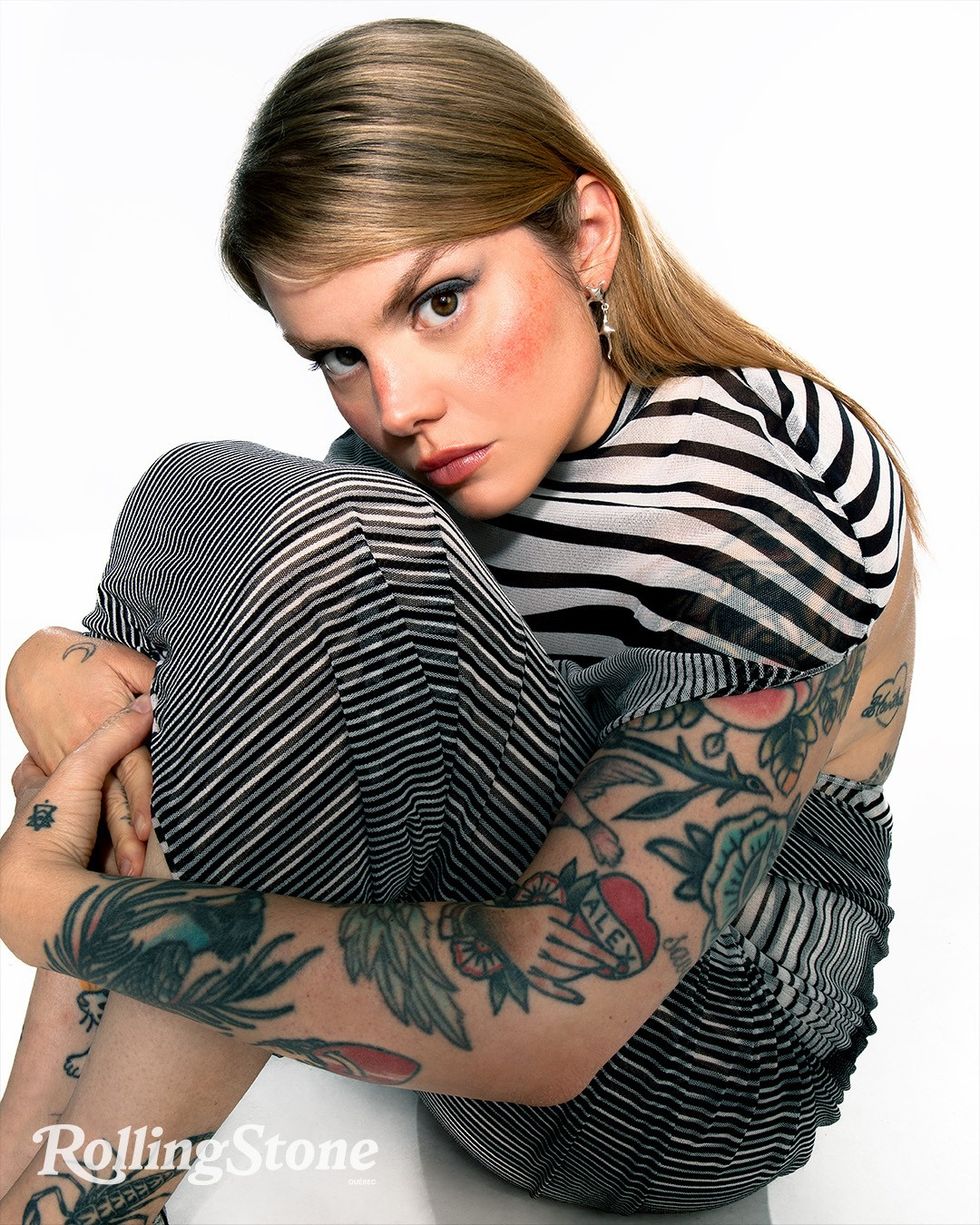
Millions of albums sold, shelves of Félix and ADISQ awards, even a Victoire de la musique, none of it keeps her from second-guessing herself. “I doubt my creative work way more than I used to. My insecurities have shifted.”
When she first appeared in the late noughts, Coeur de pirate was somewhat of an anomaly: a frail, blonde, tattooed teenager more comfortable on MySpace than in front of TV cameras. She looked like she belonged in an emo band (she was in one) rather than a conservatory (she studied in one). A sort of heir to Pierre Lapointe and the chanson he was bringing back into vogue, her mega-hit Comme des enfants catapulted her into Quebec’s star system, almost overnight.
It was a pre-Instagram era. While she was already an early adopter of microblogging, unlike today’s stars whose popularity is tracked in real time, Béatrice Martin was flying blind, with no metrics to truly measure her success. Fame was still elusive, tangible only in the eyes of others.
But in those early social media years, she quickly became a target, for gossip magazines dissecting her love life as much as trolls digging into her past.
“There were things that were really traumatizing, extremely formative. If you put anyone in that situation, not everyone comes out of it okay,” she recalls. “People were shocked by my very existence as soon as I showed up. They didn’t understand why I had tattoos, why I was making this kind of music while looking like that. The list goes on…”
That overnight celebrity was constant whiplash: there was no lukewarm reception. “I lived through really big highs, and really big lows. I got so much love, but so much hate too. I wasn’t even in my twenties—I was like 19 when it started. I was trying to navigate it all in the public eye, but I was just a kid,” says Martin, now the mother of a young teenager.
The numbers, however, do not lie. Despite the haters, she quickly became one of Quebec’s most successful musical exports in over a decade. Her self-titled debut went gold in Canada soon after its 2008 release. In France, upon its release in spring 2009, it sold over half a million copies and went Diamond.
On tour, she began writing new material to fill out her setlists. In January 2011, she entered Hotel2Tango studio to record Blonde, her sophomore album, with Howard Bilerman (Leonard Cohen, Godspeed You! Black Emperor, Arcade Fire).
It was, she says, a time of fewer creative doubts. “Back then, I was like, ‘Oh my God, my songs are so good,’ but I was scared of how others would perceive me.”
“I recently re-listened to Blonde. Not to toot my own horn, but I can’t believe I wrote that album at 20! There’s a song called Danse et danse that’s really simple lyrically, but to have that perspective at that age… I felt so old inside, even though I was still a teenager. I had a perception of things that was so… I can’t believe I wrote that back then. I couldn’t write it today.”
Catchy, nostalgic, and more pop than her debut, Blonde sold over 700,000 copies and cemented her status as a true francophone pop diva in a rapidly shifting industry. Those formative years taught her to weather storms, lessons that would prove vital down the line.
The genesis of Cavale did not begin in a studio but in an office. In the summer of 2020, with the world gripped by a pandemic and mass social movements, everything collapsed at Dare to Care, the renowned label that had signed artists like Malajube and We Are Wolves, and with which Coeur de pirate had been signed from the very beginning.
In the wake of the second wave of the #MeToo movement, musician Bernard Adamus faced allegations of sexual misconduct and domestic violence, while label head Eli Bissonnette was accused of creating a toxic workplace and of protecting Adamus. When Bissonnette stepped down, the entire structure of Dare to Care and its sister company Grosse Boîte was thrown into jeopardy.
That August, the young mother entered negotiations with Bissonnette to buy the label, a deal finalized in January 2021, just months before she underwent surgery on her vocal cords after being diagnosed with a hemorrhagic polyp.
“I learned as I went. When the acquisition happened, so many people left. The GM who had been there from the start left. Everyone left,” Béatrice Martin recalls. “I had to learn how to manage a crisis. First, you have to talk to the artists, because that’s the most important part. Some left. Some stayed.”
“It made sense for Béa to take over,” remembers musician Gab Bouchard, about that call from his new boss. “After that, we built a really nice relationship, both personally and professionally.”

Back then, Bouchard had just released his debut album and was mainly concerned with keeping his team intact. “I’m not a complicated guy. If you respect me and I respect you, that’s enough. From there, it can only grow. It’s a mutual respect, artistically and business-wise, because we end up doing both together.”
Step by step, Martin and her team started the machine back up, opening offices on Saint-Laurent Boulevard and announcing new signings. While she enjoyed her new role, she remained, above all else, an artist whose primary duty was to create, not to manage.
“I couldn’t be involved 150% anymore, because I had stopped making music. I completely stopped for two years to deal with all this,” says Coeur de pirate, who had in the meantime welcomed a second child. “At some point, for everyone’s sake, I had to go back to writing songs. It couldn’t be me handling everything. It had to be the management team. I’m on the board, I give my opinion, I do artistic direction. But I’m not the CEO.”
Her return to music was also guided by Gab Bouchard. “I hadn’t written for two years, and I think I needed someone to shake me up a bit. Gab looked at me and said: ‘What’s going on in your life right now?’ I told him I was scared, really anxious, that I felt like an empty well. And he just said, ‘Well, write about that.’ The first song that came out of it was Laisse-moi pleurer.”
Cavale, she explains, is about running away. It’s that nagging, anxious feeling that convinces you that you have done something terribly wrong. The album became an exploration of that theme, a map of her internal struggles. Sometimes it shows explicitly, as in Pensées intrusives, where she sings, “peur d’entendre, que ce que je chante ne leur va plus / J’ai peur d’apprendre, que mon temps est révolu”. (“I’m scared to hear that what I sing no longer fits them / I’m scared to learn that my time is up.”)
Elsewhere, the message is more ambiguous, like in Château de sable, written for her daughter and considered the hardest song on the album to write. “I really wanted to write a song that explains a parent’s perspective when they watch their child become a teenager, so that the teenager could hear the song and understand the parent’s view. It’s hard for me to sing because it’s too close to home.”
For Cavale’s production, Martin turned to longtime collaborator Renaud Bastien and to Nicolas Subrechicot, known for his work with French artist Zaho de Sagazan. “I felt like he had a beautiful approach. He plays everything, and I need that. I want a producer who can play every instrument and who is fully invested, very musical,” she says. “Sometimes he would suggest things and I was like, ‘Hmm, not sure.’ But in the end there was greater freedom. Before I might have been more closed. Now I’m more like, ‘Okay, add a breakdown to the song. It’s fine.’”
Although she is proud of the album and eager to share it with the public, doubts remain. The paradox in Béatrice Martin’s life is that “the older I get, the less confidence I have in my work.” She is no longer afraid of what people think of her, but she questions whether what she creates “is good.”
Obviously, it is.
When she speaks about her beginnings, it is as if she were looking at another artist, a version of herself that was more instinctive and less burdened by fear of disappointing. This may also be why she suggests that Cavale could be her last pop album in the traditional sense. “Maybe after that I’ll make my emo album,” she says, half-joking. It’s her way, she feels, of ensuring that she does not remain trapped in one box.
“I imagine that when you’re as successful as she is, it’s a little scary to put out another record. You always want it to be better than the last. After that, there is pressure, because people are waiting for you,” says Gab Bouchard. “Béa is someone who is very authentic, and she got caught up in that pressure. When you write your own songs, that kind of pressure can really crush your artistic confidence.”
Although doubt persists, she admits that she knows how to put things into perspective, and that it’s par for the course. “Honestly, I have reached a point where I tell myself, ‘whatever happens, happens.’ Otherwise I’ll get stressed out, and I don’t want to put myself through that.”
In recent years, she has dealt with various health problems that have deeply affected her. Shortly before our first interview, these issues landed her in the hospital. “I have a mysterious illness; they still do not know what it is. For a long time doctors told me it was just anxiety,” she explains. “I ended up with pericarditis and pleurisy. My inflammation levels were sky high, it was really bad. Now they take me seriously.”
Thankfully she has since started treatment and says she feels better. But she knows it is closely tied to stress, and that something as simple as lack of sleep can throw everything off. “I need to stay as zen as possible.”
What comes up the most during our conversations is how excited she is to return to the stage and to reconnect with her audience, to whom she now feels inseparable. “I really grew with my audience, and I think a lot of people grew up with me,” she says. “Knowing that people have been there for so long, that I have followed them through their life cycles and now they have children, that touches me deeply.”
Despite the fear that her “time is up,” as she sings in Pensées intrusives, she remains conscious of the unbreakable bond she has with her audience. “I know people will come, but the fear is always there anyway. Before shows, I get really stressed,” she admits. “But as soon as I get on stage, everything disappears and all is well.”

In nearly 20 years of career, she has steadily built her fan base, most likely thanks to that disarming authenticity. Versatile, she has also composed music for video games, films, and TV shows. She has served as a judge and coach on music programs in both Québec and France. She has written a children’s book, and even voiced Smurfette.
Among her fans are international stars like Halsey, who sometimes covers Comme des enfants in concert. Not to mention the legion of grateful artists on both sides of the Atlantic who owe her countless opportunities.
The artist turned mother and business leader is now fully aware of her legacy. While at the beginning she wanted to offer radio-ready pop songs, she now measures success differently. The goal is no longer simply to please, but rather to bring people together and preserve that connection.
In that sense, Cavale is not so much a risk as it is an honest offering to the audience that grew up with her. That connection has become an integral part of her art, Coeur de pirate believes. “My existence is tied to it. I cannot live without them.”
Art direction & production: Collection
Photographer: Feng Ish
Styling: Kelly-Anne Panagakos
Styling assistant: Cathy De Sa Quintas
Hair and makeup: Juliette Morgane
HMU assistant: Francis Bouchard
Special thanks to Bravo Musique, Holt Renfrew Ogilvy,Black Suede Studio, Coming Age and Marmo.