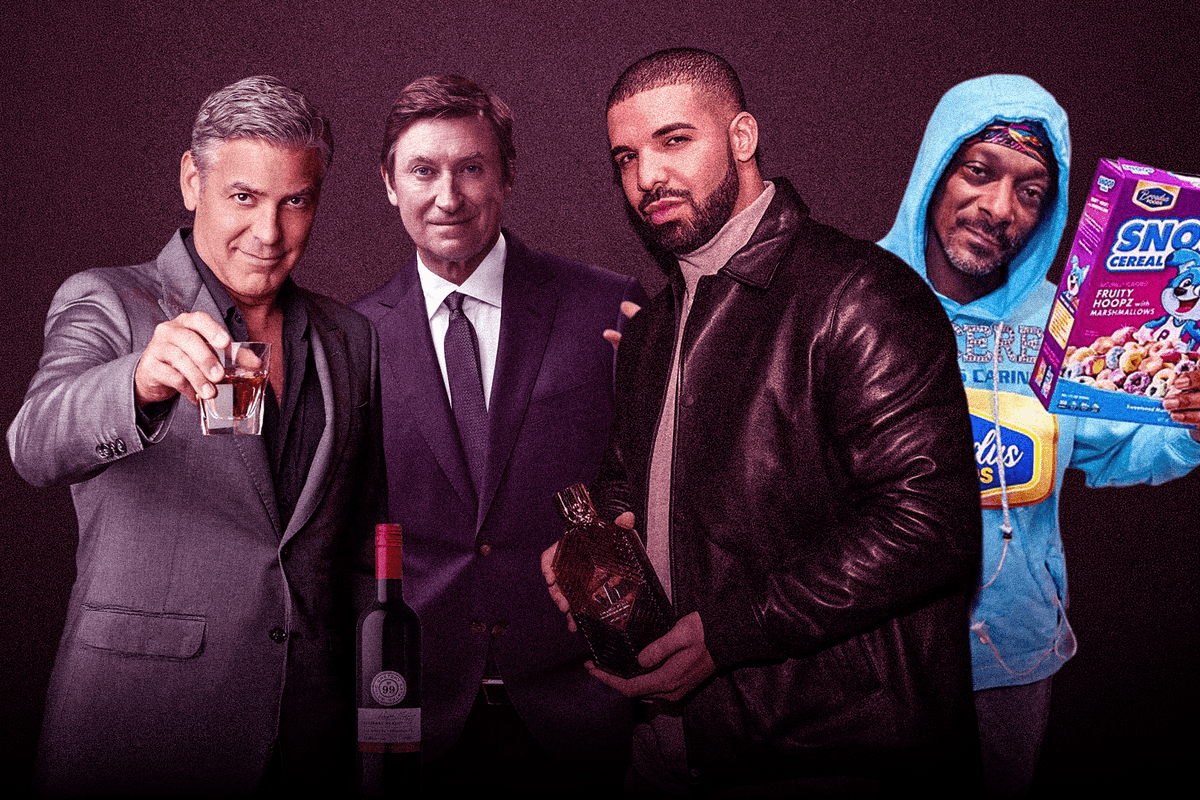

Drake has a bourbon. Wayne Gretzky has a winery and distillery. Céline Dion has perfumes. Justin Bieber co-created a line of Timbits with Tim Hortons. Ryan Reynolds invested in and sold a gin business. And don’t get me started on the number of celebrities who attempted to launch a cannabis brand.
Canada has produced a remarkable number of global cultural icons, and some have managed to follow a particular playbook – build the fame, then monetize it through brand extensions, equity stakes, licensing arrangements, and product partnerships. The press releases are always celebratory.
The legal documents supporting them are something else entirely.
As a lawyer, I spend my days reading the contracts that nobody photographs at the announcement event: the trademark licensing agreements, the investment documents, and the co-branding arrangements that determine who actually owns what when the social media rollout is over. Here are a few takeaways about doing business with public figures that I have learned.
The Brand Is the Asset
Start with the most basic point, which is also the most persistently overlooked: a celebrity’s name, likeness, and associated trademarks are valuable commercial properties – arguably more valuable, in some cases, than any underlying product they’re attached to.
When a musician lends their name to a food brand, or when an athlete invests in a supplements company, the deal is not really about the consumer product. It’s about attaching a protected intellectual property asset, the celebrity’s brand, to a commercial vehicle and hoping both parties benefit from the arrangement. The product is the delivery mechanism. The name is the thing of value.
That means trademark registration for the product is not a formality to be handled after the deal closes. It’s the foundation on which the entire structure rests. A name or logo that has not been properly registered in each relevant jurisdiction is a brand that can be squatted on, diluted, counterfeited, or simply appropriated by someone who filed with the trademark office first. Canada and the United States operate entirely separate trademark systems, and the assumption that U.S. registration provides meaningful protection against Canadian exposure (or vice versa) is a costly and remarkably common mistake. The window between when a deal is announced publicly and when someone files a trademark application in the other country can be very short.
I’ve seen it happen.
Equity Isn’t the Same as Control
A celebrity brand deal will often involve the announcement of an “equity stake”, and with good reason: it sounds better than a licensing fee, it aligns long-term incentives, and it gives the celebrity a narrative about ownership rather than mere endorsement. Ownership plays better in interviews. It photographs better. It fits the zeitgeist of an era in which every cultural figure is expected to also be an entrepreneur.
But equity in a private company is worth exactly what the underlying shareholders’ agreement says it’s worth. If that agreement gives the celebrity a minority position with limited information rights, no meaningful board representation, a drag-along provision that can force them out on someone else’s timeline, and a poorly drafted exit mechanism, the stake may be genuinely difficult to realize. The celebrity’s name has provided the brand with enormous commercial value. The celebrity themselves may end up holding paper that’s hard to convert into anything tangible.
This matters with particular sharpness in the restaurant and food-and-beverage sector, where celebrity brand extensions are both especially common and especially prone to reputational risk, which are always newsworthy, but can collapse in a wave of bad press. There is no indemnification clause that makes a tabloid story disappear.
When a celebrity-backed restaurant concept fails publicly and messily, the legal documents may determine who absorbs the financial loss. They don’t determine who absorbs the brand damage.
The Hidden Clause Nobody Talks About
Equity and licensing are only part of the legal architecture. The other part is the endorsement agreement itself. Most endorsement contracts contain two categories of termination risk that are rarely publicized. The first is the morality clause: a provision that gives the brand the right to terminate if the endorser becomes, in the sponsor’s judgment, the subject of public disrepute, scandal, or conduct that reflects unfavourably on the brand. The language is typically broad by design, and it is the subjective decision of the brand owner that could lead to disputes.
Canada has produced its own instructive case on exactly this intersection. In Zigomanis v. D’Angelo Brands, an Ontario court considered what happened when an energy drink company purported to terminate its endorsement deal with professional hockey player Mike Zigomanis on two grounds: that he had been demoted from the NHL to a minor league affiliate, and that intimate photographs he had privately sent his then-girlfriend before the contract was signed had later been published online without his consent. The brand argued that both events triggered the termination provisions. The court disagreed on both counts. The demotion, it found, was not clearly captured by the contract’s language as a ground for termination. The photographs, taken and shared privately before the agreement existed, did not constitute conduct that would “shock, insult, or offend the community” within the meaning of the morals clause – particularly given that the communications were private, consensual, and predated the contract. D’Angelo Brands had wrongfully terminated the agreement and was liable for the full value of the contract.
The lesson is that the morality clause negotiation deserves as much attention as the fee negotiation. A broadly drafted clause gives the brand enormous unilateral power to exit a relationship at the first sign of controversy, leaving the endorser with damages litigation as their only remedy. A narrowly drafted clause protects the endorser but may leave the brand exposed to exactly the kind of reputational association it was trying to avoid. Neither party benefits from imprecision. The contract that everyone signs at the announcement event is the same contract that determines who pays whom when things fall apart.
What Actually Protects You
None of this is an argument against celebrity brand partnerships, which can be genuinely lucrative and strategically intelligent when properly structured. It is an argument for treating the legal architecture of the deal with the same seriousness as the marketing strategy, rather than rushing it as the last step.
Register the trademarks associated with the celebrity-backed product before anything is announced. Negotiate the shareholders’ agreement as carefully as you negotiate the equity percentage, because the percentage is almost meaningless without understanding the terms that govern it. Know what a name is licensed to do, what standards govern how it’s used, and what happens to it contractually if the company using it goes bankrupt, gets acquired, or simply stops returning calls.
The photo at the announcement event will live on social media indefinitely. The contract will live in a drawer. But when things go sideways, it is the contract that determines what happens next.
Fame is the asset. The agreement is the insurance policy.
Chad Finkelstein is a partner and registered trademark agent with the law firm of Dale & Lessmann, in Toronto.




 Griffin Lotz for Rolling Stone





 David Manheim and Hunter Biden Courtesy of David Manheim