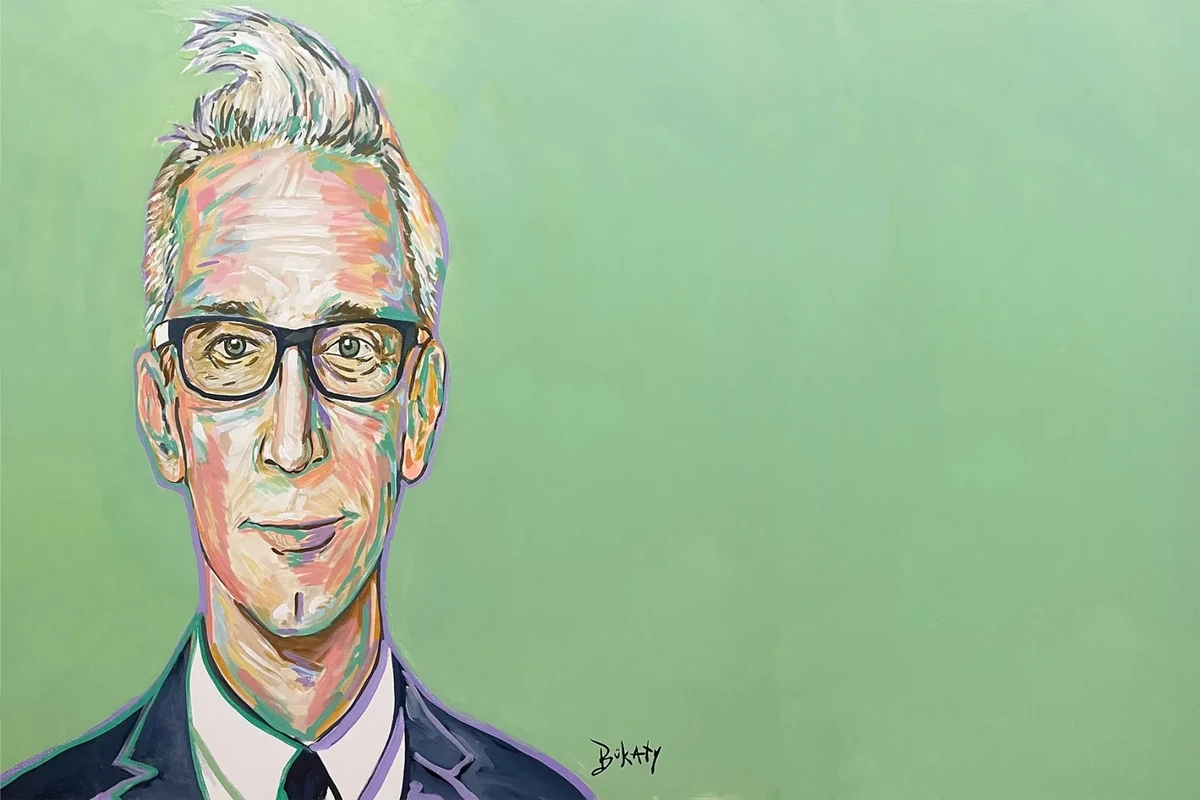

“I’ve got 147 days.” Andy Dick is keeping count of his time in sobriety following the latest relapse in a years-long struggle that dates back to the mid 1990s, when he was a budding TV star and comedian known for his roles on News Radio and The Ben Stiller Show, among others. Four months and 26 days ago, he nearly died. Video of Dick slouched over on a Los Angeles sidewalk circulated quickly. He seemed a goner.
I got to meet Andy Dick on the phone six years ago, during the early days of the Covid-19 pandemic. He was booked to be a guest on my addiction/recovery podcast called Dopey: On the Dark Comedy of Drug Addiction. Normally, our guests were people in recovery with a survivor’s tale of hope and redemption. Andy was funny, volatile, lively, and very drunk. He made no bones about it — who he was, what he was doing, and why he wasn’t interested in getting sober. He made a splash in our community — the audience was aghast, dismayed, and yet ultimately still amused by his unrelenting defiance.
Over the years Andy came on our show three or four times. He was always a rousing guest — amusing, playful, pointed, and seemingly always altered (presumably drunk) — and set on not getting sober.
We would message here and there, but I hadn’t heard from Andy for months when I woke up on Dec. 11, 2025 to learn that Andy had overdosed on fentanyl on the streets of L.A. He technically died, and was revived with Narcan, a life-saving nasal spray that rapidly reverses opioid overdoses. I immediately reached out and he asked me to call him so he could give us the scoop. He came on the phone wasted, retelling his now-famous brush with death. He hung up on me with a diabolical laugh when I pried too much about trying to help him get sober.
I found out the next day that our mutual friends, interventionists Jennifer Gimenez and Tim Ryan, had gotten ahold of Andy and got him into treatment. I checked in with them and heard he was doing well. When we connected for this interview, he was excited, scattered, hopeful, emotional, defensive, funny, and open. One second he was showing off different pairs of glasses and talking about his faux-hawk; the next he was describing waking up after being revived and wondering why they hadn’t just let him die. Andy hopped on a Zoom with me from his undisclosed sober living house, super excited to chat addiction and recovery, and super stoked to be in Rolling Stone.
Take us back to Dec. 11, 2025. What are your recollections of that day?
I was hanging out with some friends. I won’t say their names because I did say their names before and then they all got in trouble. They got lambasted or bombarded or thrown under a bus. Like it was their fault. It’s not their fucking job — it’s nobody’s job to take care of me except me, right? I was with them, I think maybe I was feeling a little over-protected and I wanted to just get away — bolt. B-O-L-T. And so, I kind of bolted away because I saw some people across the street. They were passing around a pipe with what I assumed to be pot.
And I quickly, as quickly as I could, took a hit from the pipe. And I also saw in the pipe that it was white. So it wasn’t pot. I’m like, that’s okay. I can smoke a little hit of cocaine or whatever.
But it turned out it was a bad idea. I shouldn’t have left my friends. I shouldn’t have taken a hit of whatever that was from strangers that were just standing around on the sidewalk. Not necessarily bums, but they weren’t in three piece suits either. And then I went into an elaborate story that lasted like 10 seconds and then I just plopped down and allegedly died.
Do you remember dying?
The tunnel that they say there is, I never saw one. Nothing. But I did legit die because there was nothing going on and they had to do one of those Narcan shots on me before. And then when I woke up, I thought, “Why didn’t you just let me die?” Which is very sad that I had that thought. But the first thing I said allegedly was, “Where’s the vodka?”
Why did you finally go to treatment?
I don’t think I had a choice. The ambulance came and they were trying to load me up into it. I do know that I refused. I said, “Nope. I’m not getting in the ambulance. I’m not going anywhere.” But finally I had a couple friends come over. Jennifer Gimenez and Tim Ryan. Jennifer and Tim saved my life. They just did.
Do you feel like it was forced on you or do you feel like you were like, “I need to do this”?
It was a little of both, but the thing is that you can’t force anybody to do anything. I could have run.
But they dangled a bunch of carrots in front of me. “You’re not going to be able to do this movie, you’re not going to be able to do this series.” There were a lot of things in the works that are still in the works. And by “in the works,” I mean they are ready to go. But the dying throws a wrench into it.
When do you think it changed from being fun to being miserable?
In between drink four and five. [Laughs.] If I could do a thing where I can just have one to three drinks per day — spread out throughout the day — I would do that. But ultimately, there’s no success. That’s the most frustrating fucking thing.
When we last spoke, we talked about sobriety, and you said, “I don’t wanna fucking do this, but I’m doing it.” How do you feel about sobriety now?
It’s hot and cold. Like right now doing the interview with you, I’m like, fuck, thank God. I could have just went out last night. But thank God I didn’t.
Why do you think the professional stuff juices you up so much?
Family’s number one. But now I have my family, my son, my daughter, my other son. My daughter’s pregnant. My son already has two babies, so I’m a grandpa three times over.
This legacy thing is getting more and more like, “Jeez, I better pull my fucking shit together so they’re not just talking about old grandpa Dickie over there.” I don’t want that legacy.
Does relapse scare you?
No. Anything that has to do with me, even my own death or dying, doesn’t scare me. … Relapse doesn’t scare me because I’m not afraid of it. This is horrible to say, but I don’t give a fucking shit if I relapsed.
Are you familiar with this concept of being canceled?
Yeah, that’s the term people are using. No, I’m uncancellable. They try. There is no committee that can — it’s too late. I’m past it. Only if I keep my shit together. Only then am I uncancellable.
Everybody right now is obsessed with the Nineties. Why were the Nineties so special?
That’s when I had three TV shows on three different networks. You can’t have that in today’s day and age. I was on three different networks. I was all over the fucking Nineties. The Nineties were mine.
What was it like coming up in the ‘alternative comedy’ scene?
I was inspired by Andy Kaufman. I don’t know why I did this, but I just went on stage with a Maxi-Pad. I just unpeeled the thing and I had it stuck to my forehead and I just went on stage as if nothing was on my forehead. It was the stupidest fucking thing ever.
Last time we spoke, I brought up Phil Hartman and you got angry at me. Do you carry guilt around his death?
I never did. I never had guilt. I didn’t do anything that had anything to do with Phil Hartman dying. But we were very, very, very close.
Phil Hartman and I smoked pot all the time. Me and Phil Hartman would go to my trailer and just smoke pot and have the best fucking time. He confided in me. He was going through a lot. And when he died, I didn’t think the world was fair. I was mad at God. I was mad at everyone in my world. That’s when I was like, “Fuck it. I’m just gonna drink until I’m dead.” I really had that feeling.
And yet here we are. 147 fucking days sober. Good things are happening.
From your mouth to God’s ears. I want life to be fucking fun, man. I had a lot of fun smoking pot. I had a lot of fun drinking and doing other drugs. But if you add them all up, those fun times were just… not that fun. It’s not as fulfilling as just being sober and seeing your grandkids play. Or them looking at you and immediately smiling. And then when they laugh at something I do, I’ll do it over and over and over where they’re laughing till they’re crying and I still can’t even figure out what the fuck they’re laughing at. And that beats all of it.





 Nick Wilde from Zootopia greets fans during the Magic Kingdom parade. Kenslie McGuire