
A year ago High Times was on its last legs, in receivership due to large debt. Founded in 1974 by a marijuana smuggler, the notorious weed magazine had not published an issue in several years. The website had gone dark. They stopped organizing their popular Cannabis Cup judging contests. Then Josh Kesselman came sniffing around and made an offer to buy it.
“It’s amazing how degraded High Times was to the point that it would be sold for so cheap in a lot of ways,” Kesselman tells me. That price was $3.45 million. The deal went through last June.
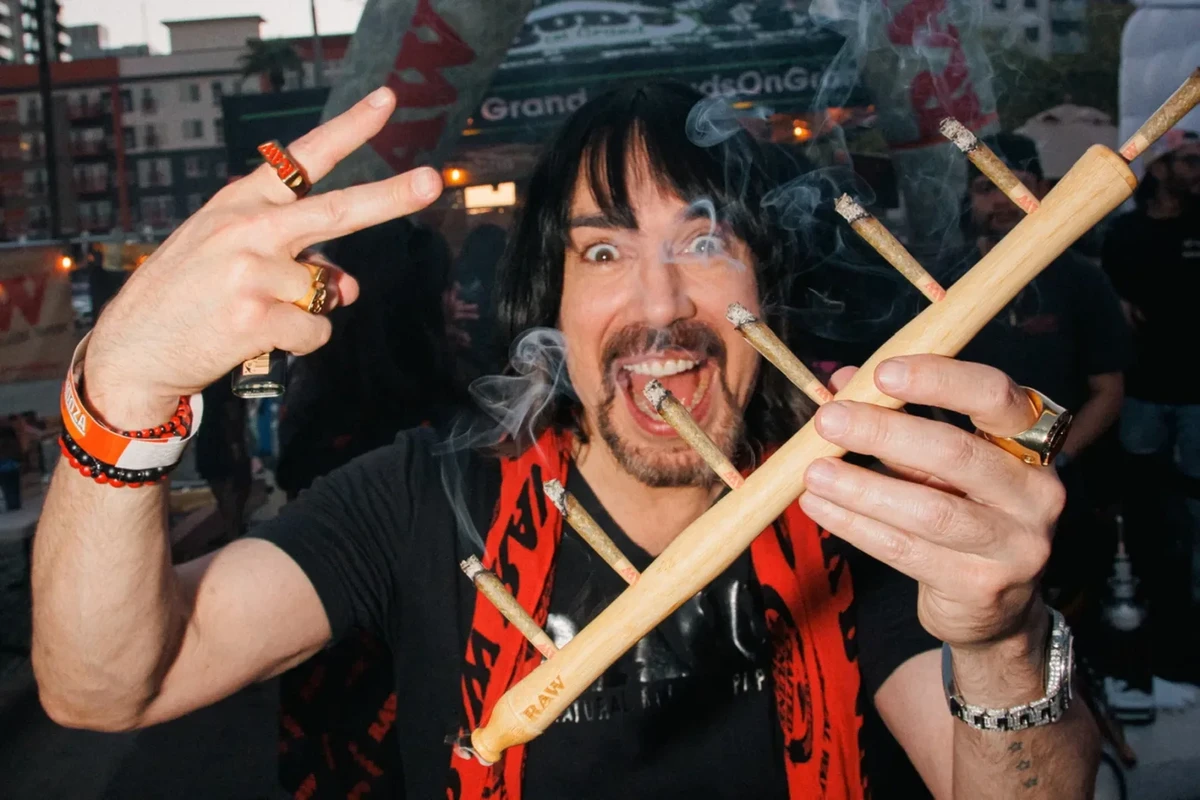
I’m in Phoenix, Arizona to visit Kesselman’s offices that house both his Raw papers empire and now High Times. Kesselman picks me up in his Tesla with his 16-year-old Chihuahua, Chloe, in the back seat. He has a distinct rock-star look with long black hair and a goatee. His clothing mimics his brand’s colors: everything is red and black.
I first met Kesselman, 55, several years ago at trade show in New York where he worked the floor dressed in Raw duds for two days. A people person, he’s quick to take photos with consumers who are either already Raw fans or potential ones. Every handshake might equal a sale. With High Times, he has a new product to push.
Kesselman knows my background as a former editor of High Times and picks my brain about the company’s roller-coaster history. The magazine’s mercurial founder Tom Forçade (born Gary Goodson) killed himself in 1978, leaving the company in a trust for the next 22 years. High Times barely survived the drug war of eighties and nineties.
As seen in his hilarious instructional videos he constantly posts social media, Kesselman’s a fast talker, something he learned from a therapist as a way to prevent him from stuttering. It adds to his true-believer intensity.
“It worked for me,” he says. “But you have to go fast. If you go slower, you might stutter.”
We started the day with a tour of the RAW warehouse. It’s piled high with boxes filled to the ceiling with all kinds of cannabis merchandise and paraphernalia, though mostly rolling papers. Forklift operators scoot around the aisles, horns beeping, as I eye sundry products, like Kesselman’s original papers brand Elements before RAW became his top seller. He loads me up with a bagful of RAW swag.
While we drive to the main office, Kesselman places a vegan order for lunch. He’s big on protein shakes and encourages me to have one at the office. An expert roller, Kesselman cranks out joint after joint, showing me techniques like wetting the filter tips so they neatly fit inside each creation. Weed doesn’t appear to slow him down; he’s the stoner Energizer Bunny.
A longtime High Times reader, Kesselman is the right man for the job of resurrecting the 52-year-old legacy cannabis brand. With Raw valued at $200 million, he can afford to buy things he likes.
However, the office doesn’t feel anything like the old High Times headquarters in New York. No staffers actually work there (yet). It’s more of a virtual office. New editor-in-chief Javier Hasse lives in Argentina and Kesselman’s business partner, Matt Stang, is based in Los Angeles.
When High Times went into receivership in 2024, Kesselman called Stang, a former High Times employee he had gotten to know over the years.
“Matt, should I try to buy High Times?” he asked.
“Dude,” Stang replied. “There are so many people out there, so many problems.”
The asking price at that point was $7 million. Stang was still hesitant, but the two decided to buy it. They ended up paying $3.5 million.
Stang was right — there were issues. The main problem was copyright infringement by several parties. According to Kesselman, “High Times was dormant, and some guys were trying to squat on a lot of the intellectual property and had filed a bunch of trademarks for High Times dog food, podcasts, music, you name it. And as soon as we jumped in, we went hard.” He estimates it cost more than a million dollars to clean up the besieged company.
“My friends were collecting baseball cards. I started collecting rolling papers in the same way.”
Kesselman knew all about High Times’ recent history under the leadership of Adam Levin, whose investment firm Oreva Capital purchased 60 percent of the parent company Trans High Corporation for $42 million in 2017, following the death of longtime co-owner Michael Kennedy. After renaming the company Hightimes Holdings, he used the magazine’s history to lure investors. But it was all smoke and mirrors — in 2023, he settled with the SEC over charges that he illegally paid an analyst to promote the stock. In 2025, he pleaded guilty to conspiracy.
KESSELMAN’S ORIGIN STORY BEGINS IN New York City. Born on April 19, 1971, he grew up in Hewlett, Long Island, a beacon of mid-century suburbia. Kesselman loves to talk about his father who smoked marijuana and did a trick with a rolling paper, lighting it up until it vanished, that entranced young Josh.
While at Hewlett High, he and a friend were kicked out for ripping a bong hit in the dean’s bathroom. That changed Kesselman’s life in many ways. Mentally, it made him question society’s disapproval of pot; geographically, it moved him back to New York City, where he completed high school at Robert Louis Stevenson on the Upper West Side.
Already a rolling-paper nerd, Kesselman visited New York’s head shops where he found various packs he’d never seen before, like the ungummed Club Modiano and Blanco y Negro with its blackface cover, both from Spain.
“My friends were collecting baseball cards,” he explains. “I started collecting rolling papers in the same way.”
One day in 1987, he walked into Village Cigar in New York’s West Village and bought his first copy of High Times. “My friends showed me High Times,” he says. “I’d go to the shop on 7th Avenue that’s flat-iron shaped. I remember High Times being in a brown paper bag behind the counter.”
It was behind the counter for a reason — to prevent sales to minors. but Kesselman, then 16, wasn’t carded.
“That was the cool thing about New York City, it was more open. I went in there and asked, ‘Can I get a High Times?’ ‘Sure, man, here.’ I bought that and put it under my jacket and paid him whatever it was back then.”
It was the beginning of a beautiful relationship. “I cherished that copy of High Times,” Kesselman says. “I went through every page of it, read it a couple of times and then I started buying High Times all the time.”
He enrolled at the University of Florida in Gainesville. By his senior year, Kesselman was operating headshops under the name Knuckleheads. He sold papers, pipes, bongs, tobacco products and all kinds of paraphernalia — until one of his five stores was busted in 1993. Unwittingly, they had sold a bong to the 18-year-old daughter of a U.S. Customs Service special agent in charge for the Northern District of Florida. A raid swiftly followed.
“They came in with helmets and boots on, the whole fucking thing, doors flew open at the store. They also went to my house. I was charged with selling drug paraphernalia and interstate transportation of drug paraphernalia.”
Three years later, Kesselman was convicted and sentenced to house arrest, probation and a $150,000 fine.
Besides not going to jail, there was another silver lining for Kesselman: one of the arresting officers told him that while bongs and pipes were illegal, rolling papers, also used for tobacco purposes, were not.
“He left, and I was like, ‘Guess I’m going into the paper game.’ That was my lesson. It was like the universe was talking to me. ‘Go into paper, son.’ And I was like, ‘All right, I’m going to the papers.’”
DAY TWO WITH KESSELMAN STARTS with a visit to Camelback Mountain, a craggy 2,600 foot peak that’s within Phoenix’s city limits. He lives in the next town over, Paradise Valley. It’s desert with rocks strewn everywhere. He wants me to meet his animals — two horses named Jagger and Bowie and donkey called Elvis. We feed them oversized carrots that they snap off with each bite.
Kesselman lives in a ranch house on the property that he had built. His wife Betty, who’s Canadian, resides in Vancouver. He visits her every couple of weeks.
Kesselman moved to Phoenix in 1996. He founded HBI Innovations, a wholesale distributor of smoking products, in 1997, his first rolling paper brand Elements and, by 2005, Raw, inspired by a song title and lyric by rapper Big Daddy Kane (“24/7 chillin’, killin’ like a villain, the meaning of RAW is Ready and Willing”).
The gestation of Raw took several years because Kesselman was obsessed with creating a new type of paper — thin, translucent and brown that contained no additives or calcium carbonate (chalk).
“I was telling [the factories], ‘No, I want this translucent brown paper.’ They didn’t want to take the risk.”
Most papers he grew up using were thick and white, like Bambu. Club Modiano was thin, just not brown and translucent. He imagined a Club-style thin paper with gum that was also brown and you could easily see through. He told his mill in France that he wanted them to make thin brown papers.
“They’ve been making white rolling papers in some of these mills for 150 years. And instead I was telling them, ‘No, I want this translucent brown paper.’ They didn’t want to take the risk and basically said no. Then I hit up a smaller mill and they agreed.”
The large rolls of paper were shipped to a production factory in Spain, where the world’s first brown translucent rolling papers were cut and placed into packs. “I’m risking everything to make this RAW thing,” Kesselman says. “But I had to do it, because I knew people wanted it.”
Twenty-one years later, every rolling paper company has their version of Raw’s brown papers. It was Kesselman’s invention. “That beautiful paper, they loved it, and it spread throughout the world as one big-ass connected sesh circle,” he says.
Kesselman talks about sesh circles a lot. It’s where stoners congregate to pass joints, cones and pre-rolls, preferably to the left.
A few days after I left Arizona, Raw participated in the Buds-A-Palooza event in downtown Phoenix. Kesselman came equipped with a half-pound joint. Yes, you heard that right. “It was amazing with the prototype half-pound joint,” he texted me along with several videos of people smoking it.
Known as “Mini Josh” on Facebook, he regularly posts reels that hype his stoner hacks or just has him smoking five joints at once. One reel is about flat joints he calls “flattys.” In the videos, his eyes bug out as he speed-talks his way through the short scripts.
With the proliferation of pre-rolled joints these days, Kesselman knows it’s an uphill battle “to teach Gen Z how to roll.” That’s why every day there’s a new clip on social media with him encouraging people to fill up his papers with quality cannabis. “They need to learn,” he insists. “It’s our responsibility to hand down this craft.”
Kesselman hopes Gen Z will gravitate to High Times like previous generations of stoners did. Things have certainly improved since the sale. High Times’ website now publishes five articles a day, two new quarterly print issues are available and the company’s Cannabis Cups have returned so far to New York and New Jersey. In addition, Kesselman is planning a massive Cup event for 20,000 attendees, but details have yet to be announced. Also expect to see plant-touching products, like flower and vapes, from Raw in the near future.
“That plant has done so much for me in my life,” he genuflects. “And High Times has really changed me. It transformed me. It made me realize the possibilities that were out there.
“If someone had said to me, ‘Someday you’re going own High Times, Josh,’ I wouldn’t have fucking believed it.”
Steve Bloom is a former editor of High Times and publisher of CelebStoner.com. He last wrote for Rolling Stone in 1988.










 Nick Wilde from Zootopia greets fans during the Magic Kingdom parade. Kenslie McGuire