
There was danger outside the gate, we understood that. You could see it.
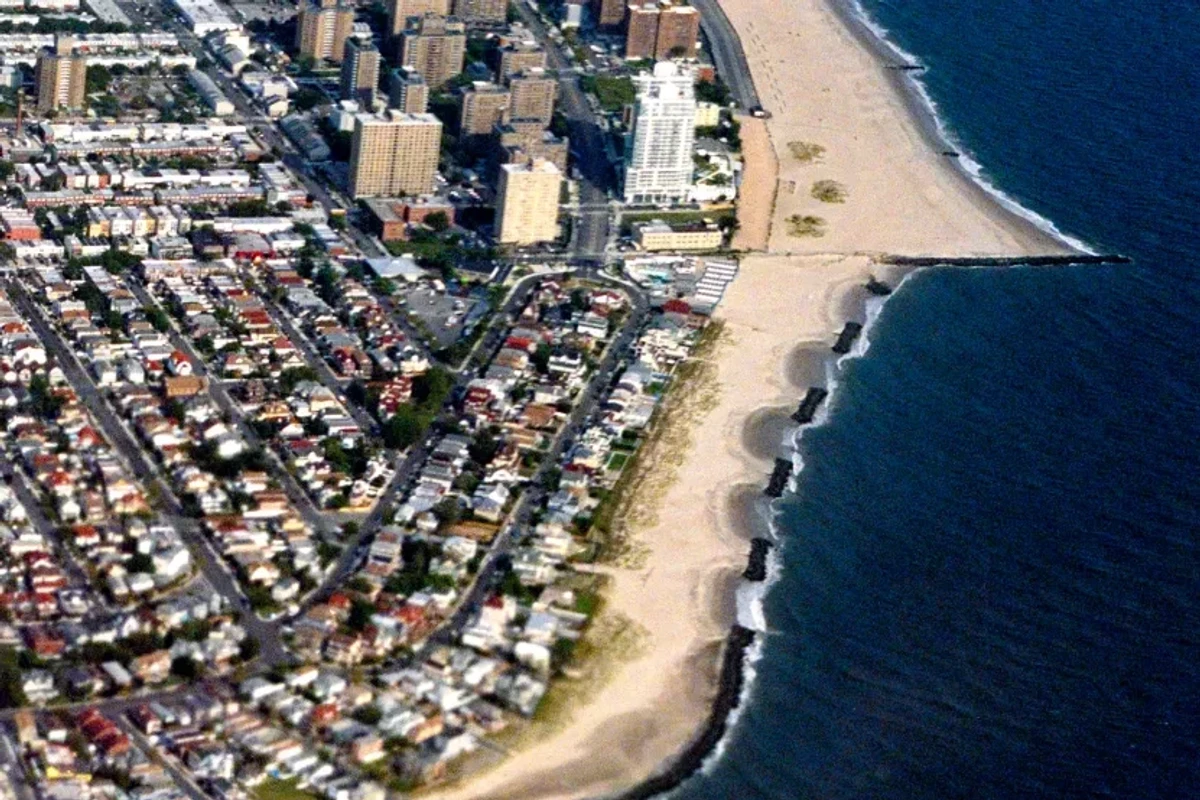
Precariously balanced on the very tip of Coney Island, Sea Gate, where I was raised, is surrounded by water on three sides and divided from the rest of the world by a two-story chain link fence. The fence, broken up only by two actual gates manned by guards, stretches three-quarters of a mile along 37th Street, from New York Harbor on the north side to the Atlantic Ocean on the south.
On our side of the fence, tree-lined streets. The closer you get to the ocean, the bigger the houses. From the beach, a view of the Verrazano Bridge. In the 1890s, the Vanderbilts, Dodges, and Morgans built houses here. In fact, some of the houses on the beach were 40-room mansions before they got divided up during the Depression. It was a private beach escape for the rich. You can understand why they fenced the neighborhood off. On the other side of the fence, where today stand residential high-rises, were slums. In effect, Sea Gate was an island on an island.
Growing up in the Sixties, the place was like one big playground. From the Parachute Jump on Coney Island, the symbol of my childhood, you could probably see the Statue of Liberty. This amusement park ride, Brooklyn’s Eiffel Tower, was itself a kind of poor man’s Statue of Liberty — it represented the idea that wherever you were, you could have a bigger view of where you could end up.
My mother and I lived with my grandparents in the last house before you got to the fence. We had a view from our kitchen window, through chainlink, of abandoned cars, boarded-up tenements, garbage, old bicycle frames that had been picked clean, still locked to a pole.
In those days, the neighborhood kids had the run of the place. We went outside as soon as we got up and didn’t come home until dinner. There was a catwalk, too narrow even to fit a bicycle, that we kids called “the Path,” which ran between our house and the fence. The older boys often parked their bikes in our driveway, took the Path, and came back later to pick their bikes up.
The Path was maybe three feet wide, broken cement, overhung in places by my grandmother’s privet hedge, whose tiny white blossoms carried the scent of my Brooklyn childhood. Half in shadow, half in sun, the Path provided a back route in the neighborhood, which we simply referred to as “the Gate.” Perhaps because it ran behind our house, along 37th, an unseemly street, the Path held a mystery and a danger.
At some point, someone cut a hole in the chainlink there. I remember seeing kids, and sometimes even grown men, slipping through to avoid the guards at the gates. My grandmother warned me to stay away from there, and yet the opening was only four feet from our house.
Since our street was a dead end, it created a perfect “diamond” for the boys in the neighborhood to play stickball. I knew many of them by sight, even those five or six years older than me, because my grandfather set us up with a stickball resale business when I was four. “Over the fence” was a home run, which meant many pale pink Spaldeen balls ended up on our roof. My grandfather sold them back to the boys for five cents less than what they had originally paid for them and passed the money to me.
I have vivid memories on warm summer evenings of my grandfather pulling out the ladder and placing it against the side of the house, untucking his white starched shirt and climbing up. I stood at the bottom of the ladder and watched. It seemed like magic. After a few minutes, as if he had been collecting eggs, he came down with a shirt-tail apron full of Spaldeens.

The author’s grandfatherCourtesy of Gabrielle Glancy
FOLLOWING THE RELEASE of the Epstein files in January, I began to notice a lot of posts about him on the “I Grew Up in Sea Gate” Facebook group. Someone posted a class picture with Epstein standing in the back row among a bunch of awkward-looking pre-teens at Mark Twain Junior High, where my mother taught English during the years he was a student there. The person who’d posted the photo bragged about attending Epstein’s bar mitzvah, and claimed that Jeffrey had grown up in Sea Gate. I took a screenshot of the kid whose head was circled in red magic marker and saved it on my phone so I could take a closer look. That’s Jeffrey Epstein? I couldn’t believe it. I recognized him. Epstein, I thought, had been one of our stickball clients.
Dizzied, I shot a question at Google: “Where, exactly, did Jeffrey Epstein grow up?” And voila, I had before me the exact addresses in Sea Gate where the Epsteins had lived.
As it turns out, I grew up on the same street at the same time as Jeffrey Epstein. That’s not a metaphor. It’s a fact. I know it sounds ridiculous, but it’s true. Sea Gate, Coney Island.
“You’re not going to believe this,” I said to my cousins when I revealed to them what my Google search had turned up. I then took the opportunity to ask them, each in turn, if my grandfather had molested them, as he had me. It just seemed like the right moment to bring it up after all these years, because suddenly, the whole world was talking about pedophilia.
“Not really,” my oldest cousin Josie* said. “But he was weird.”
My cousins had lived on the other side of the fence, in Coney Island. They did not live with my grandparents in Sea Gate as my mother and I did.
“You know Grandpa was a foreman for Fred Trump when he was building Trump Village, don’t you?” Josie said. “One day when I was there, Donny came over.”
“How old were you?” I asked.
She thought for a moment. “About eleven,” she answered.
My cousin Josie and Donald Trump are exactly the same age. I was my grandparents’ youngest grandchild by 14 years, and Josie was the oldest.
I have to say I was shocked by the idea of Donald Trump and his father standing in our living room, and didn’t really believe her. As if this weren’t enough, she added, “And, of course, you know the Mafia runs Sea Gate.”
Incredulous, I reported the contents of this conversation back to my best friend from childhood, Molly.
“Howard. Listen to this,” Molly called to her husband.
“Gabby says Josie says Sea Gate was run by the Mafia. Isn’t that crazy?”
“Everyone knows that,” I heard Howard chirp back from the other room.
Like us, Howard had also grown up in Sea Gate.
WHEN THE EPSTEIN STORY broke, the pieces both came together and fell apart for me. I began to think about proximity and coincidence. A few years before, when I was living on the West Coast, I had tried to write about the murder of two teenage girls who were allegedly being sex trafficked by the police in the house next door to ours when a bullet came through my window. As Mary Karr says in her introduction to The Liars’ Club: “When fortune hands you such characters, why bother to make stuff up?”
Following the Epstein revelation, I interviewed one of the now grown-up kids on our block in Sea Gate, Paula, who told me she had reason to believe my grandfather molested Jeffrey Epstein.
“There were seven pedophiles on our street alone,” Paula said. A neighbor named Litsky, she said, “was fucking both boys and girls.”
“Did your grandfather molest Jeffrey Epstein, too?” she mused. “I don’t know for sure, but I wouldn’t doubt it.”
Absurd as it may be, and kind of shocking, I realized that I would not be surprised. I must credit my beloved mother for this paradox, as well as for the many other secrets and contradictions that filled our lives. “I’m shocked but not surprised” was my mother’s mantra.
Like me, she, too, had been molested by my grandfather, her father. And yet, she seemed to find her decision to assign us to the same bed when I was a child neither shocking nor surprising. Perhaps she would not even have considered it a decision. Was the arrangement, which rendered me and my grandfather bedfellows, a coincidence? It seems she had bequeathed him to me.
Whatever the reasons, my grandfather and I were relegated to a pickle-green pullout couch in the living room of the tiny house my grandfather had built up against the fence in Sea Gate, Coney Island, where he rubbed himself against me every night until I was seven and aged out of his affection.
I never thought to question any of this. It felt normal, though slightly, I don’t know, sour, like milk on the turn.
 Jeffrey Epstein as a childThe House Committee on Oversight and Government Reform
I wasn’t the first to sleep with my grandfather on the green pullout couch, which ironically, later, I also inherited. Apparently, my grandmother had kicked my grandfather out of their bedroom as long ago as 1919, the year their first child was born, when they were barely 20. That was a rough year all the way around — you may recall it was the year of the Black Sox scandal and the Spanish flu — just a few years after my grandparents had come through Ellis Island from Eastern Europe.
All my cousins recalled the chicken coops my grandfather used to build in the living room out of bedsheets and chairs. He must have missed his pigeons from back home. There, in the dark of the makeshift coops, my grandfather built a secret island where he played his “games” with us.
How my grandfather could afford to buy a plot of land in the gated community of Sea Gate in the 1930s and build three row houses and a synagogue on our street is as mysterious as where that guy went every day. Dressed in a three-piece suit, hat, and overcoat, even in summer, he left in the morning and didn’t come home until well after dark. My mother always reminded us that Pop had “friends” in high places, and that he referred to the local judges by first name.
I realize now that an economic divide determined where stickball was played. You wouldn’t be batting balls like that in the part of Sea Gate where the Vanderbilts lived. Indeed, because our house was the low of the low, the farthest from the beach, the closest to the fence, we became the stickball capital of the neighborhood. And because we owned our house, and my grandfather had built it, we had at least a little bit of cachet in a neighborhood where there was a clear division between the rich and the poor.
The Epsteins, on the other hand, rented a second-floor apartment at the end of our street in a house that, like many of the old mansions, had been divided up and turned into rentals. That as an adult Jeffrey Epstein surrounded himself with the richest people in the world is probably not an accident.
I have wondered, in light of all that has come out about him, if Jeffrey Epstein felt on the poor side of that great divide and sought to right that wrong. He may even have felt that same division or isolation in his own home — the genius son of a gardener and school aide. Apparently, he skipped two grades, was a music prodigy and something of a math whiz. In that way, Jeffrey Epstein lived on an island on an island on an island. It is no wonder he bought an island for himself when he had the means to do so. He was used to living on one.
That he used sexual exploitation as some sort of bargaining chip, for that piece of the puzzle, there must have been other factors at play. Was one of those factors my grandfather? Did my grandfather molest Jeffrey Epstein, as it seems he did many of the other kids in the neighborhood? He might as well have.
I know I said that it was not a metaphor that I grew up on the same street as Jeffrey Epstein. I suppose I have contradicted myself. Indeed, if it wasn’t my grandfather who molested Jeffrey Epstein, someone must have — literally or metaphorically. There must have been forces around him and inside him that added up to his breaking bad.
WAS SEA GATE A HOTBED for pedophiles? A breeding ground, as it were? Probably no more than most places. History, and especially current events, has shown us that exploitation by the rich, powerful, and privileged is everywhere.
Not long ago, I came upon a book review that had run in The New York Times in the Nineties. The article was titled “We Have Met the Pedophiles and They Are Us.” I didn’t understand it at first. But I understand it now. When it comes to pedophilia, you don’t have to look that far to find it. “If you wanna know for whom the bell tolls, it tolls for thee.”
Is it not alarming (pun intended), normal though it was for me, that my mother’s open-mouthed kiss was what woke me every morning to get up for school? When I was 12, I locked my lips, both to keep out my mother and to keep in the family secret that had been passed from her lips to mine. I only half knew how strange all this was when I was a kid. Really, it wasn’t until the Epstein scandal broke that I began to see how all the pieces of my childhood fit together.
I have often wished, these last months, that I could tell my mother about Epstein. He grew up on our street, Mom, I would say. Given the family, the neighborhood, the government, the culture, and the world in which we live, I’m pretty sure I know how she would respond. Nodding. Hand to her head. I’m shocked but not surprised.
I always felt proud to say I grew up in Sea Gate. I see now, though, that whenever there’s an inside the gate and an outside, there will be secrets, and danger, on both sides of the fence.
Going through my mother’s effects recently, I discovered the last thing she scribbled into her writing journal. The words were barely legible because she was 92 when she wrote them and had a tremor — a single sentence on the top of a blank page in an otherwise empty spiral notebook: Sexual abuse by my father.
Since I am the last of our tribe, I am the only one left to tell the story.
*The names of all participants in this story have been changed to protect their privacy.
Gabrielle Glancy is a poet, novelist, and essayist whose work has appeared in The New Yorker, The Paris Review, and The American Poetry Review. She has just completed a memoir titled You Win.






 Griffin Lotz for Rolling Stone





 David Manheim and Hunter Biden Courtesy of David Manheim