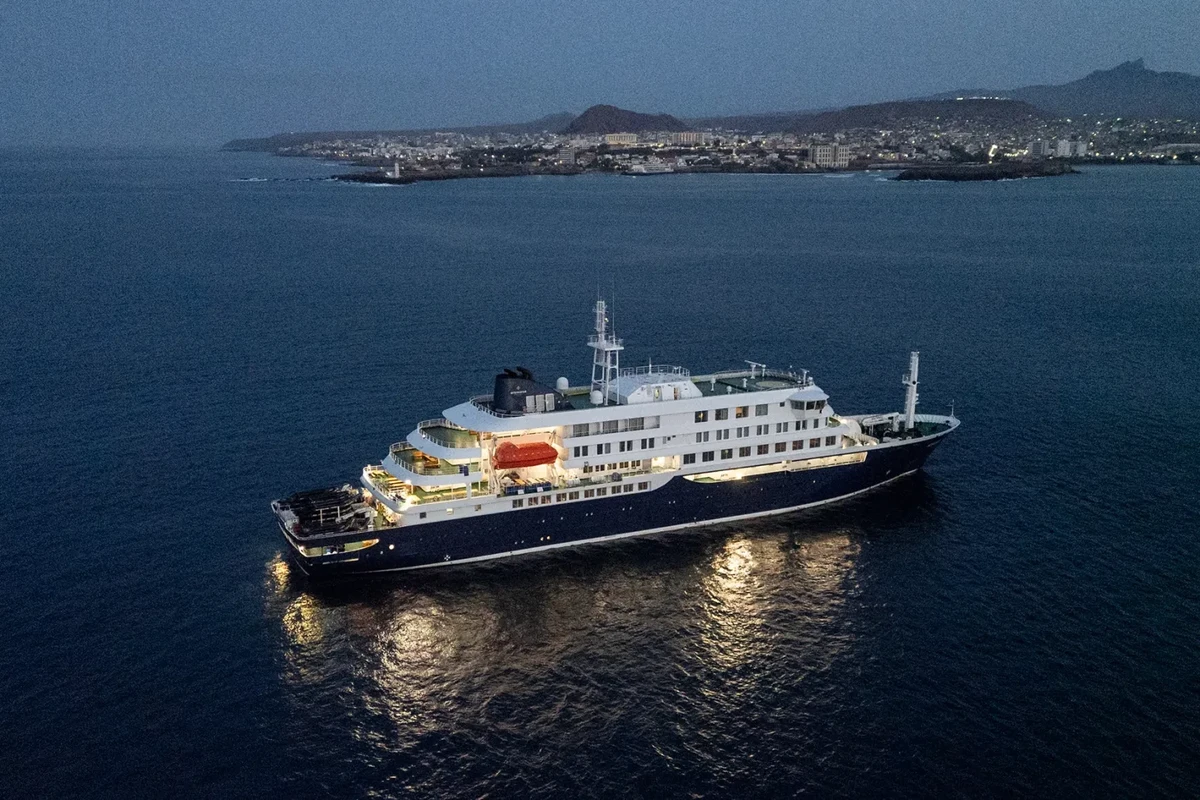

For the past several days, the world has watched a hantavirus outbreak unfold on a cruise ship in the Atlantic Ocean now carrying roughly 100 passengers. So far, the rare but deadly virus has left five people sick and three dead, according to the World Health Organization (WHO). Of those cases, five are confirmed to be hantavirus — including at least one of the deceased — and three are suspected.
Thanks to the chaotic release of information from the WHO, cruise ship company (Oceanwide Expeditions), and a travel influencer (who partnered with the company), it’s been difficult to stay on top of the situation and what’s accurate. Beyond that, Trump administration policies — like pulling out of the WHO — are keeping the U.S. out of the loop during the ongoing global investigation into the outbreak.
So, what exactly is going on onboard the ship? How concerned should we be about the outbreak? And what do rodents have to do with it? Well, strap in: it’s time to temporarily become experts in another virus.
What actually happened on the cruise?
The MV Hondius, a polar explorer vessel registered in the Netherlands, departed Ushuaia, Argentina on April 1 with 114 guests plus the crew on board with plans to visit Antarctica and remote islands in the South Atlantic on a weekslong cruise.
But six days into the voyage, a 70-year-old male passenger fell ill with fever, headache, and diarrhea. He died on April 11. It took nearly two weeks for the ship to make its way through the South Atlantic to the island of Saint Helena, a British Overseas Territory, which was “the first possible location where this passenger could be disembarked for repatriation,” a rep for the company told Rolling Stone. When it docked on April 24, the deceased’s body was removed from the ship. His wife also disembarked, immediately experienced gastrointestinal symptoms, and died two days later.
Along with the couple, 28 guests also left the cruise at Saint Helena, and made their way home to 12 countries: Canada, Denmark, Germany, the Netherlands, New Zealand, Saint Kitts and Nevis. Singapore, Sweden, Switzerland, Türkiye, the United Kingdom, and the United States.
Also on April 24, an adult male passenger started showing signs of pneumonia. He was medically evacuated to South Africa on April 27, where he is currently hospitalized in an Intensive Care Unit. On May 2, testing confirmed that he had a hantavirus infection. Another passenger on board the MV Hondius died that day, though the cause of their death appeared to be pneumonia.
On May 4, the passengers who disembarked in Saint Helena received an email from Oceanwide Expeditions, the Dutch cruise company operating the ship, notifying them that they had been exposed to hantavirus, according to the company representative. But by this point, they had already flown to destinations around the world, potentially bringing the virus with them.
When someone contracts a hantavirus infection, the symptoms don’t show up for anywhere from one week and two months. This means passengers might not have any symptoms for several weeks, says Kirsten Lyke, MD, an infectious disease specialist and professor of medicine at University of Maryland School of Medicine.
However, according to Tedros Adhanom Ghebreyesus, PhD, director-general of the WHO, it’s possible that more cases of hantavirus tied to the cruise ship will be reported, but the outbreak is not cause for alarm. “While this is a serious incident, WHO assesses the public health risk as low,” he said at a press conference on Thursday. “Our priorities are to ensure the affected patients receive care, that the remaining passengers on the ship are kept safe and treated with dignity, and to prevent any further spread of the virus.”
At this point, it’s unclear exactly how hantavirus made it onboard the MV Hondius. “This is going to take a little bit of detective work,” Lyke tells Rolling Stone. “The going hypothesis right now is that the [first identified] case, which is a husband and wife, were in Argentina and may have been exposed during a hike or other tourist activity and then brought [hantavirus] onto the ship, where it could then spread person to person.” (Argentina has the highest incidence of hantavirus in Latin America.) The other possibility is that the virus was spread through mice on the ship, she says, as people can contract it after coming in contact with rodent urine, feces, or saliva.
What is hantavirus?
Hantavirus is typically spread from rodents to people, but the particular strain that’s infecting those on the cruise, according to the WHO — the Andes strain — is the only kind that can also be transmitted from person to person.
Early on in a hantavirus infection, someone will likely experience mild flu-like symptoms, followed by respiratory issues, like shortness of breath. “They may not be coughing up stuff, but gradually, they’ll have a harder and harder time breathing, and then that can lead to shock and affect other organs,” Lyke says. When people die from a hantavirus infection, it’s typically because of respiratory failure and not being able to get enough oxygen, she explains.
She suspects that the passengers and crew of the MV Hondius will have to quarantine on the ship until it has been eight weeks since active transmission, or the last person was removed from the ship that was ill. Ann Lindstrand, the WHO’s representative in Cape Verde, confirmed that a possible quarantine could last as long as two months, adding, “eight weeks in a horribly long time to be in quarantine.” Oceanwide Expeditions isn’t offering any details on how long passengers’ quarantine might last. “We are unable to confirm the details of onward travel for guests at this stage,” the company said in a press release. On Friday, the AP reported that the ship was on its way to the Canary Islands, where it will “arrive at a completely isolated, cordoned-off area,” according to Virginia Barcones, Spain’s head of emergency services.
Currently, there is no treatment for hantavirus — just supportive care. “There’s been some experimental attempts to use different antivirals, but they haven’t really panned out,” Lyke says. “It’s incredibly difficult to study these viruses, because you just don’t see them that often, and you can’t expose people to these types of viruses.”
Hantavirus has a very high mortality rate — up to 50 percent in the America, according to the WHO.
How will the United States’ withdrawal from the WHO impact the outbreak?
The United States’ withdrawal from the WHO, which took effect in January, has put American public health officials at a disadvantage, says David Larsen, PhD, professor and chair of the public health department at Syracuse University. It has meant that hantavirus experts from the CDC weren’t among the first people involved in the outbreak investigation. “It’s not ideal to not be in the loop on infectious disease outbreaks,” he tells Rolling Stone. “Being involved in the outbreak response is very different from receiving information from the WHO that they send to the public.”
Pulling out of the WHO also means that the U.S. no longer has access to the organization’s surveillance databases.
Typically, it takes some time for the first information from an outbreak investigation to be released, as public relations teams and various governments have to clear it first. Those involved in an investigation get that information right away and can share it more quickly with public health officials in their country. “It’s not good for Americans that there is an outbreak of an infectious disease that we’re not boots-on-the-ground going to because it makes us less safe,” Larsen says.
Making good on his promise to “give infectious disease a break,” in April 2025, Secretary of the Department of Health and Human Services Robert F. Kennedy Jr. slashed the budget for the CDC’s Vessel Sanitation Program (VSP), which investigates outbreaks, conducts health inspections on cruise ships, and trains staff on public health practices. As a result, all full-time VSP employees lost their jobs — despite the fact that taxpayer dollars don’t fund the program.
This leaves American cruise ships vulnerable if there were to be a similar outbreak on a vessel from the U.S., Larsen says. “You can’t gut an agency then expect it to do a job,” he explains. “The CDC has a clear mission: to protect the American people from infectious disease threats. A huge component of that mission is to understand where the infectious disease threats are and then be able to respond to those.”
Another job of the VSP was cooperating and coordinating with scientists in other parts of the world. “Our relationships with other countries are absolutely not healthy,” Larsen says. “If you don’t have the same level of cooperation and sharing, it makes us less secure.”
This lack of oversight is also concerning because cruise ships are “vulnerable locations,” according to Larsen. “If we can’t go on a cruise because we’re worried about infectious disease outbreaks — because there’s nobody there to support the inspection of these vessels and make sure everything’s working fine — that’s a lack of freedom,” he says.
Do we need to worry about hantavirus?
Public health officials in the U.S. are currently monitoring passengers who returned from the cruise on April 24 located in five states: Georgia, Texas, Virginia, Arizona, and California. At this point, none are showing signs of the hantavirus, according to the respective authorities.
While hantavirus isn’t as contagious as measles, for example, Lyke says that it’s possible for it to spread in a limited way. “We don’t know a lot about exposure,” she says. “Presumably, it’s spread by respiratory secretions — being in a room with someone for a period of time could be enough. I think the closer and longer the contact, the more likely that one could be exposed.”
On average, those infected with Andes virus typically infect fewer than one other person. In contrast, one person infected with SARS-CoV-2, could, on average, infect 15 to 20 others.
Separate from this outbreak, there is also a strain of hantavirus in the United States known as the Sin Nombre virus, which is found in the Four Corners region (Arizona, Colorado, New Mexico, and Utah). This is the strain that killed Gene Hackman’s wife, Betsy Arakawa, in February 2025.
In the United States, people contract hantavirus most frequently when they’re hiking in New Mexico and staying in a log cabin, Lyke says. “We’re always telling people to be super careful,” she notes. “Aerate the cabin or any other closed area with rodents. You also might want to wear a mask and sweep it out.”
Overall, though, hantavirus is “very uncommon,” according to Lyke. From 1993 to 2023, there were 890 reported cases of hantavirus in the United States. “This is one of those kind of one-offs where it’s a little bit sensational, it’s a little unusual, and I don’t think people necessarily need to worry at all,” she says.
Along the same lines, WHO officials are stressing that there is no reason to panic. “I want to be unequivocal here: this is not SARS-CoV-2,” Maria Van Kerkhove, PhD, acting director of the WHO’s department of epidemic and pandemic management said at the press conference. “This is not the start of a Covid pandemic. This is an outbreak that we see on a ship. There’s a confined area. We have five confirmed cases so far. This is not the same situation we were in six years ago.”





 Griffin Lotz for Rolling Stone








 David Manheim and Hunter Biden Courtesy of David Manheim