
Will speaking about violence get me banned?” asked a member of the Stop AI Discord chatroom in the early evening of Dec. 8, 2025. His username was Butlerian Jihadist, a reference to a human rebellion against machines in Dune.
His post caught the attention of a producer working for a podcast called The Last Invention, which was documenting debates about artificial general intelligence (AGI), a hypothetical form of AI that could surpass human intelligence. The reporter messaged Butlerian Jihadist asking him what form of violence he had in mind.
“Luigi’ing some tech CEOs,” the user responded, referring to Luigi Mangione, who has been accused of killing United Healthcare CEO Brian Thompson. (Mangione has pleaded not guilty to all charges.)
Butlerian Jihadist was interviewed on the podcast soon after, in late January. His real name is Daniel Moreno-Gama, and he was a then-19-year-old Texan who believed AGI could lead to the end of the human race. When journalist Andy Mills, the host of the podcast, asked Moreno-Gama if violence was on the table as a way to prevent this technology from taking hold, Moreno-Gama responded, “No comment.” Mills asked about his “Luigi’ing” remark he’d made earlier and he said that shouldn’t be taken too literally.
“So you don’t really think it would be wise for someone to, let’s say, kill [OpenAI CEO] Sam Altman,” Mills asked.
“No, these people have unlimited resources — one person is not really going to do that much of a dent,” Moreno-Gama replied. “It’s almost all risk, no reward.”
Three months later, Moreno-Gama was arrested on accusations of throwing a Molotov cocktail at Altman’s house, then driving to OpenAI’s San Francisco headquarters with a jug of kerosene and threatening to burn the building down and kill anyone inside. Authorities say they found a document on him listing other AI companies as targets. (Moreno-Gama has pleaded not guilty to all charges, and his lawyer requested a mental health evaluation.)
Around the time of the Moreno-Gama incident, a 29-year-old man named Chamel Abdulkarim was arrested on charges of setting fire to a toilet paper warehouse in California. A witness told law enforcement that after the fire, which Abdulkarim allegedly started in protest of capitalism, Abdulkarim said “a lot of people are going to understand” and compared his actions to when “Luigi popped that motherfucker.” A month later, prosecutors claimed Jonathan Rinderknecht, who’s been accused of starting the Palisades fire, was fascinated by Mangione, searching for his name online along with terms like “kill all the billionaires,” according to court filings. Investigators also say he compared the arson to the United Healthcare CEO shooting. (Rinderknecht has pleaded not guilty. His lawyer told The New York Times that prosecutors were politicizing the case: “If fascination with Luigi Mangione is evidence of arson, the U.S. attorney’s office is going to need a much bigger courtroom — because they’ll have to indict half the country.”)
While these crimes aren’t necessarily modeled after Mangione’s alleged actions, a suspect invoking Mangione is quick to garner media attention. And even when suspected criminals don’t mention Mangione at all, the press and the public often rush to connect their crimes or accuse young men of being copycats. This happened with the shooting at NFL headquarters in New York City, when Charlie Kirk was assassinated, and to a lesser extent, with the recent incident at the White House Correspondents dinner.
Sociologists and criminologists who study the effect of high-profile crimes say the reasons behind “copycatting” are nuanced. U.S. political violence is at a record high, and the way we react to violent acts is shifting. The glorification of criminals who attack the rich is not new — think Depression-era bank robber John Dillinger — and experts say this is often amplified in times of income inequity and economic turmoil. It’s why we sometimes see acts of disturbing violence celebrated and meme-ified, as the victims are dehumanized or dismissed as villains. When Kirk was shot, video of his murder was all over the internet, one could scroll between photos of their friends’ kids, recipes for pasta, a trailer for a movie, and then be faced with a brutal and bloody killing.
“Many forms of popular culture present violence to us as a spectacle, something that we can enjoy without consequence,” says David Schmid, an English professor at the University at Buffalo, who researches Americans’ fascination with murder and true crime. “And in that respect, Luigi Mangione’s [alleged] shooting of [Thompson] is really, for many people, not that different from something that happens on the TV or in a movie or when they’re playing Grand Theft Auto. There’s not much reality to it.”
“Digital culture creates this opportunity to devalue human beings,” says Jacqueline Helfgott, a criminology professor and author of Copycat Crime: How Media, Technology, and Digital Culture Inspire Criminal Behavior and Violence. “That’s the harm that comes from all of this.”
During Mills’ conversation with Moreno-Gama, the alleged Altman attacker said he didn’t agree with Mangione’s alleged fatal violence against Thompson. But then the teen added, “I think what we saw with Mangione is a lot of people were able to excuse it.”
A COPYCAT CRIME IS MODELED AFTER or inspired by a previous crime, fictional or real. There are many factors that can make crimes more likely to be mimicked, Helfgott explains: “Making crimes look fun, the attractiveness of the perpetrator, the degree to which the perpetrator and person who’s mimicking [them] are alike in some ways.”
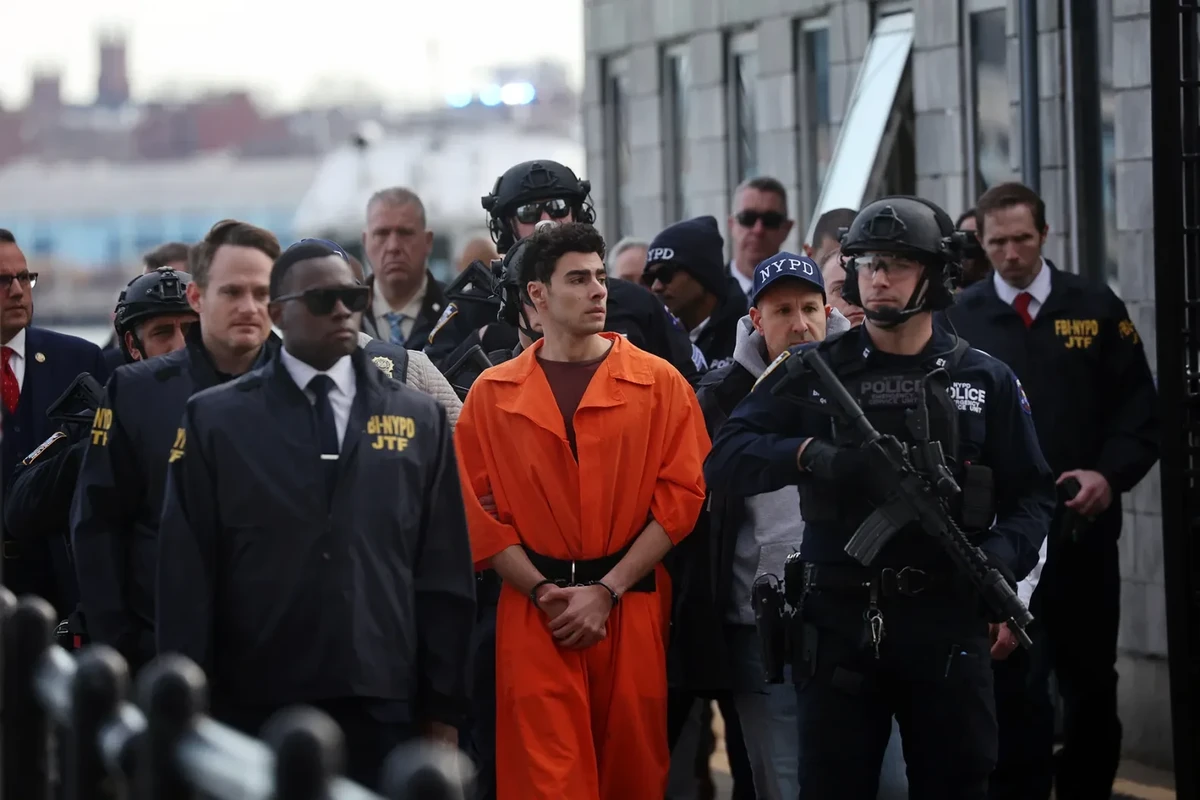
“The copycat effect is the story that’s told about the violence, and the rationale for that violence resonating with people” Helfgott says. In Mangione’s case, she explains, some believe he was trying to “save people from harmful insurance companies.” Combined with the images of Mangione coming off of a helicopter on his way to a Manhattan courthouse — a perp walk that resembled a Marvel movie — Mangione’s arrest had a lot of the trademarks that would inspire people thinking about committing crimes.
“All of that stuff contributes to exacerbating the copycat effect because not only is the rationale for violence there, and he’s seen as some sort of modern-day Robin Hood,” Helfgott says. “He’s also this aesthetically-appealing individual that many people are idolizing. Everything about this case exacerbates the copycat effect.”
Helfgott says “edge-sitters,” or people considering committing a crime, are often influenced by digital culture, media imagery, and the aesthetics of violence. Additionally, those early on in their criminal career often try on their criminal identity by mimicking others’ crimes.
A true copycat is rare, says media psychology professor Andreas Miles-Novelo, who studies technology’s impact on aggression, but often people notice which elements of a crime get attention and then replicate them. In psychology, this process is called “mirroring.” For example, Thompson’s murderer wrote “delay,” “deny,” and “depose” on the bullets, echoing a common phrase used by critics of the insurance industry. The concept of inscribing bullets was not new to this crime, but it was an aspect of the murder that was widely talked about, and then, within a year, engraved bullets were found at crime scenes like Charlie Kirk’s murder and a shooting at a Dallas immigration facility.
People considering committing political violence in order to make a statement may attempt to replicate what they see as effective for others in the past. “How was Luigi most effective at making his [alleged] statement?” Miles-Novelo says. “It makes sense that somebody later on is going to replicate what worked for him to some degree, just as we all observe things in real life and see what works and what didn’t work. That basic dynamic we engage in shows up in crime, as well.”
ONE OF THE FIRST EXAMPLES OF COPYCAT crimes was in the wake of Jack the Ripper, an unidentified serial killer who targeted female sex workers in 1888, Miles-Novelo says. In subsequent years — even up until 120 years later in 2008 — there were murderers that mirrored the Ripper’s crimes.
“Jack the Ripper became this media sensation that sent London into a frenzy,” Miles-Novelo says. He explains that when an event gets more coverage in the media, and more attention drawn to it, it becomes a more accessible idea. “When the motivations behind that violence is something that people can [identify] with, the stories just catch fire.”
“We talk about it as a cycle,” Miles-Novelo says. “We keep talking about it, we keep seeing it, that makes the idea of it more accessible in people’s minds, which means it’s more likely to happen, which means that somebody else is going to see it, talk about it, and on and on we go.”
Media coverage can play a part in keeping the perpetrator in the public’s consciousness. By detailing the crime, the media spreads access to a script that can be followed in these performances of rage. This effect is exacerbated with social media.
There’s no question there’s a correlation between media coverage and crimes, says Steven Gorelick, a retired professor of criminology and media studies at Hunter College of the City University of New York. We’ve seen crimes replicated after high-profile events, for example, the huge rise in school shootings after the 1999 massacre at Columbine High School.
But Gorelick and others say violent crimes are a complicated phenomena, and the reasons behind them cannot be simplified or reduced to one thing. Miles-Novelo points out that the strongest predictor of gun violence is access to a firearm, for example, and the most significant risk factor for future aggressive behavior is a history of aggression. And, of course, there’s the psychological profile of each individual’s mental health.
“The public’s quick adoption of a copycat explanation obliterates all of the nuances of what’s happening in any given case,” Gorelick says.
“CELEBRITY CRIMINALS HAVE BEEN AROUND for a long time,” says Schmid, author of Violence in American Pop Culture. “It really helps if they are close to a Robin Hood archetype — someone that takes from the rich, and to be honest, they don’t even have to give to the poor.”
Even if there’s not a redistribution of wealth, Schmid says, criminals can garner attention by “attacking people who are seen as having too much power, wealth, and influence and not to be using it for the benefit of society.”
“Those feelings are especially accentuated when you have a lot of ordinary people struggling to get by, as we do right now, as we did back in the 1930s with [infamous bank robbers] Bonnie and Clyde, that’s when these types of crimes really tend to resonate with people much more strongly.”
It matters what is happening in society around the crime, Schmid says. He describes President Donald Trump’s administration as marked by an “atmosphere of lawlessness” that he thinks contributes to why polling shows Americans are becoming more open to the idea of violence as a solution than they have in the past.
“I see Mangione as a product of a period in our history when acts of violence are not only becoming increasingly common, but also becoming increasingly excused,” Schmid says. “We’re closer than ever to thinking of violence as a legitimate means of expressing political discontent.”
When asked about the constant linking of Mangione’s alleged crimes to different forms of political violence, Mangione’s attorney Karen Friedman Agnifilo says, “As we have stated before in multiple public court filings, Mr. Mangione does not support violent actions and does not condone past or future political violence. These repeated attempts to connect him to unrelated acts or to insinuate that he condones or supports these acts are irresponsible, dangerous and prejudicial.”
Mangione as a symbol of political violence creates a significant problem for his defense team, who have argued his crime was not one of political violence. “The charges in the federal case do not involve political violence but instead the stalking of a single person who is not a politician or public servant or someone engaged in politics,” his lawyers wrote in a September filing, the same month the terrorism charges against Mangione were dropped. Nevertheless, a federal prosecutor in January said he was eager to bring the case to court in order to show Mangione’s supporters that what he did wasn’t right.
Criminologists point out that society can create a narrative — whether based on reality or an exaggeration of it — that dominates culture and surpasses the motives of one person. Which is why people are still talking about Mangione’s case, using his name as a synonym for the verb to kill, and mirroring aspects of his alleged crime, more than a year later.
Helfgott says, “Luigi Mangione has become a cultural artifact that has aestheticized violence in a way that has made it much bigger than him as an individual person who allegedly committed a crime.”





 Griffin Lotz for Rolling Stone





 David Manheim and Hunter Biden Courtesy of David Manheim