
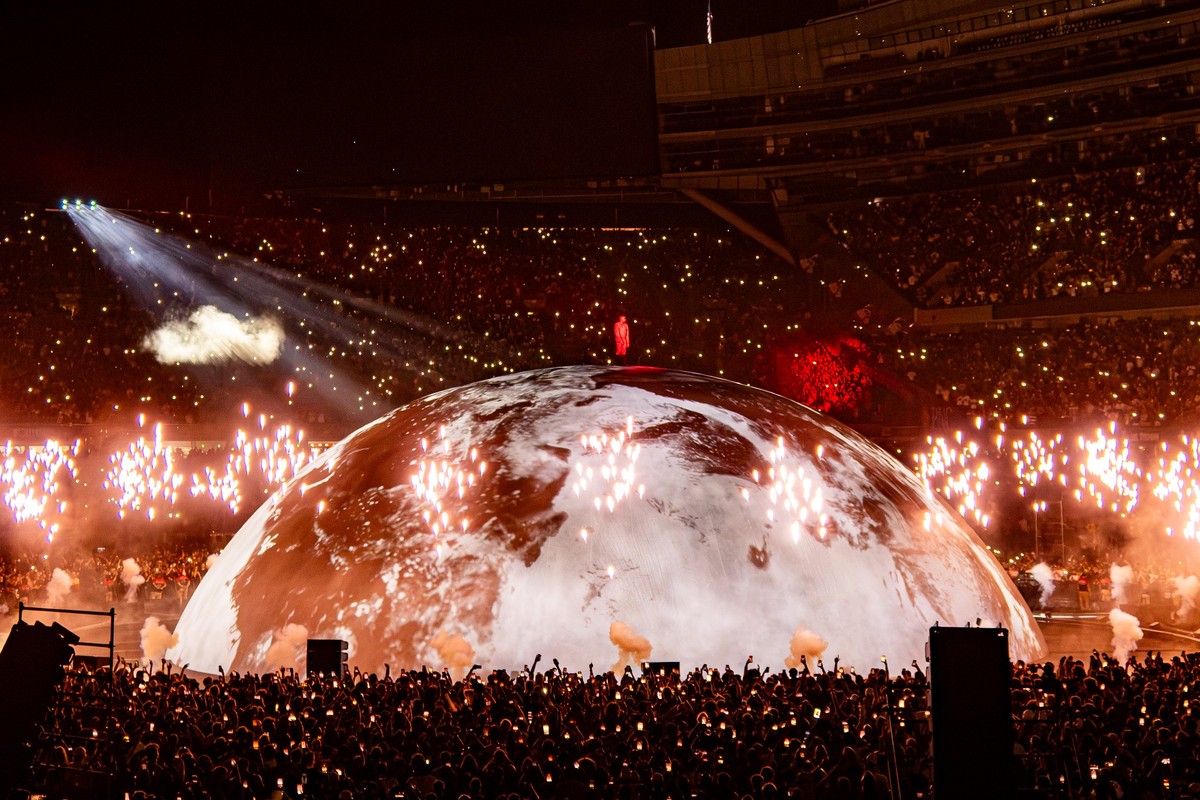

For all the mythology built around Ye (formerly Kanye West) as a singular genius, the most convincing argument for his influence has always been crowded with other people. Look closely at almost any important period of his career and somebody else is standing there: a rapper he produced for, an artist he signed, a voice he pulled unexpectedly onto a record, a peer who challenged him, a protégé who eventually became a superstar or a collaborator with whom the relationship became almost as famous as the music they made together. At Soldier Field this week, Ye managed to put an astonishing amount of that history in one place, making a compelling case that one of his greatest contributions to hip-hop might be the world he built around himself.
That world has hardly been harmonious. Friendships have fractured, G.O.O.D. Music relationships have soured and collaborators have criticised Ye publicly, often receiving plenty in return. Yet, across two nights in Chicago, the distance between those chapters seemed to collapse: Big Sean and 2 Chainz performed “Clique” and “Mercy”; Rick Ross returned for “Devil in a New Dress”; CyHi resurfaced for “So Appalled”; Twista took things back to “Slow Jamz” and “Overnight Celebrity”; Lupe Fiasco performed “Touch the Sky”; Chief Keef brought “Love Sosa” and “I Don’t Like”; and Common, Consequence, GLC, Really Doe, Future, Travis Scott, Young Thug and Don Toliver all moved through the stage before Kid Cudi arrived, bringing one of Ye’s most complicated creative relationships into the homecoming too.
Seeing the names written together almost misses what made it so good, because these artists don't belong to one Ye era, and they certainly don't belong to one version of hip-hop. Twista and Chief Keef alone represent radically different moments in Chicago rap history, while Travis Scott belongs to a generation that came of age after many of the musical risks Ye helped push into the mainstream, whereas Consequence and GLC were there when Kanye West was still fighting to convince the industry that the guy making the beats could also be the guy making the album. What made Soldier Field interesting was precisely that none of this history arrived neatly organised; instead, more than two decades of it seemed to keep walking onto the stage.
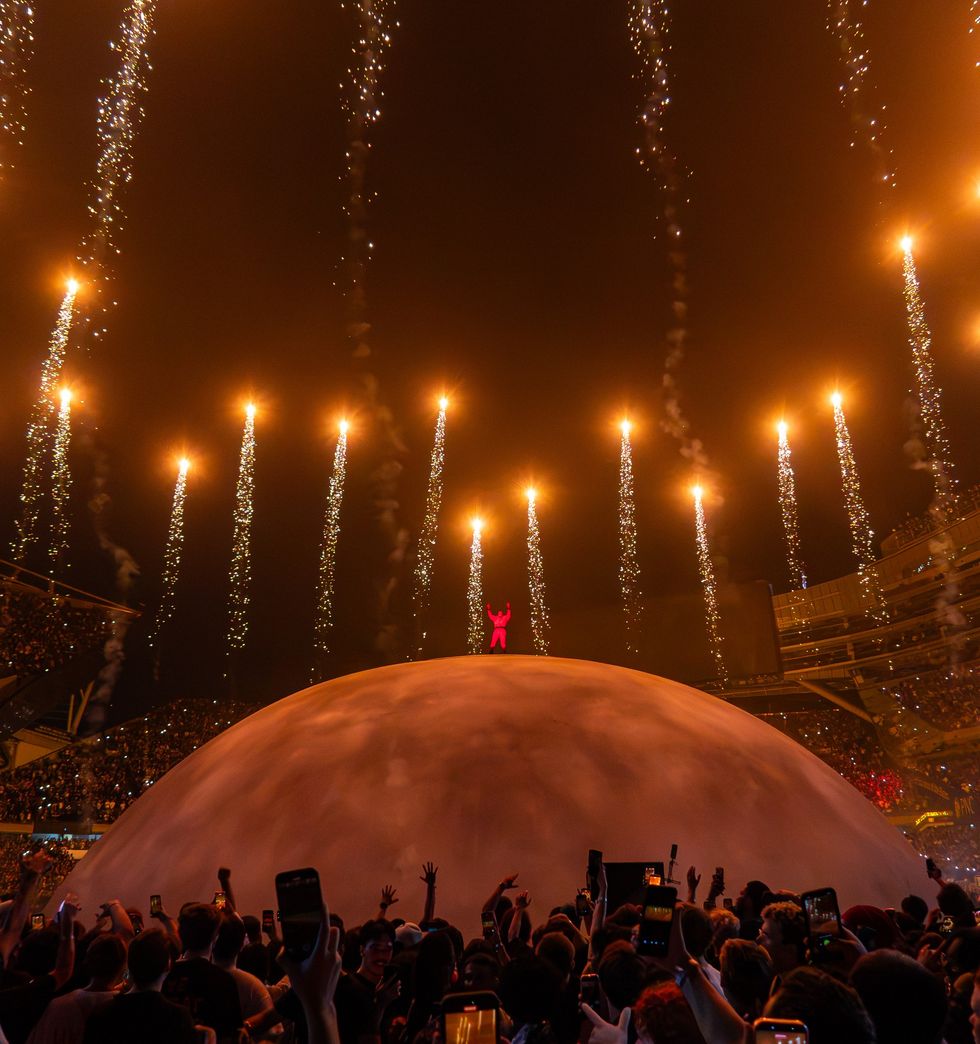 Ye in ChicagoCambams Cam
There was something fitting about Ye’s hometown becoming the place where those timelines could meet. Twista performing “Slow Jamz” more than two decades after the song helped establish West as a rapper offered one kind of homecoming, while Lupe returning for “Touch the Sky” offered another. Chief Keef performing “I Don’t Like,” after Ye helped turn the song into a G.O.O.D. Music posse cut in 2012, completed a different circle entirely, connecting Ye with a generation that would transform Chicago rap after his own ascent. The city was not merely the location of these concerts; its evolving rap history was part of what made them matter.
The G.O.O.D. Music appearances carried a different kind of nostalgia. There was a period when a Ye posse cut felt like its own event, when “Mercy,” “Clique” or a G.O.O.D. Friday release could make his extended musical universe seem impossibly exciting. The intervening years made hearing those records again more interesting than a straightforward throwback, however, because the artists involved had become stars themselves, pursued separate careers and, in certain cases, fallen spectacularly out with the person who originally brought them together.
Big Sean provided the weekend’s most obvious example. Ye signed him to G.O.O.D. Music in 2007, but their relationship eventually deteriorated so badly that, during a 2021 appearance on Drink Champs, Ye described signing Sean as “the worst thing” he had ever done. Sean subsequently challenged Ye’s account of their relationship and aired frustrations of his own, which made their reunion at Soldier Field particularly striking. Ye introduced Sean as his “homie from the D” before the pair performed “Clique”; Sean then delivered the wonderfully awkward-in-context “I Don’t Fuck With You,” and 2 Chainz joined them for “Mercy.” By the end of the appearance, Sean had told Ye that he loved and appreciated him, with Ye returning the sentiment. Watching them enjoy the records they had once made together said more than a grand declaration of reconciliation could have.
Kid Cudi’s appearance carried even more emotional history. Their creative partnership has produced some of the most adventurous music in either artist’s catalogue, while their friendship has also broken down publicly more than once. Cudi’s contributions around 808s & Heartbreak, their subsequent collaborations and eventually Kids See Ghosts made him much more than another artist in Ye’s orbit, which is why seeing him embrace Ye before they performed “Father Stretch My Hands, Pt. 1” and “Ghost Town” carried such weight. There was no need to pretend their history had been uncomplicated; the years of friendship, disagreement and reconciliation were precisely what made the moment affecting.
Those appearances also highlighted something Ye’s reputation for singular genius can obscure: his greatest records have always depended heavily on collaboration, and much of his talent has been in recognising what somebody else can contribute to an idea. My Beautiful Dark Twisted Fantasy remains perhaps the grandest example, its maximalism emerging from an enormous cast of musicians, producers and rappers whose contributions could occupy an entire verse or last only a few seconds. Soldier Field effectively allowed an audience to see that creative instinct rather than simply hear it.
Celebrating that musical history, however, cannot mean treating the more disturbing parts of Ye’s recent history as another feud to be folded into a story about complicated relationships. His repeated antisemitic remarks and embrace of Nazi imagery are categorically different from disagreements with former friends or collaborators, and their seriousness is not diminished because some of those relationships have since been repaired. Nor should the presence of so many artists beside him in Chicago be interpreted as collective absolution; who chooses to reconcile with Ye personally is separate from the harm caused by rhetoric directed at an entire community.
At the same time, acknowledging Ye’s musical influence is not the same as excusing his behaviour, and Soldier Field demonstrated why both realities have to exist in any honest assessment of his legacy. The influence of 808s & Heartbreak does not disappear because its creator later made antisemitic statements, just as the music Ye made with Big Sean or Kid Cudi does not cease to matter because those relationships fractured. The harder, and more useful, task is to reckon with the work without allowing admiration for it to soften the seriousness of everything that followed.
That tension is ultimately what made Chicago worth considering beyond the spectacle of who might walk out next. Some of the people onstage had been there near the beginning, others entered Ye’s story much later, and several had long since built influential careers of their own. Over two nights in the city where his own career began, those histories briefly converged again, revealing both the extraordinary reach of Ye’s musical legacy and the complicated reality in which it now exists.
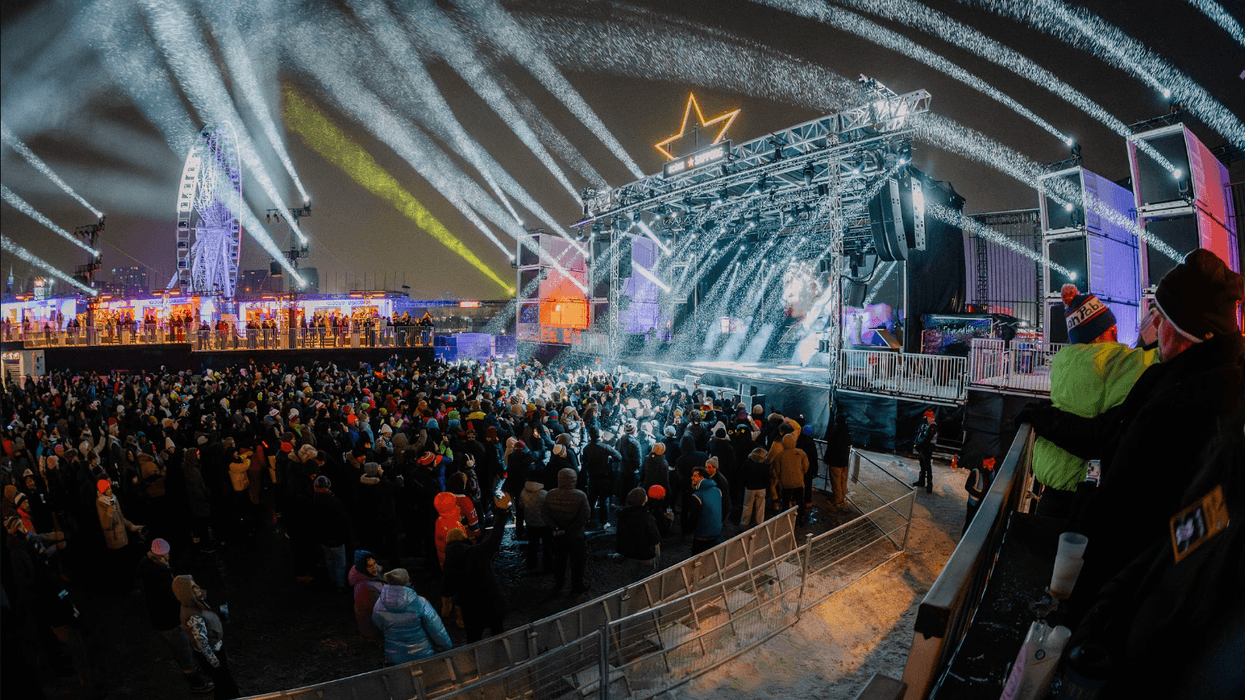
Ye’s independently produced global stadium run is being executed in the U.S. alongside IKON Presents, with the Chicago weekend alone drawing approximately 142,000 fans across two nights, according to organizers.



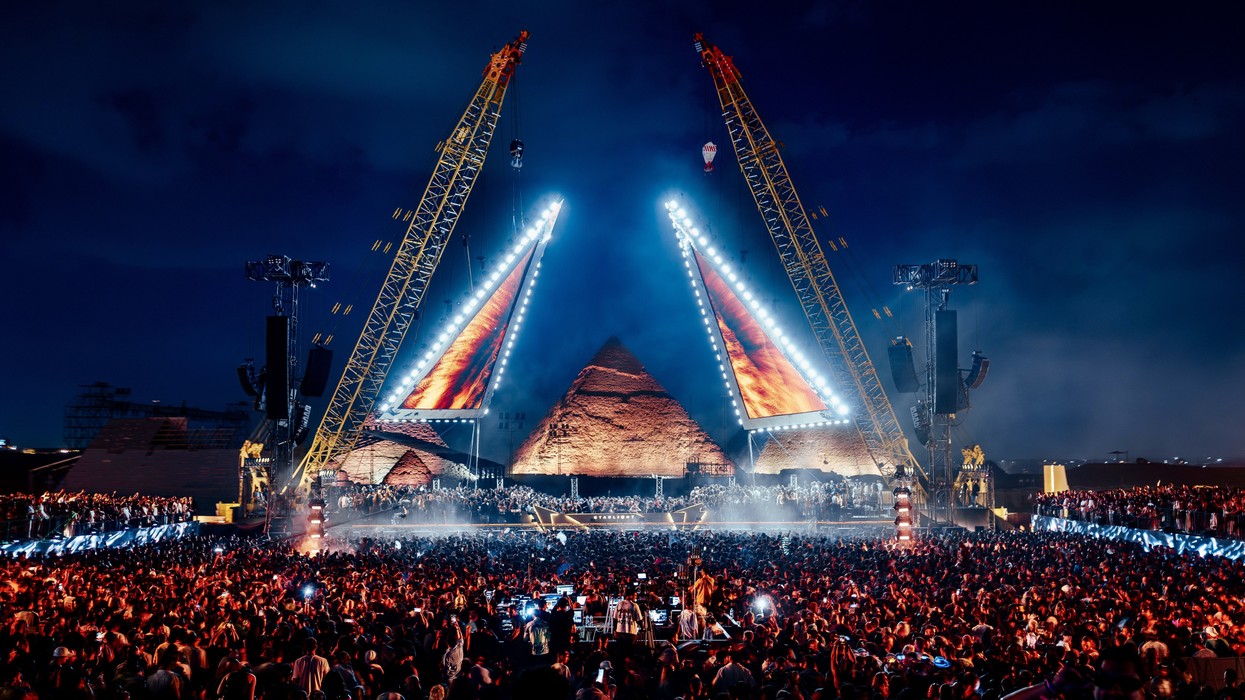
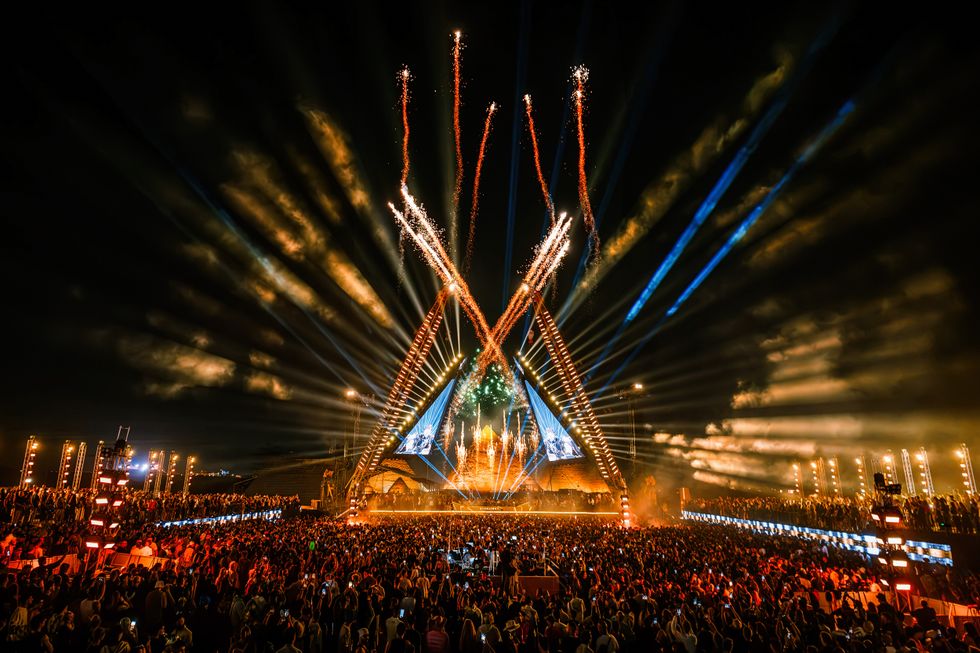 Courtesy Photo
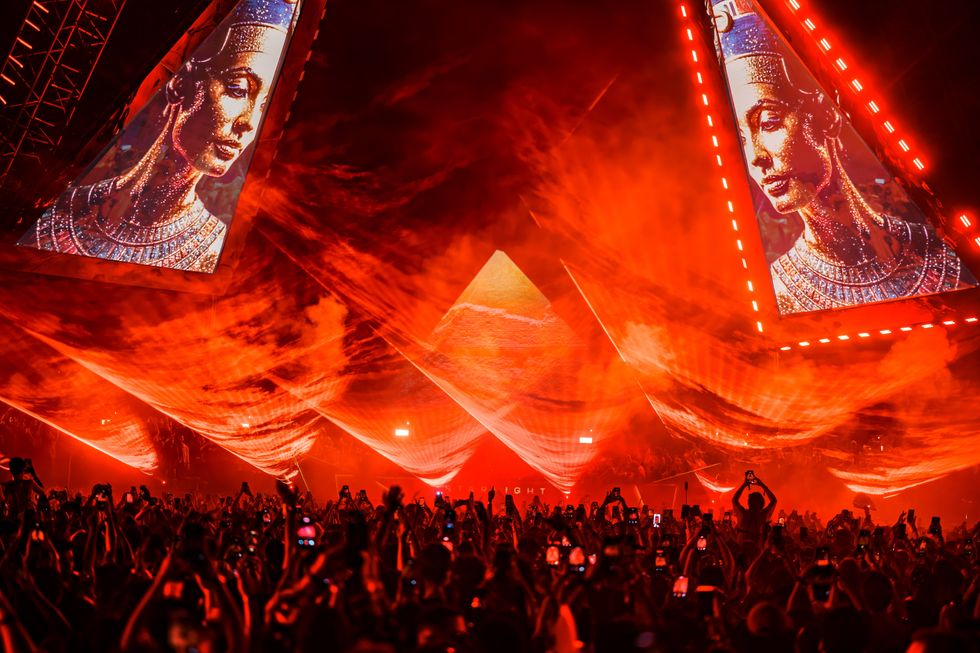 Courtesy Photo
Liam Payne (left) and Harry Styles of One Direction onstage during the 2013 American Music Awards at Nokia Theatre L.A. Live on Nov. 24, 2013
Harry Styles Finds the Right Words on Liam Payne Tribute Song
For the past seven weeks, Harry Styles has reserved two minutes at each of his Madison Square Garden shows to reflect on the last time he gathered this many people in this room. Four years have passed since he performed 15 record-breaking nights at the venue during his Love on Tour. Now, every night at the new Together, Together shows, which span 30 nights at MSG, he acknowledges that “a lot of life happened to me and landed on me in ways that maybe it hadn’t before.”
Styles doesn’t usually go into much more detail; he typically just describes those in-between years as “a great reminder for me of just how wonderful and beautiful, difficult and inspiring, and also how fragile a life can be.” He encourages the audience to look around at each other and celebrate the community they’ve built together. Then he dives into “Sign of the Times.” It happens every Wednesday, Friday, and Saturday like clockwork. But when he delivered this speech on Friday, Oct. 16, there was a shift. It didn’t conclude in its usual way.
Instead, Styles turned his attention to the banner commemorating his 15 consecutive nights at the Garden in 2022. “It means a lot to be able to look up there at my name up there from the last tour,” he said. “There are so many people, friends and people that I’ve worked with, that I would’ve never been able to do this without.” Two years ago, he continued, he lost one of those pillars. Friday’s show fell on the same day as the second anniversary of the death of Liam Payne, a loss that time has not made it easier to acknowledge. “I’m sure a lot of you have been through something similar,” Styles said. “I hope you haven’t.”
A frequent assessment of Styles, both among his fans and those who’ve only encountered him at a distance, is that he often talks at length before getting to the point. He recognizes it himself on the Kiss All the Time. Disco, Occasionally song “Coming Up Roses,” where he sings about fumbling his words. But recently, comments about his long-winded way of speaking have started to feel like purposeful misreadings. There are clear and carefully considered thoughts present between his starts and stops. Anyone truly listening will pick up on those threads.
Styles cut himself off a few times during his speech on Friday. He tried to talk for a second about looking after each other, and repeated his point about the banner and the people who’ve supported him. He never mentions Payne by name, instead referring to him as a friend, which somehow became a point of criticism from some fans. The context is clear enough. Still, he seems to know it’s a gamble to expect understanding, especially when the conversation grows more complex and personal.
After about a minute and a half, Styles figured it best to show us what he means rather than tell us. “I’m gonna sing a song I wrote two years ago for my friend,” he said before premiering “Wise Enough.” The sullen tribute to Payne settled the room into a cool near-silence, punctured by quiet gasps and muffled crying. It was beautiful, devastating, and deeply exposing to watch Styles share his grief with 20,000 people in the best, and maybe only, way he knows how.
Earlier this year, Styles told Zane Lowe about the acute dread surrounding the expected performance of his mourning. “Full transparency, even the idea of talking about it, I struggle with that a little bit. There was a period when he passed away where I really struggled with acknowledging how strange it is to have people own part of your grief, in a way,” he said. “I have such strong feelings around my friend passing away. And then suddenly being aware there’s maybe a desire from other people of you to convey that in some way, or it means you’re not feeling what you’re feeling.”
Artists often describe the act of sharing new music as a change in ownership, something that is no longer their own once it has been handed over to an audience. “Wise Enough” feels protected from this. It would be confounding to see Styles ever record and release it in any official capacity. The song is openhearted in a way that exposes deep scars, anxious in a way that worries and fidgets about time and how it passes, and inconsolable in a way that doesn’t make the futile attempt to fight through anger, regret, or sadness.
“I can tell you what it’s like to bury friends on Wednesday nights/Gather in a garden around the fire,” Styles sings in a particularly cutting verse on the song, which concludes with an honest admission: “I’m not wise enough to call for a conversation/And then back it up, right?/Like you’re in the sky.”
Celebrity doesn’t obscure grief. It doesn’t come with a script for what to say when someone is sorry for your loss, or when they recollect their own version of the person you knew. No one really has the right words for these moments. Over the weekend, fans debated whether “Wise Enough” is actually titled “What Is Enough?” Styles introduced the record so briskly it was hard to decipher. The question of adequacy feels similarly impossible to answer.
Grief is so plain in how universal it is, but so complex in how and when it chooses to present itself. It can be policed only as much as it can be predicted, which is to say barely at all. That Styles let us into his now yearslong search for some semblance of understanding — knowing how his words have been picked apart before for far lesser things — shouldn’t be taken for granted.
Styles never acknowledges that banner at MSG. It’s not for lack of gratitude — he cried when it was unveiled. But the point he has reiterated every Wednesday, Friday, and Saturday since the end of August is that the achievement is something that must be shared because he couldn’t have done it alone. He talks about being on stage as if what happens in that room exists far beyond and outside of himself, something that endures even in his absence.
It’s true in a way. There’s muscle memory tied to the music. It’s in the spinning, dizzying way fans dance to “Satellite,” or the way they wildly kick their feet and make the building shake during “Kiwi,” a song he brought back to the set just for New York. It’s just like before, but still so different.
Friday night continued as usual after “Wise Enough.” Styles belted out “Sign of the Times” in the sobering way he always does, then “Aperture” let in a cathartic flood of strobing lights and pulsating beats. The emotional whiplash took physical form as fans consoled one another, holding out their hands to help up friends and strangers who crumbled to the floor at the conclusion of the tribute. Some were crushed by their memories of loving One Direction, and the care they hold in their hearts for Styles. Some were just as wrecked by their own personal losses.
A lot of life and loss can happen in four years, as Styles says each night. For some people who were at MSG on Friday, there are friends present in their memories from the last tour who are missing from the new ones they’re making. The lyric “You dance until you’re tired/No, you don’t, and now you never will/Will you?” surfaces their own devastation completely separate from what inspired Styles to sprawl those words on a page. How do you dance to “Aperture” — the beating heart of this show in its declaration that “we belong together” — after hearing something like that?
You take the hand of the friend or the stranger who pulled you from the ground and use it to lead each other back to the dance floor. When Styles talks about community and stresses the importance of caring for one another each night, he reminds everyone of the fragility of a moment, and urges them to cherish every second they get. To dance wildly and sing loudly and wrap their arms around each other. To hold tight to what’s here right now.
It’s all any of us have, so it has to be enough.