
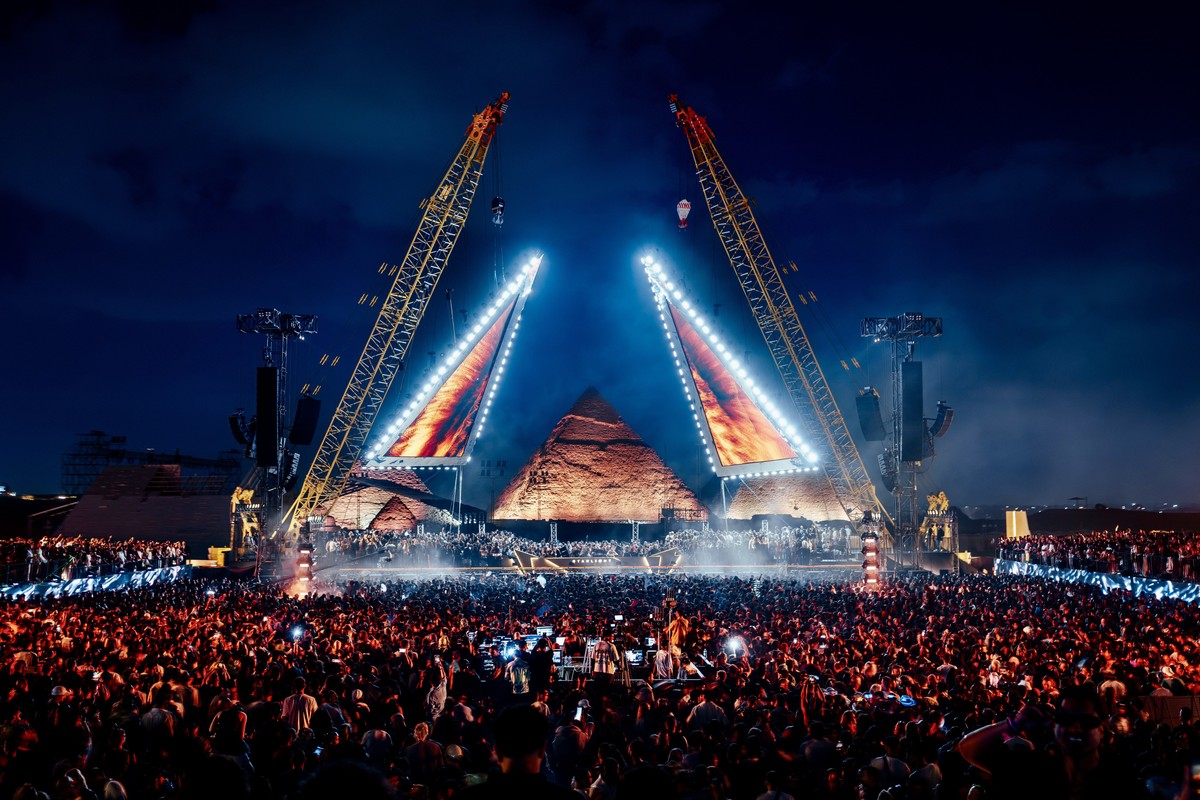

There are few things that can prepare you for the sight of thousands of people dancing to electronic music with the Great Pyramids of Giza towering in the distance. Even fewer can prepare you for the production accompanying it. Over two nights in Egypt, I watched Starlight Festival unfold from practically every possible vantage point, from behind the decks and the thick of the general admission crowd to the VIP viewing stands and lounges. Each offered a different perspective, and remarkably, every single one was stellar. For a festival making its debut in one of the world's most extraordinary locations, that consistency was perhaps its greatest achievement.
Held on October 9 and 10, Starlight brought more than 60 international and regional artists to a designated site overlooking the pyramids. Organised by Serbia's EXIT Festival in collaboration with P+US, Venture Lifestyle's electronic music platform, the sold-out event attracted attendees from 114 countries across five stages. Charlotte de Witte, Michael Bibi, Adriatique, Indira Paganotto, Enrico Sangiuliano, Vintage Culture and Pete Tong led a programme spanning melodic house, tech house and harder varieties of techno. According to the organisers, it was the first multi-day, multi-stage electronic music festival at Giza and the largest electronic music gathering in the area since Jean-Michel Jarre's millennium concert in 1999.
For EXIT, the Egyptian debut carried particular significance. Founded in Serbia in 2000 as a student-led movement advocating democratic change, the festival spent more than two decades establishing itself at Novi Sad's Petrovaradin Fortress. Following its public support for student-led protests in Serbia, EXIT announced that it could no longer continue staging its flagship event at home under the prevailing financial conditions. The organisation attributed the withdrawal of public funding and sponsorship support to its political position, a characterisation disputed by Serbian authorities. Its subsequent international expansion culminated in Starlight, developed with P+US as one of the most ambitious stops on its 2026 tour.
That history became particularly interesting to hear firsthand. Having travelled from Mumbai via Riyadh, I arrived at Giza Palace, a five-star property whose beautifully scented lobby, impeccable service and thoughtful welcome provided an excellent introduction to Egyptian hospitality. The first evening brought an intimate dinner with EXIT's leadership, booking agents, programmers, publicists and fellow international guests. Conversations moved between the festival's Serbian roots, the challenges of staging events across borders and the considerable planning required to bring an international production of this scale to Giza. It was a fascinating opportunity to understand the people and decisions behind an event that had been months in the making.
The following evening began at Khufu's, the acclaimed restaurant overlooking the Giza plateau, where an excellent four-course meal preceded our first visit to the festival. Between the hospitality, beautiful surroundings and conversations with the organisers, there was a genuine sense of anticipation around what we were about to experience.
Getting inside, however, required patience. Multiple security checkpoints and thorough inspections made the arrival process somewhat hectic. Given the location, the precautions were understandable, and the personnel remained consistently courteous, often explaining the procedures to visitors. Nevertheless, a more streamlined entry process would make a considerable difference to future editions.
 Courtesy Photo
Once inside, the production was quite simply breathtaking.
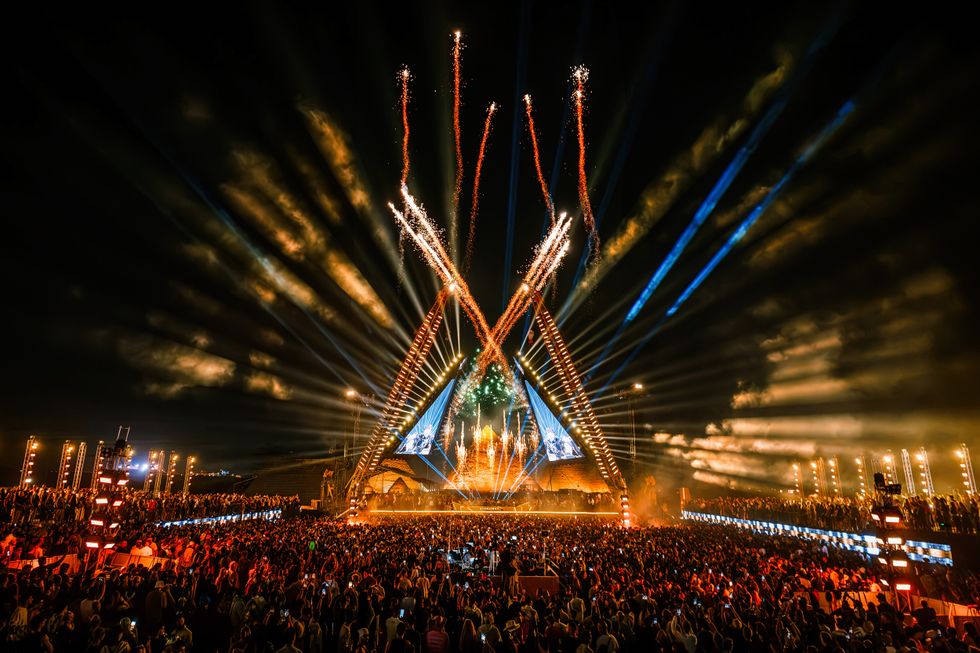
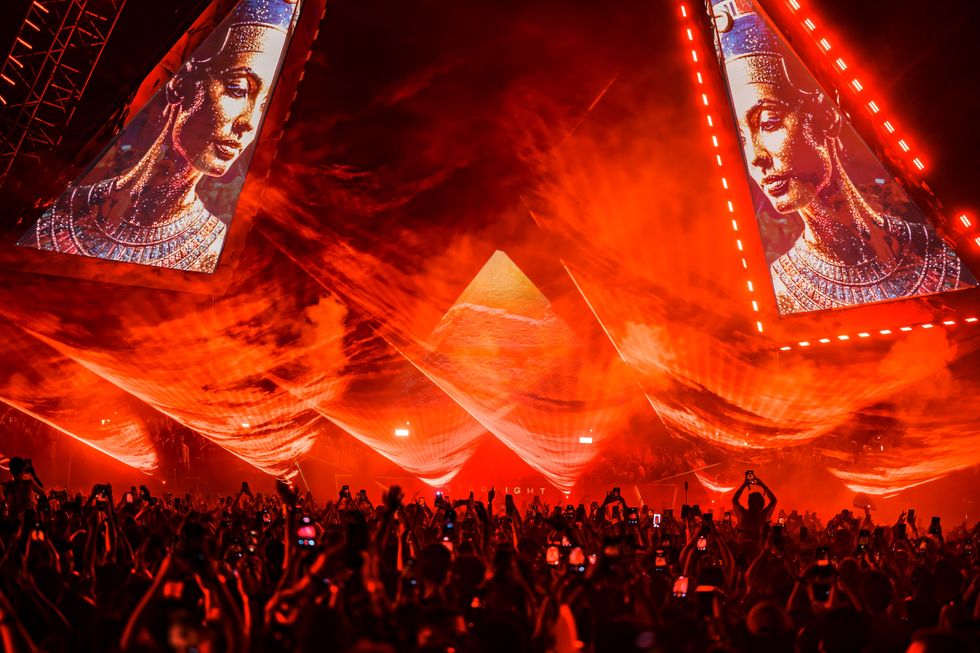
Designed by multimedia studio Sila Sveta, the main stage featured two enormous triangular screens suspended above the performance area, their geometry echoing the pyramids beyond. Rather than obscuring the monuments, the design framed them, allowing the landscape to become an integral part of the visual composition. As darkness fell, intricate animations, lasers and meticulously synchronised lighting transformed the installation, creating optical illusions that occasionally made the pyramids appear to float above the stage.
I've attended festivals with considerably larger stages and more elaborate installations, but Starlight's lighting was among the finest I've encountered. The visual sequences were exceptionally precise, with an attention to detail that made the entire production feel cohesive. Against the dark desert sky, the effect was extraordinary, particularly when the lasers appeared to extend the stage far beyond its physical boundaries. It was the kind of production that demanded a few minutes of uninterrupted appreciation before you could fully take in everything happening around you.
Fortunately, the music was every bit as compelling.
Friday's programme included Adriatique, Pete Tong and Vintage Culture performing back-to-back, alongside live electronic acts WhoMadeWho and Satori. Adriatique were an immediate highlight. The Swiss duo's melodic techno, with its carefully layered arrangements and measured progression, translated beautifully to the main stage. Their set had a hypnotic quality, allowing the music to develop naturally while the surrounding production amplified its impact.
Elsewhere, EXIT's No Sleep stage offered a considerably more intense experience. Indira Paganotto's ARTCORE showcase brought harder, faster techno to the festival, with Charlie Sparks, BIIA, Paolo Ferrara and Valentinø among the featured artists. The stage attracted a substantial crowd, offering a welcome contrast to the melodic and house-driven sounds elsewhere. With two major stages and three smaller spaces, Starlight had enough variety to keep audiences moving between different musical experiences throughout the weekend.
Saturday was particularly memorable, delivering three of my favourite performances of the festival. Cloonee's groove-heavy house set was infectious, with an irresistible rhythmic energy that made it difficult to leave the dancefloor. Michael Bibi followed with an equally impressive performance, his command of pacing and transitions demonstrating precisely why he remains such a compelling presence on the international circuit.
Watching Bibi from behind the decks was especially memorable. Something is fascinating about experiencing a festival from the artist's perspective, with thousands of people dancing beyond the stage and the entire production unfolding around you. Yet, what impressed me most was that the experience was just as enjoyable when I returned to the general admission crowd. The sound, atmosphere and sheer scale of the production translated exceptionally well from the dancefloor, while the VIP viewing stands offered a spectacular perspective on the stage and pyramids. Even the lounges provided a comfortable space to take in the event without feeling removed from its energy.
 Courtesy Photo
It is not unusual for festivals to offer vastly different experiences depending on the ticket category, but Starlight managed to deliver something genuinely impressive across all of them. Whether I was standing behind the DJ booth, dancing among the crowd or watching from an elevated platform, the atmosphere remained consistently engaging. That attention to the overall audience experience deserves particular recognition.
Charlotte de Witte, making her first appearance in Egypt, brought Saturday's main-stage programme to a formidable conclusion. Her uncompromising approach to techno provided an exhilarating change in intensity, with forceful selections and assured transitions that worked beautifully alongside the stage's elaborate lighting. The production reached some of its most impressive moments during her performance, although de Witte remained firmly in command of the experience.
Beyond the headliners, the lineup featured an impressive mix of international and regional talent, including Enrico Sangiuliano, Fiona Kraft, Floyd Lavine, Deer Jade, Layla Benitez and Baset. Credit is due to Jennifer Cochrane for putting together such a well-curated programme, one that offered plenty to discover beyond the main stage. The smaller stages were equally compelling, giving audiences the freedom to explore different sounds and artists rather than simply moving between the weekend's biggest names.
There was also something rather wonderful about the crowd itself. Starlight's international appeal was evident throughout the grounds, with conversations taking place in numerous languages and visitors arriving from across the world. At one point, I unexpectedly bumped into friends from four different countries, none of whom I had arranged to meet. We had all travelled independently to Egypt, making the encounters as improbable as they were delightful. I've experienced the occasional unexpected reunion at festivals before, but Giza was certainly a first.
The hospitality throughout the trip was another highlight. From the team at Giza Palace to the organisers responsible for our dinners and transport, there was a genuine warmth to the experience. The festival grounds were well maintained, the bars adequately stocked and the facilities comfortable. Occasional language barriers with local staff were handled with admirable patience, often through translation applications on their phones. These may seem like small details, but they contribute enormously to the overall experience, particularly at an event welcoming visitors from so many countries.
Starlight was not entirely without its challenges. Entry procedures could be streamlined, and the complexities of staging an event near one of the world's most important archaeological sites will continue to require careful planning. The preservation of Giza's historic landscape must remain a priority as the region attracts increasingly ambitious international productions.
For a first edition, however, the festival was an impressive achievement. The collaboration between EXIT and P+US combined substantial international experience with local expertise, resulting in an event whose musical programming, production and hospitality felt thoughtfully developed. The announcement of a return on November 5 and 6, 2027, suggests that the organisers are already looking beyond the success of the inaugural weekend.
I arrived in Egypt expecting an exceptional setting and a strong lineup. What I experienced was a festival that exceeded those expectations in practically every respect. Between Adriatique's absorbing performance, Bibi's infectious energy, de Witte's commanding finale and a visual production I won't soon forget, Starlight delivered two of the most enjoyable nights I've spent at an electronic music event. More importantly, it demonstrated that an ambitious new festival can deliver an equally rewarding experience whether you're standing behind the decks or dancing in the middle of the crowd.
Next on my calendar is Zamna, which returns to Sharm El-Sheikh from November 20 to 22, with CamelPhat, Mind Against and Marco Carola among the names worth looking forward to. For now, though, Starlight deserves its moment. Few inaugural editions manage to leave such a lasting impression, and Egypt has given me every reason to return.






Trump is Selling Out Ukraine to Putin