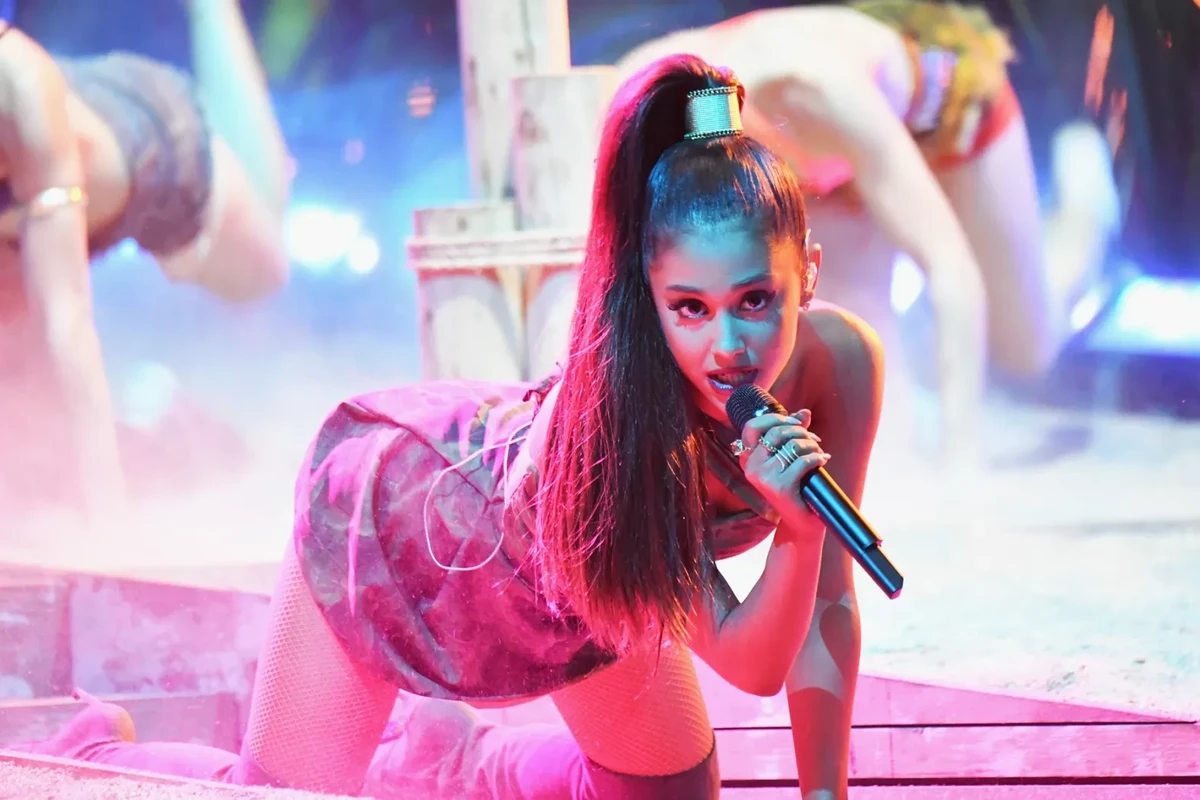

Ariana Grande could never have become the kind of era-defining pop star we know her to be if she’d been timid or precious about her feelings. This is the artist who earnestly sang “This situationship has to end” on Eternal Sunshine while addressing the dissolution of her marriage. She’s the same one who casually delivered the lyric “Look at you, boy, I invented you” on Thank U, Next, which she recorded after breaking off an engagement with someone whose name is a song title on Sweetener. The same one who released Positions.
Grande couldn’t have made these albums without creating Dangerous Woman first. Ten years after its release, the singer’s third studio album is fundamental to her evolution as one of the biggest voices in pop, both figuratively and literally — “Greedy” might be the loudest song she’s ever made. But more than anything, Dangerous Woman was pivotal in establishing the kind of stories Grande could tell with that ironclad voice, and the emotions she could convey through it. It put the future of pop right in her hands.
“Young Ariana run pop,” Nicki Minaj rapped on “Side to Side,” the highest-charting single from the album. It would be two years before Grande scored her first Number One single (with “Thank U, Next” in 2018), and yet Minaj’s declaration carried so much truth. Pop was in a transitional space in 2016: Rihanna and Beyoncé solidified their legacies with Anti and Lemonade, respectively. The charts were mostly dominated by Drake and Justin Bieber. Elsewhere, the Chainsmokers and Meghan Trainor scored major hits, too. But there wasn’t anyone operating in the same space as Grande. It’s one thing to have a powerhouse voice. It’s another to control it the way she does across Dangerous Woman.
“Into You” is one of the truest examples of an instant classic in modern pop history. “The first sentence, that ‘I’m so into you / I can barely breathe’ is like maybe the closest thing to pop perfection I’ve ever heard,” Lorde said a few days after “Into You” arrived as the second single from Dangerous Woman. Grande sings that lyric in a low tone, not quite a whisper, but something just as fragile and out of breath. As she inches towards the explosive first chorus, her voice moves closer and closer until it consumes the entire song with a daring demand: “Baby, come light me up.” The enraptured bridge takes it from exceptional to masterful.
“Touch It” is similarly dizzying from beginning to end. Whenever it starts to sound like it’s reached a peak, she takes it further, plowing forward with unrelenting high notes and knockout vocal runs. The thudding percussion on “Thinking Bout You,” the final track on the album, replicates an eager heartbeat. Tucked just behind the beat, airy harmonies swirl around Grande as she grasps at a phantom embrace and the song ramps up into an explosive bridge. “I’ve been waiting patient, patiently/’Cause I don’t have you here with, here with, here with me,” she sings. Then comes the full-send, euphoric release: “But at least I have the memory.” It feels like a natural precursor to “Imagine” from Thank U, Next, or “Better Off” from Sweetener — songs you have to close your eyes to really hear and, consequently, feel.
Most of the album was created with Max Martin, Ilya Salmanzadeh, and Savan Kotecha, as well as Tommy Brown. With credits on 10 of its 15 songs, it was the most involved Grande had ever been in the writing process at that point in her career. These days, Grande serves as writer and co-producer alongside Martin and Salmanzadeh, who have come to be her closest collaborators. Her now-signature vocal production style, stacking layers and layers of airy harmonies in intricate arrangements, first started to take shape on Dangerous Woman. So did her narrative voice. Grande has an expert understanding of how pop has come to operate over the past decade, not just as an artform but as a kind of archive of an artist’s life.
As an album title, Dangerous Woman is as on the nose as the pop records that preceded it, like Rihanna’s Good Girl Gone Bad, or Christina Aguilera’s Stripped. It’s important to note that the discourse around nearly every woman in pop a decade ago was completely inseparable from the expected performance of feminism. Something as standard as embracing yoursexuality was positioned as a radical act, rather than women just, well, existing. And yet, Dangerous Woman almost never feels like it’s trying too hard to convince you to see Grande in a new light — even in the moments that haven’t held up as well. The proclamation of “We got that hood love/We got that good love/We got that hot love” on “Bad Decisions” is undercut with a knowing wink: “Ain’t you ever seen a princess be a bad bitch?”
Even at 22, she built intrigue around her pop persona. On the second half of “Knew Better / Forever Boy,” a two-part record that breaks up, moves on, and falls in love all within five minutes, Grande sings, “Never been with a boy more than six months/I couldn’t do it, got too used to it.” It’s not a confession, just a fact. It’s how we get “The Boy Is Mine” and “Twilight Zone” on Eternal Sunshine, where she sings, “Why do I still protect you?/Pretend these songs aren’t about you/Hope this might be the last one/’Cause I’m not fooling anyone.” There’s an intimacy in how she sings about relationships, direct in her delivery but not ignorant about her audience’s curiosity. The first lyric we hear on “Let Me Love You,” a sultry collaboration with Lil Wayne, is: “I just broke up with my ex.”
Pop didn’t seem to fully go all-in on Grande until Sweetener and Thank U, Next catapulted her into the highest echelons of the genre. It was when it became impossible to separate the narrative of her life from her music. The bombing at her Manchester stop on the Dangerous Woman tour in 2017 and the death of her former partner and collaborator Mac Miller in 2018 cast a heavy shadow of grief around her career. With each new release, audiences treated her with an exaggerated fragility that ignored the tenacity she wielded across Dangerous Woman. Her brazenness on the album wasn’t in response to any trauma or tragedy — bouncing back and pushing through is how she’s always kept herself grounded.
The bluesy “I Don’t Care” is one of the most underrated cuts on Dangerous Woman. It’s a clear precursor to “Shut Up” on Positions and “True Story” on Eternal Sunshine, not just in sound but in subject matter. “Now I laugh about the things that used to be important to me/Used to have a hold on me,” she sings. “Like what do you think, and what he thinks, and what they think/But I love me.” In the years that followed Dangerous Woman, Grande would find herself in need of these reinforcements more and more. Being able to shut out the noise kept it from drowning out her voice. That focus let her sharpen her skills as a songwriter and producer as the artistic metamorphosis that began on Dangerous Woman completed its evolution.
Dangerous Woman took Grande from hitmaker to tastemaker. For a moment, she seemed comfortable in that initial position. Dangerous Woman was almost called Moonlight, after the doo-wop inspired ballad that opens the album. “Focus,” the horn-heavy, one-off single released in 2015, was initially intended to be the lead single. But both songs retread ground Grande already covered. “Focus,” ultimately left off the album entirely, would have been more at home on 2014’s My Everything alongside “One Last Time,” “Problem,” and “Break Free.” Meanwhile, “Moonlight” called back to her 2013 debut, Yours Truly. Dangerous Woman needed to be different. Her shift in direction brought the undercurrent of R&B influence from her earliest releases to the forefront while still asserting her position in pop.
Anyone who was caught off guard by her full lean into this intersection on Positions wasn’t paying attention when it mattered most. “She’s now at the peak of her powers as a tastemaker, a songwriter. All the success she’s had, she’s learned from it all: What her voice is, what works for her,” Kotecha told Rolling Stone about Grande in 2019 following the release of Thank U, Next. “When the producer or engineer is not understanding what she wants [from the vocal arrangement], she just goes, ‘Do you mind if I sit and do it?’ She’ll go into Pro Tools and fix it. She’s a master of the craft. I’ve been around some of the greatest singers of all time. I’ve never seen anything like this.”
In July, Grande will release her eighth album, Petal. “It’s definitely from a place where I have been maybe too shy or polite to tap into before,” she said about the record. “This kind of just feels like, fuck it.” It’s the same ethos that shaped Dangerous Woman, when Grande first realized being shy and polite would never serve her as well as being an unapologetic, absolute pop powerhouse.