
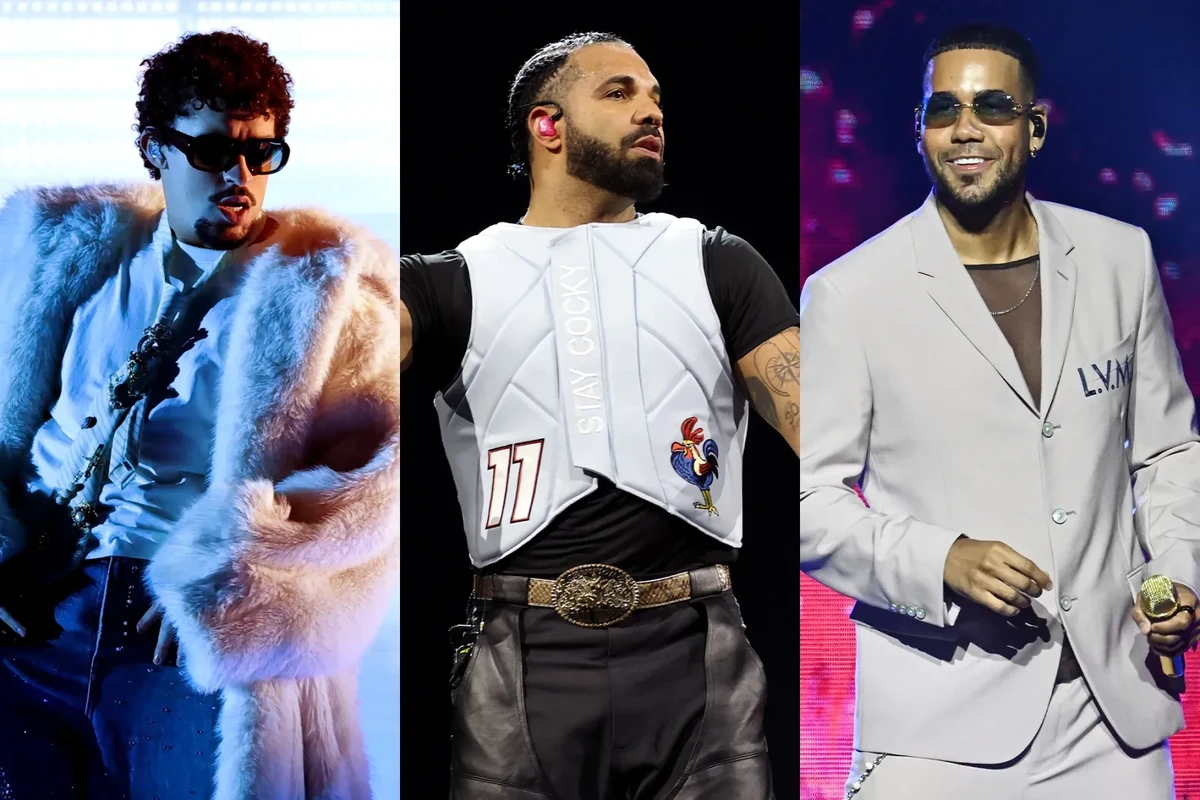

Drake‘s Iceman is right around the corner, which means speculation about the highly anticipated album has reached a fever pitch. Charlamagne tha God added to that frenzy on The Breakfast Club on Monday, when he claimed Karol G makes an appearance on the album. This would mark her first-ever collaboration with the rapper.
Neither Drake nor Karol has not confirmed the rumors. Representatives for both Karol G and Drake did not immediately respond to Rolling Stone’s request for comment. But given Drake’s history of collaborating with Latin music artists, a Karol G feature is not out of the realm of possibilities.
Over the course of his career, Drake has often embodied his Champagne Papi persona and dabbled with Latin music, working with some of the genre’s biggest stars. He’s hopped on tracks for Romeo Santos, Bad Bunny, and rising música mexicana artist Chino Pacas, and even tapped these artists for his own songs. Below, we look back at all of the times the rap superstar expanded the boundaries of his sound to include Latin music.
2014: “Odio,” Romeo Santos feat. Drake
On 2011 hit “The Motto,” Drake famously sang about how “Spanish girls love [him] like [he’s] Aventura.” Three years later, life imitated art when the rapper hopped on a song with Romeo Santos, lead singer of the New York bachata group he name-checked. The melancholic, bachata-flavored track is Drake’s first-ever attempt at singing in Spanish, and he gives it his best: “Celo sus besos / Sobre tu cuerpo / La envidia se apodera así de mí,” he sings, which translates to “I’m jealous of kisses / On your body / Envy takes hold of me.” It’s proof that even in another language, the moody rapper still can’t shake his loverlorn disposition.
2018: “Mía,” Bad Bunny feat. Drake
In 2018, Bad Bunny and Drake teamed up for a collaboration that shifted the conversation between hip-hop and Latin trap. The song perfectly fused signature elements from both genres, creating a club hit that peaked at Number 5 on the Billboard Hot 100 and gave Bad Bunny, a then-rising star, his first top ten on the chart as a lead artist. “Mía,” which was featured on the the Puerto Rican musician’s debut LP X 100pre, also marked the first time Drake rapped entirely in Spanish for a song, which Bad Bunny insisted on. “It was a great moment for both [of us],” Benito told Billboard Canada recently. “He really believed in Latin music at that time. It was the very beginning.”
2023: “Gently,” Drake feat. Bad Bunny
Five years later, Drake tapped Bad Bunny for a track on his For All the Dogs LP. This time the Canadian rapper went into Spanish-accented Drizzy mode but only for a couple of lines before continuing to spit over a classic dembow beat. True to his roots, Bad Bunny delivered his verses in Spanish with a uniquely Boricua flow. “Gently” didn’t come with a music video filmed in Miami like “Mía” did, but it still charted at Number 12 on the Hot 100.
July 2024: “Healing,” and “Sideways,” Gordo, Drake
Drake and Gordo have been longtime collaborators; Gordo is known for a bunch of tracks on Drake’s 2022 album Honestly, Nevermind. So it made sense that in 2024, Drake hopped on artist/DJ/producer Gordo’s third LP Diamantes, working as an unofficial consultant on the entire album. “He rides for me that heavy and he’s letting the world know that,” Gordo told Rolling Stone at the time. On both “Healing” and “Sideways,” Drake sings about love lost, his R&B-inflected vocals contrasting Gordo’s electronic beats for a hypnotic effect.
October 2024: “Modo Capone,” Chino Pacas, Fuerza Regida, Drake
-
Drake further explored the world of Latin music when he worked with música mexicana artist Chino Pacas on a corrido. The Toronto rapper sings “Cubanas me gusta portarlas, dinero es poder” over a flurry of guitarrón, accordion, and saxophone notes.
“Modo Capone” came together after Drake saw Pacas perform at the Houston Rodeo. Later, he hit up the música mexicana artist over Instagram DM, asking him to write a song for him. Pacas sent him “3 Letras (OVO),” a corrido dedicated to the rapper’s success. It was impressive enough that Drake hopped on a song with Pacas, gifting the young artist with a major collaboration for his debut LP. “You can tell his professionalism and his years in the industry,” Pacas told Rolling Stone at the time. “It’s something else. We have a lot of chemistry and that’s why we ended up working together.”
2025: “Meet Your Padre,” Drake, PartyNextDoor feat. Chino Pacas
The chemistry between Pacas and Drake remained strong a few months later when Pacas jumped on Drake and PartyNextDoor’s joint album $ome $exy $ongs 4 U for “Meet Your Padre.” The track is heavy on the Toronto influence, filtering any Mexican notes through an icy OVO sheen as Pacas delivers lines in Spanish with his signature throaty timbre. Meanwhile, Drake sticks to English and briefly confuses his Latin references, rapping about a Brazilian city, the Dominican genre “bachata,” and Mexican girls in the same verse.



 Courtesy Photo
 Courtesy Photo
Liam Payne (left) and Harry Styles of One Direction onstage during the 2013 American Music Awards at Nokia Theatre L.A. Live on Nov. 24, 2013
Harry Styles Finds the Right Words on Liam Payne Tribute Song
For the past seven weeks, Harry Styles has reserved two minutes at each of his Madison Square Garden shows to reflect on the last time he gathered this many people in this room. Four years have passed since he performed 15 record-breaking nights at the venue during his Love on Tour. Now, every night at the new Together, Together shows, which span 30 nights at MSG, he acknowledges that “a lot of life happened to me and landed on me in ways that maybe it hadn’t before.”
Styles doesn’t usually go into much more detail; he typically just describes those in-between years as “a great reminder for me of just how wonderful and beautiful, difficult and inspiring, and also how fragile a life can be.” He encourages the audience to look around at each other and celebrate the community they’ve built together. Then he dives into “Sign of the Times.” It happens every Wednesday, Friday, and Saturday like clockwork. But when he delivered this speech on Friday, Oct. 16, there was a shift. It didn’t conclude in its usual way.
Instead, Styles turned his attention to the banner commemorating his 15 consecutive nights at the Garden in 2022. “It means a lot to be able to look up there at my name up there from the last tour,” he said. “There are so many people, friends and people that I’ve worked with, that I would’ve never been able to do this without.” Two years ago, he continued, he lost one of those pillars. Friday’s show fell on the same day as the second anniversary of the death of Liam Payne, a loss that time has not made it easier to acknowledge. “I’m sure a lot of you have been through something similar,” Styles said. “I hope you haven’t.”
A frequent assessment of Styles, both among his fans and those who’ve only encountered him at a distance, is that he often talks at length before getting to the point. He recognizes it himself on the Kiss All the Time. Disco, Occasionally song “Coming Up Roses,” where he sings about fumbling his words. But recently, comments about his long-winded way of speaking have started to feel like purposeful misreadings. There are clear and carefully considered thoughts present between his starts and stops. Anyone truly listening will pick up on those threads.
Styles cut himself off a few times during his speech on Friday. He tried to talk for a second about looking after each other, and repeated his point about the banner and the people who’ve supported him. He never mentions Payne by name, instead referring to him as a friend, which somehow became a point of criticism from some fans. The context is clear enough. Still, he seems to know it’s a gamble to expect understanding, especially when the conversation grows more complex and personal.
After about a minute and a half, Styles figured it best to show us what he means rather than tell us. “I’m gonna sing a song I wrote two years ago for my friend,” he said before premiering “Wise Enough.” The sullen tribute to Payne settled the room into a cool near-silence, punctured by quiet gasps and muffled crying. It was beautiful, devastating, and deeply exposing to watch Styles share his grief with 20,000 people in the best, and maybe only, way he knows how.
Earlier this year, Styles told Zane Lowe about the acute dread surrounding the expected performance of his mourning. “Full transparency, even the idea of talking about it, I struggle with that a little bit. There was a period when he passed away where I really struggled with acknowledging how strange it is to have people own part of your grief, in a way,” he said. “I have such strong feelings around my friend passing away. And then suddenly being aware there’s maybe a desire from other people of you to convey that in some way, or it means you’re not feeling what you’re feeling.”
Artists often describe the act of sharing new music as a change in ownership, something that is no longer their own once it has been handed over to an audience. “Wise Enough” feels protected from this. It would be confounding to see Styles ever record and release it in any official capacity. The song is openhearted in a way that exposes deep scars, anxious in a way that worries and fidgets about time and how it passes, and inconsolable in a way that doesn’t make the futile attempt to fight through anger, regret, or sadness.
“I can tell you what it’s like to bury friends on Wednesday nights/Gather in a garden around the fire,” Styles sings in a particularly cutting verse on the song, which concludes with an honest admission: “I’m not wise enough to call for a conversation/And then back it up, right?/Like you’re in the sky.”
Celebrity doesn’t obscure grief. It doesn’t come with a script for what to say when someone is sorry for your loss, or when they recollect their own version of the person you knew. No one really has the right words for these moments. Over the weekend, fans debated whether “Wise Enough” is actually titled “What Is Enough?” Styles introduced the record so briskly it was hard to decipher. The question of adequacy feels similarly impossible to answer.
Grief is so plain in how universal it is, but so complex in how and when it chooses to present itself. It can be policed only as much as it can be predicted, which is to say barely at all. That Styles let us into his now yearslong search for some semblance of understanding — knowing how his words have been picked apart before for far lesser things — shouldn’t be taken for granted.
Styles never acknowledges that banner at MSG. It’s not for lack of gratitude — he cried when it was unveiled. But the point he has reiterated every Wednesday, Friday, and Saturday since the end of August is that the achievement is something that must be shared because he couldn’t have done it alone. He talks about being on stage as if what happens in that room exists far beyond and outside of himself, something that endures even in his absence.
It’s true in a way. There’s muscle memory tied to the music. It’s in the spinning, dizzying way fans dance to “Satellite,” or the way they wildly kick their feet and make the building shake during “Kiwi,” a song he brought back to the set just for New York. It’s just like before, but still so different.
Friday night continued as usual after “Wise Enough.” Styles belted out “Sign of the Times” in the sobering way he always does, then “Aperture” let in a cathartic flood of strobing lights and pulsating beats. The emotional whiplash took physical form as fans consoled one another, holding out their hands to help up friends and strangers who crumbled to the floor at the conclusion of the tribute. Some were crushed by their memories of loving One Direction, and the care they hold in their hearts for Styles. Some were just as wrecked by their own personal losses.
A lot of life and loss can happen in four years, as Styles says each night. For some people who were at MSG on Friday, there are friends present in their memories from the last tour who are missing from the new ones they’re making. The lyric “You dance until you’re tired/No, you don’t, and now you never will/Will you?” surfaces their own devastation completely separate from what inspired Styles to sprawl those words on a page. How do you dance to “Aperture” — the beating heart of this show in its declaration that “we belong together” — after hearing something like that?
You take the hand of the friend or the stranger who pulled you from the ground and use it to lead each other back to the dance floor. When Styles talks about community and stresses the importance of caring for one another each night, he reminds everyone of the fragility of a moment, and urges them to cherish every second they get. To dance wildly and sing loudly and wrap their arms around each other. To hold tight to what’s here right now.
It’s all any of us have, so it has to be enough.