
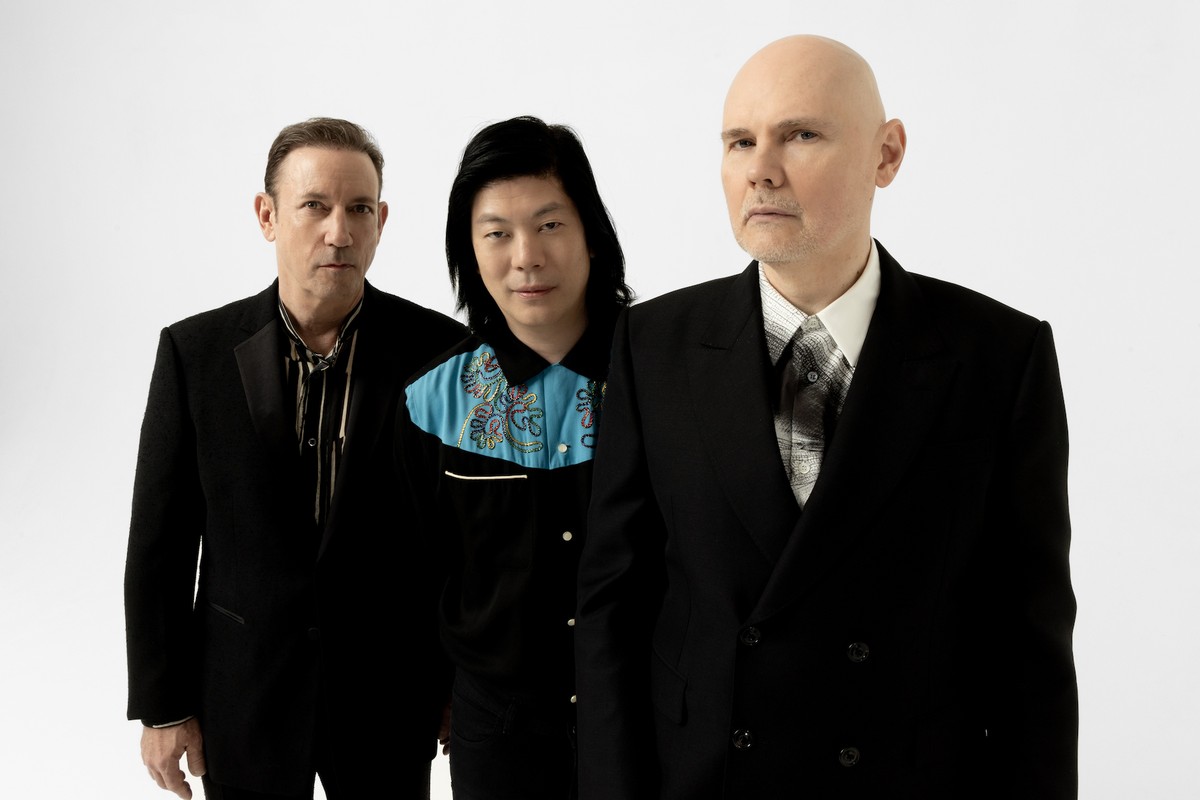

Throughout rock and pop history, musicians have been undone by ambition and creative indulgence, but Billy Corgan has long thrived on both. Swimming against the current, and splashing water in our faces, has always seems to enthrall and energize him and Smashing Pumpkins. Just last year, Corgan unveiled the last disc of a three-part “rock opera,” Atum (pronounced “Autumn,” naturally), and who else would have not only turned to a long-expired rock trend but also sprinkled it with moments of musical and verbal lyricism?
With Aghori Mhori Mei, Corgan has returned to thrashy, and more compact, basics: a mere 10 songs, heavy on the thud. With the Pumpkins reduced to its core original trio — Corgan, guitarist James Iha and drummer Jimmy Chamberlin — the album demonstrates that they’ve lost little of their brute force. As tracks like “Sighommi” show, they can still riff up a Twisters-of-rock storm, partying like it’s 1999, and Corgan’s voice has deepened but has retained its singular cheese-grater nasality.
But as much as the band fires up its engines, the record rarely achieves liftoff. Corgan ponders crumbling and poisonous relationships in “Pentecost” and “Goeth the Fall,” which lighten the musical if not emotional mood. But the blend of textures heard on post-reunion albums like Shiny and Oh So Bright. Vol. 1/ LP: No Past. No Future. No Sun. and Cyr is largely gone, reducing the Pumpkins to an unrelenting and often oppressive metal band. With their repeated use of “thee” and lines like “Lift mine eyes in his stead,” the lyrics feel more Chaucer than Corgan, weighing things down further. You have to give it to Corgan for still devising song titles like “Sicarus,” but Aghori Mhori Mei mostly makes one yearn for concept albums again.







 Nicolas Gerardin


Everybody Likes Drake Again. That Means We’re Healing