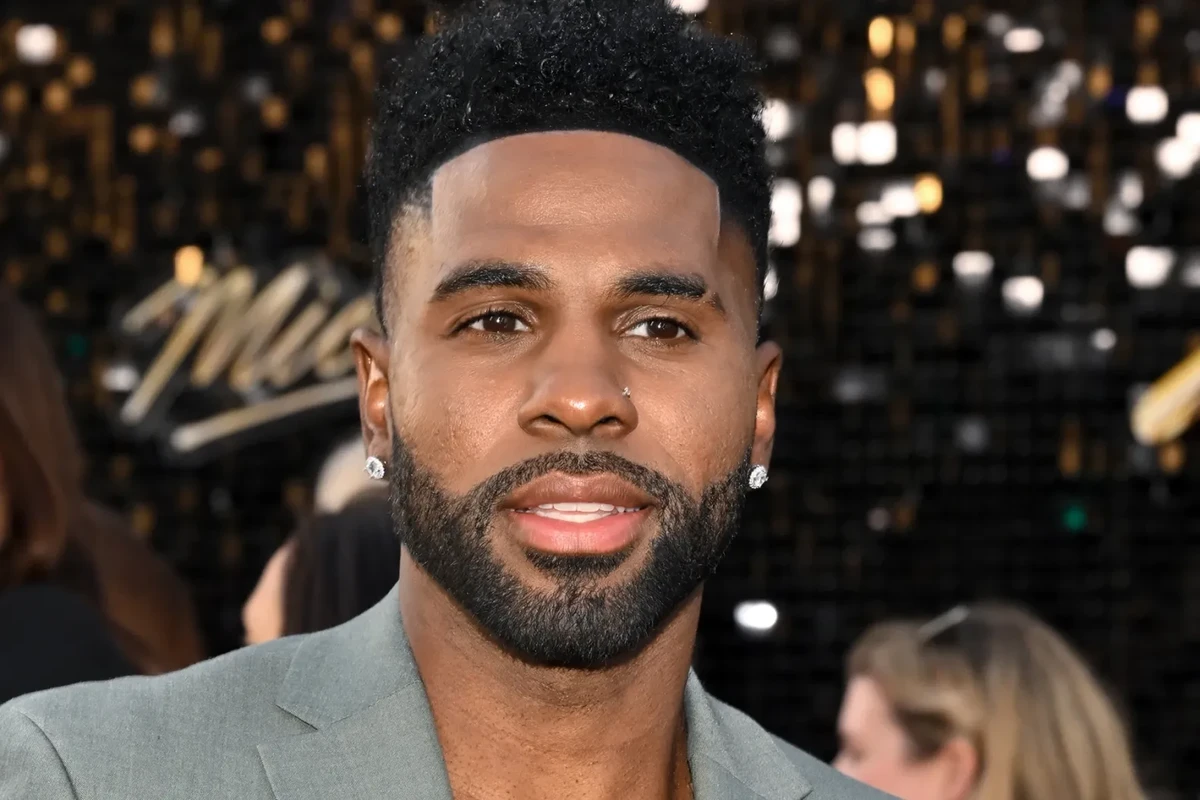

Jason Derulo appeared in a Los Angeles federal courtroom Wednesday as jurors watched a 2024 deposition video of the pop star singing a snippet of his hit track “Savage Love” seated against a drab office wall — a setting far removed from the flash and polish of his live performances
In the video, Derulo faced pointed questioning from a lawyer representing Matthew Spatola, the Grammy-winning guitarist and producer now suing him for writing credit and royalties. The lawyer, heard but not seen, asked Derulo to demonstrate how he allegedly dictated the guitar and bass parts for “Savage Love” by singing them to Spatola during two sessions at his home studio in April 2020, in the early weeks of the pandemic lockdowns.
“I can sing whatever you’d like,” Derulo said gamely in the deposition video, smiling broadly while dressed in a white shirt with a disco collar opened low to show his glittering chain. He then sang a series of simple, monosyllabic vocal sounds, tapping lightly to keep time. Jurors watched impassively on the first day of what’s expected to be a two-week trial.
“He claimed to sing the guitar parts to Mr. Spatola. He claimed to sing the bassline he wanted him to play. But a big part of the problem for Mr. Derulo is that you cannot sing a guitar chord. The guitar has six strings, and a voice can only sing one note at a time,” Spatola’s lawyer, Thomas Werge, told the panel of four women and five men in his opening statement, teeing up the video.
Werge told jurors that his client wrote what he described as the “critical pre-hook section” that precedes the song’s chorus and, in his view, transforms the underlying beat created by the New Zealand artist Jawsh 685. The beat, titled “Laxed,” went viral on TikTok in early 2020 and serves as the foundation of the track. The lawyer said Spatola also wrote the “instrumental bed” for Derulo’s version of the song during the two sessions at Derulo’s home studio. Spatola accepted payment of $2,000 but “never signed anything” giving up his rights to composition credit or publishing royalties, the lawyer told jurors.
In his dueling opening statement, Derulo’s lawyer Joshua Rosenberg said his client was “captivated” by Jawsh 685’s “Laxed” beat in early 2020 and worked tirelessly on his version of the song over 60 hours spread across 10 marathon sessions with his longtime engineer and regular writing partners. Rosenberg said Spatola was brought in for only six of those hours as a session guitarist, not a writer.
“Mr. Derulo gave Mr. Spatola a very simple assignment: Listen to the pre-existing music that Jawsh 685 composed on a synthesizer and play it on guitar. If there were any modifications, Jason Derulo sang them first. He told Matthew Spatola what he wanted him to play,” Rosenberg told the jury. He said Spatola “was paid for services rendered.”
The lawyer said that after legal negotiations, Jawsh 685, whose legal name is Joshua Christian Nanai, was credited as the sole producer of Jason Derulo’s song, formally titled “Savage Love (Laxed – Siren Beat).” Jurors heard that the composition’s publishing ownership was then divided so that Nanai received 50 percent, Derulo 25 percent, Derulo’s longtime co-lyricist Jacob Kasher Hindlin, known as JKash, 20 percent, and Paul Greiss, an instrumentalist and mix engineer, five percent.
Rosenberg told jurors Nanai was the “heartbeat” of the song and suggested Spatola was unfairly trying to take away from that. “The producer is the primary creator of the beat, the melody, the harmony, and the structure. Jawsh did all that, in his bedroom, on the other side of the world. And no one helped. No one should take a producer credit away from Jawsh 685 or dilute it with a co-producer credit,” the lawyer said.
“Playing music is very different than creating,” the lawyer continued. “[Spatola’s] contributions were commonplace, insubstantial, and buried in the background. Look, this is Hollywood. Everyone wants credit for a hit. The plaintiff, Mr. Spatola, does not deserve it.”
For his part, Spatola’s lawyer quoted several lines from Derulo’s 2023 book, Sing Your Name Out Loud, in which the musician admits he self-released his version of “Savage Love” on social media even before he had a signed deal with Nanai. Werge suggested it was a “pattern” with Derulo, where the singer was willing to “take advantage of a young artist,” meaning Nanai, to further his career.
“I was proud of the song and hated the idea of shelving it,” Derulo wrote in the book, describing how Nanai stopped returning his calls after Sony signed Nanai as an artist on its Columbia Records Label on April 27, 2020. Derulo wrote that his manager advised him not to post his version of the song, but he did it anyway, and Sony quickly sent a barrage of cease-and-desist letters.
“Columbia went crazy trying to get it taken down,” Derulo wrote in one passage read aloud to jurors. “But at that point, ‘Savage Love’ was everywhere. There was no stopping the monster, and I couldn’t have taken it down if I’d tried. I’ll be real with you, though: I didn’t try.”
Werge told the jury the evidence will show that “Jason Derulo thought he was successful and powerful enough that he could get away with simply taking [Spatola’s] work for his own without saying anything.” He said Derulo “is going to make excuses as to why he failed to acknowledge” Spatola’s alleged contributions. “This is why you are here: to make sure Matthew Spatola does not get a raw deal,” he said.
After the opening statements, Spatola was called as the first witness. He told jurors he started playing guitar as a four-year-old boy living on Long Island. He recalled moving to California after seeing an advertisement for a music school in the pages of Rolling Stone.
Spatola said he’s played on stage with lots of famous musicians, including T.I., Future, The Weeknd, Jessie J, and Kehlani, but he decided to move away from live performance into more production work so he could settle down and start a family, he testified. His production credits include the songs “Thug Love” and “Till The Wheels Fall Off” for A Boogie Wit Da Hoodie.
Derulo is expected to take the witness stand later in the trial. The artist declined to speak with Rolling Stone after the first day of testimony.
Spatola first sued Derulo and Sony in 2023, asking for a declaratory judgment finding that he was a co-author of Savage Love (Laxed – Siren Beat) and is due a share of the credit and royalties. Savage Love was commercially released on June 11, 2020, debuted at 81 on the Billboard Hot 100, and climbed into the Top 10 two months later. It reached the top spot of the Billboard Hot 100 on October 17, 2020, after a boost from the release of a remix version by the wildly popular South Korean band BTS.
If the jury ultimately sides with Spatola, the court will determine any profits owed to the guitarist during a second trial, the judge previously ruled.