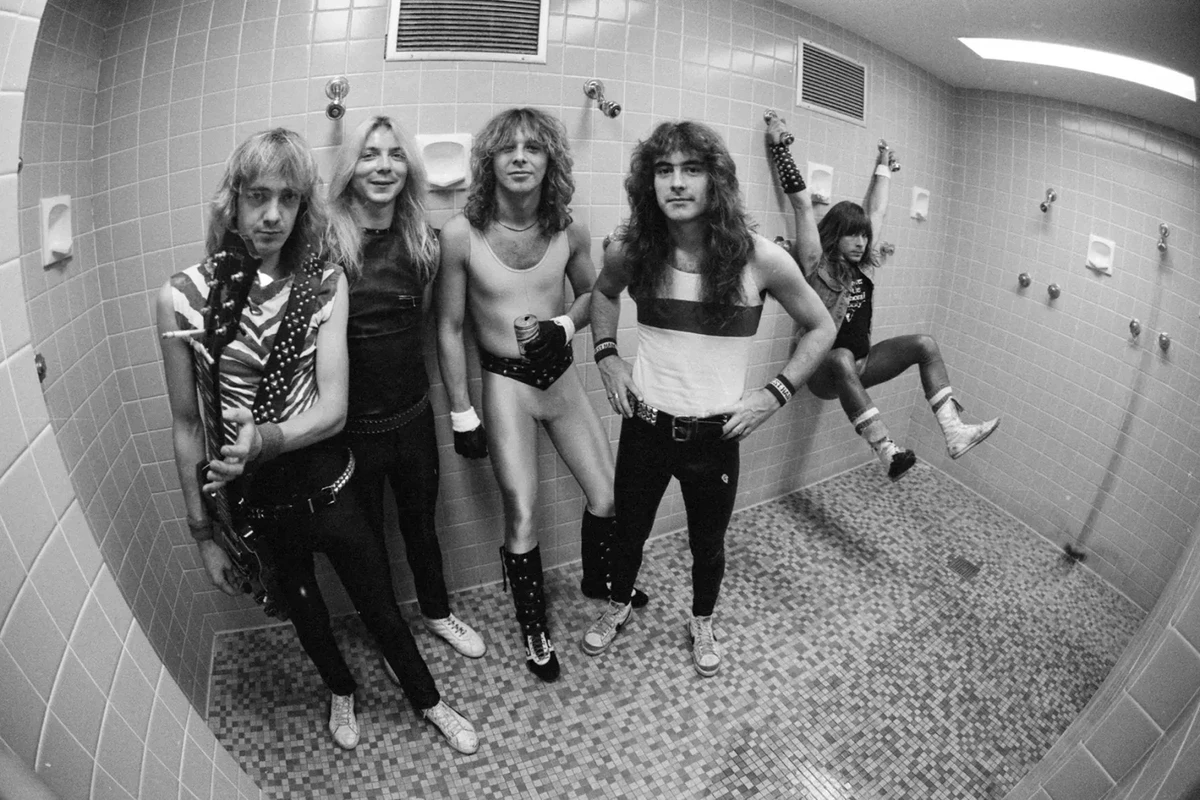

In the early Eighties, the world witnessed Iron Maiden on a Promethean quest for fire, driven on a soul level to deliver “Run to the Hills” and “The Trooper” to humanity. But within a few years, they were exhausted from constant touring with occasional bickering. A new documentary depicts how bad it got, with singer Bruce Dickinson pleading with manager Rod Smallwood for fewer tour dates, saying, “You can’t restring a voice.” Ultimately, Dickinson and guitarist Adrian Smith both quit for these reasons during the band’s golden years. (Both musicians returned in 1999 with refreshed appreciation, and they’ve remained since then.)
In the film, Burning Ambition, which opens theatrically on May 7, Dickinson likens the tour grind to “five years in the golden cage.” In one scene, around his 1993 departure, he muses, “Is it all worth it, this madness?”
His answer today is not rhetorical: “The madness is worth it,” Dickinson, 67, tells Rolling Stone with a chuckle over Zoom from his London home. “When you leave, you come down in the cold light of day, and you go, ‘You know what? This is kind of cool. The world does need Iron Maiden.”
In another Burning Ambition scene, Smith, 69, who left in 1990, recalls in voiceover how, aside from the concerts, “everything else was horrible” in the late Eighties. He quit, citing writers’ block, and, after starting a family and playing in short-lived projects like ASAP with Zak Starkey, he saw things differently. “I could see what Iron Maiden was all about,” he says on a Zoom from a hotel in Turks and Caicos, where he’s touring with another side project, Smith/Kotzen.
Iron Maiden’s members have been reflecting on the band’s history a lot lately, as they continue last year’s 50th anniversary celebrations into this year. Formed in 1975 by road sweeper turned bassist Steve Harris, the group rode out into the headbanging mainstream on the New Wave of British Heavy Metal with 1980’s Iron Maiden, an album whose songs provided a blueprint for riffs that gallop like the William Tell Overture, anthemic choruses, and an improbably hopeful, die-with-your-boots-on mentality that separated the group from metal forerunners like Black Sabbath and Led Zeppelin. After several lineup changes, Maiden have stayed the course, thanks to de facto leader Harris’ steadfast vision. “Steve wanted to do it his way and we fell in behind him and helped him do it,” Smith says of the group’s earliest days. They’ve since become one of metal’s biggest and most influential bands, transcending the genre with their macabre mascot Eddie, whose visage has adorned celebrities from Miley Cyrus to Justin Bieber.
 Steve HarrisRoss Halfin/Courtesy of Trafalgar Releasing
Retrospection is a rarity for the group, which has been known in past decades to scoff at fans who want the hits and play a new album in its entirety, as they did with 2006’s A Matter of Life and Death. Even now, Dickinson shrugs off people who complain that recent Maiden albums like The Book of Souls and Senjutsu lean too progressive. “Go listen to other bands,” he says, laughing. “It’s a free world, just about.” But this year, they’re acknowledging their legacy, and it has nothing to do with their recently announced induction into the Rock and Roll Hall of Fame, which they’ll be skipping since the ceremony conflicts with Australian tour dates.
Instead, they’re embarking on a tour they’ve dubbed Run for Your Lives, playing set lists that focus heavily on repertoire they recorded before Dickinson’s departure. They’ve also booked their own two-day Eddfest in Knebworth, England, which will include sets by ousted former members, including singer Blaze Bayley (Dickinson’s Nineties replacement), and a Maiden supergroup, Maiden United, which features onetime guitarist Dennis Stratton, who played only on Iron Maiden.
And of course, there’s Burning Ambition, named for an obscure Maiden B side, a film which Dickinson says is “as close to independently proving” that the world needs Iron Maiden “as you can get.” For this project, they uncharacteristically allowed an outsider, filmmaker Malcolm Venville, who has made documentaries about Lincoln, FDR, and Churchill, access to their archives — and themselves — to paint a portrait of Iron Maiden and its fans.
Using animations of Eddie and talking-head interviews with famous fans including Javier Bardem, Metallica’s Lars Ulrich, Chuck D, and the Cure’s Simon Gallup, among others, the doc traces the group’s East London origins, galvanizing a loyal fanbase that now sees them in arenas and stadiums. The band’s participation was limited to offscreen interviews. Venville, 63, says via email that his aim was to show “not just their history but the scale of what they’ve built.”
“You don’t want a hagiography of Iron Maiden,” Dickinson says. “You want warts and all the bones, because Maiden’s is a story of burning ambition, but it’s also a story of triumph through adversity and tragedy, and all the things that are in big family relationship. You can’t really do that from within because everybody’s got their own version of reality.”
“[The film’s] quite emotional,” Smith says. “There’s a few touchy things in there, stuff that’s a bit near the bone.” The moments that hit Smith hardest were related to band members who left and, unlike Dickinson and himself, didn’t return: singer Paul Di’Anno, whose leather-tough gravelly voice defined Maiden’s harder-edged first two albums, and drummer Clive Burr, whose textured syncopations transformed Maiden’s gallops into standalone drum riffs until he left after recording the group’s touchstone, 1982’s The Number of the Beast. Di’Anno died in 2024, Burr in 2013. Smith was also affected by footage of Nicko McBrain, Maiden’s longest-tenured drummer, who chose to retire from touring in 2024, a year after experiencing a stroke.
 Paul Di’Anno fronting Iron Maiden on the Killer World Tour in 1981Paul Natkin/Getty Images
The film also contains archival footage of mudslinging and backbiting comments from several of the musicians about various members’ comings and goings. “It’s like the baggage that you carry as you go through life,” Smith says. “We are a family, really. We’ve had our disagreements because the stakes are high, but I think the band has integrity. We’ve tried to do things the right way.”
For his part, Harris, 70, has expressed burning ambivalence about the film. “I think they really should have put up that it’s a documentary about Iron Maiden, not by Iron Maiden, because it’s not us,” he recently said. “We didn’t have that control that we normally have if we’re doing it ourselves. … I think we’d have done it in a slightly different way, and I’ll say no more.”
“The intention was never to explain Maiden to the fans,” Venville says. “They don’t need that. It was to reflect something back that feels true.”
WHEN SMITH FIRST watched Burning Ambition, the archival footage floored him. “There’s stuff of me from when I was very, very young,” he says. “It’s almost like another life.”
The guitarist joined Maiden in November 1980, half a year after they had released their self-titled debut. He’d grown up with Maiden guitarist Dave Murray, and his group Urchin had gigged with Maiden. Even though they weren’t punk (“We actually didn’t like punks at all,” Harris once told Rolling Stone), they operated like a DIY punk ensemble, building a fan base with a self-produced and self-distributed EP, The Soundhouse Tapes, and heavy gigging. “The band has always operated slightly outside of the establishment. It’s almost like a big cult band,” Smith says. “I think our fans identified with the struggle, the fact that we did it the hard way.”
Iron Maiden’s singer when Smith joined, Di’Anno, had short hair and a uniquely gruff voice but couldn’t cut it on the road. “Paul, I think, felt the pressure a lot,” the guitarist says. “He used to lose his voice quite a bit. My impression of him when I joined was that he was a happy-go-lucky guy. He didn’t strike me as a hard, ambitious guy. He just liked having fun. So I think he was almost relieved when he left the band.” He pauses and adds, “I hope Paul had some happiness in his life after Maiden.” (Di’Anno’s life is the subject of an independently produced documentary due out this year.)
Dickinson, who’d been singing with New Wave of British Heavy Metallers Samson, joined in September 1981, six months after Killers’ release, and his operatic-yet-masculine “air raid siren” wail immediately set them apart from every other metal group. “It’s like you’re watching Broadway,” Anthrax’s Scott Ian comments in Burning Ambition. But what made the extraverted Dickinson a fit for Iron Maiden was his unstoppable drive. One of the reasons Venville wanted to make a Maiden documentary is that Dickinson was an unconventional frontman, pursuing alternate careers as an airline pilot, fencer, novelist, broadcaster, and entrepreneur at the same time he was singing “Hallowed Be Thy Name.”
“The idea that he could front one of the biggest bands in the world on relentless world tours, qualify as an airline captain, and then suggest improvements to British Airways’ pilot-training manual tells you something about his mentality,” the director says. “He doesn’t do things by halves. Then there’s Steve Harris, almost the opposite: private perfectionist, and quietly obsessive. That tension between them felt like the engine to me. One expansive, one exacting.”
But Dickinson believes he and Harris aren’t so different. The grit that pulses through Maiden’s lyrics, which often draw from literature, is a shared DNA between the pair. “That determination reflects Steve definitely, and me, as well,” he says. As an example, Dickinson recalls how when doctors diagnosed him with throat cancer in 2014, his first question was, “When can I get back to singing?” The answer was “about 10 months.” “I said, ‘I’ll beat that,'” Dickinson beams. “And that’s the way we are, and we’re still like that.”
Dickinson’s health is now restored, but with “all kinds of bits” of his body renovated. “I got two metal hips, I got a busted Achilles I had stitched back together five years ago, various contusions and lumps and bumps,” he says. “But I’m still running around like a lunatic, and the voice is doing great.” And he adds, “I just finished a solo record: We did 16 tracks in 21 days, all 100 percent live. It’s like the anti-AI generation.”
Dickinson believes Iron Maiden’s purpose of presenting live spectacles is “unashamedly escapist.” “When you go to a movie, it’s an escape, depending on the kind of movie you like,” he explains. “And you get to choose which movie you go to. I do not want to watch a documentary about Bono rescuing African children, as wonderful as that may be. I want to see Jason Statham take down the bad guys, because that’s what I’m in the mood for. And people pick Iron Maiden because they’re in the mood for that particular thing.”
Burning Ambition illustrates how Iron Maiden have made it their quest to provide that escape for fans all over the world, drawing heavily on footage from their Iron Maiden Behind the Iron Curtain VHS, which documented a 1984 tour of Poland, Hungary, and Yugoslavia. “We’ve always looked to go into new places, and no one had really done that,” Smith says. “[Those audiences] had never really seen anything like us before. They knew of some of our music, but I almost felt a bit sorry for them. They had such a life of austere hardship. I remember going to the best hotel in Warsaw, and they had one thing on the menu.”
“What we do is give people an opportunity to escape from the shitty world in which we live and to get together with other human beings on a level playing field, whether they are doctors, bankers, plumbers, bricklayers, whatever religion, whatever nationality, whatever color,” Dickinson says. “We don’t exclude anybody.”
 Iron Maiden in 1983 Ross Halfin/Courtesy of Trafalgar Releasing
HALFWAY INTO the documentary, there’s an archival scene in which Bruce Dickinson gets frustrated with an interviewer who misinterprets the lyrics to “Run to the Hills.” “It’s an anti-Indian–killing song,” the singer insists. “The whole thing about it is, ‘This is what happened, and it’s not like the cowboy movies.'”
Then the screen cuts to Javier Bardem, who recontextualizes the song by reciting the lyrics slowly as poetry, giving gravitas to the first-person account of a Cree character begging for freedom from enslavement by white people.
“It’s a wow moment,” Dickinson says.
“The way he read the words sounded very profound,” Smith says.
“I’ve never heard them read in a poem by a great actor,” Dickinson says. “I got a sense of melancholy and sadness from it.”
Venville says this is the point of the film. “There’s a depth to their work that’s easy to miss,” he says. “History, literature, and philosophy are embedded in the music.”
Although Burning Ambition tells Iron Maiden’s story, moments like Bardem’s recital demonstrate why the band has its diehard fanbase. “The real revelation was the audience,” Venville says. “The fanbase isn’t just battle-jacketed headbangers; it’s global, organized, and deeply connected. It behaves almost like its own ecosystem.”
When asked how he hopes Burning Ambition makes Maiden fans feel, Venville answers simply, “Recognized.”
When the film starts, the first voice you hear is Dickinson’s telling an audience, “It doesn’t matter whether you’re male, female, Muslim, Christian, Catholic, Jewish, it doesn’t matter: If you’re a Maiden fan, you’re an Iron Maiden fan.” It’s a sentiment so nice, Venville used it twice in the film.
Dickinson was surprised to hear it multiple times, but stands by the sentiment. “Sometimes you have to say shit like that,” Dickinson says, citing many ways people have misinterpreted what the group stood for, from a lack of women at the early concerts to accusations of Satanism because of “The Number of the Beast” to the way he waves a Union Jack proudly during “The Trooper.” But the band’s critics have them wrong.
“Maiden’s like a giant umbrella that people can get under,” Dickinson says. “And once they’re under the umbrella, it doesn’t matter where they came from, who they are. Under the umbrella, they’re all Iron Maiden fans.”
 Iron Maiden in 2025JOHN McMURTRIE
“I think people would be surprised by who Maiden fans are,” Smith says. “The new leader of Japan is a Maiden fan; she plays drums. Maybe we’re being acknowledged a little bit more by the mainstream now. We’ve had a couple of songs on famous TV shows. We never chased that, but people are seeing us in a bit of a different light.”
Iron Maiden have always shrugged off other people’s attempts to enshrine their legacy. They were nominated for the Rock Hall twice before getting in this year, and in 2018, Dickinson wielded sharp words against the institution. “I actually think the Rock & Roll Hall of Fame is an utter and complete load of bollocks,” he said. “It’s run by a bunch of sanctimonious bloody Americans who wouldn’t know rock & roll if it hit them in the face.”
So does he worry that a legacy-focused documentary might come off like a capstone to Iron Maiden’s career? “When you say capstone, you don’t mean a headstone, do you?” he asks, laughing. Then he parries the perceived slight with a parody of a Maiden song: “In a grave new world.”
After he regains his composure, he looks at the big picture. “Fifty is always going to be a big, symbolic number,” he says. “We are not showing any signs of coming to an end, but we will. Inevitably, it will happen. How it happens, when it happens, we don’t know.”
Then he gets a new handle on the picture, figuratively and literally. “Rather than a capstone, I’d say this documentary is a frame,” Dickinson says. “This is a frame through which to view the rest of our career.”







 Matt Collyer of The Planet Smashers