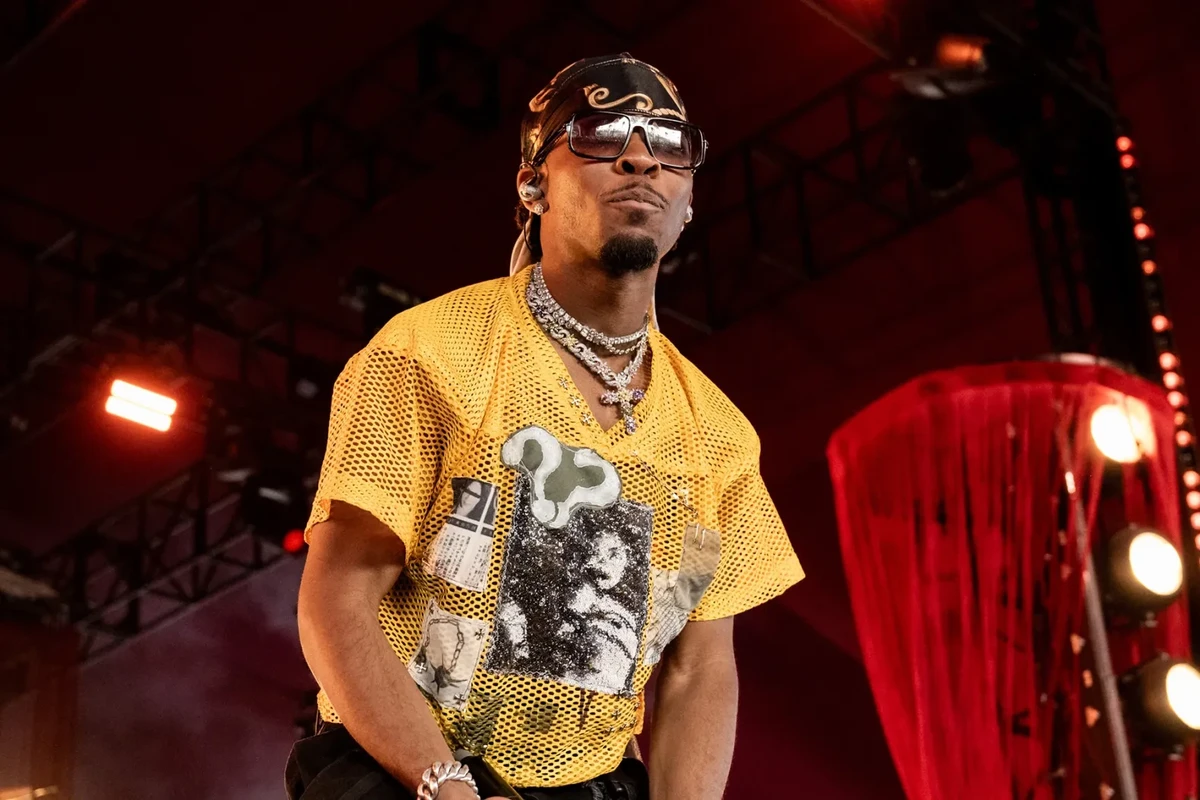

Platinum-selling singer D4vd allegedly stabbed 14-year-old Celeste Rivas to death in his Hollywood Hills home on April 23, 2025, then later dismembered her body with a chainsaw in a blue inflatable kiddie pool in his garage before stowing her remains in his Tesla and lying to friends who noticed “the strong smell of decay.”
That’s the damning narrative Los Angeles prosecutors laid out over nine pages of a preliminary hearing brief filed Wednesday and released to the public over the objection of D4vd’s defense team. Prosecutors claim surveillance video shows the singer driving his Tesla on July 29, 2025, before he parked it around the corner from his rental house and left on a concert tour. The Tesla was later towed and impounded, with investigators finding Rivas’ dismembered and badly decomposed remains in the front truck on Sept. 8, 2025.
“For several weeks, or possibly months, defendants left the victim’s body to decompose inside his Tesla. He lied to friends, business associates, and others who noticed the strong smell of decay in and around his home and vehicle,” the blockbuster brief, obtained by Rolling Stone, claims.
At a court hearing Wednesday, D4vd, born David Anthony Burke, sat quietly in an orange jail uniform as his lawyer, Blair Berk, argued that the evidence brief was so “entirely one-sided” it would taint the jury pool potentially needed for a future trial. Berk asked the court to seal it. After hearing from both sides, Judge Charlaine Olmedo denied the request, though she agreed to postpone Burke’s preliminary hearing several weeks, from May 1 to May 26, at the defense’s request.
The new brief, filed in anticipation of the preliminary hearing, claims Burke, 21, first met Rivas when she was 11 years old. Prosecutors allege Burke “began a sexual relationship” with Rivas when she was 13, and that Riverside County officials contacted Burke in February 2024 and informed him of her age after she was reported missing by her family.
Despite speaking with law enforcement, Burked “continued to pursue” Rivas, the filing states. He allegedly drove to her home in Lake Elsinore, south of Los Angeles, and “paid a junior high school student in the victim’s class $1,000 to give the victim a cell phone [that he] purchased so they could stay in contact,” prosecutors claim.
Recovered texts between Burke and Rivas “contain references to sex, pregnancy, abortion, and use of the Plan B emergency contraceptive,” the brief alleges. Burke and Rivas also exchanged “explicit photographs documenting and corroborating their sexual relationship,” it claims. One text purportedly sent by Rivas and obtained from Burke’s iCloud reads, “All we do is have sex and just hang out man I want more than that for myself.”
According to prosecutors, Burke “broke up” with Rivas in November 2024, though they continued to communicate. The new filing alleges Burke and Rivas “engaged in a lengthy argument described in detail in their text messages” on the night before Rivas was last seen alive.
“The messages reveal the victim’s jealousy over defendant’s relationships with other women, as defendant led her to believe they had a future together,” the brief reads. Rivas purportedly became “extremely upset and threatened to disclose damaging information about her relationship with defendant to end his career and destroy his life,” prosecutors claim. Burke sent an Uber to pick Rivas up from Lake Elsinore on April 23, 2025, the night she allegedly was murdered.
Prosecutors allege Burke texted with Rivas during her ride, and that the driver dropped the teen off at Burke’s Hollywood Hills address around 10:10 p.m. Burke then sent text messages to Rivas at 10:30 p.m., inquiring where she was, the filing states.
“The people contend this was part of defendant’s premeditated plan to cover up the murder, as she was already dead by this time,” the filing reads. “Knowing he had to silence the victim before she ruined his music career as she had threatened, very soon after her arrival at his home, defendant stabbed the victim to death multiple times and stood by while she bled out.”
Prosecutors allege Burke left his home at 11:30 p.m. and texted and called Rivas’ phone, asking where she was. “Again, these acts were calculated and planned to set up his defense,” the filing states. Burke allegedly drove to an area near Lake Cachuma in Santa Barbara County to “dispose of her property,” returning home the next morning to attend a radio interview. He later ordered a shovel from Home Depot, which was delivered by Postmates on April 24, 2025, and two chainsaws, a body bag, heavy-duty laundry bags, and a blue inflatable pool, which were delivered by Amazon in early May, the filing claims.
Burke made the purchases under a fake name, Victoria Mendez, and returned to Santa Barbara County twice more, the brief alleges. He also ordered a “burn cage” to his home under the same fake name, “as part of his plan to incinerate evidence,” prosecutors contend. Burked allegedly used the chainsaw to dismember Rivas in his garage, using the blue pool “to prevent her blood from spilling” on the floor.
Blue plastic fragments found embedded in Rivas’ remains were later matched to the inflatable pool by the LAPD’s forensic laboratory, prosecutors say. The filing claims Burke amputated Rivas’ left ring finger because it contained a tattoo of his name.
When detectives searched Burke’s Doheny Place rental home after Rivas’ remains were found, blood samples found in the garage “matched the victim’s unique genetic profile,” the filing states. A Caltrans worker also found Rivas’ U.S Passport card off a highway in Santa Barbara County in January 2026, prosecutors claim..
“The circumstances and present state of discovery led us to conclude we need this additional time to review the discovery we just got or are about to get,” Burke’s defense lawyer Marilyn Bednarski said at the Wednesday afternoon hearing, requesting the probable cause hearing move to May 26.
Judge Olmedo then asked Burke if he agreed to the postponement of his preliminary hearing. “Yes, your honor,” he replied.
Burke was charged last week with the first-degree murder of Rivas. Prosecutors also charged him with continuous sexual abuse of a child under the age of 14 and unlawful mutilation of human remains. They added special circumstance allegations of murder of a witness, murder for financial gain, and lying in wait, which make him eligible for the death penalty. (Prosecutors have yet to decide whether to pursue the death penalty.) Burke has pleaded not guilty.
Last week, Deputy District Attorney Beth Silverman revealed that Burke’s iCloud account, obtained by investigators, contained what she described as “a significant amount of child pornography.”
Bednarski and Berk pressed for an immediate preliminary hearing. Judge Charlaine Olmedo said it would begin this Friday, May 1.
Burke was arrested on April 16 at a house in the Hollywood Hills. Prosecutors said police served a simultaneous search warrant at the property not far from the iconic Chateau Maramont hotel. Silverman said the case involves a large volume of evidence, including material obtained through a wiretap, and that three grand juries were convened in recent months to investigate.
A long-awaited autopsy report released last week concluded Rivas died from “multiple penetrating injuries” to the upper abdomen. It described two stab wounds that perforated her liver and chest. The manner of death was ruled a homicide.
The report also described the condition of her remains, noting dismemberment and advanced decomposition that made visual identification and fingerprinting impossible. Toxicology showed a low level of ethanol and presumptive positives for several drugs pending confirmation.
Prosecutors allege Rivas was last seen entering Burke’s Hollywood Hills home on April 23, 2025, and was killed that day. They contend her body was mutilated weeks later. Burke’s lawyers have said he “did not murder Celeste Rivas Hernandez.”
If convicted as charged, Burke faces either life in state prison, without the possibility of parole, or the death penalty. Prosecutors have said a decision on whether to seek the death penalty will be made at a later date.
Born in New York and later raised in Texas, Burke first gained attention as a Fortnite gamer and musician with the self-produced song, “You and I.” He broke through to mainstream success in the summer of 2022 with the hit singles “Romantic Homicide” and “Here With Me,” after they garnered so much traction on TikTok, they jumped to spots on the Billboard charts. He released his debut EP, Petals to Thorns, in May 2023.
His debut studio album, Withered, was released in April 2025, two days after Rivas was seen for the last time.
At a press conference, LADA Nathan Hochman claimed that Rivas was only 13 years old when Burke allegedly engaged in repeated “lewd and lascivious sexual relations with her.”
“Burke’s actions did not allegedly stop there,” he said. “When she threatened to expose his criminal conduct and devastate his musical career, Burke allegedly murdered her, cut up her body and stuffed her body in two bags that were placed in the front trunk of his car.”