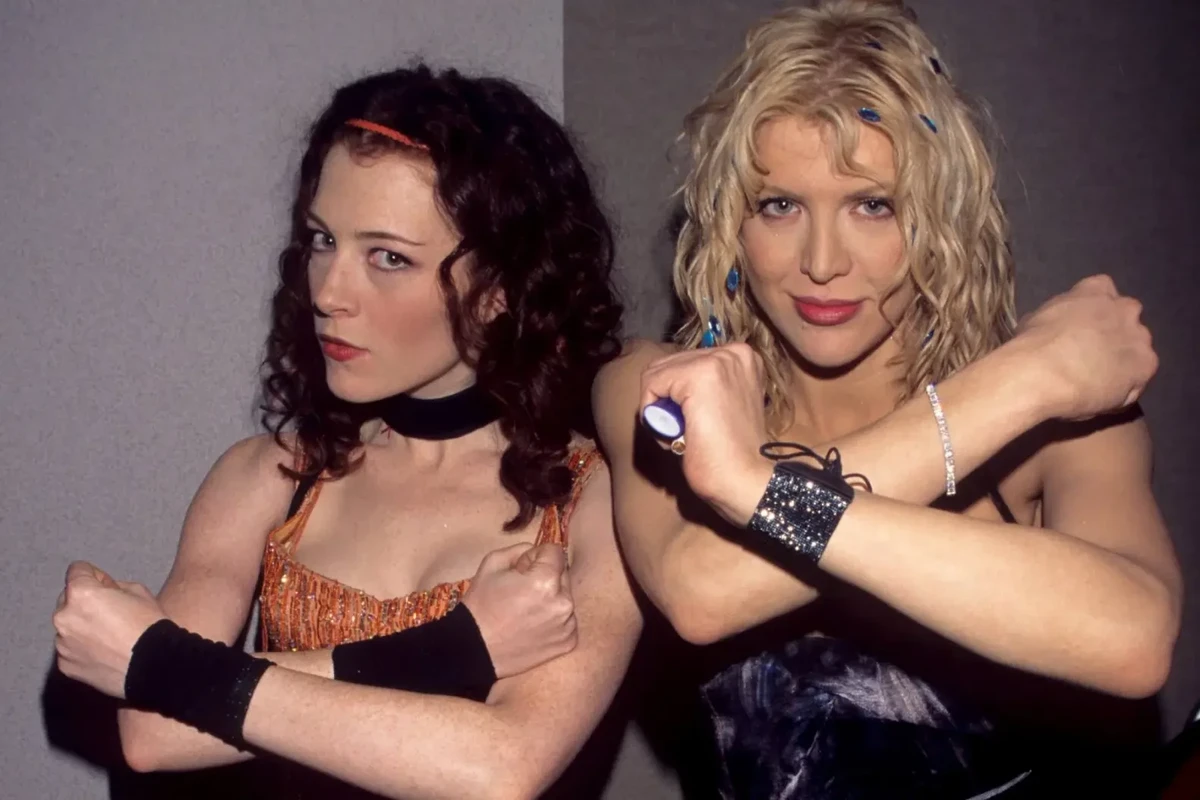

Melissa Auf der Maur joined Hole in the summer of 1994, during the darkest time for the band. Courtney Love‘s husband, Nirvana frontman Kurt Cobain, died by suicide that spring; Hole bassist Kristen Pfaff died of a heroin overdose shortly after. Auf der Maur’s friend Billy Corgan recommended her to Love to replace Pfaff, and she declined. “I don’t really connect with the music,” she writes in her upcoming book Even the Good Girls Will Cry: A 90s Rock Memoir. “And then there’s the shitty pain of the overdose and suicide. I don’t want to be part of that insane fame.”
But Love eventually won her over, and she joined one of the most powerful and controversial rock bands of the Nineties. In this exclusive excerpt from Even the Good Girls Will Cry, Auf der Maur reflects on Hole’s evening at the Metro in Chicago on Oct. 21, 1994, now regarded as one of their greatest shows. The book, which Auf der Maur describes as a “part coming-of-age autobiography, part travel diary, part psychedelic scrapbook,” arrives on March 17 via Da Capo.
OCTOBER 1994
It quickly becomes clear that I am on tour with a force to be reckoned with. Never before have I seen anyone possess Courtney’s level of power and destruction while also revealing what it means to have survived pure hell. In less than six months, she has lost her husband and her bass player, been left a single mother, and been publicly accused of using drugs during her pregnancy. Soon she will be similarly accused of killing her husband. Her performances are full of unpredictable body movements, accusations, and screams, laced with dark humor and no small amount of drugs to take the edge off. She has very little to lose and everything to gain by being her most empowered and imposing self onstage. Audiences are captivated, night after night.
I knew it was risky for me to join Hole. Let’s not forget, my initial instinct was to say no. But here I am, taking everything in. A typical Hole show during this time is like boarding a high-adrenaline roller coaster every night, with equal concern for the safety of Courtney, the audience, and the band members and, ultimately, our sanity. It’s a bit like what I imagine going to battle in front of an audience might feel like, like gladiators on display. We never know what’s going to happen next.
In October 1994, just a month into our headlining tour, we hit Chicago and its active and exciting music scene. Chicago is home to the best indie labels outside of Seattle: Touch and Go and Thrill Jockey. The Metro, where we’re playing, is a legendary rock venue.
Our walk to the stage every night feels like moving in slow motion. The grubby hallway of any old club transforms into the portal of a timeless mission: to share our souls with the world. Our walks turn into more of a strut. We take deep breaths to calm our racing heartbeats before we come together in a four-person huddle. As we awkwardly hold hands for a moment, Courtney recites a prayer of her choosing for that day — either a Buddhist chant or part of the Lord’s Prayer, and punctuates the end with a visceral “Hhhhh-hah!” creating an electric shock that runs through us. Then we release our hands and take our positions onstage.

Moments in the show when Courtney confronts the audience always get a little nerve-racking. Someone could throw something at the stage and hurt one of us, or they could shout out the wrong thing and piss her off. She might ignore it, or she might choose to engage. There is never any way of predicting.
Semicoherent streams of consciousness are becoming more common the deeper we get into the tour. They’ll get way worse over time, eventually devolving into endless rambles of nothing.
I never play under the influence of anything, so the effects of the use and abuse of heroin are foreign to me. I have no way to assess what part of Courtney’s behavior is her personality, her posturing, or the drug. As time goes on I begin to pick up on the signs of clear heroin use, such as track marks, pinned pupils, nodding off, and slurring of words. The gods of punk rock who came before us, such as the Sex Pistols, had also looked and acted like this, whether they were on drugs or not. The stumbling, the “fuck you” flipping of the bird — all of that had been painted by the punks before us.
Knowing how smart Courtney is, I can’t tell what’s an act and what’s real debauchery. At this moment in Chicago, she’s pulling it off with a decent balance. But that balance is precarious, and it’s not going to sustain itself throughout the Live Through This tour. As the drugs get heavier, they’ll start to ruin performances.
Still so new in the band, I don’t have much rapport with the other two members onstage yet. During a show, I have limited bandwidth beyond — in order of importance — my bass, Courtney, and the crowd. I suspect the same goes for Patty and Eric, too. In truth we really are not much of a band. We never really play off of or tune in to each other. The leader leads the whole show. Her moods, rants, and assault function as conductor. The rest of us exist in our own vortexes, trying to stay sane and stick to our commitments to get to the finish line.
It’s said that band dynamics are like family dynamics, pathological and often top-down. There is always a leader. In a family, that’s most often a mother or a father. If the person at the helm is destructive, unpredictable, or struggling with mental health issues, the members lower down on the totem are tempted to follow the path of least resistance to avoid conflict. This is absolutely the case with Hole. Each of the band members under Courtney struggles to find his or her place in the dysfunctional family dynamic, hoping to get out in one piece, while counting on the music and the mission to give us a reason to be there. In the meantime, subjecting ourselves to unhealthy pathologies instead of more mindful and caring ones is unfortunately the norm.
Somehow, we make it through the entire Metro set without a major incident. It always feels like a success to still be in one piece, physically and emotionally, and leave the stage at the end of a set. The trick is to surrender, not to break. This is literally living life on the edge of chaos.
At the side of the stage, out of view of the audience, Courtney prepares for an encore by stripping down to her short black lace-and-satin slip. We wait for the cheers to grow to a sufficient volume to deserve our return to the stage, a silly tradition that somehow prevails even for punks. We are all riding high on adrenaline, sweating, feeling energized, and forging forces with a room of alternative kids. It is the place each of us always dreamed of being.
When she decides the timing is right, Courtney struts back onstage in her slip with a cigarette in her mouth. We follow and resume our positions.
“Hi,” she says coolly. Pressing her mouth way up close against the mic, she kicks into heavy breathing, building and building with sexually suggestive deep grunts and movements before coming to a climax. “I faked it every time, I just wanted you to know,” she tells the room.
The audience is in the palm of her sweaty, honest, and fearlessly sexy hands.
Random crowd-surfers are passed along the crest of the surging mass. Bouncers at the front of the stage fight to keep the rowdiest ones from trying to get up on stage by pushing them, forcefully, back into the pit. As the song ends with heavy thrashing, Courtney gives it her all as she screams and furiously plays her guitar.
Only one person is bestowed with the honor of stage diving tonight. The final chords of “Olympia” are still ringing when, in one seamless movement, Courtney flings her guitar off and dives headfirst off the edge of the stage, surrendering herself to the waiting hands of the crowd. Propped up by her fans, her body floats and dips below the surface, riding the human waves. The band remains onstage futzing around, making noise to accompany her final effort of the night.
These few minutes of Courtney’s surrender to the sea of hungry youth stretch into slow motion. A sea of hands passes her around, pulls at her clothes, grabs her body. Her exposed broad shoulders and bare back are slapped. Her hair is pulled. She is flipped over onto her back as random, anonymous hands grip and grab her soft, strong thighs. Like a rag doll in a ritual of sacrifice, her body hovers limply over the crowd.
Then her hands come to life and reach toward the stage, a subtle motion to bring her back “home.”
 © Melissa Auf der Maur
The meatiest of the security guards carries her out of the pit, cradled in his arms. She wraps her arms around the big man’s neck like a damsel being saved from a dragon, but this damsel is not in distress. She whispers something into his ear, gives him a kiss on the cheek, and stumbles back up onto the stage.
Now dressed in nothing but a shredded black lace bra and bikini underwear, one leg of her nylons still clinging to her body, she strikes a pose with an ironic beauty-queen check of her hip. She saunters up to the mic and casually says, “You fail,” suggesting the crowd has been a test audience for her this whole night.
“You do that to the guys?” Kurt, Eddie, Chris — none of them have had their flannel shirts ripped off their backs. She knows that, and now we all realize it, too. She flips the crowd a subtle bird with a cheeky smile. “I liked that fucking slip! Thanks a lot.”
Night after night, Courtney’s body and actions become testament to pushing the boundaries of women’s liberation. Are the assaults she endures because she dares to expose her wild warrior ways? Or are they reflections of the audience’s ingrained, even subconscious, attacks on women? Denim and flannel are inherently more durable than silk slips. The boys in bands are not being manhandled like this.
On her way off the stage Courtney knocks her mic stand to the ground, then does the same to the rest of the mics onstage. Before she exits for good she staggers around, hurling objects through space. It is a shocking display of volatile power. And also frightening and impressive in its boldness, at the same time.
Fuck you, all of you, it says.
And then she stumbles offstage, back into her life, having blown many minds with a force of womanhood that no one has seen the likes of before.
Progress. I view this as progress, even if it can also be interpreted as grotesque and rude. Courtney is waking people up to the innate failures of human instincts. She allows them to destroy their heroes, to rip her apart to get a piece of the prize.
During these moments in the show, we onstage and the engaged audience members — not the ones there to gawk at a world-famous controversial character, but the mindful ones — realize we are witnessing the exorcism of a powerful, witchy woman who is processing unfathomable loss and shock, as well as a maternal legacy of loss. Her grandmother was left in a basket on a church stoop, her mother given up for adoption at birth. Courtney was abandoned throughout her childhood and emancipated herself at sixteen. She’s a third-generation motherless daughter. Where will this leave Frances? I wonder.
When Courtney loses herself in these moments onstage, we hold her. We offer her a sonic cradle to help pacify the justifiable pain of a whole life that has led her to this moment. The public is only just becoming aware of the horror that was Courtney’s life. It is intense, and heavy, on a psychic level.
In these moments, I know exactly why I am here: To help create music that will hold us all. And for women to be leading this ritual for all who need it.
I am grateful that Courtney has music to bash these dark feelings around, grateful that we all do. Rock music saves lives. I have always believed that. But living with the unpredictability of how long this experiment will continue, whom Courtney might scream at, just how deep her sorrows are, and what demons she might summon next — this part isn’t an easy ride.
Excerpted from Even The Good Girls Will Cry: A ’90s Rock Memoir by Melissa Auf Der Maur. Copyright © 2026 by Melissa Auf Der Maur. Available from Da Capo, an imprint of Grand Central Publishing, a division of Hachette Book Group, Inc.






 Matt Collyer of The Planet Smashers