
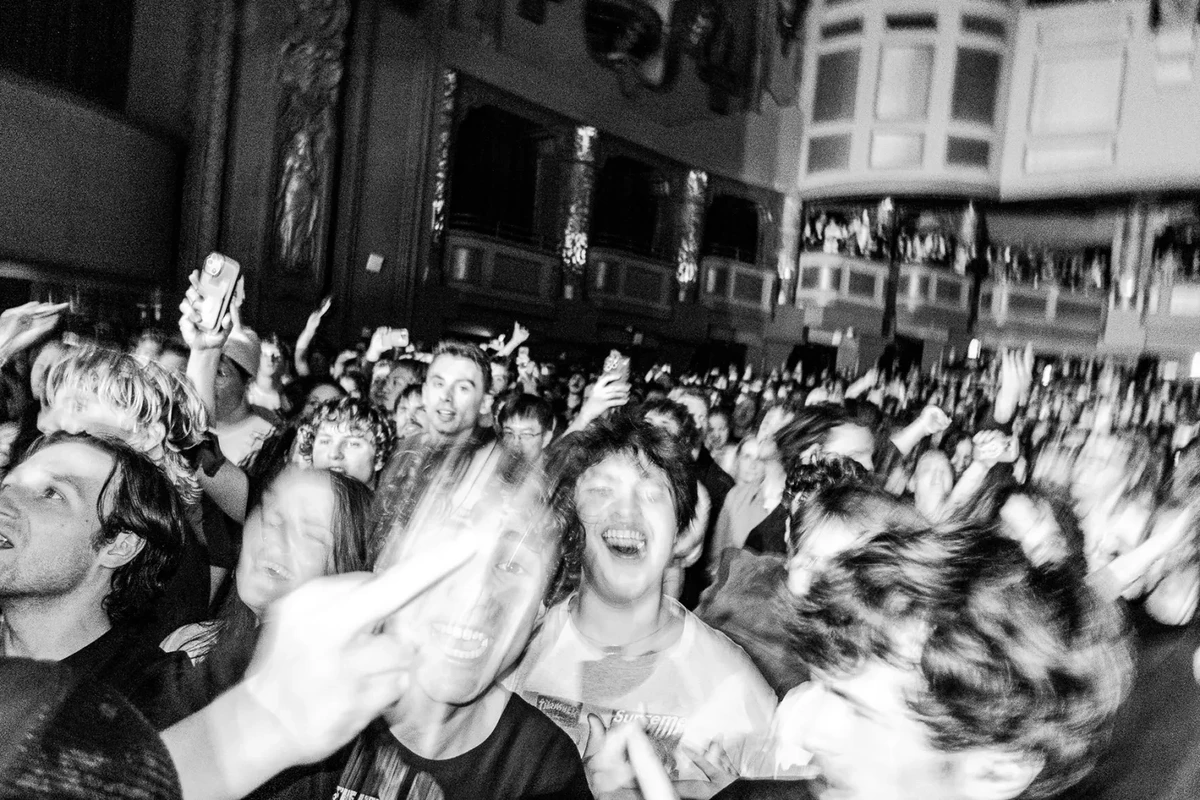

Dry Cleaning had big plans for January 2026. The English band spent much of the past two years making their third and best album, Secret Love, which brings their uniquely beguiling mix of post-punk and art-rock styles to a new creative peak. Now, with the album’s release set for early this month on 4AD, they were preparing to launch a 21-date tour of North America, historically a strong market for the band, with a Jan. 23 show in Chicago.
Ticket sales were looking good, and the band was feeling excited. But their U.S. visas hadn’t come through yet, months after they got their applications in. Soon they were facing thousands of dollars in expediting fees, on top of the already high costs of mounting a tour of that size. “I started to look at it and I was like, ‘I’m a little bit worried about cash flow,’” says their manager, Tim Hampson. “There were just too many variables starting to stack in a way that made me feel extremely uncomfortable.”
And so, around the middle of November 2025, Dry Cleaning made the agonizing decision to scratch the tour they’d announced just a month earlier and postpone most of its dates to later in 2026. In the statement they released in early December, they cited “the increasingly hostile economic forces that govern touring in the present day.” It was a remarkably upfront acknowledgment of a growing concern in the music business: According to many, it’s harder than ever for bands to make ends meet by playing live music.
“It’s a very brutal situation,” says Dry Cleaning’s lead vocalist, Florence Shaw. “It was definitely much, much, much more doable just a few years ago. Things have got nasty. It’s not even about making a profit. It’s about actually being able to do it at all.”
“It’s becoming more and more common,” adds their bass player, Lewis Maynard. “You see lots of bands just canceling tours left, right, and center. And tours that are selling well, which is crazy!”
That last point is particularly rankling for bands like Dry Cleaning, who have spent years working hard to develop their sound and build an audience for their unforgettable live shows. “It’s not like there’s no supply and demand,” says their drummer, Nick Buxton. “There is demand and there is supply, and the revenue from doing a big tour is significant. It’s a lot of money. It’s just the flights, the tour buses, the hotels, even the food, are just exploding at the moment and making it unrealistic.”
“Something’s going to change, I hope soon,” Maynard says. “Otherwise a whole huge section of gigging is going to disappear. It’s scary.”
 Dry Cleaning had to rethink their plans for touring the U.S. this yearAmy E. Price/Getty Images
IT’S NEVER BEEN EASY to earn a living playing shows, as anyone who’s spent more than a couple weeks in the music business will tell you. “To make it as an artist out there on the road takes a lot of timing, talent, luck — all those things,” says Karl Morse, a partner agent at ROAM who books tours for popular acts including Goose, Khruangbin, and the Lumineers. But there’s a widespread consensus that it’s gotten much more difficult in recent years, especially for developing and mid-size touring acts.
Even some well-established bands are giving up on touring in the U.S., like Garbage, who blamed “the economics of the music industry” when they billed their most recent headlining tour as their last ever. “We’re not complaining, we’ve had a fucking great run,” singer Shirley Manson told fans at a Sept. 17 stop in Washington, D.C. “My concern is for young musicians who go out there and tour — they’re holding down jobs, they take two weeks off their work and they go around the country. Sometimes they’re sleeping in their van, sometimes they’re staying in really, really dodgy so-called motels, and it’s dangerous and it’s really unacceptable and it really has to stop.”
Many of the industry veterans who spoke for this story trace today’s problems back to the existential challenge of 2020, when Covid shut down live music for months, putting countless crew members out of work and closing numerous venues for good. When mRNA vaccines rolled out and concerts resumed the following year, there was a huge surge in demand at all levels of the market, but it didn’t last. “Everyone was ready to come back out, and when it was safe, we saw a really strong, let’s call it six to 12 months there,” Morse says. “Everything was selling well at a premium. But then afterwards, it kind of leveled out. And it’s gotten tougher.”
The live music business is still dealing with the personnel shortage that resulted from that tumultuous period, which ultimately left fewer experienced crew members, promoters, and agents on hand as many transitioned to other careers. The bigger challenge, though, is rooted in the rapidly escalating affordability crisis that defines so much of life in this country.
“First and foremost, we’ve been dealt a tough hand with inflation and wage stagnation,” Morse says. “The availability of inventory for tour buses, the cost of those tour buses, the fuel for those tour buses, accommodation, taxes, general production expenses — all of that has slimmed the margin. The bottom line is, it’s more expensive to tour.”
“The cost of gas is crazy,” adds Andrew Morgan, an agent at Wasserman who works with MJ Lenderman, Wednesday, and Angel Olsen. “It’s gone down a little bit, but it’s still really high. Inflation is making groceries more expensive, so trying to eat reasonably on the road and not always eat fast food is tough. The cost of everything is going up.”
 Shirley Manson of Garbage has spoken out about the economic challenges facing touring actsNaomi Rahim/Getty Images
Those same economic pressures lead to tough choices for fans who have less cash to spread around on the shows they want to see. “If you’re Taylor Swift, if you’re Beyoncé, your profit margins are going to be all right,” Morse says. “But from a fan perspective, if you’re a family of four going to one of those shows, that’s a massive expenditure that might replace 10 concerts at the theater level throughout the year…. How do you incentivize people to go when their bank account might be struggling right now?”
Morgan makes a similar point about another of last year’s biggest success stories: “The amount of money that it costs to go see Oasis just sucks all this money out of the general showgoing public of any city that that tour hit,” he says, admitting that he himself saw the Gallagher brothers’ enormously lucrative reunion tour twice. “How many shows at a smaller club are they going to have to not go to because they spent that money on Oasis?”
As those examples illustrate, the reality of touring in 2026 includes a stark class divide between the A-list acts playing stadiums and everyone else. “The disparity between artists that do well and artists that do less well is broadening,” Morgan says. “It’s getting bigger.”
Even artists who succeed at climbing the traditional ladder of live music — tiny unofficial venues to small clubs to bigger clubs to theaters and onward — often find they have to navigate new obstacles as their careers grow. In Dry Cleaning’s case, the postponed tour will take them to some of the largest venues they’ve ever headlined, including places that can accommodate more than 1,500 fans in cities like New York; that means higher crew costs for things like stage lighting. “They’re on that cusp of being at the lower end of a bigger room. So the crew we need…. We can’t turn up at Brooklyn Steel without lights,” explains Hampson, their manager.
“There’s this catch-22 where as you start to build momentum, the expectations rise,” says Nik Soelter, who manages the buzzy New York acts Water From Your Eyes and This Is Lorelei. “The cost of the crew goes up so much, and the margins start to get even tighter. Maybe when you were at the DIY level and doing 200-cap rooms, things started to feel pretty good. All of a sudden you’re in 500-cap rooms and you’re like, ‘Oh, my God, we’re making even less money than before.’”
And since very few acts in any genre can count on significant income from streaming, finding a way to turn a profit or at least break even on the road is even more crucial. “It’s one of the last areas we could be potentially making money,” Maynard, Dry Cleaning’s bassist, adds. “So then if you’re losing money all across the board, you’re kind of fucked.”
DRY CLEANING ENDED UP salvaging their 2026 U.S. tour by pushing most of the dates to this spring, cobbling together some new shows to replace the handful they had to cancel, and rerouting their travel around a festival booking at Kilby Block Party in Salt Lake City. As the year began, Hampson was still working on securing a grant in the U.K. to help make up any shortfall in funds.
“If we get that, happy days,” he says. “But it is quite a crazy scenario where you’re relying on funding for a band that’s three critically acclaimed albums in, that have appeared on Jimmy Fallon a couple of times, going ‘How do we make this work?’ A mad place to be.”
Some artists from outside the U.S. have decided the costly, time-consuming visa application process is simply not worth it, and opted not to tour here at all. “I’ve got some international artists who say it’s too damn expensive to apply without knowing if it’s just going to get caught in limbo,” Morse says. “I personally book a lot of foreign artists who are taking a very cautious approach right now.”
Those that do tour here, wherever they’re from, know they can’t take fans for granted. “It’s a really hard ask to get somebody to not only spend money out of their pocket, but spend an evening of their life,” says Josh Stern, an agent at Ground Control Touring who works with acts including post-hardcore band Show Me the Body, independent Brooklyn rapper MIKE, and enigmatic British producer Vegyn. “You have to figure out how to make the shows unmissable.”
Some acts are trying to do that by putting together super-stacked bills combining multiple artists, or by scaling down to smaller rooms for a more intimate experience. Others talk about developing alternate revenue streams, like tour-exclusive merch — though the still-common practice of venues taking a cut of merch sales remains a source of consternation, especially since those same venues are reluctant to share their alcohol sales with the bands who get fans in the doors. “Everybody’s here to see this artist; they’re not here because you’re a bar, they’re here because you’re a venue,” Soelter says. “And I understand that running a venue is also a tight-margins game, and keeping the bar sales helps these venues stay afloat. But I think if you’re going to take a cut of merch sales, then you need to give a cut of bar sales.”
One artist looking for another way forward is Colleen Green. She broke through as an indie fave in the mid-2010s, performing sharp, catchy pop-punk songs backed only by her guitar and a drum machine at long-gone venues like Brooklyn’s Shea Stadium. Over the years, the tours got bigger, but not necessarily more profitable. “I did a Europe tour a couple years ago with a full band for the first time ever and ended up losing $5,000,” she says. (Sadly, that’s not an uncommon tale. “I think breaking even in Europe is the ultimate goal for everybody — just not being in the red on a European tour,” Soelter says.)
 Colleen Green at a 2025 show with Rozwell KidGrant Kimura*
Last year, Green toured North America with the band Rozwell Kid to mark the 10th anniversary of her cult-classic 2015 album I Want to Grow Up. It was fun to revisit the old songs, but also harder than she expected, as she added up the costs of travel, lodgings, and paying her backing band. “The most stressful part about it was, are we going to make any money?” she says. “And I hate that it comes down to that.”
So this winter, she’s trying something different: a fully DIY solo tour that she booked herself, just like the old days, playing record stores and pizza shops with her friend Cassie Ramone of Vivian Girls. When we spoke, shortly before the tour began on Jan. 20, Green was looking forward to workshopping some new songs in small venues like the ones she came up in.
“Man, maybe it won’t work,” she says. “But hopefully it does.”




 Aaron Idelson



North West with her mom at a Lakers game in 2024
North West Was Born To Be a Star
As the celebrity children of the 2010s come of age and follow in their parents’ footsteps, we’ve arrived at the next generation of nepo babies. There’s no better example right now than North West, scion of Kim Kardashian and Kanye West’s celebrity empire, who, at 12 years old, seems poised to become a fixture in the future of not only music but also fashion. Take her recent single, “Piercing on My Hand,” which arrived on DSPs on Feb. 6, and was reported as a soul-sampled track produced by Ye and Will Frenchman. The single was reportedly released via Gamma., the independent music company co-founded by former Apple exec Larry Jackson in 2023 — the same company Ye recently partnered with for the release of his upcoming album, Bully. She also joined her dad onstage in Mexico City to debut “Piercing on My Hand” live. It’s a position that’s by now familiar for North, who previously appeared on Ye and Ty Dolla $ign’s Vultures single “Talking/Once Again,” which reached Number 30 on the Billboard Hot 100 and also charted in the U.K.
Perhaps this all represents a maximalist approach to the challenge of raising kids in the public eye. While it’s common to see celebrities attempt, with varying levels of success, to shield their children from the limelight, North has been slowly learning how to navigate being born into fame. This week, People reported that her mom, Kim Kardashian, filed applications in January to trademark the company name “NOR11” for use in the sale of clothing and accessories, including dresses, footwear, loungewear, hats, watches, jewelry, handbags, and cosmetics cases. North has already gained attention for her sense of style, raising eyebrows after revealing piercings on her middle finger last September, prompting online criticism because of her age. Her debut single is partly inspired by the controversy.
In addition to “Piercing on My Hand,” North has since racked up a handful of production credits for the underground rap staple Babyxsosa, including “Tokyo” and “Viral,” released as loosies on social platforms last month. The latter samples Chief Keef’s “Love Sosa” with a kind of dense, atmospheric texture that also recalls “Hold My Liquor,” the Chief Keef-assisted cut from Kanye’s 2013 opus Yeezus. North West’s producer tag, an anime voice squeaking “North-Chan” in Japanese with the sweetness of a kids’ video game, is already on its way to becoming iconic. In January, she landed a notable early placement as a producer on “Justswagup,” a single by Mag!c and Lil Novi — Lil Wayne’s son, who is 16 years old, putting him, like North, squarely in the “next-gen rap royalty” conversation.
Last month, North went on Instagram Live and answered questions from her followers about her journey learning how to make music, sharing snippets of in-progress beats, and describing more about her inspirations. That she’s so far leaned into the sound of her generational cohort, a frenetic, almost hyperpop-infused take on hip-hop, is more evidence of the genre’s changing sound. For their part, both of North’s parents are offering their support. On Monday, Kim Kardashian shared a clip on her Instagram of her listening to North’s song in the car, despite what would appear to be ongoing acrimony between Ye and Kim.
North is less a carbon copy of her parents than a Gen Alpha translation. At 12 years old, she was raised in the feed, is fluent in online culture, and is learning early that identity is something you can iterate in public. The nepo-baby conversation, which typically ascribes unearned privilege and access to the children of celebs, falls short of describing what’s actually interesting about North West. She represents how childhood, branding, and art are collapsing into a single timeline, and she is already moving through it like it’s her native language.