Skip to content
Search

Trump Fires Kristi Noem, Taps Oklahoma Senator to Lead DHS

The president now wants Markwayne Mullin to run the department leading the administration's immigration crackdown

Trump Fires Kristi Noem, Taps Oklahoma Senator to Lead DHS

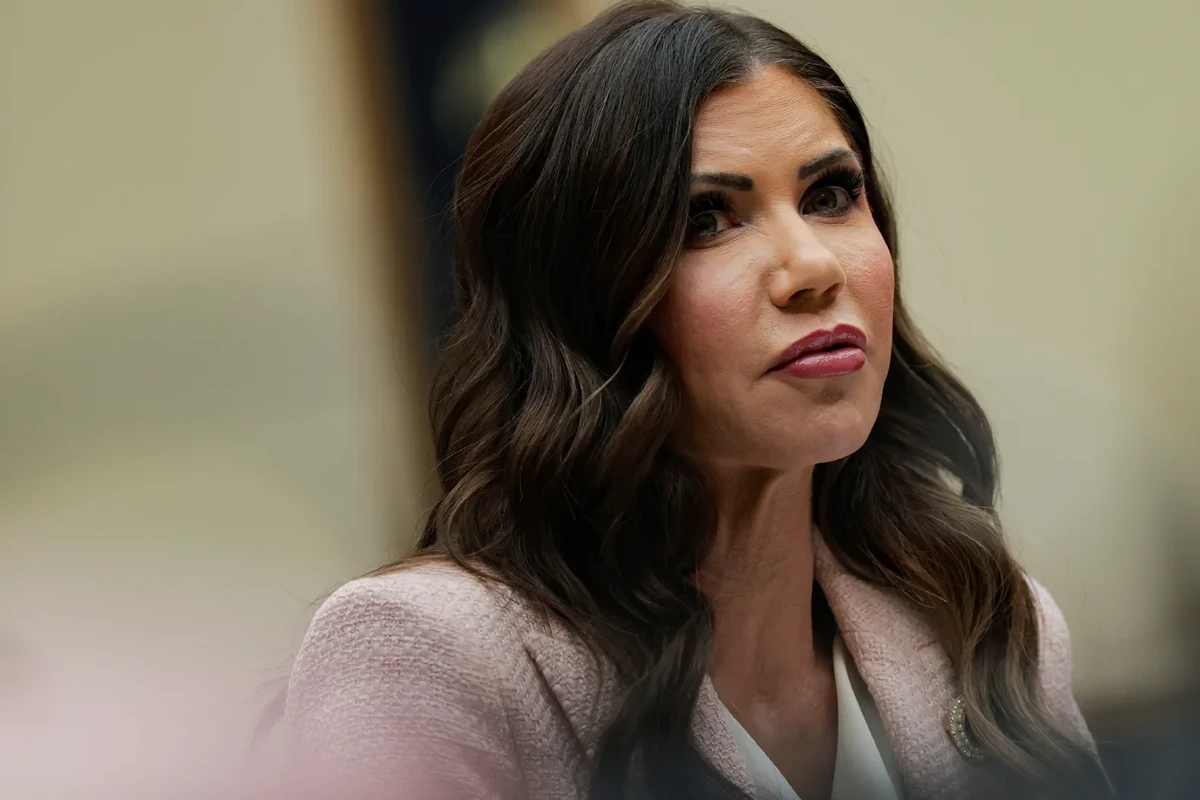
Kristi Noem testifies before the House Judiciary Committee in the Rayburn House Office Building on March 4, 2026 in Washington, D.C.

Heather Diehl/Getty Images

After weeks of public scrutiny, personal scandal, and bad press over her handling of the Department of Homeland Security, President Donald Trump has fired Secretary Kristi Noem, tapping Oklahoma Senator Markwayne Mullin as her potential replacement.

Noem is the first member of Trump’s second-term Cabinet to be removed from their position. In a statement posted to Truth Social on Thursday, Trump wrote that he was “pleased to announce that the Highly Respected United States Senator from the Great State of Oklahoma, Markwayne Mullin, will become the United States Secretary of Homeland Security (DHS), effective March 31, 2026.”


“The current Secretary, Kristi Noem, who has served us well, and has had numerous and spectacular results (especially on the Border!), will be moving to be Special Envoy for The Shield of the Americas, our new Security Initiative in the Western Hemisphere we are announcing on Saturday in Doral, Florida,” the president wrote. “I thank Kristi for her service at ‘Homeland.’”

The dismissal comes days after Noem was berated by lawmakers on Capitol Hill over a series of disastrous blunders by her department, including the killings of two American citizens by border patrol agents in Minneapolis, Minnesota, and apparent attempts by DHS to stifle investigations into the shootings. Noem has also been under fire for extravagant spending at the department, while placing restrictions on FEMA disaster relief funds.

Reuters reported that Trump was upset over Noem’s comments during hearings before the House and Senate Oversight Committees regarding multi-million dollar contracts granted to the husband of her former deputy press secretary. Noem defended the $220 million dollars in spending on ads, which prominently featured her, as well as the potentially unethical distribution of the contracts, affirming to lawmakers that Trump had approved the spending.

“I never knew anything about it,” Trump later told Reuters.

Mullin, whom Trump tapped as Noem’s replacement, has been a Republican senator from Oklahoma since 2023. He is a loyal Trump supporter, and is often on TV defending the president’s agenda — most recently the war against Iran. Mullin tried to justify the war to reporters earlier this week in part by insisting it is not an actual war. When he was told that Trump, Defense Secretary Pete Hegseth, and even Mullin himself had described the offensive as a “war,” Mullin claimed “that was a misspoke.”


More Stories

The Rise of the Digital Oligarchy
Illustration by Matthew Cooley. Photographs in illustration by Julia Demaree Nikhinson/POOL/AFP/Getty Images; The White House; Adobe Stock

The Rise of the Digital Oligarchy

On Jan. 11, 1994, I drove to UCLA’s Royce Hall to hear Vice President Al Gore deliver the keynote address at the Information Superhighway Conference. I was in the early stages of building Intertainer, which would become one of the first video-on-demand companies. The 2,000 people crowded into that auditorium did not know it, but they were crossing a threshold. The roster of speakers read like a who’s who of industrial power: TCI’s John Malone, Rupert Murdoch, Sony’s Michael Schulhof, Barry Diller of QVC. These were among the richest and most commanding figures in American communications. Today, their combined force and fortunes are a rounding error beside Elon Musk, Mark Zuckerberg, Peter Thiel, Jensen Huang, Jeff Bezos, and Marc Andreessen. The world the Hollywood moguls walked back out into would not, in any meaningful sense, be the world they had left.

Keep ReadingShow less
Bernie Sanders and AOC Want to Pump the Brakes on AI Development

Rep. Alexandria Ocasio-Cortez (D-N.Y.) and U.S. Sen. Bernie Sanders (I-Vt.) in April 2025.

Natalie Behring/Getty Images

Bernie Sanders and AOC Want to Pump the Brakes on AI Development

Senator Bernie Sanders and Representative Alexandria Ocasio-Cortez are announcing their support for two new AI bills aimed at putting a federal moratorium on the constructions of data centers. Sanders is introducing his bill, the AI Data Center Moratorium Act, on Wednesday.

“AI and robotics are creating the most sweeping technological revolution in the history of humanity. Congress is way behind where it should be in understanding the nature of this revolution and its impacts,” Sanders says in a statement to Rolling Stone. “We cannot sit back and allow a handful of billionaire Big Tech oligarchs to make decisions that will reshape our economy, our democracy and the future of humanity. We need serious public debate and democratic oversight over this enormously consequential issue.”

Keep ReadingShow less
Top Trump Official Resigns Over Iran War: ‘No Imminent Threat’

Joe Kent, director of the National Counterterrorism Center, testifies on Wednesday, Dec. 11, 2025.

Tom Williams/CQ-Roll Call, Inc/Getty Images

Top Trump Official Resigns Over Iran War: ‘No Imminent Threat’

The director of the National Counterterrorism Center resigned from his post on Tuesday in protest of Donald Trump’s ongoing war against Iran. Joe Kent, a former Army Ranger and CIA paramilitary officer, announced that he “cannot in good conscience support” the war, and that Iran was not an imminent threat to the United States, which the president and his administration have claimed in order to justify attacking the nation.

“Iran posed no imminent threat to our nation, and it is clear that we started this war due to pressure from Israel and its powerful American lobby,” Kent wrote in a statement released through his office and circulated on social media. “As a veteran who deployed to combat 11 times and as a Gold Star husband who lost my beloved wife Shannon in a war manufactured by Israel, I cannot support sending the next generation off to fight and die in a war that serves no benefit to the American people nor justifies the cost of American lives.”

Keep ReadingShow less
Trump Says Iran War Is Both ‘Very Complete’ But Also Just ‘the Beginning’

President Donald Trump at the Republican Members Issues Conference in Florida on March 9, as the war in Iran continues

Roberto Schmidt/Getty Images

Trump Says Iran War Is Both ‘Very Complete’ But Also Just ‘the Beginning’

As the U.S.-Israeli war on Iran escalates, President Donald Trump and his Cabinet have offered a litany of dizzying updates on the conflict.

During a phone interview with CBS News on Monday, Trump said the war with Iran is “very complete, pretty much.” Speaking from his Doral, Florida, golf club, the president claimed “[Iran has] no navy, no communications, they’ve got no air force. Their missiles are down to a scatter. Their drones are being blown up all over the place, including their manufacturing of drones.” He added, “If you look, they have nothing left. There’s nothing left in a military sense.”

Keep ReadingShow less
The Terrifying New Era of American Imperialism
Illustration by Matthew Cooley. Photographs in illustration by Celal Gunes/Anadolu/Getty Images; Getty Images; Nicolas Economou/NurPhoto/Getty Images

The Terrifying New Era of American Imperialism

In 2017, I published a book called, Move Fast and Break Things: How Facebook, Google and Amazon Cornered Culture and Undermined Democracy. For the next year, I lived mostly in transit around the world — 50 cities, dozens of stages, endless conversations about how the tech empires had bent our culture out of shape, numbed public life, and hollowed out the foundations of democracy.

It was outside the United States, though, that the dissonance struck most deeply. I remember sitting on high-speed trains that glided so fast and silently they seemed to erase distance itself, watching wind farms cross the horizon like silent fleets. In country after country — places far smaller and, on paper, far poorer than ours — I kept asking the same question: how could they manage to build what we could not? Why did the richest nation on earth feel like it was living off the leftovers of its mid-twentieth century optimism?

Keep ReadingShow less