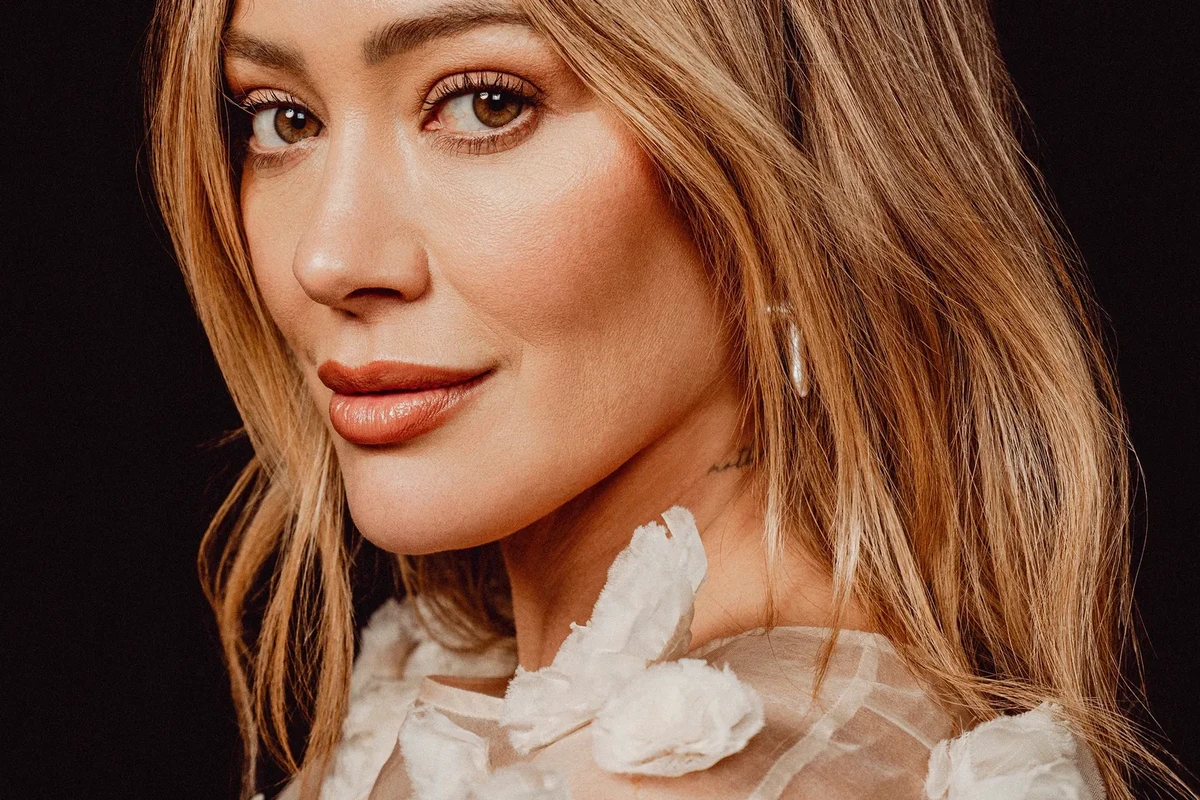

As a former child star, Hilary Duff is often asked how she turned out OK. Maybe it’s because of the 38-year-old actress-singer’s self-described “trad wife” tendencies: She’s happiest at home in Los Angeles, tending to her four children and her backyard chickens, making sourdough bread and crocheting. But the reality is more complicated. “It’s easy to look at me from the outside and be like, ‘She’s so balanced and grounded and has seemed to figure it out,’” she says over Zoom in late January. “But there’s been a lot of ups and downs and struggles.”
She answers the same question with her first album in more than a decade, Luck … or Something, out Feb. 20 via Atlantic. The title derives from the synth-heavy stunner “Adult Size Medium,” where she sings, “How did we get here?/Was it luck or something?” “I am happy with who I am,” she adds. “But the ‘or something’ is really the meat of the answer.”
The last time Duff released new music, in 2015, Barack Obama was president, Mad Men had recently aired its series finale, and she’d just met her future husband, musician-producer Matthew Koma. “We got set up through my A&R person, and we ended up hanging for two hours, just talking about music,” Duff recalls on a second Zoom date, this time with Koma by her side. “Matt sent an email to his manager afterwards and was like, ‘She’s really pretty.’” (“I said, ‘I want to marry her,’” Koma adds.) After dating on and off for several years, they tied the knot in 2019, and have worked closely together ever since.
Koma, 38, says that Duff was always “flirting” with the idea of returning to music, but she began to take it seriously in 2024, after the birth of their youngest daughter, Townes. Her only hesitance was how much the internet has changed culture in the past decade. “Everyone has a way to tell you how they feel about what you make, and that felt scary,” she says. “I was like, ‘Why would I subject myself to this? We have a happy life and amazing kids.’ But obviously, I miss performing, and I desperately miss having that person be in the forefront.”
With the rise of 2000s nostalgia, Duff has also found a younger fan base, including many people who were most likely born around the time her breakthrough album, Metamorphosis, was released in 2003. She was already a household name by then, thanks to starring in the Disney Channel series Lizzie McGuire and films like Cheaper By the Dozen, Agent Cody Banks, and A Cinderella Story.
By last year, the demand for new music had become feverish, and the internet erupted when she teased her return in September 2025. Fans proclaimed that she was “here to save pop music,” which stunned Duff. “That was not even real life,” she says. “I was like, ‘What the fuck is happening? Some bot did this.’ It was not a normal day.”
She did her best to push that pressure aside, with Koma urging her to simply make exactly what she wanted, with zero expectations. “We’re not doing this for anybody,” he says. “There’s nothing riding on this. This is for her.” As Duff recalls, “He was like, ‘We just have to make what we think is cool, what you want to listen to in your car.’ He has a way of boiling everything down and making it super digestible for me. So that was the approach of the record. What keeps me up at night? What are my insecurities? The themes are what 10 years has brought on. It was super healing to make something that felt exactly like me, and where I am right now.”
The result is a cohesive, no-skips record that offers an update on Duff’s life, including honest looks at motherhood, marriage, and the passing of time. It’s a pop record that holds very little back, offering a realistic, at times unglamorous portrait that is highly relatable. Lizzie McGuire made viewers feel seen because Duff was clumsy and awkward, falling into platters of spaghetti and getting dumped by her first boyfriend. She’s still doing something similar now, 25 years later, as she mirrors our adult anxieties. “Are we having enough sex?/Are there exes you miss?” she sings on the glittery “Future Tripping Out.” “Will your crisis be a car/Or some bitch at a bar/Who says she loves Bon Iver/Calls him Bon Ivar?”

“It was really important to me to not make a record that was like, ‘I’m a mom and I pick up my kids at school and pack lunches every day and it’s so hard,’” she says. “It was not at all what I was interested in talking about. What I was interested in talking about is the shift in how it makes me feel, as a person.”
Koma — who has collaborated with Britney Spears, Shania Twain, Zedd, and others — co-wrote Luck with Duff, and produced it alongside his longtime collaborator Bryan Phillips. Koma says the playful opener “Weather For Tennis” is a direct callback to the sonics of Duff’s earlier work. “It’s these pre-Hot AC, Michelle Branch-ish production models, but let’s keep the core of the songwriting essence the same,” he says.
That songwriting is sharper than ever, like on “Holiday Party,” where she wrestles with the fear of her husband cheating on her at a festive gathering (she says this is a recurring dream of hers). “I always think Matt’s going to leave me for some coolio indie songwriter that he works with,” she says. “Which is so insane,” Koma replies. “But also very real. Those are real things to get hung up on emotionally.”
Some of the strongest moments on the album are when Duff strikes a balance between bright, blissful pop melodies and sincere, even devastating lyrics. “I wish I could sleep on planes/And that my father would really love me,” she sings in “The Optimist,” a sparse tearjerker complete with cozy lap steel (played by Emily Rosenfield, who’s also in Olivia Rodrigo’s backing band and performed at Duff and Koma’s wedding). “There’s times where I talk to my dad and times where I don’t talk to my dad,” Duff admits. “I do have a pretty sunny disposition, but a lot of shit has gone down, and that’s life.”
On “We Don’t Talk,” she details another strained relationship within her family: ‘‘’Cause we come from the same home, the same blood/A different combination but the same lock.” When she played her first major concert in 18 years recently in London, she performed the delicate track on a mustard sofa. Fans speculated that the song was about Duff’s sister, Haylie, from whom she’s rumored to be estranged; some even went as far as to think the color of the couch was an Easter egg (to some online Sherlocks, it resembles a couch they saw in a video, case closed).
“I feel almost like when I got divorced [in 2015], where I dealt with it privately, and then the news comes out and you’re like, ‘OK, great. I’m going to deal with this all over again,’” Duff says. “I was prepared, a little bit. I made a choice to put that song on my record. That’s definitely the most lonely part of my life, and I struggled with, ‘Am I going to share this?’”
Without directly naming the song’s subject, she adds, “People have known my life since I was a child, and so they know all the characters in it and they know what I’m talking about. For me, it was important to be open about that theme. It genuinely came from the heart.”
There’s one thing she wants to push back on, though. “I was not, however, prepared for people to be like, ‘The couch is the color of the couch…’ That is absolute bullshit, and totally not true and crazy. And I don’t have the time to make threads for people to catch on to about that. I have a full life and a busy family, and this was literally just a song about my truth, and that was it.”
DUFF IS A MILLENNIAL through and through — she even samples Blink-182’s “Dammit” on the new album’s centerpiece, “Growing Up” — and like many of us in that generation, her TikToks are a work in progress. “I’m such an Instagram girly,” she says. “All my friends that are on TikTok are like, ‘You’re living in the Stone Age.’”
Even so, she does see some of the TikToks commenting on her music, like when she released “Roommates,” the addictive second single from Luck. “It was like, ‘This is Sabrina Carpenter reheated in the microwave,’” she tells me. “I was like, ‘How do people even get these mean terms? It’s so fucked up!’ And then I go into the comments and someone’s like, ‘Does anybody realize she was here first?’”
 Aaron Idelson
She goes on: “Everybody’s insane. Pop music is pop music. I realize that the talking heads on TikTok need to have something to say, and luckily for the most part, it’s been super positive and nice. And then the mean ones stand out and I’m like, ‘Your hair color is literally terrible! Let’s talk about your hair color!’”
When planning her comeback tour — an intimate run she called Small Rooms, Big Nerves, prior to announcing her upcoming world trek, the Lucky Me Tour — Duff was forced to contend with all aspects of her musical past. “I have a big discography, which is a blessing and a curse,” she says. “Some songs are embarrassing, and some are super fucking good.” Her set list features several Luck tracks, but it’s mostly a love letter to fans, as she winds back the clocks and tears through gems like “So Yesterday,” “Come Clean,” and “What Dreams Are Made Of.”
I ask her if she’ll ever do the Metamorphosis deep cut “The Math,” a whimsical rocker that likens love to mathematical equations. When I explain to Duff that the line “I am calling you back/This is Star 69” taught me what the telephone re-dial code was, she says, “I literally die inside every time. Those lyrics? I’m ashamed.” Koma chimes in: “That’s been our inside joke since day one. We’re like, ‘All right, play ‘The Math’ three times in the set!”
She does embrace one part of her past she used to find mortifying: Her onstage choreography for 2007’s “With Love,” which became (what else?) a viral TikTok trend. “It took me a little while to find peace with it, and the humor in it,” she admits. “Obviously, it’s silly and embarrassing. But the fact that people across the whole entire world take the time to learn a dance and make a costume and post it on the internet, I’m obsessed with it. It took me getting to 38 to be like, ‘Oh, I get this. I get this and I love it, and I’m here for it.’”
On tour, Duff brings fans onstage to join her in the “With Love” dance. They’re usually decked out in 2000s fashion, from butterfly clips to space buns, or her signature outfits from The Lizzie McGuire Movie. She’s considering including celebrity guests as the tour continues, similar to Carpenter’s “Juno” arrests or Role Model’s many Sallys. “It’s also a great way to take a little break,” she jokes. “Mama needs a break.”
During our first interview, while Duff is on tour in Toronto, our Zoom is briefly interrupted when Duff’s nanny FaceTimes her, so her kids can say hello. Though she’s reawakened her pop star persona, her primary focus is still her family; Koma even built a rehearsal space for Duff next door to his studio, so the family could all be together. “He’s so romantic, this guy,” she says.
Duff tells me about the other day, when she was packing to leave for tour and doing a wardrobe fitting, trying on racks and racks of clothing while her seven-year-old daughter was sick upstairs. “In my mind, I’m like, ‘They’re going to look back at this time and be like, I was sick and my nanny was painting my toes and my mom was downstairs shopping.’ And I’m just like, my job sucks sometimes. You know what I mean? That should be me up there.” (Adding insult to injury, it turned out that her daughter was upstairs watching another Disney series, Bunk’d. “I was like, ‘What about Lizzie McGuire? Hello!'” Duff jokes.)

By the time I attend Duff’s Brooklyn show on Jan. 27, her children are with her backstage, taking slices of a sparkly cake, fittingly decorated with butterflies. There was palpable joy coming from the crowd, which is something she’s still getting used to. As Koma told me earlier, “She’s such an unaware person sometimes, of how much she means to people. And I understand that, because I think it would be a weird thing to live in a reality where you were too in touch with that. So it’s a beautiful thing that she’s not, but it’s also beautiful to see her have those moments where you can’t deny how celebrated and how deeply [she’s] affected people.”
To this, Duff concedes. “I do feel like one of my magic tricks is being able to connect with people. To be able to reach them and relate to them, and them feel close to me.” But can she actually save pop music? “That’s too big of a responsibility,” she says, “but it does make me chuckle.”


 Steve Cohen*
 Paul Heartfield*