![‘Horizon — Chapter 1’ Is Kevin Costner’s ‘How The West Was [Yawn]’](https://ca.rollingstone.com/media-library/image.jpg?id=52990768&width=1200&height=800&quality=90&coordinates=0%2C0%2C0%2C0)

Kevin Costner is contemporary America’s No. 1 cowboy patriarch, the sort of actor who gives off a strong frontier-zaddy vibe while looking remarkably at home on a horse. He wasn’t the sole reason why Yellowstone became a massive hit, just the biggest; whether you love or loathe Taylor Sheridan’s ranch-style soap opera, it’s hard to argue with the sheer star power and earned sense of take-no-shit gravitas Costner brought to the role of John Dutton. That show not only gave Costner a renewed level of cultural currency — the man never stopped working, but he was more likely to show up as strong supporting player than a headliner post-Draft Day — it also gifted him with a fresh re-up of industry clout. Prior to him anchoring Sheridan’s ever-growing empire of home-on-the-range programming, the 69-year-old had been pitching his idea about an epic Western for years and received his share of polite “No, thanks.” Now, the idea of Costner + Stetson, multiplied by Monument Valley and divided into several chapters, felt like it had a built-in audience already in place.
No one knows whether those core Yellowstone/Costner fanatics will show up to this first installment of the writer-director-producer-star’s throwback. If they do, however, they will definitely find something very familiar. A mix of colliding storylines, stock characters, and an everything-but-the-stagecoach checklist of genre conventions, Horizon: An American Saga — Chapter 1 is less a revival of the big-screen Western than an attempt to be every single Western all at once. And knowing that his vision of manifest-destiny expansion and colonization would be too grand and sprawling for a single movie, Costner has designed this initial three-hour chunk as a sort of supersized pilot that’s one long promise of down-the-road payoffs. You can’t say it’s unambitious, any more than you could call it coherent, and the result is less Dances With Wolves Redux and more Palms on Faces.
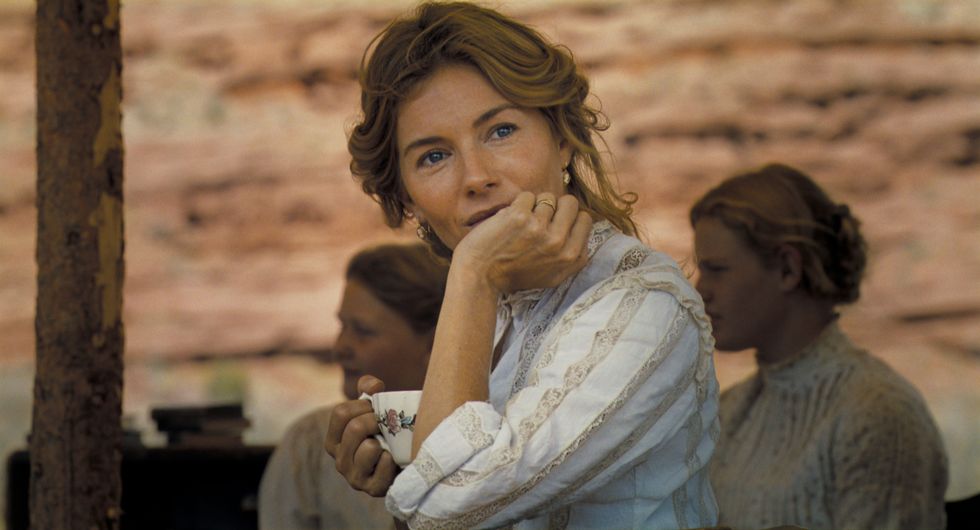
We open on an anthill, which may or may not be an homage to Sam Peckinpah’s The Wild Bunch but is definitely a portrait of a community working in harmony with its environment. (We applaud the metaphor regardless.) Then a huge post is thrust into the middle of it, scattering its tiny occupants and staking a single owner’s claim to the land. It’s on this spot in the San Pedro Valley that the town destined to be known as Horizon will eventually be founded, though it will take several years, a number of different settlers, and more than a few deaths to establish a semi-permanent residence on this would-be Eden. Over the years, Apache warriors have killed to protect their territory and way of life. And the fact that the latest group of homesteaders have just held a dance in the town barn doesn’t spare them from a massacre. One family in particular, the Kittredges, put up quite a fight. But they too are overwhelmed, and only the matriarch Frances (Sienna Miller) and her daughter, Elizabeth (Georgia MacPhail), survive.
They are taken in by the U.S. calvary, who’ve come from a nearby outpost to bury the dead and counsel the living. Three soldiers stand out: Lt. Trent Gephardt (Avatar‘s Sam Worthington), a dedicated military man who nonetheless recognizes that the Native Americans were indeed here first; Col. Houghton (Danny Huston), who views the taming of the wild west as inevitable; and his right hand man, Sgt. Major Riordan (Michael Rooker, immediately winning the honorary Victor McClagen Salty Irish Sidekick of the Year Award). Some settlers, like the Kittredge women, stay with them at Camp Gallant. Others form vigilante groups that plan to sell scalps for profit, because turning violence into commerce has been the American Way since time immemorial. As for the indigenous population, they’re experiencing their own inter-tribal friction as the militant Pionsenay (Owen Crow Shoe) is ready to wage war while other Apache, like his brother Taklishim (Tatanka Means), want to live a peaceful life away from Horizon.
Meanwhile, over in the Montana Territories, a woman with a baby pulls up in front of a cabin at dawn. She grabs her shotgun, shoots a middle-aged male sleeping inside, then escapes. This is Lucy (Jena Malone). That rat bastard with a chest full of buckshot is the gent who got her pregnant, and it’s implied their coupling was not consensual. The man’s two grown sons, Junior (Jon Beavers) and Caleb Sykes (Jamie Campbell Bower), are tasked with tracking her down and returning their infant stepbrother to outlaw-family fold. The former is the kind of slow, steady predator who tends to out-think his prey. The latter is your run-of-the-mill loudmouth psychopath. Both seem to love the delicious taste of chewable scenery.
Wait a second, you may find yourself asking roughly one hour in, a.k.a. 1/12th of this lumbering saga’s full running time (No. 2 drops in August and we’re supposedly getting four chapters in all): Isn’t Kevin Costner starring in this epic as well as calling the shots? Yes, he certainly is. Our tall drink of A-list water literally rides into the picture as one Hayes Ellison, a saddletramp who, it’s strongly hinted, used to make a living with his gun. Now he trades horses and does other odd, far more legal jobs. Hayes has blown into the mining town of Watts Parish in Wyoming, in need of some rest off the range. The local belle du jour, Marigold (Abbey Lee), takes a shine to him and begs Hayes to come up and see her some time. She lives up the hill with a woman and her child, who happens to be — surprise! — Lucy. And it seems that the Sykes brothers have also followed their target’s trail to Watts Parish, and the town ain’t big enough for all of them….
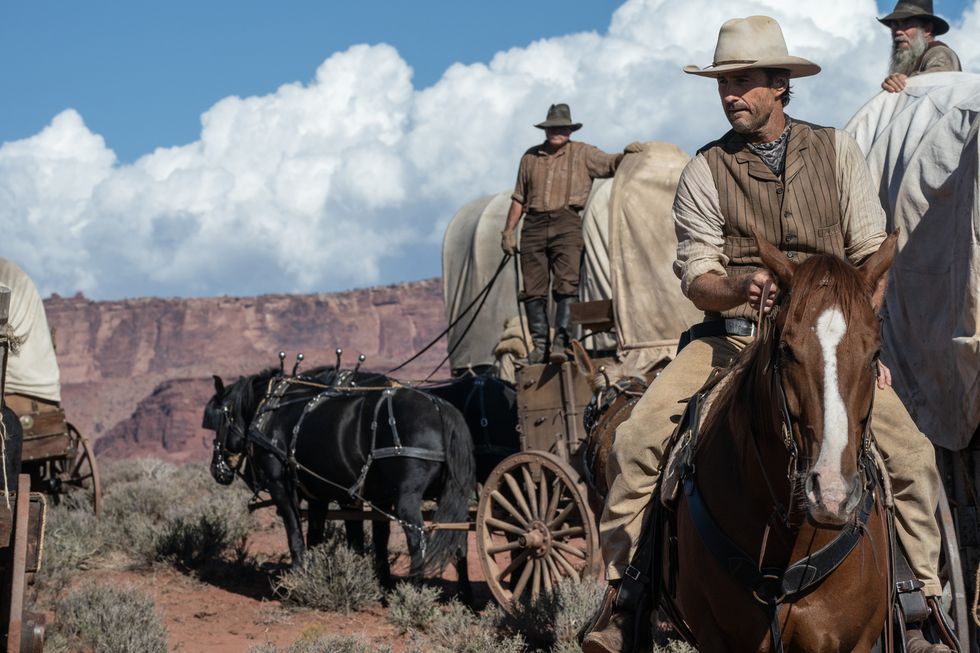
But hold on! We haven’t even mentioned the wagon train yet! Over yonder, on the Santa Fe Trail, Matthew (Luke Wilson) is leading a group of pioneers in covered wagons. He’s got to contend with harsh climates, the threat of random Apache attacks, and Hugh and Juliette (Tom Payne and Ella Hunt), a British couple who tend to act like their fellow settlers are servants. As if the grit-vs.-snoot tensions weren’t enough, Matthew also has to keep an eye on two Laplander travelers (Douglas Smith and Roger Ivens) who have taken an intense interest in this English rose. Like everyone else, these folks have seen the plastered posters for some prairie Shangri-La called Horizon and are heading west to seek their fortune.
Will all of these storylines converge in due course, forming Voltron-style into some sort of grand national origin story? Only Costner knows — and he’s willing to take his time gettin’ to where he’s going and tease out each narrative in a way that will test audiences’ tolerance levels. It’s not that his idea of recounting how the West was won from a series of different, sometimes conflicting vantage points isn’t the smart way to tackle a melting pot that’s just beginning to bubble. The problem is that none of these stories is able to stand up on its own, much less as a part of some bigger visionary cinematic mural. You barely have a chance to know or glean insight into one set of characters before you’re dragged and dropped into a different narrative strand, where folks are given just enough time to posture or spout folksy platitudes before the plotline roulette wheel spins again. And again. And again.
Sometimes, the effect is thematically detrimental, as with the Native American narrative; viewers get just enough scenes among the Apache in Chapter 1 to understand that their history is also our collective history, but not enough to balance out a lot of set pieces in which they’re treated as the same faceless, nameless murderers you’d see in 1930s Westerns. Their saga may get fleshed out in later entries, but the cake-and-eat-it-too aspect (especially coming after recent works like Killers of the Flower Moon) is off-putting. Other times, simple A-to-B storytelling suffers from the too-much-yet-not-enough blues. At one point, Worthington’s noble lieutenant addresses the camp gossip swirling around his interest around Miller’s widow. If you’re like us, your reaction isn’t to swoon over the old-fashioned romantic vibes but something like: There have been rumors? What? When? Why? From whom? Did we miss a scene, or did the set-up for this get left on the cutting room floor?
(A quick word about the performances: Much like Chapter 1‘s competing scenarios, they’re all over the map. Worthington and Miller make you hope they get more time together. Any time Costner is onscreen, you can feel Horizon‘s energy level spike. Wilson is doing his Wilson thing, only in a cowboy hat. Rooker appears to be having a blast in his own personal remake of Fort Apache. Virtually every bad guy seems to have been cast in bulk from a firm that supplies network procedurals and basic-cable horse operas with villains — we’re assuming they got a group deal with Mustache-Twirling Ornery Varmints R’ Us.)
You can feel Costner’s reach exceeding his grasp as he tries to bring back your grandfather’s Westerns in one big, ungainly TCM-binge of a highlights reel — a goal we wholeheartedly support and we wish to Ford he’d nailed. It makes you want to forgive Open Range, his 2003 cattle-drive opus, for its far more modest sins. Chapter 1 ends with a kind of “this season on Horizon” montage of coming attractions, including peeks at new characters, new actors (Glynn Turman! Giovanni Ribisi!), new shootouts, etc. You’re supposed to feel excited about what’s around the corner. Instead, you feel strung along and exhausted. The irony is that the very thing that has allowed Costner to turn this long-gestating dream project in to a reality has, in so many ways, made it completely irrelevant. What you’re really seeing is a pale imitation of a Sheridanverse series pilot, retrofitted with big-screen Hollywood bombast. Except you can now get the real thing elsewhere, and done much better. Sorry, pardner. That stake has already been claimed.