
This story contains spoilers for the Industry Season Four finale.
A Spotify save-worthy soundtrack, epic needle drops, and a euphoric shimmery score set Industry apart when it comes to music on television.
The sound of HBO’s buzziest show — which was recently greenlit for a fifth and final season — is as live-wire as the series itself, and Season Four, which concluded tonight, pulled from a more eclectic mix than ever. Its eight episodes featured Eighties anthems like Alphaville’s “Forever Young,” New Order’s “True Faith” and “Fine Time,” and an Italian disco-style remix of David Bowie’s “Heroes”; dance club classics in Daft Punk’s “Veridis Quo” and “All On You (Perfume)” by Paris Angels; plus more current songs from Turnstile.
Finance bros turned series co-creators Mickey Down and Konrad Kay lean into the madness of their international banking-set soap with the musical choices, even if some of their most provocative ideas don’t make the final cut. While Ken Leung’s veteran trader Eric Tao walks out of finance and off into leafy suburbia to Judy Collins’ version of Joni Mitchell’s “Both Sides Now” in Episode Six, rights holders denied the request to also use the song in a glory-hole scene earlier in the same episode.
Unlike similar shows that tackle worlds of money and power, such as Billions and Succession, Industry has made music its surprising heartbeat, using cultural references to emphasize overarching themes of greed, corruption, and relentless ambition. Aristocrat Henry Muck (Kit Harington) singing “He Is an Englishman” from Gilbert and Sullivan’s opera H.M.S. Pinafore to himself in the shower — and the song later returning to back the final scenes of Henry enjoying a cushy prison sentence from his family estate — is a pointed jab at the country’s nearly impenetrable class system. Tender CEO Whitney Halberstram (Max Minghella) creepily sing-whispering Whitney Houston’s “I Wanna Dance with Somebody (Who Loves Me)” on a sinister yet intimate call with Harper suggests the fraudster may have plucked his fake name from a karaoke catalog.
In early seasons, the show’s creative team wanted to “make the trading floor sound like a dance floor,” capturing the essence of youthful optimism and the sheen of opportunity, music supervisor Ollie White tells Rolling Stone. But as Eric, Harper Stern (Myha’la), Yasmin Kara-Hanani (Marisa Abela), and Rishi Ramdani (Sagar Radia) swapped sterile corporate bullpens for chic offices, five-star hotel suites, country estates, and even jail cells, the sounds of their worlds turned heavier and darker.
Rolling Stone spoke with White and composer Nathan Micay to discuss why Mad Men and The Big Short references popped up this season, how they foreshadowed Yasmin’s descent into moral corruption, and where the show might be headed next.
What was your introduction to the show? How did you come to work with its creators?
White: I was introduced to Mickey and Konrad through a mutual friend. I was DJing a lot at the time, and I met Mickey first at an afterparty, which I was DJing. We bonded over music. He told me that he was working on a TV show. I was doing music supervision for trailers, adverts, and a few indie films. We just started making playlists from that.
[Down and Kay] always think about music. They write a lot of music into the script, which is so good. It helps everyone know what the tone and the mood is, and the directors can film with that song in mind. When we get into the edit, we try it out. It doesn’t always work out, obviously. But then a lot of the time it does, and it really elevates it because it means everything has been built with the song in mind.
It’s fascinating to hear that while they are scripting, they’re talking about song choices. Have there been certain scenes built around a specific song?
White: Episode Five [of Season Four], we used Billy Idol’s “Eyes Without a Face.” That whole episode was built around that song. That song basically is the clue to everything: that Tender is fake. There’s nothing there. It’s a front. That was one of the songs that we had probably in the Season One playlist: the tone, mood, vibes. We knew that we could never afford it at that stage, so we didn’t even think about it, but it was definitely in our playlists. Then they wrote that episode, and [the song] was so ingrained in it, it was essential that we got it. It was everything. They titled the episode after it as well.
A lot of songs featured in Mad Men also appear on Industry this season, like Peggy Lee’s “Is That All There Is?” and “Sukiyaki” by Kyu Sakamoto. And you have former Mad Men actress Kiernan Shipka joining the cast [as escort turned Tender employee Hayley Clay]. Were those references intentional?
White: Everything is intentional. Mickey and Konrad paint with a very maximalist brush. They like their references, and they love their inspirations. [In] Episode Two, Stanley Kubrick [and] Barry Lyndon was a massive influence for them. A Clockwork Orange was a massive influence, particularly for Whitney’s character. American Psycho as well. We have utilized all of that. We actively want the audience to make note of those references and think about how they felt when they watch those films or watch those TV shows. We want to invoke that we’re referencing culture, and a really great way to do that is through music.Mickey did this really cleverly, [and] there’s a track that’s used in The Big Short that we use in Episode Eight. [“Tú Y Tu Mirar… Yo Y Mi Canción” by the Los Angeles Negros plays after Harper successfully shorts Tender and her call to Eric goes to voicemail.] It was his suggestion to use the song. I was like, “Why are you putting this in there? I don’t understand it.” He didn’t tell me. Then when I looked into the song, I was like, “Oh, it’s used in The Big Short.” It was all on purpose. We wanted to reference that point.
Nathan, what was something you and the showrunners wanted to capture through the score in Season Four, where the original trappings of Pierpoint & Co., the bank where these players came up, are largely out of the picture and these characters are existing in startup offices, luxury hotels, and estates?
Micay: [We wanted to capture] the change in sense of scale. The primary settings of the first two seasons are more or less an afterthought now. The stakes feel just as high on an individual level, character to character, but they carry the potential for societal consequences now. It’s one thing for Harper not to report loss on a trade at Pierpoint, [now it’s] something entirely different for her to have her name riding on a £500 million bet. Not to mention Whitney intermingling what he knows to be a fraudulent company with the U.K. government.
We wanted the score to feel more sinister, less intimate, and somewhat otherworldly. These characters are now often living in a world most people could only imagine, and sometimes it’s literally a facade to placate people’s imaginations.
You composed certain themes for characters. For Harper, Yasmin, and Eric, how would you describe the original elements of these sounds, and how did that evolve over four seasons?
Micay: In Season One, Harper and Yasmin were excited grads in what felt like an exciting place. The music was kinetic, and I tried to make every moment of theirs feel electric and moving. Eric’s original sound was straight-up rumbling sub bass. I wanted him to feel larger than life. When he talks, the earth shakes. They fear him. This continued into the next two seasons, but that scale of fear and respect began to equalize, at least between Harper and Eric.
Harper’s themes have become heavier, less melodic, and carrying more weight. Yasmin’s have become darker, and in a way, sadder. Her scenes this season were mostly involving very detuned and off-kilter piano. Her life never seems to feel on the level, ever. So I tried to capture that with these big detuned piano stabs. Toward the end of the season, as Harper’s big plan finally pays off, I got to finally return to those early-season feelings of joy with synth. The score of this series always comes back to synth.
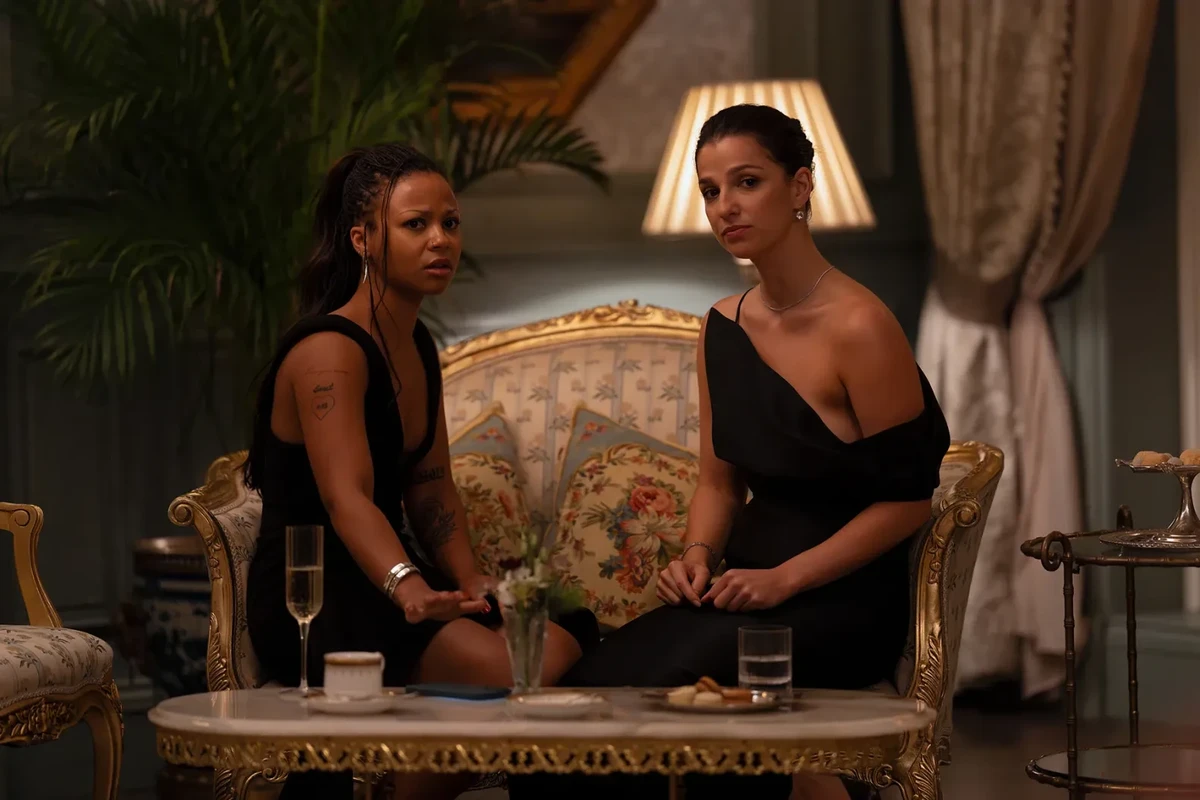
Yasmin was revealed by the finale to be a blend of Ghislaine Maxwell and Jeffrey Epstein, with shades of her father — the cause of a new rift between her and Harper. You used “Mon Dieu” by Édith Piaf for large portions of the finale. Why go romantic for a moment that’s so horrific on its face?
White: We decided that what this moment needed to be, for the music, was representing these two characters. Obviously, they’re talking about horrific content, but we wanted to ignore that for the moment and just think about what the music can do. These two characters that are friends, that are pulling apart. This is the final straw. Yasmin has turned around to Harper, and it’s heartbreaking [in her] saying, “This is the only thing that makes me feel powerful, where I belong.”
We wanted a song that could capture the emotional heartbreak of these two characters and what they’d gone through. The score that we were [originally] trying was totally different; it portrayed Yasmin as a baddie, basically. But we ended up going a different route.
Were there any personal highlights this season when it came to scoring certain sequences?
Micay: The score during the big Harper-Whitney phone call where he sings Whitney Houston, then reads his letter to Henry and later gets the big reveal from Ferdinand — I think that’s the best cue of the season. It was a huge undertaking with so many tones and major moments happening one after the other.
Besides that, the cue of Henry bursting into his dinner party high on acid in Episode Two was super fun to do. I’d been wanting to do something with big Ghost in the Shell-style drums [from the animated Japanese cyberpunk sci-fi movie] since Season One and they finally let me.
Industry has some huge needle drops. My favorite was the Pet Shop Boys’ mashup of “Where the Streets Have No Name” and “Can’t Take My Eyes Off You” in Episode Two. Do you have a favorite needle drop of this season?
White: That [Pet Shop Boys song] is up there. If you hadn’t said that’s your favorite, I would have said that it’s my favorite. So, I’ve got to choose something else: I would say Turnstile’s “Magic Man,” which we used when Henry gets arrested. I loved it. I just love that band. It’s my favorite album from last year. They were really excited about getting used in the TV show. The song works so brilliantly for Henry at that moment.
In the finale, we hear the title song “Blue Spring” again, which you’ve mentioned encapsulates the feeling of new beginnings and possibility. Is there anything you can share about the creative choice to end on that note? Does this signal a happy future for Harper?
Micay: I think so! But knowing Harper, she’ll find a way to make sure that happy future is short, no pun intended.



 The All-American Rejects at Soho House Courtesy of Soho House