
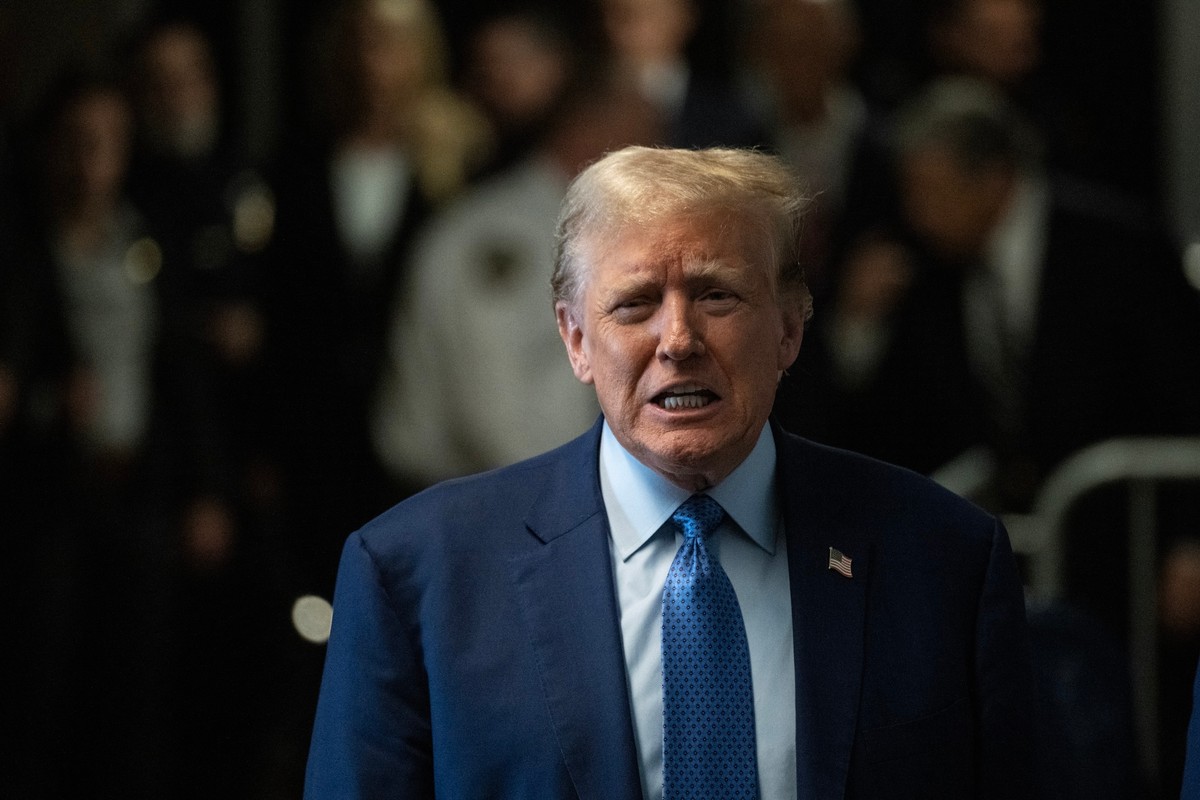

If he becomes president again, a recently run wargame determined NATO could collapse under another Trump administration.
Donald Trump loves to complain about NATO and what he perceives as member nations not contributing enough financially to shared defense. He has threatened to put the U.S. on a “standby” position in NATO if member nations don’t bend to his will.
The wargame, run by British defense expert Finley Grimble, predicted that even if Trump doesn’t fully withdraw the U.S. from NATO, the organization could fall apart, Business Insider reported Sunday.
“A US policy of frustrating NATO has the potential to cause the alliance to collapse, with the EU as a candidate for eventually replacing NATO’s ultimate function — defending Europe from Russia,” Grimble, who served as wargamer and strategy advisor to the UK government, wrote on PAXsims.
According to the current National Defense Authorization Act, the president cannot “suspend, terminate, denounce, or withdraw” the U.S. from NATO without the “advice and consent” of a two-thirds majority of the Senate. But that doesn’t mean that a president couldn’t do serious damage to the treaty partnership without fully withdrawing.
“What Donald Trump can do is just really hollow out what NATO does,” Grimble told Business Insider. “He doesn’t need to leave NATO to ruin it. He can ruin it from within.”
U.K. experts in defense and intelligence participated in the wargame, playing the leaders of various countries. In the simulation, Trump took office and attempted to arrange a peace deal between Russia and Ukraine, with assistance from Turkey while excluding other European nations. When the deal failed to materialize, Trump severely restricted U.S. aid to Ukraine, and other nations moved to “fill the void.”
The simulation Trump’s next step was to go into “dormancy” in NATO (similar to Trump’s threat to go on “standby”) and withdraw half of the 100,000 U.S. troops currently deployed in Europe, sending them to the Indo-Pacific and decreasing U.S. involvement in NATO exercises. The simulated U.S. government then prohibited NATO’s Supreme Allied Commander in Europe (the SACEUR, who is always a U.S. official) from acting without first getting permission from the U.S.
“Ultimately, SACEUR is answerable to the president of the United States,” Grimble told Business Insider. “So [the SACEUR] can start slowing things down, or prevent things from happening. The U.S. can just take the funding from NATO programs and they will collapse.”
This policy of dormancy led simulation Turkey to consider withdrawing from NATO, and both Turkey and Hungary begin strengthening economic ties with Russia. In the simulation, Russia began exploring options to “cut off the Baltic States from the rest of NATO” but ultimately decided not to do so.
By Oct. 2026, the wargame predicted that Ukraine would sign a treaty with Russia recognizing Crimea and additional areas of Ukraine as Russian territories. Ukraine also installed a pro-Moscow government in Kyiv and agreed never to join NATO. Meanwhile, France decreased its participation in NATO, bringing tension between Poland, Germany and France.
During Nov. 2026 to Jan. 2027, the simulated Trump administration begins “in-depth senior talks to repair” bilateral U.S.-Russia relations, end the sanctions, and “resurrect the broken security architecture between them.” Plans are developed for a meeting between Russian President Vladimir Putin and Trump. During this time, the wargame predicted that U.S.-China tensions will escalate, U.S. relations with Europe will deteriorate, and NATO members will reduce their presence “given the perceived increase in likelihood for a Russian invasion.” All of this could lead to negative economic and security consequences for Europe.





The Terrifying New Era of American Imperialism
In 2017, I published a book called, Move Fast and Break Things: How Facebook, Google and Amazon Cornered Culture and Undermined Democracy. For the next year, I lived mostly in transit around the world — 50 cities, dozens of stages, endless conversations about how the tech empires had bent our culture out of shape, numbed public life, and hollowed out the foundations of democracy.
It was outside the United States, though, that the dissonance struck most deeply. I remember sitting on high-speed trains that glided so fast and silently they seemed to erase distance itself, watching wind farms cross the horizon like silent fleets. In country after country — places far smaller and, on paper, far poorer than ours — I kept asking the same question: how could they manage to build what we could not? Why did the richest nation on earth feel like it was living off the leftovers of its mid-twentieth century optimism?
Conversations in Europe added another layer. People spoke casually of health care as a right, not a privilege; of sending their children to university without dread or debt; of a shared obligation to slow the warming planet. It was not utopia — just an older, steadier faith in the public good. The idea that freedom and mutual responsibility might coexist had not yet been driven out of their political imagination.
Back home, the contrast was impossible to ignore. We stumble on crumbling bridges and argue about the price of insulin yet never question why nearly two-thirds of what Washington calls “discretionary spending” is locked inside the machinery of the National Security State. In the 2026 budget, 59.6 percent is marked for the Pentagon (even more if Trump succeeds in getting an additional $600 billion), another 6.4 percent for Homeland Security. No other democracy has made such choices — or lived so comfortably with their consequences.
President Eisenhower famously warned us in his farewell speech that the military and the defense contractors would be unwilling to give up the giant budgets they had gained since the end of World War II:
This conjunction of an immense military establishment and a large arms industry is new in the American experience. The total influence — economic, political, even spiritual — is felt in every city, every State house, every office of the Federal government. In the councils of government, we must guard against the acquisition of unwarranted influence, whether sought or unsought, by the military industrial complex. The potential for the disastrous rise of misplaced power exists and will persist. We must never let the weight of this combination endanger our liberties or democratic processes.
For more than three decades, presidential campaigns — from Clinton through Obama to Trump — have promised a reckoning: an end to “stupid wars” and a redirection of national wealth toward rebuilding America itself. Yet once in office, each fell under the shadow of Eisenhower’s warning about the military-industrial complex. None dared to reduce defense spending, and so Eisenhower’s second fear — that this imbalance would “endanger our liberties or democratic processes”— has slowly come true. But now under Trump we are engaged, as The New York Times noted, “in a resurrection of the mission of empire — acquiring the territories and resources of sovereign peoples.”
Trump campaigned on the promise that the United States would stop policing the world, that the era of regime change and open‑ended intervention was over. Now we have invaded Venezuela, kidnapped their president, and Trump tells us we “are going to run the country for a long time,” as if Venezuela were a failed subsidiary being placed into receivership. Next up was Iran, with a New York Times banner headline proclaiming, “Trump Calls for Overthrow of Government.” The idea that the United States will “run” or administer another sovereign nation, even “temporarily,” ought to trigger every alarm that still works in Washington.
We are entering a new era of American imperialism. Trump Deputy Chief of Staff Stephen Miller recently told CNN’s Jake Tapper, “We live in a world, in the real world, Jake, that is governed by strength, that is governed by force, that is governed by power. These are the iron laws of the world since the beginning of time.” As Jonathan Last wrote in The Bulwark, in both Venezuela and in Minneapolis, “What we are seeing is a worldview for which the only value is the domination of enemies. There is a name for that. It is fascism.”
American fascism, to the extent that it exists as more than a slur, expresses itself less in blackshirts than in the quiet normalization of permanent imperial management. The classic fascist regimes insisted that a nation’s vitality depended on expansion — that without new territories to subdue and administer, the social order would atrophy and turn inward on itself. Contemporary American power dresses this same logic in the language of “stability operations,” “rules-based order,” and “responsibility to protect,” but the underlying premise is familiar: the United States must supervise, discipline, and, when necessary, occupy other societies in order to preserve its own sense of mission. What Hitler called “Lebensraum” and Mussolini cast as a “proletarian nation” bursting its confines reappears in the Washington vernacular as forward deployments, security partnerships, and transitional authorities that somehow never transition. The point is not that today’s policymakers are closet Nazis, but that a republic which comes to believe it cannot remain itself without governing other people’s territory has already internalized a key article of the fascist creed: that conquest is not an emergency measure or tragic exception but the normal condition of a serious country. As Timothy Snyder, author of On Tyranny, noted, “Fascism demands a major foreign war to kill one’s own people and thereby generate a reservoir of meaning that could be used to justify indefinite rule and further oppression, to make the world seem like an endless struggles and submission to hierarchy as the only kind of life.”
Trump is not wrong to demand that Europe shoulder more of its own defense. In March of 2016 he told the New York Times’ David Sanger, “at some point, we cannot be the policeman of the world.” The irony, of course, is that under his watch American defense spending has only swelled and America has assumed a belligerent stance towards both competitors and former allies. No American troops have been withdrawn from Europe. Trump’s new demand for a 50 percent jump in the Pentagon’s budget is not a policy so much as a symptom. It reads less like a response to any discernible strategic assessment than as a sequel to the Maduro raid, an attempt to convert one clean, televisable operation into a permanent line-item tribute to himself. In that sense the proposal is pure Trump: spontaneous, grandiose, and retroactively draped in the language of “long and difficult negotiations” that plainly never occurred in any conventional budget process. The point is not whether Congress ever enacts a $1.5 trillion authorization; the point is to establish a new psychic baseline in which anything less than a “Dream Military” feels like an insult to the man who ordered Maduro’s capture.
Seen from the vantage of America after empire, this is what late-imperial politics looks like when the imperial story has outlived the material conditions that once sustained it. The old language of sober responsibility and tragic necessity has given way to the logic of the algorithmic feed: each crisis, each boat bombing, each killing, each “decisive” show of force must be instantly topped by something louder, costlier, more spectacular. Trump is only the most garish embodiment of a broader political class that long ago internalized the idea that military power is the last reliable currency of national meaning; he simply strips away the last restraints and says the quiet part out loud, equating the health of the republic with the size of his own arsenal. The danger in such a politics is not just fiscal or geopolitical. It is that, in a country willing to spend $1.5 trillion to feel invincible abroad while treating the killings of Renée Good and Alex Pretti at home as collateral damage to be managed with fearmongering and lies about domestic terrorism, the distinction between security and domination disappears entirely.
Follow the Money
Adjusted for inflation, the United States will spend in 2027 almost a trillion dollars more on the military than it did at the height of the Cold War. The combined military budgets of China, Russia, Germany, India, United Kingdom, and France are only $786 Billion. Yet for all that money, the structure of the armed forces has been hollowed out: we have roughly half as many active-duty service members, half as many ships in the Navy, and half as many aircraft in the Air Force. More than half of the Pentagon’s budget now flows not to soldiers or sailors, but to private firms — the contractors, consultants, and corporate intermediaries who have become the real custodians of the American war machine. For more than three decades, the Pentagon has functioned as a kind of black hole in the federal ledger, failing audit after audit even as nearly a trillion dollars a year disappears into a fog of untraceable contracts, “improper payments,” and bureaucratic bloat that its own buried studies estimate in the hundreds of billions. The inability — or refusal — to produce a clean set of books is not a technical glitch but the operating system of American militarism, a permanent state of engineered opacity in which waste and fraud cease to be aberrations and become the business model of empire itself.
When Donald Trump proposed buying Greenland in 2019 — and later mused about “taking” it — the impulse seemed so outlandish that much of the world laughed it off as another episode in the long-running theater of American excess. Yet the Greenland moment, in retrospect, looks less like farce and more like a kind of tragic symbolism, the twilight gesture of a hegemon that had forgotten the difference between dominance and delusion. Trump’s threats to “conquer” or annex the island — a NATO-protected territory of Denmark — encapsulated a fantasy of American omnipotence that no longer existed, while accelerating the very unraveling it sought to deny. The fantasy that Washington can script another nation’s political future at the point of a gun survives only by ignoring the wreckage already left behind — from Saigon to Baghdad and beyond. It rests on a peculiar imperial arrogance: the conviction that history’s verdicts do not apply to us, that this time the occupation will be brief, the technocrats wise, and the locals grateful, until the cycle of disillusion and violence begins again.
The financial foundations of U.S. power have also begun to look less secure. A Deutsche Bank report that once would have been confined to economic circles recently became geopolitical fodder, noting that Europe is America’s largest creditor, holding roughly $8 trillion in U.S. assets. If Trump’s trade wars once seemed like symbolic politics, they have since revealed an unsettling asymmetry: the United States depends more on foreign financing than most Americans realize, and its leverage is waning. The same government that once underwrote the Marshall Plan and NATO’s defense architecture now talks like a debtor demanding tribute from its lenders. It is vintage Trump. Having driven his Atlantic City casinos into bankruptcy, he fixated not on his own recklessness but on the temerity of those who financed it. He even threatened to sue one of his lenders, as if the real offense lay in having believed him capable of repayment.
Meanwhile, the ghosts of the old Cold War have returned, but their allegiances have shifted. Critics accused Trump in 2016 of election collusion with Putin — an allegation Republicans dismissed as hysteria — but in dismantling NATO’s cohesion, Trump pursued what had long been the supreme objective of Putin’s worldview. For Moscow, NATO’s eastward reach has always been seen as aggression; for Washington, it was deterrence. But in the grand scheme of things Russia is a minor power, with a GDP considerably smaller than California.
For now, the center of modernity is in Shanghai. While we borrow money from China to fill the coffers of the military industrial complex and subsidize the fossil fuel industry, the Chinese are building the low carbon, high intelligence future. The United States, restless and unfocused, turns again to the vanities of empire — scheming over Venezuela, coveting Greenland, bombing Iran — while across the Pacific, China gathers its strength in silence, investing colossal sums in the instruments of the coming age: artificial intelligence, robotics, quantum code, the manipulation of life itself. By purchasing power, its economy already surpasses America’s by nearly a third; its factories and power grids hum at twice the scale; its navy, relentless in construction, will eclipse America’s within the decade. China now leads in the engines of the future — electric mobility, fourth-generation reactors — while the United States grows dependent on its former pupil for the most vital sinews of modern life, from antibiotics to rare earths. The balance of the century is shifting — not with banners or battleships, but with algorithms, reactors, and the quiet gravity of accumulated power.
So, what drives us to spend our blood and treasure on the military? Surely the answer lies in Eisenhower’s “unwarranted influence … of the military-industrial complex.” In 1993, Clinton’s Defense Secretary Les Aspin and his deputy William Perry effectively told the big prime defense contractors at the so‑called “Last Supper” that post–Cold War budgets would not sustain the existing industrial ecology, and that they were expected to merge or die; over the following decade the number of major prime contractors collapsed from dozens to roughly a handful, even as the top five’s share of federal defense contract dollars rose from around one‑fifth to nearly 50 percent. What was sold as rationalization and acquisition “reform” in an era of peace dividends instead entrenched a structurally dependent state, increasingly reliant on a few leviathans whose pricing power, political leverage, and freedom to offshore and financialize only grew as real competition disappeared. Although Clinton, Bush and Obama paid lip-service to the idea of competition they were all neo-liberals at heart who had adopted Reagan’s mantra of deregulation. And the monopoly defense contractors stopped investing in R & D and instead became vehicles to funnel their cash to shareholders and executives.
Now, a new group of monopolists, based in Silicon Valley are vying to create a digital military industrial complex. Their philosopher king, Peter Thiel, made it clear to the Wall Street Journal, “Americans mythologize competition and credit it with saving us from socialist bread lines. Actually, capitalism and competition are opposites. Capitalism is premised on the accumulation of capital, but under perfect competition, all profits are competed away. The lesson for entrepreneurs is clear: if you want to create and capture lasting value, build a monopoly.” Thiel and Marc Andreessen’s drone maker, Anduril, and Elon Musk’s Space X are determined to put that philosophy into practice. And because figures like Musk and Thiel are exceptional hype artists, they have a new trillion-dollar project for Trump to fund: the Golden Dome.
The Golden Dome is a $3.6 trillion bid to turn the old Reagan Star Wars fantasy into a homeland missile shield, using constellations of space-based sensors, AI-driven command systems, kinetic interceptors, and eventually directed-energy weapons to track and kill missiles in every phase of flight. In theory it promises an always-on, automated perimeter for the continental United States: satellites watching for launches in real time, software fusing the data, and interceptor swarms — some in orbit, some at sea and on land — firing fast enough to handle hypersonics, saturation attacks, and decoys. The Silicon Valley pitch is that breakthroughs in AI, sensor fusion, quantum computing, and commercial space launch finally make this dream technically attainable, and the roster of expected winners — Palantir, Anduril, SpaceX, and other “defense tech” firms — reads like a venture-backed sequel to the classic Beltway contractors.
The deeper logic, though, looks very much like the metaverse hype job: a totalizing, almost theological solution — this time to nuclear vulnerability — built out of still-maturing technologies and wrapped in seductive imagery of an impenetrable sphere around America. The physics of missile defense have not changed: “hitting a bullet with a bullet,” discriminating real warheads from decoys at scale, intercepting in time, and doing it reliably under stress remain brutally hard problems, and partial success is indistinguishable from failure if even a handful of warheads get through. That makes Golden Dome less a plausible end-state than a funding boondoggle — a way of organizing trillions of federal dollars around a shared fantasy of perfect protection, in which the tech sector sells the software of invincibility while strategic reality stays stubbornly analog and vulnerable.
Whether we want to put multiple trillions in Elon Musk’s pocket to build the Golden Dome remains a question that someone like Trump is not interested in answering. If the growth of the Military AI industry creates a new digital monopoly, resulting in millions of lost jobs, but spurring GDP growth, Trump is happy.
In the next few years, the billionaires who control the digital economy will also control the military economy. Their ability to influence Trump and Vance is evidenced by the behavior of Elon Musk during the 2024 election. By the time the filings closed, Musk had poured on the order of $300 million into the 2024 cycle, an amount large enough that it functioned less as “participation” in politics than as the purchase of a governing stake in the regime that followed. What shows up on FEC forms as roughly 290–291 million dollars in donations to Trump-aligned super PACs, outside groups, and party committees is better understood as a capital investment in state power, a way of turning one man’s private balance sheet into a dominant force in public decision-making. The scale is revealing when a single tech billionaire can outspend entire institutional coalitions, the election stops looking like a contest among citizens and starts to resemble a shareholder vote in which one owner quietly holds a blocking stake.
The time has come for Americans to decide, as Eisenhower once warned us to, whether we wish to be citizens or subjects — participants in a republic or passengers in an empire sustained by monopoly, militarism, and distraction. Perhaps only the Democratic Party has the independence from the oligarchs to return to its 1960s roots as the anti-war, anti-monopoly party of working people. During his 1968 presidential campaign in a speech at the University of Kansas, Robert Kennedy issued a broadside against an economy dominated by profit, militarism, and corporate corruption. If you read the speech, it is still relevant to our current dilemma. “It measures neither our wit nor our courage, neither our wisdom nor our learning, neither our compassion nor our devotion to our country,” Kennedy said of America’s gross national product. “It measures everything in short, except that which makes life worthwhile. And it can tell us everything about America except why we are proud that we are Americans.”
A Vision for Change
The arc of our decline was never inevitable. It was the cumulative result of millions of quiet abdications: of civic duty to marketing, of public good to private gain, of truth to convenience. What the republic most needs now is not another savior or algorithm, but a revival of responsibility in the old, exacting sense — the willingness to take part in self-government, to see the commonwealth not as an inheritance but as a trust. As Eisenhower said, “Every gun that is made, every warship launched, every rocket fired signifies, in the final sense, a theft from those who hunger and are not fed, those who are cold and are not clothed.”
Polling shows that the public wants a change. Chicago Council’s 2024 report notes that, “Americans largely agree the government should spend more resources on domestic priorities than on defense.” Let’s imagine a $300 billion yearly savings from a reduced Defense budget. How would we reallocate that money? Here are some ideas. The Georgetown University Center on Education and the Workforce estimates that a national free-college program focused on public institutions would cost about $58.2 billion a year. The Congressional Budget Office and Joint Committee on Taxation analyzed a policy fully lowering Medicare eligibility to 60 starting in 2026 would cost about $25 to 30 billion a year in the initial years. And if we wanted to have high speed rail with new 220‑m.p.h. trains along the Eastern seaboard, it would cost on the order of $151 billion for a Boston to Charlotte route. The Boston to New York City trip time would be 45 minutes. This kind of non-polluting electric rail service would make it possible for people to live outside of the big city centers and have a low stress commute.
We have lived during a decade of Trump’s political dominance, as the philosopher Antonio Gramsci foresaw, in an interregnum, “The old is dying and the new cannot be born. In this interregnum many morbid symptoms appear.” The term Interregnum was first applied to the five-year reign of Oliver Cromwell in England from 1653 to 1658.
If Trump is our Cromwell, then this interregnum is less a beginning than an afterglow, the long, strange light that lingers after an empire’s sun has set. Like Cromwell’s England, which mistook zeal for providence and the seizure of a king for the birth of a new order, Trump’s America confuses disruption with renewal, as if rage alone could rearrange a constitutional cosmos that no longer quite believes in itself.
Cromwell shattered the old regime in the name of redemption and left behind not the godly commonwealth he imagined, but a restoration that quietly tamed the crown and elevated Parliament, codified at last in the Bill of Rights of 1689. What endured were not his sermons or his armies, but the tired compromise that followed him, the slow drafting of limits and liberties by a society that had burned through its appetite for revelation.
So it may be with us. The MAGA years may come to look less like the foundation of a new dispensation than like the Whigs’ last flare before disappearance, an episode of furious improvisation that clears the ground for some other alignment not yet fully visible. The movement that once seemed to swallow the Republican Party whole may, in time, recede into a cautionary memory, leaving behind a scattered cadre of reactionaries and exiles — today’s Never Trumpers and disenchanted loyalists — who try to piece together a different vocabulary of right and left from the debris.
Every empire, it seems, breeds its own Cromwell, a figure who believes he is inaugurating an age when he is really presiding over an ending. And every interregnum carries the same sorrowful wisdom: that nothing begins entirely anew, that the future is fashioned instead from the spent materials of the past, as a people learns again, slowly and without guarantee, how to live after power — how to be America after empire.
Jonathan Taplin is the Director Emeritus of the Annenberg Innovation Lab at the University of Southern California and the author of Move Fast and Break Things, The Magic Years, and The End of Reality.