
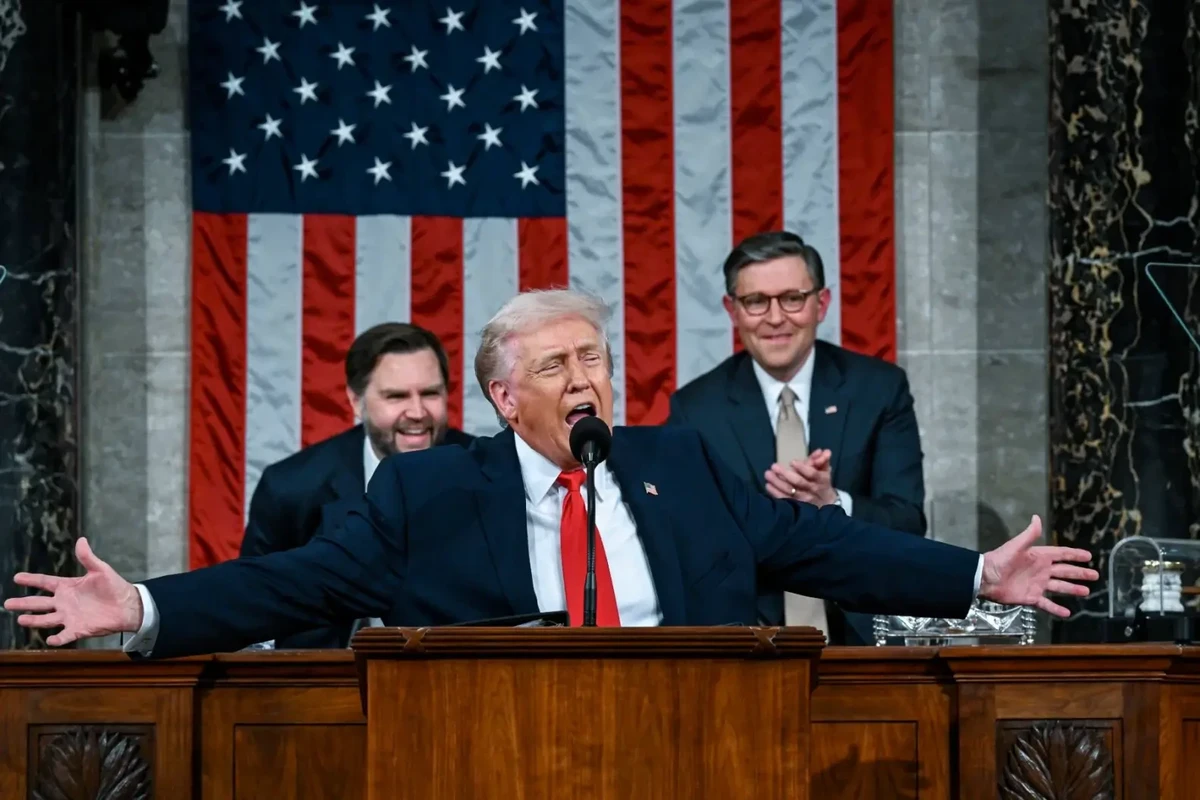
He said it was going to be long. He wasn’t lying.
Donald Trump told reporters earlier this week that his State of the Union address would be “a long speech,” and unlike with many of his key campaign promises, the president delivered. He spoke to lawmakers for 108 minutes on Tuesday, breaking the record he set last year for the longest speech ever delivered to Congress.
The speech was filled with the requisite presidential shoutouts to special guests in the audience. The U.S. men’s hockey team was there, fresh off their first Olympic gold medal in almost half a century. So was Erika Kirk, the widow of Charlie Kirk. The president also nodded to attending working moms, military veterans, and first responders to the floods that ravaged Texas last year. Trump toward the end of his speech recognized a 100-year-old Navy pilot before Melania Trump fastened the Medal of Honor around his neck. “I’ve always wanted the Congressional Medal of Honor, but I was informed I’m not allowed to give it to myself,” said Trump, who also doled out a Presidential Medal of Freedom, Purple Heart, and another Medal of Honor during the address.
The foundation of the nearly two hours Trump stood before Congress, however, was the president’s just-as-requisite torrent of ravings and falsehoods.
The president claimed to have ended “DEI,” ushered in the “hottest” economy in American history, and saved the country from the “scourge” of undocumented immigration. He extolled the signature policies that have tanked his popularity across the country, defending his implementation of widespread tariffs that have driven up costs for consumers. In the presence of some of the Supreme Court justices, the president dismissed a decision released last week in which the court ruled that he had unlawfully exceeded the bounds of his emergency economic powers and usurp tariff authority granted to Congress by the Constitution.
Despite plummeting approval over his administration’s immigration enforcement agenda, much of the president’s speech focused on the same kind of immigration fear mongering that defined his 2024 campaign. Americans have been horrified by Immigration and Customs Enforcement’s brutal tactics, and Trump seemed to be trying to convince the nation that immigrants, the real enemy, are here to kill you and your families. He described a series of violent crimes committed by undocumented migrants in gory detail, linking them all — regardless of the actual immigration status of the perpetrator — to open borders and Democratic policy.
At one point, Trump demanded that lawmakers “stand up” if they agreed that the primary role of the American government was to “protect American citizens, not illegal aliens.” Of course, the Democratic side of the aisle did not stand up in response to the loaded question,” prompting Trump to shout, “You should be ashamed of yourselves, not standing up.”
Reps. Ilhan Omar (D-Minn.) and Rashida Tlaib (D-Mich.) shouted back in response that Trump himself had broken that principle under the guise of immigration enforcement. “You have killed Americans!” Omar shouted from the audience, referencing the killing of two American citizens — Renee Good and Alex Pretti — by ICE agents in her home state of Minnesota. “You should be ashamed,” she added.
Rep. Al Green (D-Texas), who is known to be a disruptive presence at Trump’s State of the Union addresses, wasn’t heard from … because he was kicked out of the chamber shortly after the speech started for holding up a sign that read “BLACK PEOPLE AREN’T APES,” a reference to a video Trump posted recently that included a depiction of Barack and Michelle Obama as apes.
Trump translated his obsession with citizenship status into his demand for federal electoral reform that would disenfranchise millions of eligible American voters, but help Republicans win future elections. The president repeated false claims that widespread election fraud cost him the 2020 election — suggesting that this should really be his “third term” — and called for Democrats to aid Senate Republicans in passing the Safeguard American Voter Eligibility (SAVE) Act. The bill is a sprawling election reform law that would require Americans to appear in-person to present proof of citizenship when they register to vote, implement national voter ID requirements, heavily restrict mail-in voting and registration, and give the federal government unprecedented access and influence on state voter rolls.
“Why would anybody not want voter ID?” Trump said. “One reason: because they want to cheat. There’s only one reason. They make up all excuses, they say it’s racist, they come up with things you almost say what imagination they had.”
The SAVE Act has passed the House, but needs a 60-vote majority to pass the Senate, and is unlikely to succeed without the support of a significant portion of the Democratic minority, which does not seem inclined to provide the president any boon ahead of the midterms.
Just hours before Trump arrived at the Capitol to address the joint session of Congress, NPR and MS NOW released back-to-back reports indicating that the Trump administration had withheld documents related to allegations that Trump sexually abused a minor — including dozens of pages from a series of FBI interviews with the accuser — from the Epstein files the Justice Department has released over the last several months. Rep. Robert Garcia (D-Calif.) says Democrats are investigating the allegations that the documents were wrongfully withheld.
The revelation cast an even brighter spotlight on the Epstein-related protests already taking place at the State of the Union. Dozens of Democratic lawmakers boycotted the event, a rare occurrence in the speech’s history. Some of the Democrats attending the speech invited survivors of Epstein’s abuse as their guests, while others wore pins or held signs calling attention to the scandal. Reps. Ro Khanna (D-Calif.) and Thomas Massie (R-Ky.), both leading figures in the congressional push for transparency related to the Epstein case, have bridged the sacrosanct partisan seating divide of past State of the Unions and sat together for the event.
Many of those who ditched the address instead attended the “People’s State of the Union,” a collection of public speeches and speakers held on the National Mall. Lawmakers who attended the event included Sens. Chris Murphy (D-Ct.), Adam Schiff (D-Calif.), Chris Van Hollen (D-Md.), Ed Markey (D-Mass.), Jeff Merkley (D-Ore.), and Tina Smith (D- Minn.), as well as Reps. Greg Casar (D-Texas), Pramila Jayapal (D-Wash.), Maxwell Frost (D-Fla.), and Robert Garcia (D-Calif.).
The official rebuttal to the State of the Union was delivered by recently elected Virginia Governor Abigail Spanberger, who won an upset election that snatched the state’s governorship away from Republicans last year. “Let me ask you, the American people watching at home, three questions,” she said. “Is the president working to make life more affordable for you and your family? Is the president working to keep Americans safe, both at home and abroad? Is the president working for you?”
“We all know the answer is no,” Spanberger said.








 NYPD officers detain Susan Sarandon and pro-Palestinian demonstrators near the United Nations, ahead of Benjamin Netanyahu’s address, on Sept. 24, 2026.CHARLY TRIBALLEAU/AFP/Getty Images

Vladimir Putin addressing the audience during the Valdai Discussion Club meeting on Oct. 1
As Trump Dithers, Ukraine War Is Approaching a ‘Fatal Point of No Return’
The war in Ukraine is becoming increasingly dangerous, with the risk of escalation spilling further into Europe. As Russia and European governments trade explicit warnings that the conflict is spreading, the United States is pursuing diplomacy aimed less at stopping the carnage than restoring ties with Moscow.
With the Russian military making little progress on the ground in eastern Ukraine despite nearly five years of war and more than a million casualties, the Kremlin is intensifying aerial attacks. Ukraine, which has been the target of Russian missiles and drones since the war began in February 2022, is now experiencing a sharp uptick in attacks on infrastructure and populated areas that threaten to plunge parts of the country into cold and darkness over the winter.
The aerial blitzkrieg is intended to destroy Ukraine’s morale, infrastructure, and economy, President Volodymyr Zelenskyy recently told the Financial Times, citing intelligence intercepted by his country’s security services.
Zelenskyy told the paper that Russian President Vladimir Putin, in discussions with top Kremlin officials, had removed constraints on the bombardment campaign: “He said there are no rules now.”
U.S. disengagement from the conflict during Trump’s second term, coupled with the American president’s animosity toward Zelenskyy and Ukraine more generally, has only emboldened Putin. After promising he would stop the war “within 24 hours” after reelection, Trump’s tepid support for Ukraine and its European allies has increasingly convinced the Kremlin it has a chance to permanently rupture the NATO alliance.
At the Valdai Discussion Club on Thursday — an annual high-profile international summit in St. Petersburg — Putin said that continued European support for Ukraine was pushing the conflict toward a “fatal point of no return.”
The Kremlin has long described the war as an extension of a confrontation with the collective West. With more than 1.5 million active service members in the Russian military, about 44 percent of Moscow’s budget for 2027 is dedicated to defense and security spending. Around 700,000 Russian soldiers are serving on the front lines in Ukraine, where casualties remain staggeringly high.
Editor’s picks
The 250 Greatest Albums of the 21st Century So Far
The 100 Best TV Episodes of All Time
The 500 Greatest Albums of All Time
100 Best Movies of the 21st Century
Meanwhile, Moscow is conducting a campaign of so-called “hybrid warfare” — with officials in multiple countries alleging that a series of drone attacks, arsons, and sabotage originated with Russian intelligence services. The Kremlin also continues to carry out targeted killings on European soil — and has even attempted to assassinate political dissidents in the United States, according to the FBI.
Russia’s belligerent activity has set alarm bells ringing across Europe.
Speaking at a NATO event on Thursday, German Chancellor Friedrich Merz said that the continent must brace for “severe hybrid attacks,” as Russia targets production facilities and logistics hubs by which Ukraine’s allies supply the beleaguered country with arms. Europe must be prepared to “respond quickly and very clearly” to Russian provocations, Merz said.
For its part, Moscow asserts that NATO is provoking conflict, citing recent unannounced military exercises near Kaliningrad — a Russian exclave on the Baltic coast. In a communiqué to NATO this week, Russian officials warned that action against Kaliningrad would initiate a serious response, “including nuclear weapons” in order to defend its territory, and “Russian strikes against decision-making centers in the alliance’s member states.”
“This is a war that Europe is waging against us,” Russian Foreign Minister Sergey Lavrov told reporters at the Valdai forum. When asked about hybrid attacks outside Ukraine that European leaders have attributed to Russia, he said his country was only targeting support for what it dubs the “Nazi regime” in Kyiv.
Related Content
California Leaders Erupt After Trump Suggests Letting Iran ‘Take Out’ Cities
Jon Stewart Breaks Down the Threat of AI: ‘Why Can’t We Just Slow This Down?’
Dolly Parton Estate Claims Nephew Used Caution Tape and Barbed Wire to Dodge Lawsuit Service
Hayley Williams Responds to DHS’ Suggestion to Thank Officers After ICE Comments: ‘Nazi Bitches’
As the sabers rattle louder, American engagement with Moscow and Kyiv comes in fits and starts, with no apparent overarching strategy.
Critics of the White House’s approach point to a recent trip by Trump’s friend and special envoy to the Middle East, real estate attorney Steve Witkoff, and son-in-law Jared Kushner, to Moscow and Kyiv. Their tour yielded headlines, but little progress toward negotiations between the warring parties — let alone toward ending the conflict.
“I hope they had a great discussion about opening a hotel or something,” one European official told Rolling Stone. “Because it was useless otherwise.”
Diplomacy via haphazard tête-à-têtes with the president’s personal envoys is almost certainly viewed as a sign of weakness by Putin, who is well aware that Trump hopes to claim normalized ties between the United States and Russia as a crowning foreign policy achievement.
The White House is considering a range of unprecedented diplomatic deals that would help keep Russia’s economy functioning while doing little to benefit Ukraine.
These proposals reportedly include an easing of economic sanctions if Putin agrees to release some political prisoners, and a potential multibillion-dollar oil deal ostensibly aimed at stabilizing energy markets and reducing gas prices.
With gas prices rising amid the U.S.-Israeli war on Iran and midterm elections around the corner, Trump has made energy central to his Russia policy. Washington has called for an “energy ceasefire” — while Trump has blamed Kyiv for rising diesel prices in the United States.
While high oil prices are the result of a concatenation of crises, Ukraine has been targeting Russian oil refineries, producing fuel shortages and long queues for gasoline — in one of the world’s largest oil producers — over the summer.
Ukraine is also developing its own domestically produced tactical ballistic missiles. Ukrainian officials said Friday that one type of missile, the FP-7, had been successfully used in combat for the first time. But whether Kyiv can produce enough of them to create a meaningful deterrent is unclear.
As winter nears, the outlook for Ukraine is bleak. A recent attack on Kyiv consisted of nearly a dozen ballistic missiles and hundreds of drones in a single night. That many munitions slip through highlights the dire situation faced by Ukrainian defenders, who are running out of advanced missile interceptors. They also struggle to shoot down drones that are becoming increasingly numerous, sophisticated, and effective as the war drags on.
In recent months, Russia has adopted widespread use of an advanced drone, the Geran-5 — a jet-powered drone that bears an uncanny resemblance to the V-1 “buzz bombs” used by the Nazis to bombard London toward the end of World War II.
As with the German V-1 campaign against London 80 years ago, the targets are often indiscriminate. Even before the ramping-up of attacks this fall, 2026 was on track to be the deadliest year for Ukrainian civilians since the early months of the full-scale war in 2022.
The proliferation of Russian attack drones and ballistic missiles means that cities like Kyiv now spend much of each day under air alert. Even aside from the human toll and physical damage that the weapons inflict, officials estimate that the disruptions to daily life are costing the country as much as $45 million per hour in lost economic activity.
Since Friday, a series of drone attacks has targeted two of Kyiv’s major bridges spanning the Dnieper River. The damage has disrupted traffic between the capital’s “Right Bank” — with its historic core and city center — and its “Left Bank,” with its sprawling Soviet-era industrial and residential developments.
Ukraine is already experiencing a severe financial squeeze. Prime Minister Sergii Koretskyi says the country is facing a $27 billion “funding gap” before the end of the year.
Ukrainian lawmakers warn the government could even run out of funds to pay soldiers. One serving member of the Ukrainian military, who spoke to Rolling Stone on background, said by the end of the summer, members of his unit had already begun experiencing “delays” in receiving their pay.
The Ministry of Defense disputes that soldier’s salaries could go unpaid, but acknowledges that “technical issues” had caused some delays.
Meanwhile, Zelenskyy is under pressure from corruption scandals and resignations involving members of his inner circle. Polls show him potentially losing hypothetical match-ups against rivals, including former Ukrainian Armed Forces commander Valerii Zaluzhny. The country’s “long-admired cohesion” has begun to crack — an outcome that aligns with Russia’s strategic objectives.
But after nearly five years of war, both combatants are showing signs of political and economic strain.
Russia’s regular military conscription process — 120,000 new recruits are expected over the next three months — barely offsets the grievous casualties its military is experiencing at the Ukrainian front, with high estimates exceeding 1,000 casualties per day.
Some analysts believe the Kremlin is considering a massive mobilization in the wake of parliamentary elections. But Putin so far has merely called for an increase in the total number of active-duty military members by a little more than 15,000. Russia’s president remains wary of generating a meaningful anti-war movement inside Russia, while also facing pressure from hard-line nationalists expecting him to deliver victory.
Across Europe, governments are no longer treating a direct confrontation with Russia as a remote possibility. They are preparing for worst-case scenarios, particularly in the Baltic states and other countries that experienced Russian rule under the Soviets. Meanwhile, NATO insists that all members — including the United States — have an “ironclad commitment” to collective defense.
In 1914, at the outset of the First World War, few leaders understood how faulty strategic assumptions, entangling alliances, and lethal technologies were pushing the continent toward cataclysm.
But some did. On the eve of war, U.K. Foreign Secretary Sir Edward Grey famously wrote that “The lamps are going out all over Europe.”
Trending Stories
Brian May Says Queen Won’t Tour Again: ‘50 Years Is Enough’
Dolly Parton Estate Claims Nephew Used Caution Tape and Barbed Wire to Dodge Lawsuit Service
See Jack Black’s Black Sabbath Cover Band Perform With Geezer Butler at Power to the People Festival
See Bruce Springsteen Cover Neil Young With Dave Grohl at Power to the People Fest
Across Ukraine, darkness will again become a feature of daily wartime life amid rolling blackouts as a hard winter looms. And the shadows are lengthening, far beyond its borders.
But in America, the White House dithers as the president has his attention elsewhere. Perhaps Trump’s new ballroom, at least, should be well lit.