
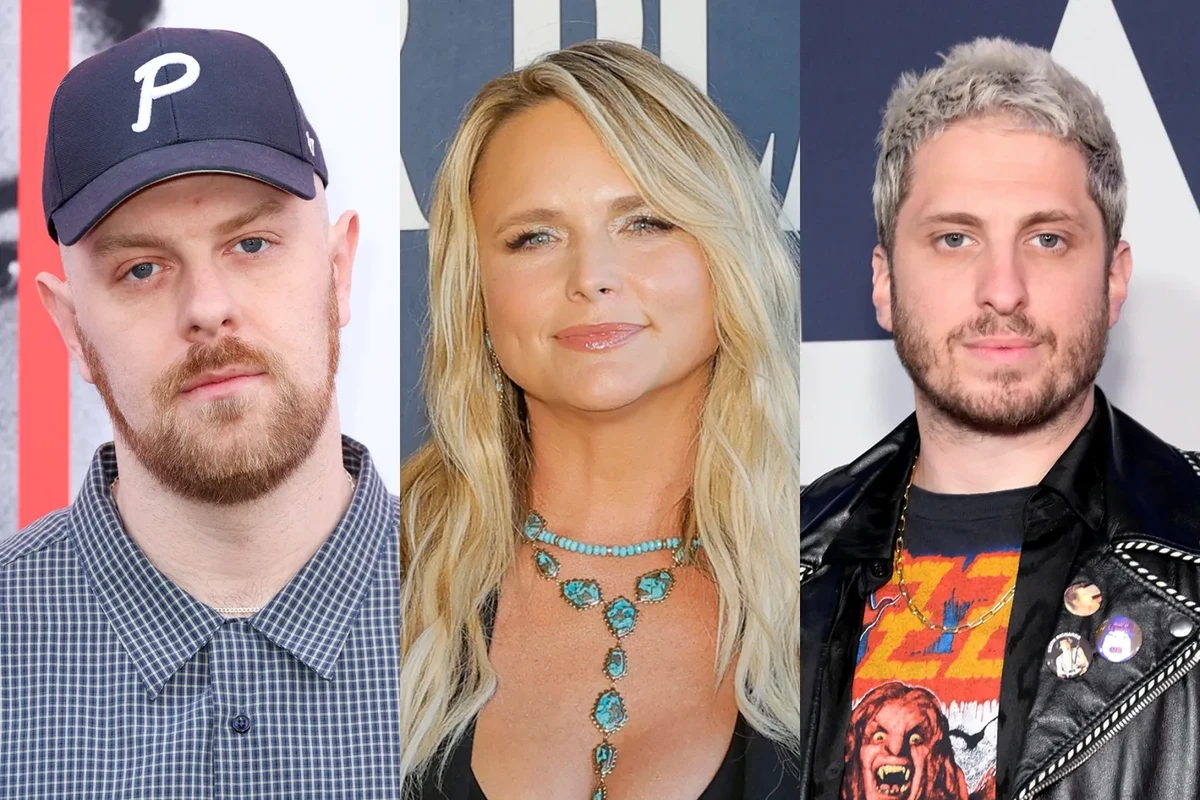

Leading up to the Grammy nominations on Nov. 16, “Rolling Stone” is breaking down 11 different categories. For each, we’re predicting the nominees, as well as who will (and who should) win on Grammy night.
For someone to claim the Grammy for Producer of the Year, Non-Classical, they need to have scored commercial hits or a big album. They also need to wow voters with the story behind the making of an album, according to Cecilia Winter, Editorial Lead of Global Hits at Spotify. “Often the people who win are people who have pulled back the curtain a little bit on their working relationship with the artists that they produced in the eligibility period,” she tells Rolling Stone. “The folks who close themselves off a little bit more maybe don’t always have the same degree of success.”
The strongest contenders in this year’s eligibility period include big names like Andrew Watt, who coaxed great late-career albums from Paul McCartney and the Rolling Stones, and Miranda Lambert, who produced not only her own album but co-produced Ella Langley’s blockbuster Dandelion. Meanwhile, Kenny Beats made his bones with Geese and Weezer, Dan Nigro seemed pretty happy with Olivia Rodrigo’s latest, and Aaron Dessner and Gabe Simon helped give Noah Kahan another massive album with The Great Divide. The likelihood of winning just comes down to which story a critical mass of voters find most impressive.
Producer of the Year, Non-Classical — Our Predictions
Kenny Beats (Geese’s Getting Killed, Fcukers’ Ö, Weezer’s Weezer, the Lurkers soundtrack)
Aaron Dessner (Noah Kahan’s The Great Divide, Gracie Abrams’ Daughter From Hell)
Miranda Lambert (Ella Langley’s Dandelion and “Choosin’ Texas,” Miranda Lambert’s Crisco)
Dan Nigro (Olivia Rodrigo’s You Seem Pretty Sad for a Girl So in Love, Gracie Abrams’ “Look at My Life”)
Andrew Watt (Brandi Carlile’s Returning to Myself, Paul McCartney’s The Boys of Dungeon Lane, the Rolling Stones’ Foreign Tongues)
Who Will Win?
Andrew Watt
Watt seems like a shoo-in. Last year, the producer, who won in this category in 2021, had strong success with Lady Gaga’s Mayhem. Now he’s worked his magic on a Beatle and the Stones. “Having this newer, younger producer who works across all these different genres help these guys move their sound into their next era, is super cool,” says Winter.
Who Should Win?
Kenny Beats
In the past year, Kenneth Charles Blume III (b.k.a. Kenny Beats) has harnessed Geese’s sound on Getting Killed (including helping them get a choral sample to work against their own music on the album’s title song), as well as Show Me the Body’s hard-hitting banjocore album, Alone Together, songs on Fcukers’ Ö, and a good chunk of Weezer’s self-titled gold album. “He has worked across such a wide range of projects,” Winter says. “I think it would be cool if that was more of the story. Having worked on the Geese project, he had a hit in the indie space, but it was still not a commercial hit in the classic sense of producers who typically bring home these awards.”
Forecasting the Field
Not only does Miranda Lambert have name recognition, but she produced the biggest song of the year, Langley’s “Choosin’ Texas.” She could score an upset win in this category. “Dandelion is a really beautiful album,” Winter says. “I think it would be really cool to get a country artist or country producer in this space for the first time in decades. And Miranda Lambert, in particular, is a cool one because she obviously knows what it is to be a commercial star in country music. She knows what it was to have her own ‘Choosin’ Texas’ years ago and has built this really strong foundation of credibility through projects like The Marfa Tapes that I think have shown her diversity as an artist. Watching her apply it to an up-and-coming star is really cool.” A nomination for Lambert would also put her in the tiny percentage of women recognized in this category. Previous female candidates include Linda Perry (who’ll try again this year for her work with Dolly Parton and Paris Jackson), and Janet Jackson. No woman has ever won.
It’s also worth considering the omnipresence of Jack Antonoff, who produced his own Bleachers album, Everyone for Ten Minutes, and songs for Lana Del Rey’s upcoming Stove. He also worked on Phoebe Bridgers’ Lost Weekend, alongside a roster of producers including Tony Berg, Ethan Gruska, and Alex G, as well as Bridgers herself.
Other powerhouse contenders include Dessner, who co-produced Noah Kahan’s The Great Divide and Gracie Abrams’ Daughter From Hell, and Simon, who continued his work with Kahan and Koe Wetzel. There’s also Mike Sabath (Raye’s This Music May Contain Hope), D’Mile (Bruno Mars’ The Romantic), Stuart Price (Madonna’s Confessions II), Max Martin, who extended his hit streak with Taylor Swift and Ariana Grande, and Dan Nigro, whose work with Rodrigo and Abrams was exemplary. Even Shooter Jennings’ name could be in the mix: The Grammy-winning producer oversaw Charley Crockett’s buzzy Clovis LP. And don’t rule out last year’s winner, Cirkut (Lady Gaga and Doechii’s “Runway”).
Then there’s Rosalía’s stunning Lux, which was an achievement in production with the ways she fused pop music with classical and avant-garde influences along with a lyrical polyglot. The credits list more than a dozen producers (including Rosalía herself) so the viability of a single producer for that album comes down to just how hard they campaign. Winter would also like to see some recognition for producer Blake Slatkin’s work on Adéla’s debut album, Prima, and producers Austin Corona and Wyatt Bernard’s contributions to Slayyyter’s Worst Man in America album. “The music that Slayyyter has crafted this year is a really fascinating and of-the-moment blend of pop, dance, and post-hyper pop. Sometimes it feels like Justice, sometimes it feels like Turnstile. There’s such a wide palette of styles, it would be really cool to see recognition on that side as well.”
Liam Payne (left) and Harry Styles of One Direction onstage during the 2013 American Music Awards at Nokia Theatre L.A. Live on Nov. 24, 2013
Harry Styles Finds the Right Words on Liam Payne Tribute Song
For the past seven weeks, Harry Styles has reserved two minutes at each of his Madison Square Garden shows to reflect on the last time he gathered this many people in this room. Four years have passed since he performed 15 record-breaking nights at the venue during his Love on Tour. Now, every night at the new Together, Together shows, which span 30 nights at MSG, he acknowledges that “a lot of life happened to me and landed on me in ways that maybe it hadn’t before.”
Styles doesn’t usually go into much more detail; he typically just describes those in-between years as “a great reminder for me of just how wonderful and beautiful, difficult and inspiring, and also how fragile a life can be.” He encourages the audience to look around at each other and celebrate the community they’ve built together. Then he dives into “Sign of the Times.” It happens every Wednesday, Friday, and Saturday like clockwork. But when he delivered this speech on Friday, Oct. 16, there was a shift. It didn’t conclude in its usual way.
Instead, Styles turned his attention to the banner commemorating his 15 consecutive nights at the Garden in 2022. “It means a lot to be able to look up there at my name up there from the last tour,” he said. “There are so many people, friends and people that I’ve worked with, that I would’ve never been able to do this without.” Two years ago, he continued, he lost one of those pillars. Friday’s show fell on the same day as the second anniversary of the death of Liam Payne, a loss that time has not made it easier to acknowledge. “I’m sure a lot of you have been through something similar,” Styles said. “I hope you haven’t.”
A frequent assessment of Styles, both among his fans and those who’ve only encountered him at a distance, is that he often talks at length before getting to the point. He recognizes it himself on the Kiss All the Time. Disco, Occasionally song “Coming Up Roses,” where he sings about fumbling his words. But recently, comments about his long-winded way of speaking have started to feel like purposeful misreadings. There are clear and carefully considered thoughts present between his starts and stops. Anyone truly listening will pick up on those threads.
Styles cut himself off a few times during his speech on Friday. He tried to talk for a second about looking after each other, and repeated his point about the banner and the people who’ve supported him. He never mentions Payne by name, instead referring to him as a friend, which somehow became a point of criticism from some fans. The context is clear enough. Still, he seems to know it’s a gamble to expect understanding, especially when the conversation grows more complex and personal.
After about a minute and a half, Styles figured it best to show us what he means rather than tell us. “I’m gonna sing a song I wrote two years ago for my friend,” he said before premiering “Wise Enough.” The sullen tribute to Payne settled the room into a cool near-silence, punctured by quiet gasps and muffled crying. It was beautiful, devastating, and deeply exposing to watch Styles share his grief with 20,000 people in the best, and maybe only, way he knows how.
Earlier this year, Styles told Zane Lowe about the acute dread surrounding the expected performance of his mourning. “Full transparency, even the idea of talking about it, I struggle with that a little bit. There was a period when he passed away where I really struggled with acknowledging how strange it is to have people own part of your grief, in a way,” he said. “I have such strong feelings around my friend passing away. And then suddenly being aware there’s maybe a desire from other people of you to convey that in some way, or it means you’re not feeling what you’re feeling.”
Artists often describe the act of sharing new music as a change in ownership, something that is no longer their own once it has been handed over to an audience. “Wise Enough” feels protected from this. It would be confounding to see Styles ever record and release it in any official capacity. The song is openhearted in a way that exposes deep scars, anxious in a way that worries and fidgets about time and how it passes, and inconsolable in a way that doesn’t make the futile attempt to fight through anger, regret, or sadness.
“I can tell you what it’s like to bury friends on Wednesday nights/Gather in a garden around the fire,” Styles sings in a particularly cutting verse on the song, which concludes with an honest admission: “I’m not wise enough to call for a conversation/And then back it up, right?/Like you’re in the sky.”
Celebrity doesn’t obscure grief. It doesn’t come with a script for what to say when someone is sorry for your loss, or when they recollect their own version of the person you knew. No one really has the right words for these moments. Over the weekend, fans debated whether “Wise Enough” is actually titled “What Is Enough?” Styles introduced the record so briskly it was hard to decipher. The question of adequacy feels similarly impossible to answer.
Grief is so plain in how universal it is, but so complex in how and when it chooses to present itself. It can be policed only as much as it can be predicted, which is to say barely at all. That Styles let us into his now yearslong search for some semblance of understanding — knowing how his words have been picked apart before for far lesser things — shouldn’t be taken for granted.
Styles never acknowledges that banner at MSG. It’s not for lack of gratitude — he cried when it was unveiled. But the point he has reiterated every Wednesday, Friday, and Saturday since the end of August is that the achievement is something that must be shared because he couldn’t have done it alone. He talks about being on stage as if what happens in that room exists far beyond and outside of himself, something that endures even in his absence.
It’s true in a way. There’s muscle memory tied to the music. It’s in the spinning, dizzying way fans dance to “Satellite,” or the way they wildly kick their feet and make the building shake during “Kiwi,” a song he brought back to the set just for New York. It’s just like before, but still so different.
Friday night continued as usual after “Wise Enough.” Styles belted out “Sign of the Times” in the sobering way he always does, then “Aperture” let in a cathartic flood of strobing lights and pulsating beats. The emotional whiplash took physical form as fans consoled one another, holding out their hands to help up friends and strangers who crumbled to the floor at the conclusion of the tribute. Some were crushed by their memories of loving One Direction, and the care they hold in their hearts for Styles. Some were just as wrecked by their own personal losses.
A lot of life and loss can happen in four years, as Styles says each night. For some people who were at MSG on Friday, there are friends present in their memories from the last tour who are missing from the new ones they’re making. The lyric “You dance until you’re tired/No, you don’t, and now you never will/Will you?” surfaces their own devastation completely separate from what inspired Styles to sprawl those words on a page. How do you dance to “Aperture” — the beating heart of this show in its declaration that “we belong together” — after hearing something like that?
You take the hand of the friend or the stranger who pulled you from the ground and use it to lead each other back to the dance floor. When Styles talks about community and stresses the importance of caring for one another each night, he reminds everyone of the fragility of a moment, and urges them to cherish every second they get. To dance wildly and sing loudly and wrap their arms around each other. To hold tight to what’s here right now.
It’s all any of us have, so it has to be enough.