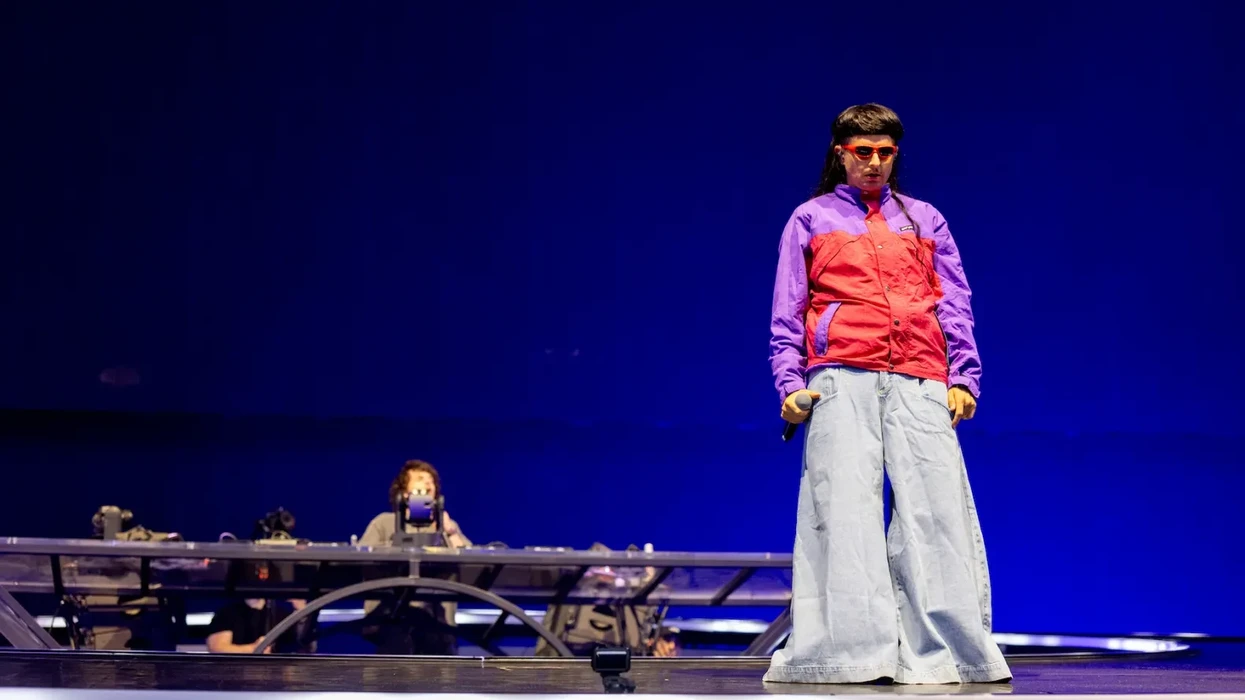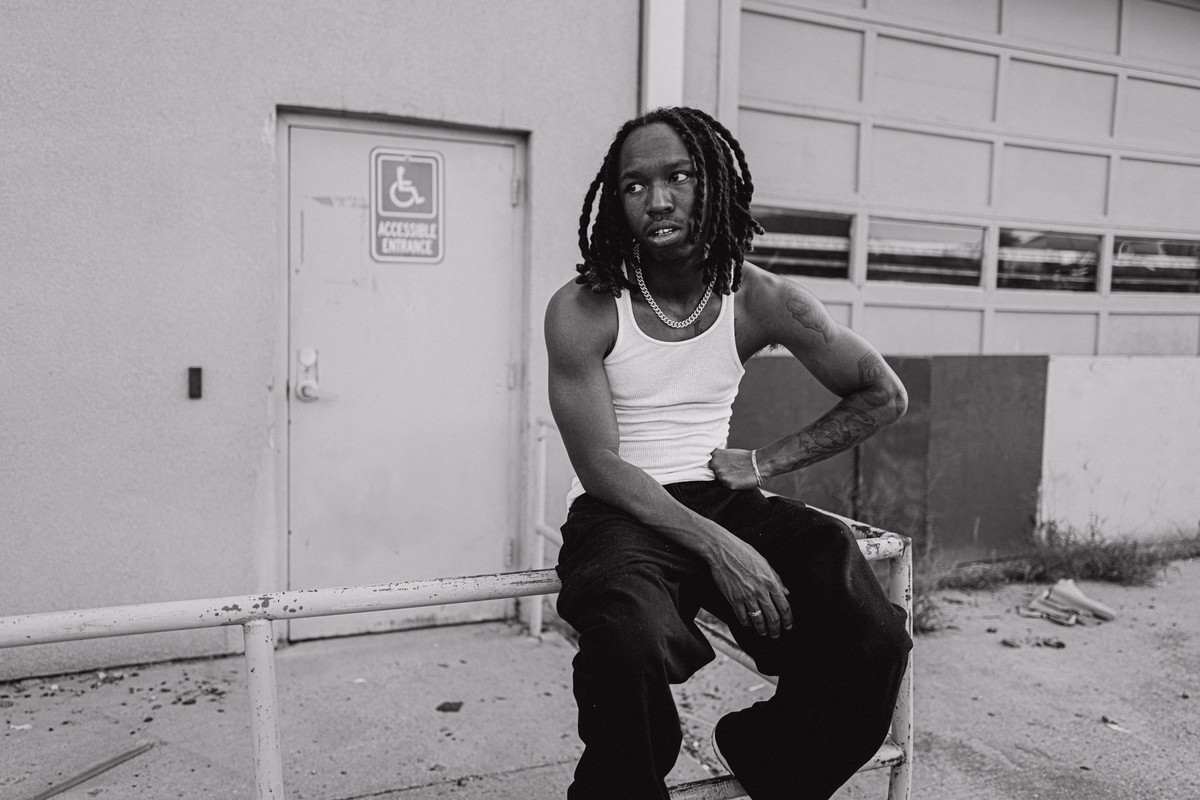

Mavi is always considerate. Our conversation in Rolling Stone’s Manhattan office begins with him asking a question. The 24-year-old Charlotte rapper is currently focused on promoting shadowbox, his third solo album, and a followup to Laughing So Hard, It Hurts, a project he’s seen mixed responses to. “Why is niggas acting like they wasn’t hating on Laughing So Hard, It Hurts when it came out?” he incredulously asks his manager and publicist at the other end of the conference table. “There are people on Twitter now telling me that it’s better than Let the Sun Talk. And when it dropped, it was people telling me, ‘Oh, Mavi’s cooked, he’s finished.’ I can’t believe that shit.”
He’s not angry. Mavi, born Omavi Ammu Minder, finds humor in the fickle listening public. He admits that budget constraints kept him from sampling on Laughing So Hard, It Hurts, hindering the project’s sonic depth. It was those confines that spurred him to collaborate with instrumentalists in studio sessions that would eventually lead to the songs on shadowbox, which dropped last week. He says shadowbox’s composition prioritized musicians working today as opposed to sampling those of yesteryear, namechecking “the guy that we aren’t supposed to mention” from Bad Boy Records. “Am I going to be reaching past the musicians in all these disciplines to something that I know is a sure thing or can I break new ground with the people of today?” he asks of his production M.O. “If I was Diddy or Dre would I have not just hit Quincy Jones straight up? I think I would’ve, at least for some things.”
The end product is a lush, soulful reflection of Mavi’s current life and times. Standout track “Drunk Prayer” feels like the fulcrum of shadowbox as the project’s lead single and thematic anchor. With emotive guitar plucks and vocals from Jordan Ward, Amindi, and Tempest, the composers nailed the warmth of a seventies soul sample as he depicts the pangs of addiction and despair with bars like, “Performed surgery on myself with just a cudgel / I’m more certain about my death than my construction.” He tells me that the song, like the rest of the album, reflects where he’s been personally while coping with “unstable self-esteem.”
“It was days where outside of taking a shower and putting on a nice outfit and making sure I have some cologne that smells nice, the only thing I did the whole day that wasn’t no type of self-hatred was record music,” he says. “[Otherwise] it’s] self-sabotaging relationships, toxic relationships, alcohol, drug abuse, phone addiction, nothing healthy.” On “Drunk Prayer” he laments, “I’m a robot for the media.”
When I ask about the line, he tells me that his annoyance is rooted in “having to be an exemplar for certain things. I have to be a Howard University neuroscience student making intelligent rap music. But that is first, such a slim facet of who I am as a person. Second, [it’s] brand new to my lineage and has debatable bearings on my actual sense of self. And also [I’m annoyed with] having to be fucking inoffensive all the time.”
Inoffensive to who?
“People’s tastes. [Being] stable, happy-go-lucky, good energy Mavi even if that’s not where my life is,” he says. “It’s been complicated because a lot of stuff I talk about on the album, I’m still in the throes of now. You ever did a press run depressed?”
Since his breakout debut Let the Sun Talk, Mavi has rightfully been perceived as a breath of fresh air in the hip-hop landscape. But sometimes hip-hop purist’s celebration of their appointed favorites can be dehumanizing, turning an artist into an avatar for hip-hop done right instead of a human being with nuance — and pain.
The title shadowbox symbolizes “a trophy case to my failures” as a human, Mavi says. “I wanted people to champion me for being a person who is learning more than championing me because of what they feel like I know or what they’re proud to feel like I know,” he says. The consideration of his shadow self stemmed from a pair of impactful conversations. We hear one of them on “drown the snake,” where his friend implores him to kill the inner demon that grew up along with his inner child. The interlude ends with Mavi asking, “so how you kill him?” He tells me that his friend Booker told him it was an impossible task because our shadows are with us all the time, and “it’s the only way you really know that you’re under the sun, that you exist.”
“I realized demonizing the one part of me that physically never leaves me is symbolically evil. Politically, I didn’t like that,” he says. “And then I started to think, even if I want to use my physical shadow to symbolize parsing myself, that may be destructive. Destruction isn’t inherently evil. It’s the first step to construction, actually. So I’m like, let’s build this shadow a place.” He observes his shadow throughout the project, like on “open waters” when he raps: “I just want it all to empty, I just wanna ball into the darkness / Of this smallness in me, like when we was all was children.”
Some of the depictions of paranoid gun-toting and drug-addled dysfunction paint a rough portrait, but they’re part of the holistic depiction of who he is. In putting these troubling moments up to the light, he reflects self-awareness of his flawed ways, which is the first step to getting them in check. The album harkens to one of author Toni Morrison’s most resonant observations: “Like failure, chaos contains information that can lead to knowledge—even wisdom. Like art.”
Water is another heavy theme on shadowbox. “Open waters” contains the album’s lone sample (an Italian composer who’s now open to working with Mavi.) Album opener “20000 leagues” introduces Mavi’s emphasis on being more “judicious lyrically,” while on “i’m so tired” he pleads: “wash me off, wash me off / So I can make another song without a crater or a scar.” He says the references are a comingling of “piety and hedonism.” The Mavi & Jesse Fox Hallen-directed music video for “Drunk Prayer” depicts him hungover and throwing up in the same stance as he prays against a casket in alternating scenes. While the baptism washes us in purity and allows us to start anew, he surmises the figurative “waters” of alcoholism and hedonism wash us in another sense. “How indulgent is religion and how religious is indulgence?” he asks. ”The whole album, when I discuss alcoholism, I also talk about that too. ‘What are you going to lose to the water?’ Every dip, you’re dying and you’re coming back out like a new nigga.”
These days, Mavi says he’s doing his best to be a “new Mavi” in productive ways, through informal “exposure therapy” to himself. According to him, that includes spending more time alone, celibacy, sobriety, reading, “brooding,” taking long walks, plotting, and “stacking my money.” He’s also been visiting more museums, learning about design and history’s great artisans. We take a mid-interview intermission to look up The Harp, Augusta Savage’s contribution to the 1939 World’s Fair that was destroyed after the event — it was an homage to the Black National Anthem. He tells me that smaller figurine models from the World’s Fair gift shop are the only remaining remnants of the art piece, and they were temporarily on display at MOMA.
His immersion into the design world has trickled into other aspects of his life; we talk about minimalism being “a tiny bit rooted in white supremacy” and the politics of orderliness: “Orderliness is how much shit that is amenable to my taste is around and how much shit that ain’t amenable to my taste ain’t around. Something being disorderly, that’s completely subjective.” His deep dive into art history has encouraged him to consider the what and why of traditionally accepted modes of being, specifically what traits he’s chosen to adopt and reject from his elders.
He’s also acting on his new creative interests. He’s still “thinking through” the stage set for his next tour, but in the meantime, his eye for detail will be reflected in his merch: he’s made incense to go along with vinyl, as well as mini-shadow boxes (at a “very affordable” rate because “these niggas are trying to wax niggas too much”). Designing his new Charlotte home may be his most consequential project yet. “This house is brand new, I want to fuck it up. I want to tear floors out,” he says. ”I want to redo everything in it. Just to do it like a study. I really wanna get into designing in my space. Also, carpentry, doing a lot of the things myself, me and my friends.”
While he’s still reckoning with his shadow, he seemed pretty upbeat during our conversation, which meanders from museum exhibits to that rap beef to his own standing in rap. The avid basketball fan tells me that rap-wise, he feels like he’s in his Steve Nash era: “Think about how people looked at Steve Nash the year before he won those MVPs. That’s probably where I would put myself. Not many niggas better than him, but we don’t want to say he’s the best.”
Nash was a respected all-star point guard for the Dallas Mavericks. But when he went to the Phoenix Suns, a team fully accentuating his talent, he became a two-time MVP seemingly out of nowhere. For a fleeting period, basketball fans had to mention him alongside every other great player. And Mavi, after an album where he says he “had the most [creative] agency” he’s ever felt, feels like he should be mentioned among the best in the world.
“I don’t think it’s a best rapper or a better rapper, because there’s no better painter or worse painter,” he clarifies. “But on that level [of] when we used to be in 9th grade on the bus, from that perspective, outside of the actual greatest to ever do this, I don’t know who is my age [and of my] generation pushing their own pen [and] rapping better than me.”
He tells me that as a rapper who doesn’t fit the “rappity rap” mold, he feels like he has to do some “propaganda work” to get more people to agree with him, but he also feels it’s “beneath him.” Contrarily, I reference Jay-Z and Lil Wayne’s “Best Rapper Alive” campaigns and TI’s “King of The South” affirmation, noting that the self-fulfilling prophecy is very hip-hop.
“That’s true. Especially because I buy chains and shit still,” he concedes, wearing a Mavi chain and a Cuban necklace. ”If I’m going to do some of it, I’m going to do all of it. Fuck it. Now, we going up. Watch, I’m going to start… I don’t know what’s going to be my attention-seeking thing.” He seems to be joking, but if Mavi starts calling himself the best or has a “Control” moment, blame me.
“It’s such a cliche to say, ‘Let the art speak for itself.’ But ultimately, my legacy will be built by the memory I put in other people. And over time, because I’m a Steve Nash, it’s going to register to people like, ‘Oh, my God.’” shadowbox is a strong contribution to that effort.