
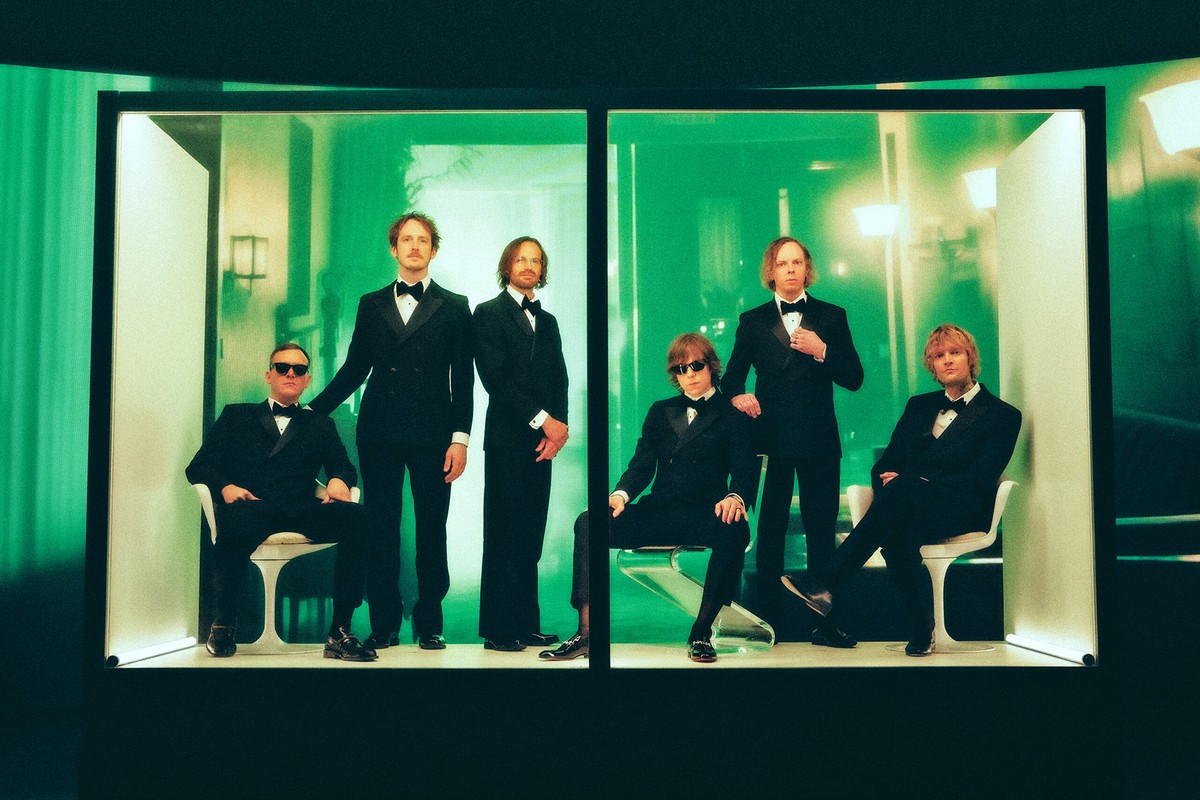

“Like a loaded gun, my love/I lost control of the wheel/Double-crossed by a neon pill,” Cage the Elephant’s Matt Shultz sings on the title track from the Kentucky band’s sixth album. The sound is familiar, a smart, subdued garage-rock swagger that’s a prime example of their ability to punch up a throwback style. But the lyrics are far from burnout boilerplate. Several years ago, Shultz experienced a psychotic response to prescribed medication, and in 2023 he was charged with criminal possession of a firearm. He described what he went through to Rolling Stone’s Ethan Millman as a “a nonstop horror film.” Two songs earlier, on “HiFi (True Light),” when Shultz sings “okay, I’m fine,” as his brother, rhythmic guitarist Brad Shultz, and lead guitarist Nick Bockrath hold a Television-like guitar convo, even that bit of tossed off bravado seems pointedly freighted, as if this is music where there isn’t much emotional space to breathe.
The process of what another song here calls “shadowboxing shame and self-inflected mind-games” has given Cage the Elephant’s music a needed urgency. Their last album, 2019’s Social Cues, circled around theme of rock stat malaise, a less-than-universal concept the band salvaged with a set of songs that cleverly mixed Sixties traditionalism and Eighties revisionism. Obviously, the mental strain Shultz sang about has been put into sharper contrast by his recent troubles. Once again, they’re teamed with producer John Hill, whose Grammy-winning resumé (Eminem, Rihanna, etc) may seem somewhat unlikely for a rugged, agile guitar crew. But his light touch fits a pliable sound that shifts from the Seventies piano-pop introspect of “Float Into the Sky,” to the bare-knuckled glam-rap of “Good Time,” to “Rainbow,” a shot of salvation-seeking psychedelic soul-pop. As on Social Cues, the band pulls off a neat trick of historic remodeling, often suggesting a funky Southern rock band in the late 1970s who just fell in love with U.K. punk and New Wave. “Ball and Chain” is a dark guitar weave over a cuttingly murky groove. “Shy Eyes” sounds like Iggy Pop making an album for Factory Records in 1980.
What evolves amidst all the album’s many genre modifications is the sound of a band using sounds they love to pull themselves through real-life drama. “Silent Picture” is s breakneck image of a life on the edge (“I don’t wanna think about it/I just want the world to disappеar,” Shultz sings), set to tense drums and a searing guitar lead that stretches to the horizon even as the lyrics hint at oblivion. They end the album with “Over Your Shoulder,” in which the band processes another deeply personal topic, the passing of Matt and Brad’s father. “Watching his image ripple past/Just a drop, life moves fast,” Shultz sings over a somber acoustic guitar processional. It’s that sense of pain and perseverance that pushes this music beyond smart modern rock and roll into something deeper.





Drake attends a game between the Houston Rockets and the Cleveland Cavaliers
Earl Sweatshirt Is Right: ‘Don’t Worry’ Is a Great Drake Song
Even the staunchest Drake hater can probably name at least one song that does it for them. For better or worse, Aubrey Graham has spent nearly two decades giving voice to the millennial subconscious more skillfully than any mainstream musician not named Taylor Swift, soundtracking the fears, insecurities, and romantic delusions of a generation raised on reality-TV melodrama and the first wave of social media’s main-character ethos. It should come as no surprise, then, that Earl Sweatshirt, underground rap’s poet laureate, has singled out the deep Iceman cut “Don’t Worry,” singing the song karaoke-style to close out his recent live sets. The track is the purest distillation of Drake’s appeal since the Take Care era, and a quiet reminder of why it’s hard to imagine him going away any time soon.
In the clips, which first started circulating around late May, during Earl’s Home on the Range Tour with MIKE on the heels of their Surf Gang-produced project Pompeii // Utility, it’s the song’s final turn that has Earl & Co. the most hyped up. “I just wanna see that boy beg on the pavement,” Drake coos, the type of revenge fantasy he’s built a career out of conjuring. Drake goes on. “I just wanna see that boy struggle with the phone bill,” he sings, getting specific. “The light bill/That’s how I feel.”
It’s PhD-level pettiness with a weirdly relatable spin. One must know the more treacherous depths of being broke to pinpoint the humiliation of struggling with the phone bill, and here Drake is wishing such luck onto anyone “trippin’ with the gang.” Whereas his entire catalog is fueled by this kind of anonymous sense of betrayal, it hits harder here. You can feel the sting of 2024’s rap beef in the glee with which Drake sings his imagined get-back, landing on an infectious melody all while basically giving a speech you’d expect from the Joker. “I might just get that boy hit for entertainment,” he sings.
This is classic Drake, turning the darker inner thoughts most people would be ashamed to admit into something almost beautiful. He is, in a way, rap’s Lena Dunham, finding art on the other side of cringe.
More recently, clips of Earl singing the song at the end of different tour stops — an ongoing bit at this point — went viral thanks to the never-ending stan wars between Kendrick and Drake fans. Some, unable to deny Earl’s bona fides as a rapper, assumed the whole thing must be an act of trolling, while others saw it as proof that Drake “won” the beef. The third option, of course, is that it’s a really good song, the type Drake is especially skilled at making.
At the height of the beef, like any millennial amidst a friend-group falling-out, Drake appeared to be rewatching The Sopranos, posting pictures from the show to his Instagram Stories. (Iceman’s hit single “Janice STFU” samples Tony Soprano uttering the infamous phrase to his sister, Janice.) “Don’t Worry” has the Machiavellian feeling of a classic mobster flick, a resolve for vengeance at any cost. A desire to see your enemies suffer. Across an entire album, it’s a mood that can feel heavy, but you’ve got to admit, when it hits, it hits. And that’s why Drake remains a fixture within not just hip-hop, but pop culture at large. He reconstructs embarrassingly human impulses as irresistible melodies. “Don’t Worry” might very well become the sleeper hit from Iceman, as clips from Earl’s concerts have already started to boost the song’s presence across feeds.
As he often does, Earl Sweatshirt simply speaks the truth.