
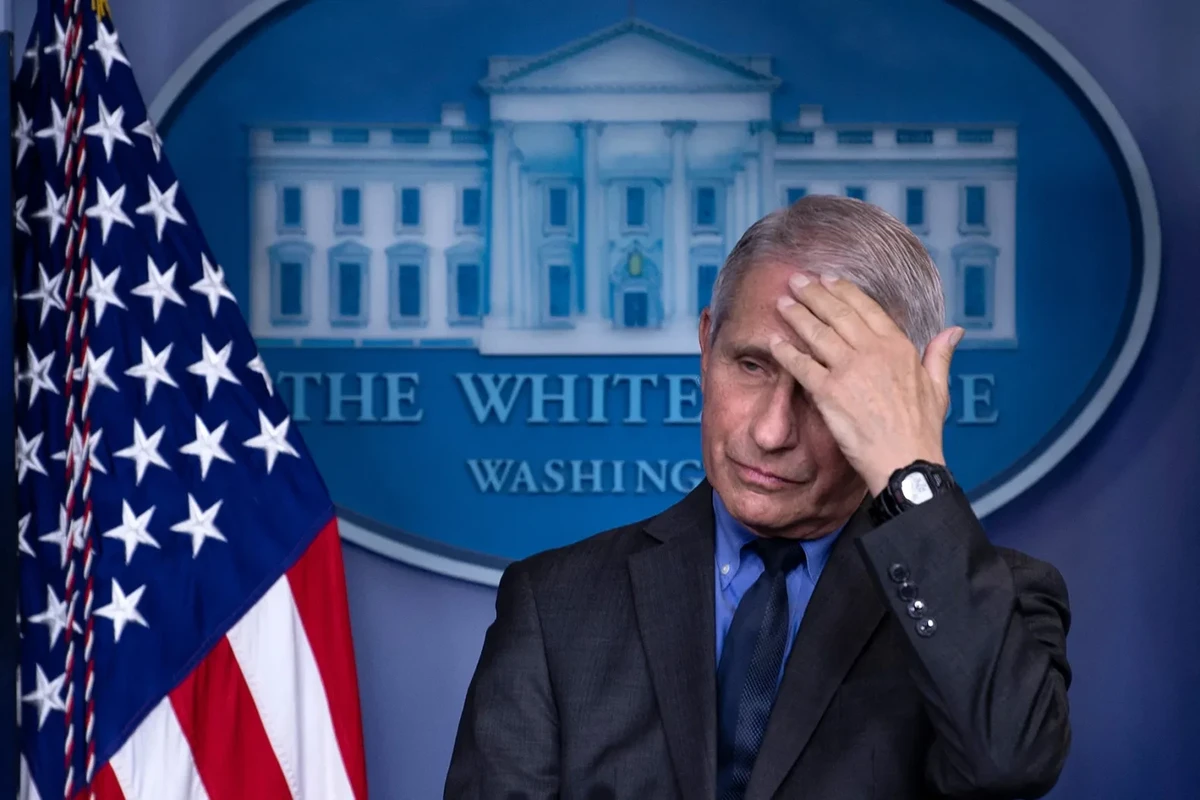

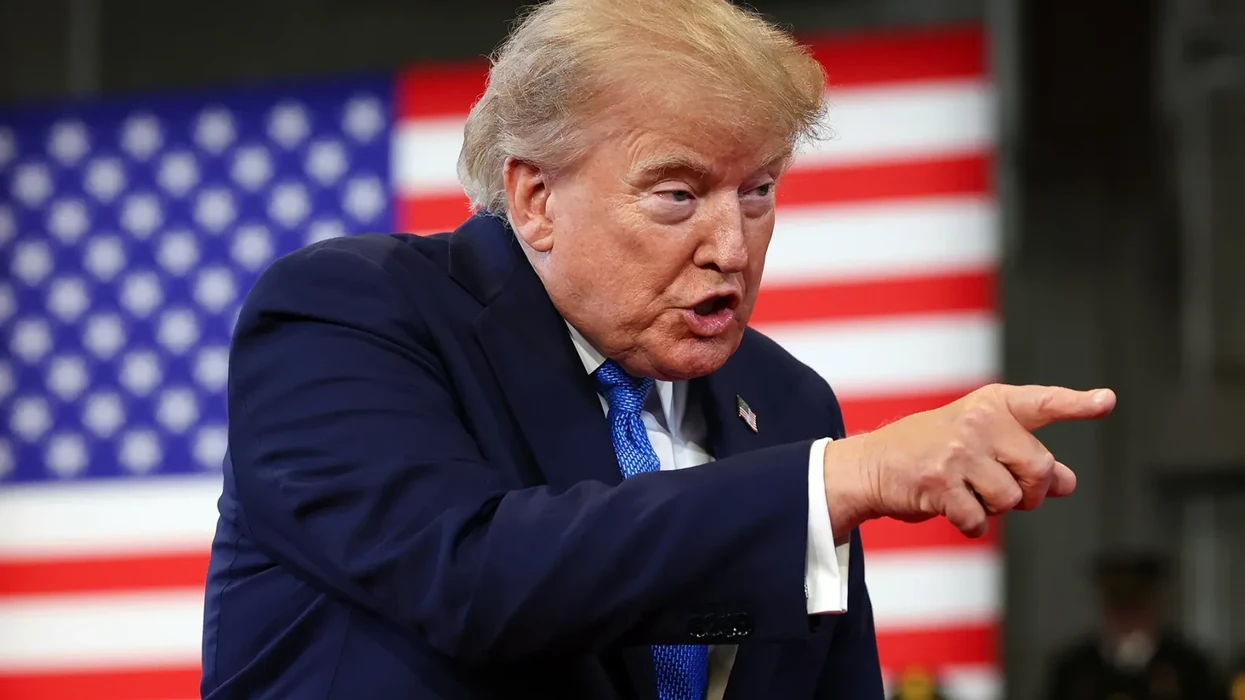
Over and over, Dr. Anthony Fauci, an infectious disease doctor who led the National Institute of Allergy and Infectious Diseases for 38 years, invoked his Fifth Amendment rights during a highly anticipated hearing before the Senate Committee on Homeland Security and Governmental Affairs (HSGAC).
“On the advice of counsel, I respectfully decline to answer based upon my rights under the Fifth Amendment to the Constitution,” Fauci repeated over the course of three hours in answer to every question from Republican and Democratic senators alike, looking alternately pained and stone-faced.
It was a spectacle that illuminated the deep and lingering ideological divide over America’s broken Covid-19 response, while shedding little light on the consequential question of how the pandemic began.
In a storied public health career in which he advised seven presidents, Fauci led the response to the HIV/AIDS crisis, helped craft the PEPFAR program, which allowed the U.S. to fund lifesaving AIDS drugs for Africa, and led America’s response to the Covid-19 pandemic.
His testimony on Wednesday came as part of an ongoing campaign by Senator Rand Paul (R-Ky.), who chairs the HSGAC, to uncover information about the origins of the pandemic as well as scrutinize Fauci’s role in leading the response. Paul recently released new documents, which include over 1,000 pages from Fauci’s personal diaries to private Slack messages between virologists allied with him to a transcribed interview with Dr. Ralph Baric, one of the world’s leading coronavirus researchers. Baric had pioneered techniques used by the Wuhan Institute of Virology, including one that allowed researchers to invisibly splice components of viruses together without leaving a trace
Health Secretary Robert F. Kennedy Jr., who vilified Fauci in his conspiratorial 2021 book, The Real Anthony Fauci: Bill Gates, Big Pharma, and the Global War on Democracy and Public Health, obtained Fauci’s diary entries from government servers and gave them to Paul’s committee. On X, Kennedy’s sister Kerry Kennedy called the release of Fauci’s diary a “clear violation” of Fauci’s privacy. RFK Jr. argued that the diary entries were not private, as they were composed on government computers.
MAGA politicians and right-wing influencers have long sought to recast Fauci as an arch villain, aiming to blame him both for sparking the pandemic and restricting freedoms during it, at a time when every country wrestled with the difficult questions of balancing individual liberties with protection of the most vulnerable, especially before the development of a Covid-19 vaccine. They have aimed to imprison him, or at the very least prove that he deceived the public. The 85-year-old scientist, once hailed as a hero, faces continuous death threats and now pays for his own security detail.
As Senator Richard Blumenthal (D-Conn.) said to Senator Paul at the hearing, after he had ejected Fauci’s attorney when he tried to sit at the witness table, “You are single-mindedly fixated on seeing Dr. Fauci prosecuted for imaginary crimes, and you are so invested in that outcome that you have created a personal brand around it.”
But as more documents have emerged through freedom of information requests, subpoenas and declassification, it is also clear that Fauci championed risky virology research, his institute helped fund some of the Wuhan Institute of Virology’s most controversial known experiments, and worked behind the scenes with a small group of top virologists to steer the evolving public narrative away from a laboratory origin, once the pandemic began.
More than six years later, there is still no “smoking gun” proof for either of the two prevailing hypotheses of Covid-19’s origins, that SARS-CoV-2 emerged from a laboratory accident at the Wuhan Institute of Virology or from a natural jump from an infected animal. Nor is there direct evidence linking Fauci, or research at the WIV that NIAID funded while he was director, to the pandemic.
In the last few months, however, a release of new documents, some partly declassified by the Office of the Director of National Intelligence under Tulsi Gabbard, and some obtained by Senator Paul’s committee through subpoenas, show that, even as leading scientists and certain government officials, including Fauci, publicly argued against a lab leak, in private, at various times, they deemed it credible and even equally likely.
Their assessment came in part due to unusual features of the virus. Those include a furin cleavage site, a distinctive segment of SARS-CoV-2’s genetic code that makes the virus more infectious by allowing it to more efficiently enter human cells, raising the question of whether the virus was engineered.
Since 2023, both the Department of Energy and the CIA have shifted their assessments towards a lab leak as the likelier origin, joining the FBI, which was the first intelligence agency to assess with moderate confidence that SARS-CoV-2 originated from a laboratory accident. Four intelligence agencies, along with the National Intelligence Council, assess a natural origin for Covid-19.
One thing that also clearly emerges from the documents: as the world was engulfed by crisis, and the American public needed transparency, the effort by Fauci and scientists allied with him to obscure or downplay the U.S. government’s entanglement with the Wuhan Institute of Virology likely weakened America’s ability to pressure China to release more information.
On January 26, 2020, as the virus was emerging, Fauci wrote in his journal, “Now we know the [Huanan seafood] market was not the source, it was the amplifier. Having said that, somewhere the virus jumped from animals to humans.” The scientists allied with him would later argue that the market was the pandemic’s origin, serving as the spot where the virus first leapt from an infected animal to humans. (No infected animal has ever been identified.)
In his diary, Fauci then mentions a February 1, 2020 conference call, one that later became the subject of intense scrutiny. He had gathered top virologists to discuss the origin of the virus. His entry makes clear that the majority on the call “felt that deliberate insertion” of a furin cleavage site “was possible” due to the type of risky research the WIV had been pursuing. “We could not let this go.”
Yet by March of 2020, they had let it go. Four of the scientists on the call, all of whom had raised concerns about a lab leak, and a fifth author, published a scientific letter in Nature Medicine, “The proximal origin of SARS-CoV-2,” asserting that “any type of lab-based scenario wasn’t plausible.”
Emails obtained through freedom of information later showed that Fauci had worked behind the scenes to help shape the publication. But at the time, his role in the letter was not publicly known.
On April 17, 2020, at the White House podium, Fauci fielded a question from a reporter: Could SARS-CoV-2 have come from a lab? He responded that a recently published analysis from a “group of highly qualified evolutionary virologists” had concluded that the virus was “totally consistent with a jump of a species from an animal to a human.”
That positioning of the Proximal Origins letter played a significant role in relegating even factual questions about the possibility of a laboratory accident to the conspiracy-theory dustbin. To this day, there remain unanswered questions about what led the scientists involved to shift their assessments between the February 1 call and the publication of their lab-leak disavowal some six weeks later.
“These guys were messaging each other about how the virus looked like it was engineered and then after speaking with Fauci, switched gears quickly and published the Proximal Origins letter,” Jason Bannan, the FBI scientist who led the Bureau’s investigation into Covid-19’s origin, tells Rolling Stone. Meanwhile, he says, “Fauci was advising [the intelligence community] to listen to those experts, so he continued to promote them.”
In May 2020, one month after Fauci touted the Proximal Origins paper and its conclusion of a natural origin from the White House podium, the Z division of the Lawrence Livermore National Laboratory — an elite group of federal government scientists who advise the intelligence community — issued a classified report which argued that an accidental lab leak was equally possible.
“We assess all of the necessary conditions for an accidental release of a laboratory-modified coronavirus — specifically a coronavirus adapted to recognize human cell receptors — were present at the Chinese Wuhan Institute of Virology (WIV) in mid-to-late 2019,” the report states. “As a result, we place equal weight on the hypothesis that the COVID-19 virus was a result of laboratory modification, along with that of a natural outbreak or the release from a laboratory of a naturally occurring virus.”
Though the report, recently released by the Office of the Director of National Intelligence, remains heavily redacted, it states that the WIV could have possessed precursor viruses that were genetically similar to SARS-CoV-2, could use reverse genetic systems to modify coronaviruses, was testing to see if related coronaviruses could enter human cells and could have accidentally released the virus.
In private, as revealed in Slack messages released by Senator Paul, the scientists allied with Fauci were assessing similar possibilities.
In June 2020, Kristian G. Andersen, director of Infectious Disease Genomics at the Scripps Research Translational Institute in California, told his colleagues on a Slack message chat, “The part I’m really struggling with is that at the end of the day, we really don’t have any hard evidence one way or the other — and especially given some of the recent evidence, we also can’t rule out that somebody actually put [the furin cleavage site] in there…. Our paper was pretty strong in saying, ‘There’s no way,’ but I have less confidence in that statement at this stage.”
He took issue with the accuracy of their own Proximal Origins letter, stating, “We’re dealing with the fact that WIV had been doing culturing of bat [coronaviruses] for over a decade exactly to understand what it takes for these viruses to emerge in humans [in biosafety level 2). We describe this in the paper and say that this work is performed “all of the world,” but that isn’t true — it has exclusively been going on at WIV.”
He then admits that in the absence of data, “I find both scenarios to be equally probable.”
Despite the scientists’ public assertions that there was a scientific consensus of a natural origin, Andersen writes that since publishing Proximal Origins, “I have explained to a ton of scientists (and policy makers) over and over again why this is a natural virus, and I have been pretty surprised to learn that most scientists I talk to believe there is a likely connection to the lab.”
Scientific theories often evolve and viewpoints change with new experiments and data. But even 18 months after publishing Proximal Origins, the doubts persisted.
In September 2021, Eddie Holmes, a professor of viral evolution at the University of Sydney, wrote to his colleagues in the Slack channel, “We still have no evidence for [SARS-CoV-2] in that lab and they must have sequenced it first. But it is very striking that a bat-derived [coronavirus] with [a furin cleavage site] turns up in a city that was on a grant proposing to muck around with [furin cleavage sites] in bat-derived [coronaviruses].”
That same month, a 2018 grant proposal to the Defense Advanced Research Projects Agency (DARPA) was leaked. In Project DEFUSE, the WIV’s lead coronavirus researcher Shi Zhengli, along with several U.S. collaborators including Ralph Baric, applied for funding to collect bat samples from caves in Yunnan Province, transport them to the WIV, extract and manipulate the viruses they contained, and engineer cleavage sites into them, much like the one that later emerged in SARS-CoV-2. To many scientists, the grant — which was not funded by DARPA — looked like a road map to the pandemic.
(Rolling Stone reached out to a spokesperson for Fauci, and to Kristian Andersen and Eddie Holmes for comment for this story, but did not immediately receive a response.)
The debate over Covid origins comes down to an essential question, as I first reported early on in the pandemic: Why, in all places in the world, did the outbreak begin in the city with a laboratory housing one of the world’s most extensive collection of bat viruses, doing some of the most aggressive research?
That research, known as gain-of-function, aims to alter pathogens to make them more virulent and transmissible to humans, as a way to study how to protect against them. Critics have long flagged the dangers of such research, likening it to looking for a gas leak with a lighted match.
In the years since the pandemic began, a concerning picture has emerged of the WIV doing gain-of-function experiments in laboratories with a low biosafety level. That pattern, along with the possibility that it was working with similar undisclosed viruses, led the FBI to conclude by the spring of 2021, with moderate confidence, that SARS-CoV-2 had originated from a lab.
And while some scientists argued that an analysis of available data provided “dispositive evidence” of a natural origin, the messages released by Senator Paul show how, even as those virologists publicly lambasted those arguing for a lab leak, in private they appeared to agree with them. “These authors who so aggressively pushed natural origins, they express very strong concerns that COVID-19 was genetically engineered,” says Alina Chan, a nonprofit biosecurity researcher who spoke out early about a possible lab leak. “When they saw the DEFUSE proposal, they knew that it was very plausible that the virus leaked from a lab that caused a pandemic.”
None of this proves a lab leak. But it does show that Fauci, and an allied group of scientists, coordinated a message that a natural origin was obvious — at a time when it was anything but. Had the waters not been so muddy, the U.S. government could have launched a credible and effective investigation of Covid-19’s origins. However, China has further stymied the release of information about the virus, making it all but impossible to definitively conclude how the pandemic began.
In his closing statement, Senator Paul asked of Fauci, “Did his actions lead to the largest man-made plague in history?”
One thing is certain. Today’s hearing got us no closer to answering that question.



Canadian Prime Minister Mark Carney speaks at a press conference in Ottawa, Ontario, on Aug. 22, 2026.
How Mark Carney Became Leader of the Free World by Standing Up to Trump
In Canadian Prime Minister Mark Carney, Donald Trump has finally met an adversary who truly understands the art of the deal — and it could threaten the entire premise of his presidency.
There have been many self-inflicted catalysts to Donald Trump’s ruination: epic corruption, inflation and the soaring price of gas, the ceaseless angry old man posts and memes, ICE’s assault on the rule of law, the Supreme Court’s mullah-like extremism, his vanity, self-pity, cruelty, and of course the unprovoked, catastrophic failed war on Iran. They are all derived from Trump’s delusional belief in his nonexistent superpowers. But the downfall of Trump will also be forever dated to a small, inexplicable and quixotic folly: his attack on Canada.
Despite the president’s incessant, bizarre claims that he can destroy Canada economically as he wages a trade war against America’s neighbor to the north, in the last few weeks Prime Minister Carney has quietly but effectively ended Trump’s ability to lead the free world in any way other than as an extortion racket and disorganized crime syndicate.
In a potlatch, in the tradition of indigenous peoples of the Pacific Northwest, a head man would display his tribe’s wealth and power by lighting their most precious possessions on fire. The destruction appeared pointless to European eyes, but First Nations peoples understood the significance of the rite: If the chieftain of the tribe could squander incredible riches, what possible hope did a rival have in waging war against such an overwhelmingly powerful enemy? The mindless waste of resources in a potlatch, as every Canadian schoolchild learns, was actually a finely tuned demonstration of dominance, and a way to avoid conflict.
Trump, the self-described big chief of America, has concocted a new and perverse version of the potlatch that better resembles setting himself on fire. By lawlessly declaring an unprovoked trade war on Canada, Trump has set alight the most valuable assets of the United States: international alliances, the Constitution, respect, friendship, trust, goodwill, the rule of law (hell, the whole idea of law). Instead of displaying his power, Trump has demonstrated his fundamental weakness and loosening grip on reality. In Trump’s form of chaotic destruction, with his historical illiteracy and rat-like cunning combined with his desire to humiliate his perceived enemies, he isn’t pursuing trade policy or a geopolitical strategy. For Trump, domination is the point. The absurdity of farmers and fishermen and auto workers on both sides of the Canadian border having their lives set ablaze in service of the president’s ego trip is the end in itself.
Measured in a simpleton’s economic terms, America appears to have the upper hand in a trade war with Canada. The economy of the United States is more than a dozen times as large as Canada’s, so a trade war that represents a national cataclysm north of the border will barely register in Trump’s America. Trump’s pretextual use of an alleged “trade deficit” to justify his trade wars is concocted according to his whims, urged on by fanatical anti-trade sycophants and enablers, the ever-changing metric a means of blackmail, the nonstop stream of insults and half-witted social media posts somehow managing to be simultaneously enraging and mind-numbingly boring to my fellow Canadians.
“Just watch,” Trump trolled last week as he promised to gratuitously punish Canada, like an old drunk sitting in his underwear yelling at his television set — only with the powers of the commander-in-chief. “All we have to do to cut our trade deficit with a country is not trade with them,” he said in the Oval Office over Labor Day weekend, adding that America will also stop trading with Europe, Mexico, and Switzerland, threatening in one unhinged rant to end trillions of dollars in commerce. As if to underscore his madness, he followed it up with a meme showing the American colors covering all of North America, as well as Greenland and Iceland. But for reasons known only to himself, he has focused his true menace on my home and native land: “If we don’t do any trading with Canada, if we just end all trade with Canada, we’d save ourselves $90 billion. Canada would be in a heap of trouble. I don’t think they’d exist. Because, again, they do 95 percent of their business with us.”
If you don’t think this is the unhinged talk of a confused old fool showing signs of dementia, take a look at the bond market.
After Trump illegally breached America’s free trade agreement with Canada last year, imposing tariffs that were based on transparent lies about fentanyl crossing the border, he proceeded to gaslight America’s ally with a steady stream of infantile ALL CAPS derision.
Living inside a constant reality TV show, with fake deadlines and formulaic melodrama, Trump then imposed a 30-day timeline for a new accord, or he would unilaterally impose additional 50-percent tariffs relying on a never-before-used statutory justification — a preposterous gambit under America’s binding trade treaty with Canada. Confronted with the prospect of constantly changing trade terms in an increasingly lawless America, Prime Minister Carney didn’t take the bait, engaging in talks in good faith but with eyes wide open (and elbows up, as they say in Canada). Using one of the oldest tricks from an increasingly pathetic and obvious set of bullying tactics, Trump then prematurely announced that a deal with Canada had been reached when there was no such agreement — an attempt to box Carney in. But again, Carney didn’t cave like so many other world leaders.
Like the many con men I’ve written about over the years, Trump is convinced of his own genius, certain that the world is a ship of fools and that he — and he alone — can see through the tissue of lies and deceptions. The problem, inevitably, is that grifters are never as smart as they think they are, a fatal flaw compounded when they start to believe their own lies — and then encounter someone who can see through their act.
As his second term has illustrated, Trump is certain that everyone will cow in the face of his “Hulk Smash”: the Supreme Court, television networks, Ivy League universities, white shoe law firms, the abject former UK Prime Minister Keir Starmer chasing after the president’s windblown papers like a schoolboy — an image that quickened his downfall. Changing the basic terms of the proposed agreement at the last moment is a classic power play in any negotiation. So it was with Canada this summer. At the last minute before Trump’s invented time limit expired, as the clock ticked towards midnight, Trump’s minions attacked Canada’s profoundly important French culture — ridiculing the notion that there is such a thing as a distinct Canadian nation at all. He slapped tariffs on the automobile industry, lumber, steel, aluminum, and for kicks and giggles, hockey sticks to shove his version of reality directly up the ass of the milquetoast Canadians.
Under the new terms Trump purported to impose, the United States (which is to say Trump) would have control over any other Canadian trade agreements. Trump then reserved the right to change the deal at any time in the future, for any reason, with no notice — meaning the deal wouldn’t be worth the pencil it was written in, as Carney noted.
Lake Ontario, that’s now Lake America, and your prime minister is a governor, and you’re going to wish that you were the 51st state by the time I get through with you.
But then something bizarre happened to Trump’s bonfire of the vanities. In Carney, the president discovered that he had encountered a man who was not looking for a fight — but who equally wasn’t afraid of him. For all the bluster and menace and braggadocio, Trump didn’t realize that he had walked into a trap. By agreeing for negotiations to happen this summer, a year ahead of the larger deal for the renewal of the North American treaty, Carney had picked the time and place for the inevitable looming confrontation; with Trump vulnerable in the coming election, the canny Carney had managed to create real leverage. Carney then cleverly enlarged the dispute and raised the stakes by accurately calling America’s attack a declaration of war, surprising the flat-footed American negotiators who apparently didn’t take Trump’s threats seriously themselves — adding another layer of leverage to Canada’s supposedly weak hand.
In Carney, it turned out, Trump has met a leader of real strength, the understated but steely and confident kind reflecting Canada’s national character. The irony is that Carney was elected last year almost entirely as a result of Trump’s Kafkaesque trade war, defeating a weak-kneed conservative who very likely would have meekly submitted to America’s neocolonialist threats. Another irony is that the politically inexperienced Carney turns out to have genius-level instincts. The whippet-thin banker is an unassuming figure, the opposite of Trump, but every bit as ruthless in his way. He is a self-made man and intellectual with degrees from Harvard and Oxford, who epitomizes the meritocracy. The child of schoolteachers in the far north Alberta, raised in a home that prized education and social responsibility, Carney earned his way to the absolute heights of global finance through his intelligence and diligence. His resume is almost a parody of accomplishment, with stints as the head of the banks of both Canada and England, as well as years with Goldman Sachs and working for the likeminded businessman-turned-politician Michael Bloomberg. Faced with the global financial crisis of 2008 and then Brexit, Carney witnessed the idiocies of economic self-destruction in the 21st century, preparing him with a unique set of experiences to confront Trump’s lawless trade war — to Canada’s great good fortune.
In truth, Carney was elected specifically to deal with such a crisis, and Canada has had decades to prepare for this conflagration. Living next to an elephant requires a certain amount of caution and awareness, so Canadians understand American politics down to the last looney. Knowing your enemy is the greatest asset in war, as the ancient Chinese philosopher Sun Tzu said, and Carney’s deeply intimate awareness of America gives him the ability to exploit Trump’s obvious weaknesses: a thin skin, hubris, impulse control, arrogance
Plan beats no plan is a truism of all crisis management, an acknowledgement that any executive, sports coach, or sentient human being understands. If you want to shape events and succeed, do the work to anticipate and understand what lies ahead so you don’t live in a state of constant surprise, chaos, and disarray. Planning is also the ultimate expression of Carney’s life force, the guiding principle of his meticulously accumulated achievements and triumphs. While Trump, like so many fools throughout time, doesn’t read or listen to contrary opinions or care to prepare, trusting his gut and native intelligence, Carney is a careful student of power dynamics and the deep lessons of history. Control what you can control, Carney explains to Canadians as he describes the need to diversify and de-risk the relationship with a declining United States. Europe might seem distant geographically, but Russia’s attack on Ukraine and self-inflicted withdrawal of its resources from Europe present an opportunity for a resource-rich nation like Canada. Membership of the European Union seems fanciful now, perhaps, but there is no question that Canadian distrust of America is hardening into real anger and dismay. The same logic applies to the countless opportunities in Asia, with Carney traveling the world signing new free trade agreements as Canada pursues a strategy to end its dependence on the undependable Americans. There is also no turning back the clock as Canada duly notes how few friends it really has in the political and media classes of the United States.
Given Trump’s use of Manhattan real estate brute force strong-arm tactics, imagine Carney’s eyes lighting up when he realized that American negotiators were attempting to attack the French-speaking peoples of Canada and the entire notion of a national culture. There was obviously no way the Canadian people were going to accept such humiliation and subjugation at the hands of an amoral gangster. As Trump’s designated thug Howard Lutnick piled on the bad faith, last-minute demands, it became evident that Carney had no choice but to walk away — despite the awful short term pain America could inflict.
Thus Carney’s plan has been put in action, with the backing of a nation unified in outrage at America’s belligerence. Trump can harm Canada, but that street runs two ways. By standing up to Trump, Carney has lured him on to the economic battlefield at the precise moment when his presidency is collapsing, with the calamitous midterm elections looming. Tight races are being run in many states that are heavily dependent on trade with Canada — Ohio, Maine, New Hampshire, Michigan, Wisconsin, Pennsylvania, Alaska — the exact jurisdictions Canada will target with long-planned tariffs aimed at specific economically sensitive economic sectors, in order to increase the pressure on the ill-prepared president.
Apart from cheap shots and idiotic put downs, Trump has no history of seeking compromise and no real plan in response, as usual, apart from lashing out like a cornered animal. Trump also has vanishingly little popular support in America for his personal grudge match with Canada, an obsession that looks weirder with each passing insult. The struggling North American car industry has been jerked around by Trump’s vengeful destruction of the electric vehicle, losing billions in the process. and taxes described as tariffs will make life even more unaffordable for working American consumers. Uncertainty and unpredictability are lethal to any investment strategy, as actual business people and union leaders understand. Across the rust-belt industries Trump proclaims he is protecting, his tariff-taxes are disrupting and distorting markets and driving up costs for no purpose other than his insistence on harming America’s neighbor and ally, an enemy only in the president’s fevered imagination.
But to what end? It’s a question with no sensible answer.
Many Americans like to think foreigners draw a distinction between Donald Trump and themselves. But this self-serving piece of evasion is rapidly disappearing for Canadians, as the United States wages a war of aggression to impoverish a friendly nation, and heedlessly attack its history and sense of place and purpose. When Trump threatens the Canadian dollar, implicitly saying that he will do all he can to make the country economically uncompetitive, the statement is front page news in Canada, while it barely rates a mention in the American press. The American politicians who register tepid defenses of Canada are remarkable not so much for standing up for their neighbor or the rule of law, but for how few and far between they are — and how feckless.
As the trade war escalates this week — or evaporates into another TACO (Trump Always Chickens Out) — the damage done to America’s reputation will be lasting. Once American arrogance is seen in broad daylight, it suddenly is everywhere, in Secretary of Treasury Scott Besant likening Canada to a “yipping dog,” or in former President Barack Obama distractedly turning up to a speaking engagement in Toronto carrying his cardboard coffee cup as if he can’t wait to collect his fee and return to Chicago to gaze admiringly at the shrine he has built to himself.
Damnatio Memoriae is the Latin term for the ancient Roman ritualistic destruction of all memorials to a tyrant, a kind of reverse branding deal with posterity that Trump is furiously trying to counteract with his White House bunker and ballroom and sad sack victory arch that memorializes no victory — structures very likely to be torn down or repurposed when Trump’s presidency expires.
With a mid-term election tsunami gathering force, Trump has already become a lame duck in the eyes of the world, albeit a particularly dangerous one facing richly deserved corruption investigations and possible impeachment. But the damage to the nation’s brand as ugly Americans and wannabe neocolonialist hegemon will be impossible to erase. As the trade conflict intensifies and Canada retaliates in a measured defensive way, taxing golf clubs to counter Trump’s childish hockey stick impost, Trump’s impulsive provocations will only reveal his inability to formulate anything like the concept of a winning strategy. When reality descends and he leaves office or is forced to finally end his mindless war and inevitably declare himself the winner, as his fragile manhood requires, Trump will further diminish himself and his country in the eyes of the world. Under Trump, America risks ending up like the president: alone, lost, friendless.
Despite Trump’s flailing efforts at waging a mutually destructive internecine war, foreign investment is growing in Canada, with a summit taking place this month for investors representing a trillion dollars to extol the virtues in backing a reliable, trustworthy country governed by the rule of law. Holding Canada’s main weapons in reserve, in accordance with Carney’s disciplined plan, if necessary Canadians can fight back with damaging export taxes on oil, gas, electricity, potash for America’s farmers — truly damaging countermeasures that will be employed only as a last resort. But Canada is already showing the world that it is possible to defy Trump, even when the country has so much to lose. Bullies like Trump can’t survive defiance because it reveals their true nature. In that sense, Mark Carney has become the new leader of the free world, fighting on behalf of nations too afraid to confront the American despot. As a result, incredibly, under Carney’s leadership Canada is becoming a kind of law-abiding underdog badass outlaw nation, in its understated but determined way — a reality I could palpably sense when I was in London in recent days and my 15-year-old English cousin expressed awe at my homeland’s willingness to stare down the bully-boy president.
“I would kill to be a Canadian,” he said.