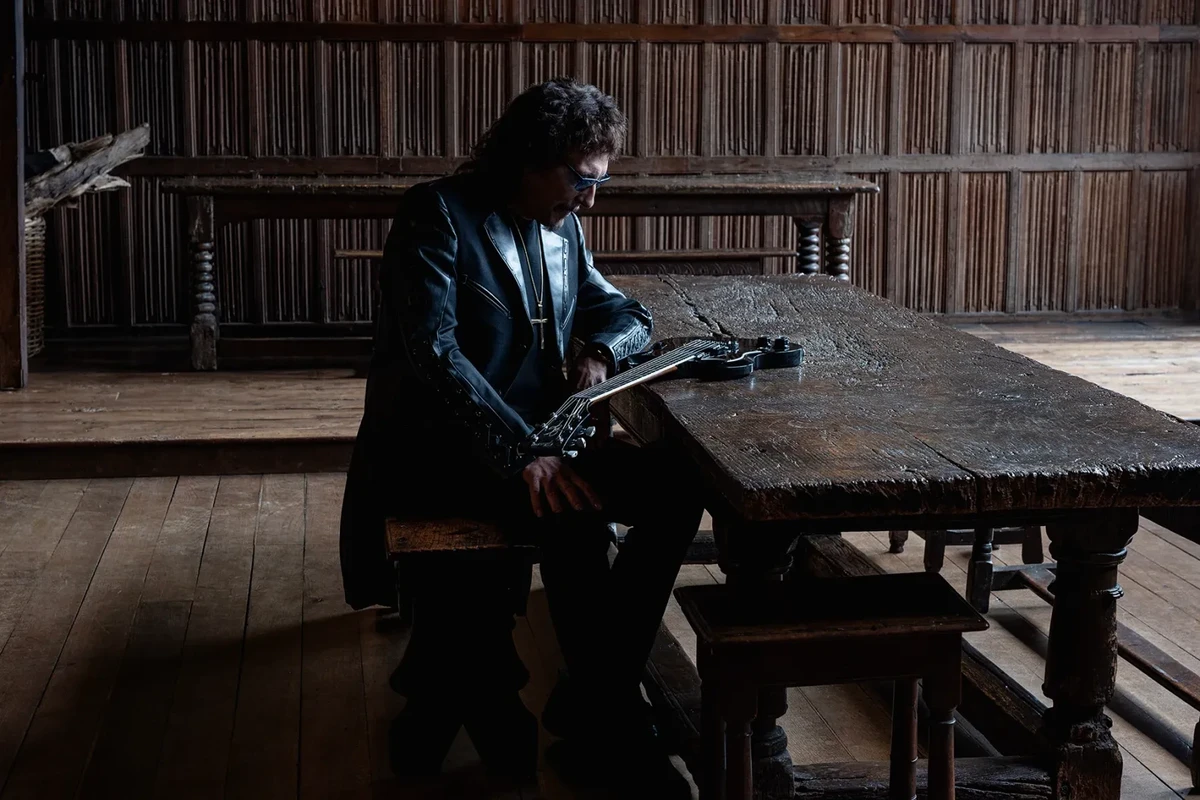

Sometimes Tony Iommi needs to remind himself to write songs that sound a little more upbeat. “I tend to always start off with the doomy stuff,” the former Black Sabbath guitarist says with a chuckle on a phone call from his home in England. “It always has been that way. I just get absorbed with doomy riffs. It’s a feeling I get when I play something heavy and powerful. I still like the up-tempo stuff, of course, though.”
“World Alone,” the first single off From the Dark, Iommi’s upcoming solo album — his first in more than two decades, due Oct. 23 — is decidedly up-tempo. But it’s still heavy. The song finds the guitarist, 78, playing a walloping riff and a snarling solo, recalling Black Sabbath’s cutting Mob Rules album but with a unique, modern twist thanks to vocalist Jørn Lande’s gutsy wailing and apocalyptic lyrics. The song and the seven others on the album, which only sound heavier and more menacing, show how Iommi is doing his own thing apart from Black Sabbath’s legacy but still staying within the doomy world of sound he began constructing nearly 60 years ago.
Over the past year, ever since Black Sabbath played their final gig at Ozzy Osbourne‘s farewell concert, Back to the Beginning, Iommi has kept a mostly low profile. That’s because he’s been fine-tuning ideas he’d been honing for at least half a decade. The seeds for the album sprang from two instrumental songs, 2021’s “Scent of Dark” and 2024’s “Deified,” that he recorded to release along with his own designer perfume. As the songs came together, he felt like he wanted a proper, well-rounded band backing him for this outing.
His first solo album was 2000’s Iommi, if you don’t count 1986’s Seventh Star, which was a solo album that Black Sabbath’s record label credited to the band, or the string of Sabbath albums on which Iommi was the only original member. The Iommi album featured singers such as Billy Corgan and Henry Rollins and various backing musicians on each track, while The 1996 DEP Sessions (2004) and Fused (2005) both featured former Deep Purple frontman Glenn Hughes singing.
For From the Dark, which Iommi co-produced with his longtime collaborator and engineer Mike Exeter, the guitarist opted for musicians who aren’t household names. In addition to Lande, the dramatically expressive Norwegian vocalist whose credits include albums with Masterplan and Ark, From the Dark features bassist Becky Baldwin and drummer Karl Brazil; Exeter plays keys. Queen guitarist Brian May plays a guest solo on the doomy “Death Wake.” Other standouts include “Legacy” and “Stormwatcher,” which bear Iommi’s signature dusky sounds.
The guitarist announced the album on Wednesday at a livestreamed event in his hometown of Birmingham, England, where he debuted the movie-like video for “World Alone,” but Rolling Stone spoke to him earlier in July about how it came together and all that has happened since Back to the Beginning.
Why was it important for you to do a solo album and not call it “Black Sabbath”?
Well, Black Sabbath’s now finished as far as the band goes, really. Obviously, the last stuff was with Ozz. Anything I’d do with Black Sabbath would just be me, and I don’t want to do that again. We’ve been there and done that.
How did you connect with vocalist Jørn Lande for this album?
We’ve worked with him before. When we’d done the Dio tribute after Ronnie passed away, we had Jørn come and sing a couple of songs with us at the tribute, and I really liked his voice. So, I thought, “Well, I’d like to use him.” I liked his voice. I mean, you could go and pick some named people, but I’ve done that.
How did “World Alone” come together?
I tend to go right into all the doomy stuff, and I thought, “Well, we could do something with an up-tempo riff, as well.” When I’d done that, and then I heard the melody he’d done, it all worked.
What was the idea behind the video?
I didn’t want to do a video with all the band. I didn’t even really, to be honest, want to do a video. But they did it. It’s sort of like a movie, really. And I appear a couple of times standing there playing. But I just didn’t want to go the old route of all the bands standing there playing and doing one of them. That’s been done a hundred times.
I’m not really into doing videos myself anyway because I always look … I’m boring. I’m just standing there playing. Nothing else I can do. I can’t jump around or leap around or anything. I’m too old for that [laughs]. But I think the guys that made it did a good job.
Did you give Jørn any direction for the lyrics at all for the album?
No, I didn’t give him any lyrical ideas at all. With a singer, it’s good if they can do their own stuff because when they’ve got to sing it, they can put it over better. It’s like with Ronnie — when he used to write the lyrics, there’s certain words that he could really get powerful on. And I think it’s the same with Jørn.
Some of his lyrics describe nuclear apocalypses. What strikes you when you listened to them?
My first thought was, “God, this is really sort of heavy, but it’s things that’s happening.” It’s what’s happening today in the world, really. Much like with the old Sabbath stuff, when we did “War Pigs”; that is happening today. What Jørn has done in this with the nuclear stuff and everything that’s happening, it’s pretty grim, really.
Are the riffs on the album new or were they ideas you’d been holding onto?
No, they’ve all been new. The thing is, I’ve got loads of riffs on CDs, cassettes, and all sorts of stuff. But by the time I’ve gone back to try and find something on them, I’ve come up with something new.
How do you get in the mood to write? Do you have candles burning?
Occasional candles burning, yeah [laughs]. I generally go in the studio and just play for a bit. And if nothing happens, I’ll leave it. I don’t push it. But generally, I’ll come up with something.
Normally when you do an album, you’re working every day, and you’ve got to do the album in a certain time because you’re under pressure; you’re either touring, or you’ve got to record it or whatever. But I’m not in that situation. I’ve been able to just take me time and live with the stuff.
Do you have to push yourself to write up-tempo songs like “World Alone”?
Not really. But I do remind myself [to write them]. When I heard [the rest of] what we’ve got I thought, “Well, we need to have some up-tempo tracks and a mid-tempo track just to balance off the album, really.”
I did have a couple of acoustic things, but I’ve not used them. I thought I’d keep the album like it is. And not only that, it’s already quite long. We wouldn’t be able to fit them on.
Speaking of acoustic playing, I was pleasantly surprised by the acoustic solo in the middle of “Legacy.”
I like to do something you don’t really expect. And to be honest, I hate playing acoustic. I’m not very good at playing acoustic. But on that bit, I just thought it would be nice and different.
My favorite riff on the album is in the beginning of “Death Wake.” You hold out a note and it kind of shudders, like creaking wood.
Yes, it’s a weird riff. I like that track as well. I like anything doom. Of course, I got Brian May on it playing the solo on that one.
You’ve been close friends with Brian May for decades. When and how did you first meet?
In the very early Seventies, he was in one studio, and I was in another. And we just hit it off. We’ve been friends for, God, nearly 60 years.
We stay in touch all the time. He’s played onstage a couple of times with me, and then we’ve done a couple of album tracks we played on together. He’s a very, very close friend.
Does he play on other songs on the album?
No. I did say to him, “Do you want to play on something else?” He said, “No, no. Your solos are good. I don’t need to play.”
But it was great that he did. I just played him a couple of things, and he’d done it here at the studio in my house. Then of course he’d play something and go, “Oh, I don’t know about it.” I go, “I like it.”
Are there other guests on the album?
No, because I wanted to keep it basically like a band. I wanted to use the same people.
How did you find the drummer on the album, Karl Brazil?
It’s strange, really. I’ve got a house by the beach, which we go down to now and again. I was walking along the perimeter of the beach, and this guy come up to me and said, “Oh, Tony, hello.” And I thought he’s just a fan. And he said, “We’ve got a mutual friend. Mike Exeter is my engineer. I’m Robbie Williams’ drummer.” Then Mike, my engineer, he said, “Oh, yeah, he’s a good drummer, Karl.”
I used him on one of my instrumental tracks with the perfume thing I did. And then I thought it’d be nice to use him on the album because he’s a good player. Also, he’s from Birmingham, which is really good because I wanted to try and keep it local.
I’ve been curious how your Robbie Williams collaboration, the song “Rocket,”came together, since it was surprising.
It surprised me as well. It was weird just when they asked if I’d play on a track with him. I didn’t realize he was going to release it as a single. Then he wanted to do a video of song. So I did that with him. And it was very good. It was very different for me to do, and I enjoyed it.
What do you like about the bassist, Becky Baldwin, who plays in Mercyful Fate and Fury?
Becky lives in Birmingham, and she’s a really good player. And she’s certainly a fan of Geezer [Butler, Black Sabbath’s bassist], and she plays in Geezer’s style. And that’s what I wanted. She’s really good.
Had you considered working with Geezer on this album?
I wanted him to play on this album, but he couldn’t do it. He’s doing his own album, I think. Or at the time, something happened there, so he couldn’t come to England. I wanted to get it done and finally get it out, really. Because Becky’s, as I say, a fan of Geezer, and she plays in that style, I though let’s give it a try. And she was good.
Speaking of Geezer, there’s been a lot of talk in the last year about a legal battle holding up the release of Black Sabbath’s earliest recordings, when you were still called Earth. Now that you have the rights to them, will they come out?
They will come out at some point. It’s weird when you hear stuff from so long ago, and all these things crop up that you forgot about.
What struck you when you listened to the recordings again for the first time in decades?
The sound and everything. Bloody hell, we’d done it in a little studio. But it was fun to hear them, actually. I sat listening to them all, and it was good because there’s some jazzy stuff and bluesy stuff we done on them where we just used to jam. On a lot of the jams, it was all guitar, and I forgot about half of that. I can’t play that now.
 Iommi and Ozzy Osbourne, 2016.Kevin Mazur/WireImage
Are you satisfied with Black Sabbath’s legacy being done?
Yeah. The legacy’s been fantastic, really. I think it was a good thing to finish off when we did the Back to the Beginning one, because all the bands who were fans of Sabbath came onto that show, which was just brilliant. And it was so nice of them to all put themselves out to come and play on the same show and no egos or anything. Everybody just got on with it and played. It was great for a final thing with Sabbath to take it together as the original band and finish it off as it should.
How did doing that last performance feel for you?
On the night, it felt very strange for me because obviously we’d never been onstage with Ozzy in a throne before, sitting down. He was always jumping around, pulling faces, and making me and Geezer laugh. But on this occasion, I couldn’t see him because he’s in that throne at the front.
Obviously, we hadn’t played with Bill [Ward, Black Sabbath’s drummer] for 20 years, so Bill wanted me to stand back by him just because he was unsure of some bits. And so I did.
When I watched it, I found it to be a very emotional performance.
It was. It really was. Of course, nobody knew Ozzy was going to go not long afterwards either. I knew he weren’t well, but I didn’t expect it to happen that quick.
Were you able to say goodbye?
He texted me the night before, funny enough, and said he weren’t feeling great and so on. But obviously, most of our conversations to each other have been, “How are you feeling? How’s this? How’s that?” And so it was just another conversation. I didn’t expect him to go overnight. Blimey. It was a hell of a shock, really.
He told me in interviews how meaningful it was to him that you were supportive of him as he healed up in recent years.
Well, we did stay in touch a lot. And he was going through so many different things and constantly in and out of hospital and having this done and that done. And again, he stood by me when I was diagnosed with cancer. He called me every day. So we’ve been supportive of each other. I do miss our conversations.
How have you handled the last year without him?
It’s been really strange. I still don’t feel like he’s gone because when I look on YouTube or whatever, there’s something to do with Ozzy, and I see him again and again. It’s almost like he’s still here. It’s really peculiar. Only, we were in touch so many times. That’s what I miss.
How has your health been?
OK, I hope. I still go in regularly for checkups. Doing this album now, it gave me time to be able to do stuff. Monday and Tuesday, we’d always book [time with Mike Exeter] to work here at my house [studio]. But on a Monday or Tuesday, it’d always be I had to go to hospital for a visit. They wanted to do this or do that. It just always seemed to fall on a Monday or a Tuesday. But we managed to get it done.
Do you have more material? Should we expect another solo album like this in the near future?
I hope so. I just enjoy doing it. It’s what I’ve always done.
I’m not into just retiring and sitting back and doing nothing. I have to do something, and music is the only thing I know what to do. I like creating it. I think it’s good for your mind, as well, to be able to make things up and come up with ideas.
Will you be performing live with the solo band?
There’s no plans for anything. I just take it as it comes now. That’s the good thing. You can sort of pick and choose: “Do I want to do that? Or is there an offer to do that?”
What’s next for you, then?
Well, I’ve done a couple of instrumentals, which I was going to put on this album, but I didn’t because we didn’t have enough space. So I might put those out somewhere along the line on an album, but I’m going to continue writing and seeing what happens. There’s always things that keep popping up to do — a bit for movies or anything, really, that just comes out of the blue — and then you say, “Oh, that’s a good idea.” And then I’ll have a go at it. I’m not ready to go away yet.