
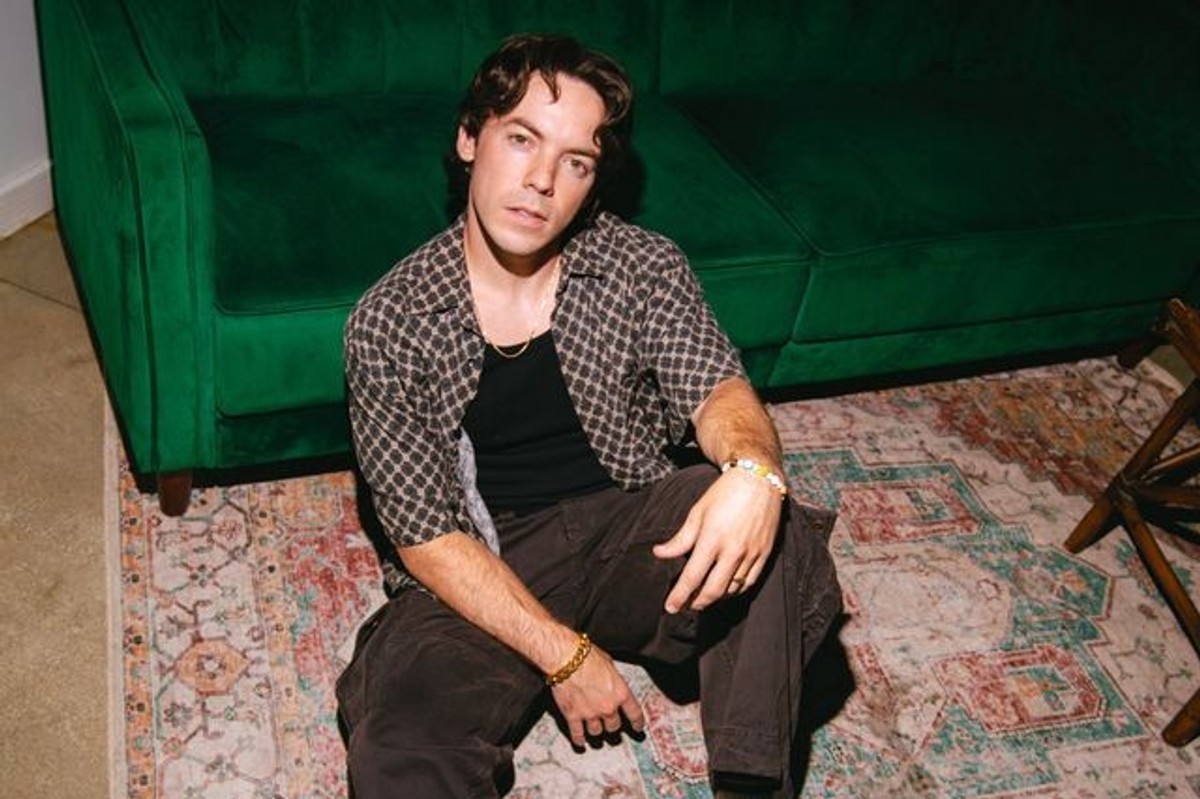

Connor Price didn’t come up through the usual music industry system. The Markham-born artist spent years working as an actor before the pandemic brought that side of his career to a halt, pushing him to take music seriously and build something of his own. What followed was a fully independent run shaped by consistency, sharp instincts for digital storytelling and a close partnership with his wife and manager, Breanna.
Together, they’ve built a hands-on operation that controls everything from releases to visuals, allowing Price to move quickly and stay directly connected to his audience. His Spin the Globe series expanded that world further, turning global collaboration into a format while introducing listeners to artists across countries.
With a catalogue that has crossed billions of streams and a fanbase built without traditional backing, Price stands as a clear example of how modern artists can grow on their own terms.
You stepped away from acting at a point where most people would keep going. What made you want to build something of your own instead of staying in that system?
When Covid hit, acting momentum took a huge hit. Auditions stopped entirely, productions paused, and I’m not the type of person who can simply sit back and wait for something to happen. I was also married with a kid on the way, so I had a family to support. My wife and I took the free time during quarantine to finally pursue music, which had been a dream of mine for as long as I could remember. It’s funny, because looking back, if I hadn’t been forced to take a step back from acting, we probably wouldn’t have been motivated enough to really chase music independently. Now that I’ve found a music career, acting has taken a natural backseat, but it’s still a passion of mine that I regularly work on when an opportunity presents itself. I’m independent, so my music career is entirely in my control, which I love. I love both crafts and will continue to create in both industries as long as I am able.
You’ve kept your team small and close, even as things have scaled. What does that actually change in how you operate day to day?
My wife and I are hands-on in every aspect of our business. From booking travel, picking and booking locations, sourcing all freelancers, planning release calendars, negotiating sync licenses, giving artwork feedback, sourcing production, approving mixes and masters, uploading the music to our distributor, submitting splits to publishers, being involved in all aspects of live performance, coming up with all marketing material and coordinating those shoots, even down to editing a large majority of the videos, etc. We’ve started to outsource the larger stuff regarding business management and legal, but everything else will always remain in-house because we prefer it that way.
You release music pretty consistently without long gaps. Is that something you’ve built into your process, or does it just come naturally?
It’s a solid mix of both. Especially when you’re independent, consistency and momentum are crucial to keeping your fanbase engaged. That includes both music and marketing. Each time I release a new song and hit Release Radar on Spotify, it gives my entire catalog a little boost. I am also able to work at a fast speed because I don’t need approvals from anyone else. There’s no label to tell us how or when we can release a track. So if I’m making music frequently, why would I wait to put it out? There are over 100,000 songs being uploaded daily to streaming services. The industry has never been more saturated. You gotta stay in the forefront of the fan’s mind, or they forget. It’s a harsh reality, but it’s important to realize and accept.
That global collaboration series you started brought in artists from all over. What made you want to build something like that into your releases?
My wife, Breanna, who manages me, actually came up with the Spin the Globe series. We had organically been connecting with independent artists from around the world, making music together, so the idea to spin the globe and turn it into a series just made what we were already doing hit a whole new level. Collaborating with artists from Zambia, India, the Netherlands, Germany, etc. brought a whole new sound to the music that we weren’t able to achieve on our own, or with artists that were in our circle. As a natural positive side effect, a lot of young listeners were exposed to new styles of music from around the world. We were also able to help a lot of smaller and insanely talented artists gain some very well-deserved attention through the series and change more lives than just ours.
You’ve stayed independent while growing your audience. What have you had to be more careful about because of that?
We’ve had to be extra careful about who we trust. Being independent comes with being an underdog in a very powerful industry, and if you trust the wrong people, they can try to take advantage of you. We’ve had larger artists steal our content (word for word, shot for shot, even down to the sound effects) and block us when we contact them to stop. We’ve had a larger artist re-distribute our song without our consent, and not pay us for almost 9 months. We have to stay extra diligent about posting content regularly, because we don’t have label-sized budgets to put behind every release, and we don’t have the access they often have to editorial playlists, etc., so we rely on the content and the fans to stream the music. Editorial playlisting makes up less than 1% of my streams. Every month, there are on average between 40 to 60 million streams on Spotify, to put that percentage into perspective.
A lot of people follow you for both the music and the personality. Has that changed how you think about what you put out?
That used to get in my head a lot, because I’ve evolved a lot over the years. A lot of the followers ask me to make music that was a part of who I was 3 or 4 years ago, but I’ve changed. I’m very thankful when the fans let me make the music I feel most connected to during that stage of my life and allow me to evolve beyond the persona I’ve shown online the last few years.
Is there anything you can tell us about your upcoming projects in 2026?
I have another album dropping with my best friend, Nic D, in June, right before we go on a mini tour. Then, after we drop that, I’m excited to focus on some more solo music since dropping my debut album last September. I have a really cool collab happening in November that I’m unfortunately not allowed to talk about at the moment, but I can’t wait to talk about it soon. Who knows. Maybe another album will happen before the end of the year.
What are your thoughts on the Future of Music in Canada?
I’m stoked to see where it goes in the next couple of years. Artists are taking their careers into their own hands more and more, and that usually comes with more experimental/authentic sounds. Canada is full of some of the most talented people I’ve ever met, and I firmly believe we haven’t even scratched the surface yet of what we’re capable of as a country. Global collaborations have always been a core part of Canadian music and I think that’s only going to increase in the near future.






 Courtesy of Martin Garrix
 Louis Van Baar*



Liam Payne (left) and Harry Styles of One Direction onstage during the 2013 American Music Awards at Nokia Theatre L.A. Live on Nov. 24, 2013
Harry Styles Finds the Right Words on Liam Payne Tribute Song
For the past seven weeks, Harry Styles has reserved two minutes at each of his Madison Square Garden shows to reflect on the last time he gathered this many people in this room. Four years have passed since he performed 15 record-breaking nights at the venue during his Love on Tour. Now, every night at the new Together, Together shows, which span 30 nights at MSG, he acknowledges that “a lot of life happened to me and landed on me in ways that maybe it hadn’t before.”
Styles doesn’t usually go into much more detail; he typically just describes those in-between years as “a great reminder for me of just how wonderful and beautiful, difficult and inspiring, and also how fragile a life can be.” He encourages the audience to look around at each other and celebrate the community they’ve built together. Then he dives into “Sign of the Times.” It happens every Wednesday, Friday, and Saturday like clockwork. But when he delivered this speech on Friday, Oct. 16, there was a shift. It didn’t conclude in its usual way.
Instead, Styles turned his attention to the banner commemorating his 15 consecutive nights at the Garden in 2022. “It means a lot to be able to look up there at my name up there from the last tour,” he said. “There are so many people, friends and people that I’ve worked with, that I would’ve never been able to do this without.” Two years ago, he continued, he lost one of those pillars. Friday’s show fell on the same day as the second anniversary of the death of Liam Payne, a loss that time has not made it easier to acknowledge. “I’m sure a lot of you have been through something similar,” Styles said. “I hope you haven’t.”
A frequent assessment of Styles, both among his fans and those who’ve only encountered him at a distance, is that he often talks at length before getting to the point. He recognizes it himself on the Kiss All the Time. Disco, Occasionally song “Coming Up Roses,” where he sings about fumbling his words. But recently, comments about his long-winded way of speaking have started to feel like purposeful misreadings. There are clear and carefully considered thoughts present between his starts and stops. Anyone truly listening will pick up on those threads.
Styles cut himself off a few times during his speech on Friday. He tried to talk for a second about looking after each other, and repeated his point about the banner and the people who’ve supported him. He never mentions Payne by name, instead referring to him as a friend, which somehow became a point of criticism from some fans. The context is clear enough. Still, he seems to know it’s a gamble to expect understanding, especially when the conversation grows more complex and personal.
After about a minute and a half, Styles figured it best to show us what he means rather than tell us. “I’m gonna sing a song I wrote two years ago for my friend,” he said before premiering “Wise Enough.” The sullen tribute to Payne settled the room into a cool near-silence, punctured by quiet gasps and muffled crying. It was beautiful, devastating, and deeply exposing to watch Styles share his grief with 20,000 people in the best, and maybe only, way he knows how.
Earlier this year, Styles told Zane Lowe about the acute dread surrounding the expected performance of his mourning. “Full transparency, even the idea of talking about it, I struggle with that a little bit. There was a period when he passed away where I really struggled with acknowledging how strange it is to have people own part of your grief, in a way,” he said. “I have such strong feelings around my friend passing away. And then suddenly being aware there’s maybe a desire from other people of you to convey that in some way, or it means you’re not feeling what you’re feeling.”
Artists often describe the act of sharing new music as a change in ownership, something that is no longer their own once it has been handed over to an audience. “Wise Enough” feels protected from this. It would be confounding to see Styles ever record and release it in any official capacity. The song is openhearted in a way that exposes deep scars, anxious in a way that worries and fidgets about time and how it passes, and inconsolable in a way that doesn’t make the futile attempt to fight through anger, regret, or sadness.
“I can tell you what it’s like to bury friends on Wednesday nights/Gather in a garden around the fire,” Styles sings in a particularly cutting verse on the song, which concludes with an honest admission: “I’m not wise enough to call for a conversation/And then back it up, right?/Like you’re in the sky.”
Celebrity doesn’t obscure grief. It doesn’t come with a script for what to say when someone is sorry for your loss, or when they recollect their own version of the person you knew. No one really has the right words for these moments. Over the weekend, fans debated whether “Wise Enough” is actually titled “What Is Enough?” Styles introduced the record so briskly it was hard to decipher. The question of adequacy feels similarly impossible to answer.
Grief is so plain in how universal it is, but so complex in how and when it chooses to present itself. It can be policed only as much as it can be predicted, which is to say barely at all. That Styles let us into his now yearslong search for some semblance of understanding — knowing how his words have been picked apart before for far lesser things — shouldn’t be taken for granted.
Styles never acknowledges that banner at MSG. It’s not for lack of gratitude — he cried when it was unveiled. But the point he has reiterated every Wednesday, Friday, and Saturday since the end of August is that the achievement is something that must be shared because he couldn’t have done it alone. He talks about being on stage as if what happens in that room exists far beyond and outside of himself, something that endures even in his absence.
It’s true in a way. There’s muscle memory tied to the music. It’s in the spinning, dizzying way fans dance to “Satellite,” or the way they wildly kick their feet and make the building shake during “Kiwi,” a song he brought back to the set just for New York. It’s just like before, but still so different.
Friday night continued as usual after “Wise Enough.” Styles belted out “Sign of the Times” in the sobering way he always does, then “Aperture” let in a cathartic flood of strobing lights and pulsating beats. The emotional whiplash took physical form as fans consoled one another, holding out their hands to help up friends and strangers who crumbled to the floor at the conclusion of the tribute. Some were crushed by their memories of loving One Direction, and the care they hold in their hearts for Styles. Some were just as wrecked by their own personal losses.
A lot of life and loss can happen in four years, as Styles says each night. For some people who were at MSG on Friday, there are friends present in their memories from the last tour who are missing from the new ones they’re making. The lyric “You dance until you’re tired/No, you don’t, and now you never will/Will you?” surfaces their own devastation completely separate from what inspired Styles to sprawl those words on a page. How do you dance to “Aperture” — the beating heart of this show in its declaration that “we belong together” — after hearing something like that?
You take the hand of the friend or the stranger who pulled you from the ground and use it to lead each other back to the dance floor. When Styles talks about community and stresses the importance of caring for one another each night, he reminds everyone of the fragility of a moment, and urges them to cherish every second they get. To dance wildly and sing loudly and wrap their arms around each other. To hold tight to what’s here right now.
It’s all any of us have, so it has to be enough.