
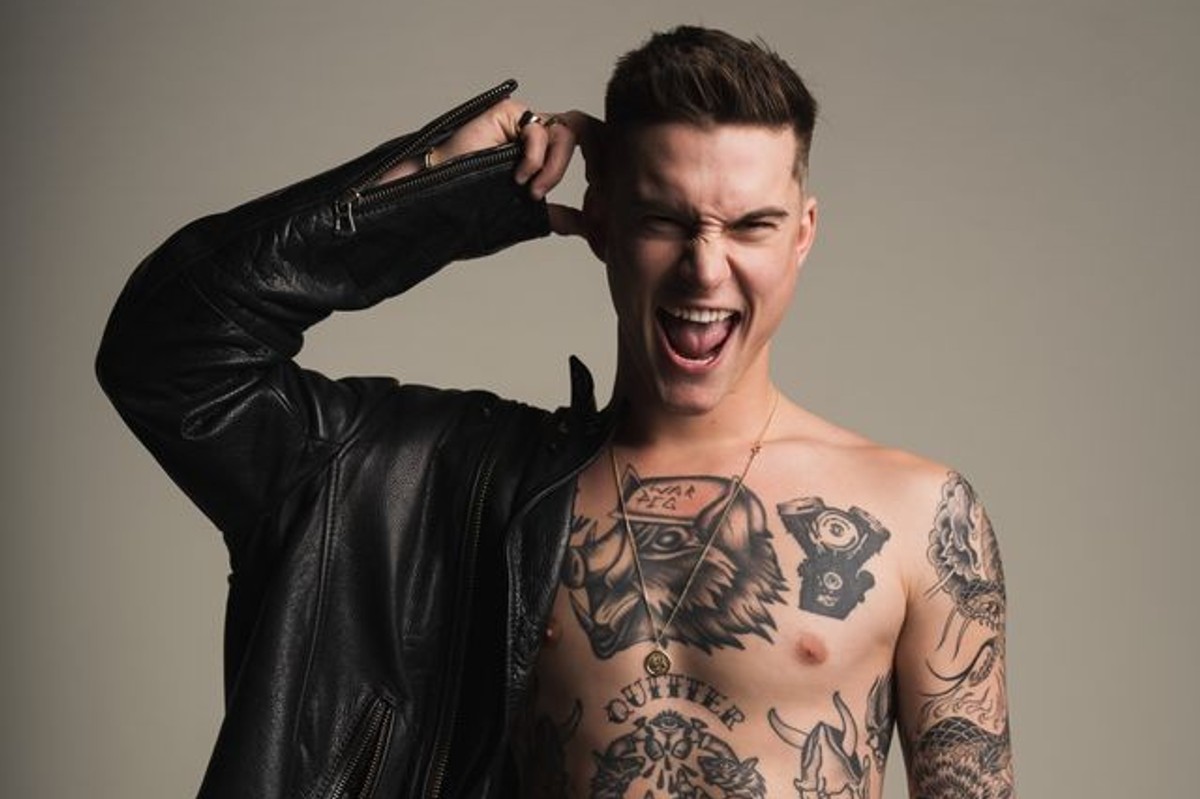

Before the music started landing, Cameron Whitcomb was back home in Nanaimo, B.C., figuring things out as he went. His run on American Idol in 2022 put him in front of a bigger audience, but it didn’t immediately translate into a clear next step. What followed was slower — writing, releasing, and building a connection online through songs that felt direct and unfiltered.
That’s the space his 2025 album The Hard Way comes from. The project is built to play straight through — concise, intentional, and rooted in his own experiences, including addiction and recovery. It moves across folk, country and alternative, but never really settles into one, which lines up with how he approaches writing in the first place.
As things pick up, that approach hasn’t really shifted. He’s still writing day by day, pulling from what’s happening around him, and letting the songs land as they are — which is exactly why they connect as quickly as they do.
The Hard Way introduced people to your songwriting in a very direct way. When you were putting that project together, what were you most particular about getting right?
What was most important in creating The Hard Way was making sure that every song lined up like a coherent album. That the songs were concise, and that the project was easy to listen to from front to back.
Your music pulls from folk, country and alternative spaces without sitting fully in one. Does that give you more freedom, or does it make it harder to position your work as things scale?
It gives me a lot more freedom to do what I need to do creatively without putting myself in a box. It allows me to write songs I love, and put them out to the world, without being too precious about genre or identity.
You’ve built a strong connection online, but your songs also feel very suited to live settings. How has performing them changed the way you think about writing new material?
Songwriting and live performances are so different, I’ve never let one influence the other. I write songs day by day. What songs become in the writing room are what they were supposed to be. Some songs are better from a writing standpoint, some perform better live. Some are both, and that's OK.
There’s a rawness to your records that people connect with quickly. As your audience grows, how do you keep that intact without repeating yourself?
My life is moving so quickly these days. New experiences, new people, new places, new cultures. It gives me tons of material to write about. As I collect moments, I write about them. It helps keep the music fresh while staying consistent, because it’s all from my perspective.
You’ve entered the industry at a different stage of life than a lot of artists. Do you think that’s shaped how you approach this moment?
Because I’m young and new to this, it makes my craft a lot less refined. Everything is less polished and more raw.
What are your thoughts on Future of Music in Canada?
With social media, it’s much easier to for Canadian artists to access the rest of Canada, and the rest of the world. Canadian artists are able to be less regional. I think Canadian artists will be much more recognized and have a bigger footprint than they have in the past.







 Courtesy of Martin Garrix
 Louis Van Baar*



Liam Payne (left) and Harry Styles of One Direction onstage during the 2013 American Music Awards at Nokia Theatre L.A. Live on Nov. 24, 2013
Harry Styles Finds the Right Words on Liam Payne Tribute Song
For the past seven weeks, Harry Styles has reserved two minutes at each of his Madison Square Garden shows to reflect on the last time he gathered this many people in this room. Four years have passed since he performed 15 record-breaking nights at the venue during his Love on Tour. Now, every night at the new Together, Together shows, which span 30 nights at MSG, he acknowledges that “a lot of life happened to me and landed on me in ways that maybe it hadn’t before.”
Styles doesn’t usually go into much more detail; he typically just describes those in-between years as “a great reminder for me of just how wonderful and beautiful, difficult and inspiring, and also how fragile a life can be.” He encourages the audience to look around at each other and celebrate the community they’ve built together. Then he dives into “Sign of the Times.” It happens every Wednesday, Friday, and Saturday like clockwork. But when he delivered this speech on Friday, Oct. 16, there was a shift. It didn’t conclude in its usual way.
Instead, Styles turned his attention to the banner commemorating his 15 consecutive nights at the Garden in 2022. “It means a lot to be able to look up there at my name up there from the last tour,” he said. “There are so many people, friends and people that I’ve worked with, that I would’ve never been able to do this without.” Two years ago, he continued, he lost one of those pillars. Friday’s show fell on the same day as the second anniversary of the death of Liam Payne, a loss that time has not made it easier to acknowledge. “I’m sure a lot of you have been through something similar,” Styles said. “I hope you haven’t.”
A frequent assessment of Styles, both among his fans and those who’ve only encountered him at a distance, is that he often talks at length before getting to the point. He recognizes it himself on the Kiss All the Time. Disco, Occasionally song “Coming Up Roses,” where he sings about fumbling his words. But recently, comments about his long-winded way of speaking have started to feel like purposeful misreadings. There are clear and carefully considered thoughts present between his starts and stops. Anyone truly listening will pick up on those threads.
Styles cut himself off a few times during his speech on Friday. He tried to talk for a second about looking after each other, and repeated his point about the banner and the people who’ve supported him. He never mentions Payne by name, instead referring to him as a friend, which somehow became a point of criticism from some fans. The context is clear enough. Still, he seems to know it’s a gamble to expect understanding, especially when the conversation grows more complex and personal.
After about a minute and a half, Styles figured it best to show us what he means rather than tell us. “I’m gonna sing a song I wrote two years ago for my friend,” he said before premiering “Wise Enough.” The sullen tribute to Payne settled the room into a cool near-silence, punctured by quiet gasps and muffled crying. It was beautiful, devastating, and deeply exposing to watch Styles share his grief with 20,000 people in the best, and maybe only, way he knows how.
Earlier this year, Styles told Zane Lowe about the acute dread surrounding the expected performance of his mourning. “Full transparency, even the idea of talking about it, I struggle with that a little bit. There was a period when he passed away where I really struggled with acknowledging how strange it is to have people own part of your grief, in a way,” he said. “I have such strong feelings around my friend passing away. And then suddenly being aware there’s maybe a desire from other people of you to convey that in some way, or it means you’re not feeling what you’re feeling.”
Artists often describe the act of sharing new music as a change in ownership, something that is no longer their own once it has been handed over to an audience. “Wise Enough” feels protected from this. It would be confounding to see Styles ever record and release it in any official capacity. The song is openhearted in a way that exposes deep scars, anxious in a way that worries and fidgets about time and how it passes, and inconsolable in a way that doesn’t make the futile attempt to fight through anger, regret, or sadness.
“I can tell you what it’s like to bury friends on Wednesday nights/Gather in a garden around the fire,” Styles sings in a particularly cutting verse on the song, which concludes with an honest admission: “I’m not wise enough to call for a conversation/And then back it up, right?/Like you’re in the sky.”
Celebrity doesn’t obscure grief. It doesn’t come with a script for what to say when someone is sorry for your loss, or when they recollect their own version of the person you knew. No one really has the right words for these moments. Over the weekend, fans debated whether “Wise Enough” is actually titled “What Is Enough?” Styles introduced the record so briskly it was hard to decipher. The question of adequacy feels similarly impossible to answer.
Grief is so plain in how universal it is, but so complex in how and when it chooses to present itself. It can be policed only as much as it can be predicted, which is to say barely at all. That Styles let us into his now yearslong search for some semblance of understanding — knowing how his words have been picked apart before for far lesser things — shouldn’t be taken for granted.
Styles never acknowledges that banner at MSG. It’s not for lack of gratitude — he cried when it was unveiled. But the point he has reiterated every Wednesday, Friday, and Saturday since the end of August is that the achievement is something that must be shared because he couldn’t have done it alone. He talks about being on stage as if what happens in that room exists far beyond and outside of himself, something that endures even in his absence.
It’s true in a way. There’s muscle memory tied to the music. It’s in the spinning, dizzying way fans dance to “Satellite,” or the way they wildly kick their feet and make the building shake during “Kiwi,” a song he brought back to the set just for New York. It’s just like before, but still so different.
Friday night continued as usual after “Wise Enough.” Styles belted out “Sign of the Times” in the sobering way he always does, then “Aperture” let in a cathartic flood of strobing lights and pulsating beats. The emotional whiplash took physical form as fans consoled one another, holding out their hands to help up friends and strangers who crumbled to the floor at the conclusion of the tribute. Some were crushed by their memories of loving One Direction, and the care they hold in their hearts for Styles. Some were just as wrecked by their own personal losses.
A lot of life and loss can happen in four years, as Styles says each night. For some people who were at MSG on Friday, there are friends present in their memories from the last tour who are missing from the new ones they’re making. The lyric “You dance until you’re tired/No, you don’t, and now you never will/Will you?” surfaces their own devastation completely separate from what inspired Styles to sprawl those words on a page. How do you dance to “Aperture” — the beating heart of this show in its declaration that “we belong together” — after hearing something like that?
You take the hand of the friend or the stranger who pulled you from the ground and use it to lead each other back to the dance floor. When Styles talks about community and stresses the importance of caring for one another each night, he reminds everyone of the fragility of a moment, and urges them to cherish every second they get. To dance wildly and sing loudly and wrap their arms around each other. To hold tight to what’s here right now.
It’s all any of us have, so it has to be enough.