
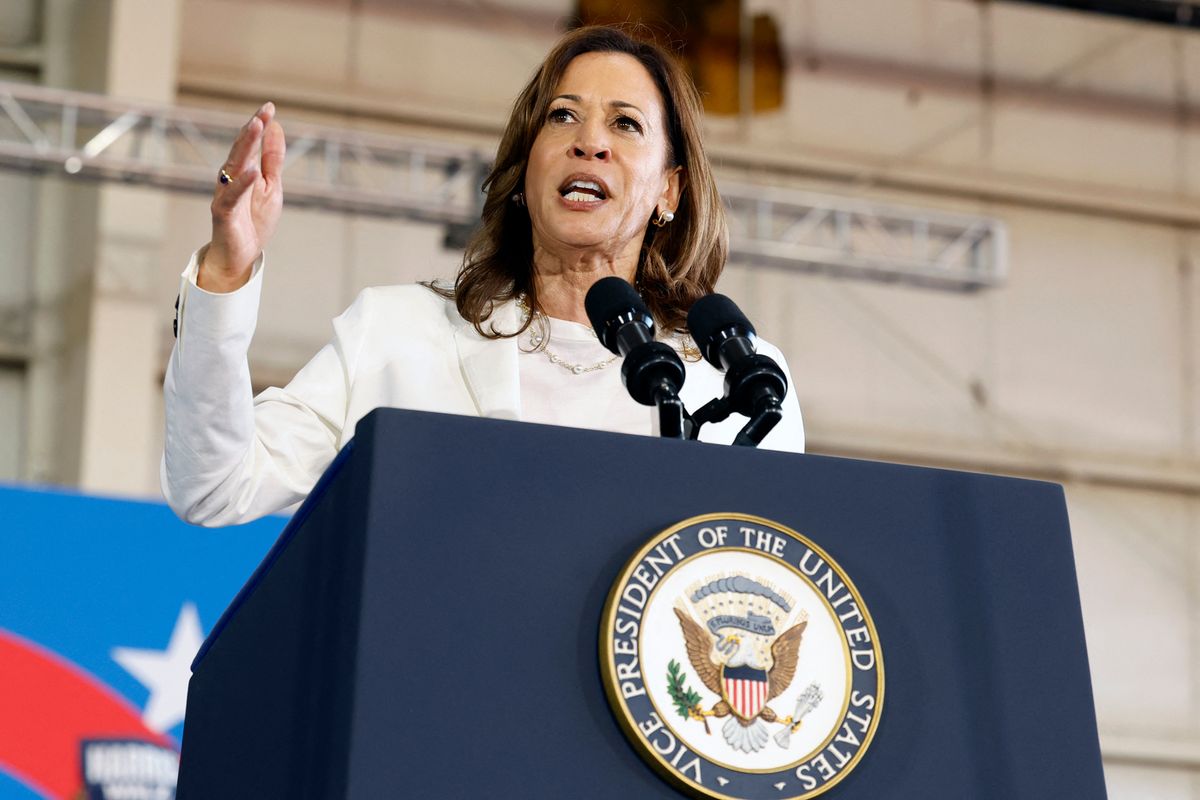

Kamala Harris and her running mate Tim Walz made their political debut to throngs of screaming supporters in Philadelphia on Tuesday night. The next day, they hopscotched over to Eau Claire, Wisconsin, for a casual meet up with 12,000 Bon Iver-heads, before touching down in Detroit, where some 15,000 people turned up on the Detroit Metro tarmac to greet them.
Harris was on stage inside an airplane hangar a little while later, when her speech — and the positive vibes that have propelled her campaign for the past two and half weeks — were interrupted by protesters demonstrating against the Biden administration’s decision to continue arms shipments to Israel, even as that country’s right-wing government uses those weapons with little regard for the lives of civilians, aid workers, and journalists. An estimated 40,000 people have been killed in Gaza since the war began in October.
“Kamala, Kamala, you can’t hide. We won’t vote for genocide,” the protesters chanted.
Delivered in Michigan — where 100,000 people withheld their votes for President Joe Biden in February’s Democratic primary over his administration’s Gaza policy — the message has some teeth. Hillary Clinton lost the Democratic stronghold by just 10,704 votes in 2016; Biden reclaimed it for Democrats in 2020, but with a slim, 154,000 vote-margin.
Harris seemed, initially, to take the interruption in stride. “I’m here because we believe in democracy. Everyone’s voice matters, but I am speaking now,” she said after the first chant broke out. Then, she resumed her speech: “Look, if he is elected, Donald Trump intends to give tax breaks to billionaires and big corporations, he intends to cut Social Security and and Medicare, he intends to surrender our fight against the climate crisis and he intends to end the Affordable Care Act — ” The chanting continued, and Harris’ patience, seemingly, ran out. “You know what? If you want Donald Trump to win, then say that. Otherwise, I’m speaking,” she said.
The moment was clipped and quickly spread around social media, where it was received poorly by would-be Harris supporters hopeful that a change at the top of the Democratic ticket would also portend a meaningful change in U.S. policy as it relates to Gaza.
There have been subtle signals that Harris would be more inclined than Biden to support such a change, including her calls for a ceasefire that pre-dated Biden’s, reports she’s advocated for stronger public criticism of Israel’s refusal to let humanitarian aid into Gaza, her personal outreach to a man who lost dozens of family members in the war, and her selection of Walz as a running mate.
But in the absence of Harris herself articulating a policy vision distinct from the current administration’s, the viral moment seemed to confirm the worst fears of voters who are disturbed by the fact that U.S taxpayers are funding what United Nations experts have assessed can reasonably be called “a genocide.”
Before they took the stage on Wednesday, Harris and Walz were introduced to the founders of the Uncommitted Movement, Layla Elabed and Abbas Alawieh, who say the campaign invited them to Wednesday’s rally. The invitation, extended after months of lobbying for both a meeting to discuss an arms embargo and speaking slot at the convention, was for a brief introduction during a photo line.
“It was only a few minutes in the photo line-up, and I did get really emotional,” Elabed tells Rolling Stone. “Harris was incredibly sympathetic. And I could feel her sympathy was very genuine… And when I said, ‘Will you meet us?’ She said: ‘Yes, let’s meet.’” Elabed and Alawieh say Harris then directed a staffer to arrange a meeting with them. They’re hopeful it will take place, but no date has been set.
“Obviously we need more than just sympathy… We can’t eat sympathy,” Elabed says. “Palestinians, who are taking the forefront of this assault, can’t live off of sympathy. We need a real policy shift. We need a real change.”
After the event, the Uncommitted Movement sent out a press release declaring that Harris had agreed to meet with them to discuss an arms embargo. The vice president’s national security advisor, Phil Gordon, immediately disputed the idea that she would support one. A spokesperson for the campaign, meanwhile, said only that Harris “affirmed that her campaign will continue to engage with those communities.”
Alawieh and Elabed remain optimistic about the prospect. “It feels like the Vice President is interested in engaging,” says Alawieh, who worked with members of Harris’ team as a legislative director in Congress. “I know Vice President Harris’s team is a strong group of people, many of whom are in touch with Arab American, Muslim American, and Palestinian American community leaders, so it hasn’t surprised me that there’s been more responsiveness, certainly, than what we were getting from President Biden.”
He added that they recognized that Harris’ campaign is new and that she and her staff are still working to get it off the ground. At the same time, he says, the Democratic campaign reset presents “a real opportunity to turn a new page on Gaza policy.”
“My sense is that the last 10 months of this administration’s Gaza policy have been disastrous, and that as we go into the most important months of this campaign cycle, a hypocritical campaign stance that says ‘Cease-fire’ in one in one breath, and then continues to support the unconditional flow of weapons in the in the next is not a sensible policy, and it’s not a good campaign strategy,” Alawieh says. “Democratic voters, including over 100,000 here in Michigan, have self identified saying that Gaza is a top policy issue for them. So if you’re listening to voters, you need to have an update to this policy. And I’m hopeful that her team sees that.”





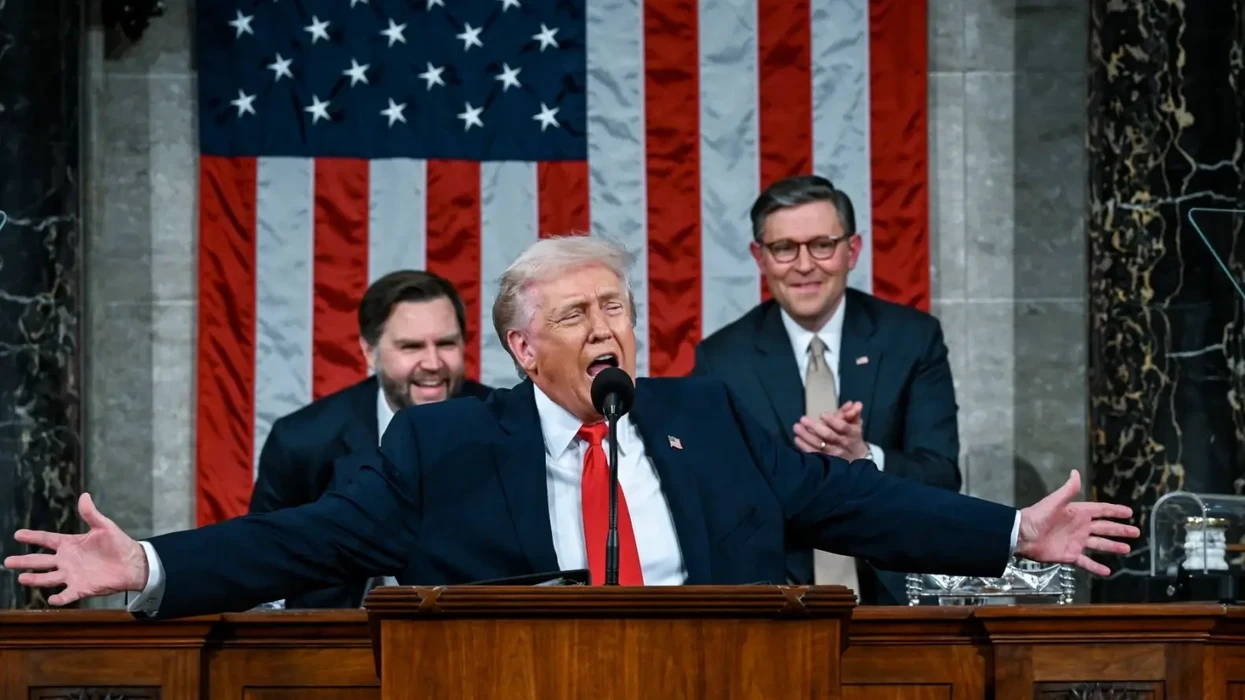
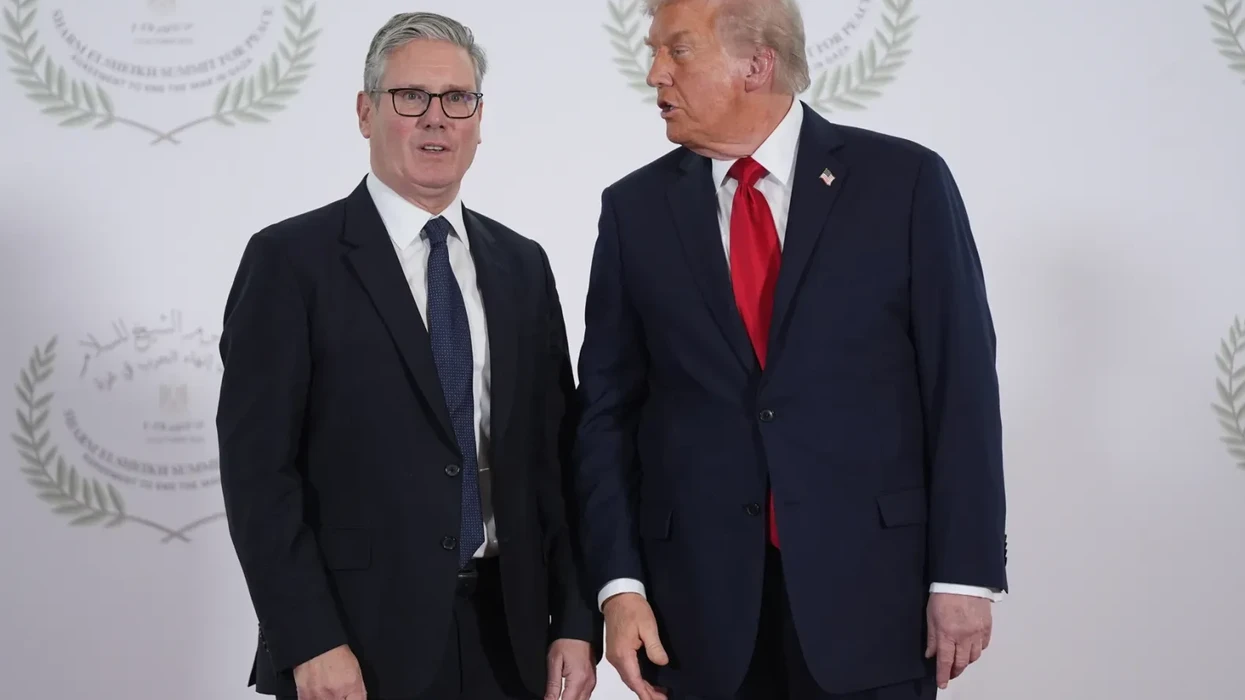

War Is Peace: Trump’s Regime-Change Reversal
As American and Israeli rockets fly into Tehran, with the stated goal of regime change, anyone who bought into the self-evidently absurd idea of “Donald the Dove” ending America’s forever wars ought to be suffering from a bloody form of buyer’s remorse.
It was always bullshit. But that’s what the Trump team was selling hard. Take human ghoul Stephen Miller’s tweet days before the election: “Kamala = WWIII. Trump = Peace.”
The Trump team reads George Orwell’s 1984 like an owner’s manual and so of course “war is peace.” Their undermining of NATO and the dismantling of American alliances in favor of a “might makes right” foreign policy executed by a sycophantic kakistocracy is a guarantee of more war amid autocratic power grabs worldwide, with a side order of corrupt crony capitalism to profit from the chaos.
If you voted for Trump and believed him, this is on you. And that includes self-styled Palestinian peace activists who thought that Biden and Harris were the worst of all possible worlds and stayed home. We will no doubt see protests for the innocent lives lost in these strikes — but I’d have a lot more time for those folks if they were also seen protesting the estimated 20,000 to 30,000 Iranian lives snuffed out by murderous mullahs in the last few months alone.
The Islamic Republic of Iran has been despotic and dangerous from its inception. The Iranian people have been oppressed and denied basic freedoms for decades. But this is an extreme example of a war of choice. The American military strikes against Iran’s nuclear weapons facility last year were justified because Iran cannot be trusted with a nuclear weapon. That is true. But the much trumpeted total obliteration of those facilities is apparently not true — or so goes the justification for this war. And don’t forget that it was Trump who pulled the U.S. out of an Obama-era deal to stop Iran from developing weapons — arguing absurdly that the imperfect anti-nuke deal needed to be blown up to stop Iran from developing a bomb. Iran’s subsequent progress toward a bomb then created the rationale toward these strikes. This is a self-inflicted state of emergency. Peace is war and war is peace.
Pity the willful dupes in Congress who deluded themselves into thinking that Trump deserved the Nobel Peace Prize. They’ll probably rationalize that he would’ve been peaceful if he got the honor. Now it will be read as a cautionary tale for not sucking up. The chairman of the Board of Peace is now bored of peace. While Rand Paul remains admirably consistent, it’s Lindsey Graham who is pirouetting around the Senate floor while the Gimp Speaker Mike Johnson is unable to speak for the basic constitutional principles of separation of powers let alone authorization to go to war.
If you’re feeling shell-shocked trying to keep up with Operation Epstein Distraction, get ready for the inevitable next crisis — regime change without a plan for replacement. This is what the Trump administration did in Venezuela — kidnapping the socialist dictator Maduro but keeping his regime in place in exchange for crude oil access. The opposition is still in exile and its leader María Corina Machado gave her Nobel Peace Prize to Trump in exchange for exactly nothing.
One of the clear lessons of history is that if you don’t win the peace, you don’t win the war. The Saudis and their Sunni allies will back the U.S. and Iran because they hate the Shia Iranians (who, incidentally, are not Arabs), but beyond removing the Iranian regime, the plans for replacement and stabilization seem TBD — and with Trump’s inability to stay focused on anything beyond his immediate self-interest, solid plans are unlikely to emerge. Maybe a leader will come from the underground opposition; maybe it will be the Shah’s son, who has been living in the U.S. waiting for a restoration like many members of the diaspora. The upside is that Iran has a distinguished history and an accomplished Persian culture: The Islamists don’t represent the entirety of the people of Iran and never have.
But the path ahead will be messy at best. It will require concerted effort and civil commitment, not just an open call for private investment from Mar-a-Lago members. If the United States is now kidnapping and killing dictators without direct provocation, it establishes a dangerous precedent which will come back to bite us after demolishing our moral authority in the world.
It is the unexpected effects, the cascades of consequence where we cannot always plan ahead, that cause most responsible statesmen to try to keep the peace. But Trump has the carelessness of a rich-boy bully who can always buy or bluster his way out of trouble. He’s a con man who has found his ultimate mark in his followers, who fool themselves into thinking that a reflexive liar is the one man with the courage to tell the truth.
Perhaps the most prominent example is the vice president himself — a bright guy who not that long ago compared Trump to Hitler and a deadly narcotic but then convinced himself that careerism demanded an abrupt conversion. After all, he endorsed Trump less than two years ago with this very serious column headlined “Trump’s Best Foreign Policy? Not Starting Any Wars,” explaining, “He has my support in 2024 because I know he won’t recklessly send Americans to fight overseas.”