
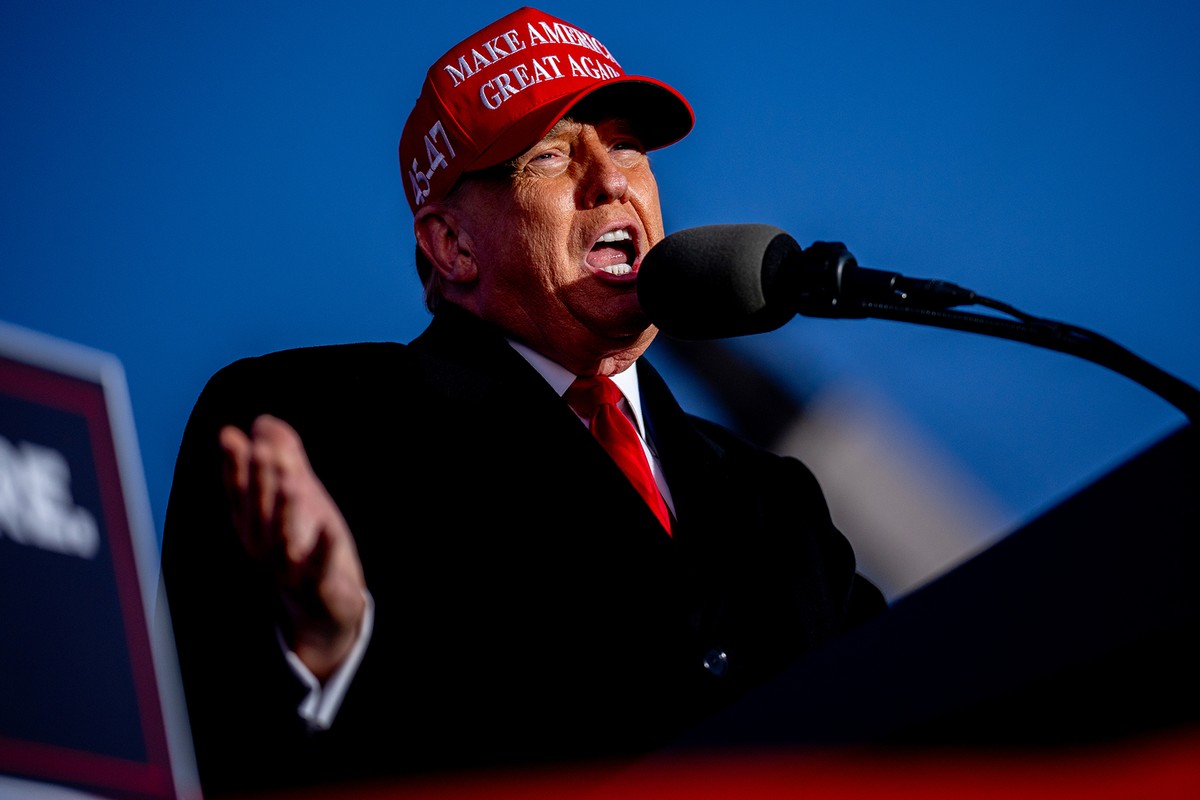

If he wins a second term in November, Donald Trump wants to covertly deploy American assassination squads into Mexico soon after he’s sworn into office again, according to three people who’ve discussed the matter with the former U.S. president.
Both during and after his presidency, the presumptive 2024 Republican nominee has floated different ideas for bombing or invading Mexico in response to the American fentanyl crisis and to “wage WAR” on notorious drug cartels. As president, Trump even thought it was possible to bomb the cartels’ drug labs, and then potentially pin the strikes on another country, according to his former defense secretary, Mark Esper.
What was once a fringe notion that senior Trump administration officials quickly moved to shut down has now become a mainstream GOP policy proposal, including among influential Republican lawmakers on Capitol Hill and conservative think tanks.
Trump is currently campaigning for the White House on a public vow to, in his words, “make appropriate use of Special Forces, cyber warfare, and other overt and covert actions to inflict maximum damage on cartel leadership, infrastructure, and operations.”
The former president has not presented specific details in public about these plans — for example, how many U.S. troops he’d be willing to send into sovereign Mexican territory. But, the three sources tell Rolling Stone, in conversations with close MAGA allies, including at least one Republican lawmaker, Trump has privately endorsed the idea of covertly deploying — with or without the Mexican government’s consent — special-ops units that would be tasked with, among other missions, assassinating the leaders and top enforcers of Mexico’s powerful and most notorious drug cartels.
In some of these discussions, Trump has insisted that the U.S. military has “tougher killers than they do” and pondered why these assassination missions haven’t been done before, arguing that eliminating the heads of cartels would go a long way toward hobbling their operations and striking fear into the hearts of “the kingpins.” (In fact, versions of this strategy have indeed been tried before in the long-running international war on drugs, including in Mexico, where the nation’s government, with U.S. support, devoted substantial resources to wiping out as many cartel bosses as possible. It has not worked.)
During some of these conversations, Trump has likened these proposals to the 2019 military raid that he ordered that resulted in the death of ISIS leader Abu Bakr al-Baghdadi, insisting that the U.S. should approach drug cartel leadership in the same manner. One of the sources, who discussed the issue with Trump earlier this year, recalls the ex-president saying that the U.S. government should have a “kill list of drug lords,” as this source describes Trump’s ideas, of the most powerful and infamous cartel figures that American Special Forces would be assigned to kill or capture in a potential second Trump administration.
Trump’s spokesperson did not respond to requests for comment on this story.
As Rolling Stone reported last year, Trump directed his policy advisers to supply him with a menu of military options for attacking Mexican drug cartels, if he reconquers the White House. This included scenarios for potential airstrikes, drone attacks, U.S. troop deployments, and other forms of warfare for taking on the major drug cartels’ leaders, who Trump has long derided as some “bad hombres.”
Just a few short years ago, the concept of a Trump or any modern administration invading or bombing Mexico — including without the cooperation of Mexico’s president — would have been widely viewed as a fanciful scheme or a mere outburst, even coming from a figure as extreme as the 45th commander in chief. However, in recent years, the policy prescriptions have gone far beyond Trump’s venting of frustrations, and entered the Republican Party mainstream.
MAGA-aligned think tanks, such as the Center for Renewing America and the America First Policy Institute, have released policy papers that forcefully endorse wielding significant military force against these criminal organizations. One of these policy blueprints — from CRA and bylined by former Trump official Ken Cuccinelli — was privately briefed to Trump in 2023, and is bluntly titled: “It’s Time to Wage War on Transnational Drug Cartels.”
Florida Gov. Ron DeSantis, formerly Trump’s top rival in the 2024 GOP presidential primary, pledged that if he were elected president, he would order Special Forces to enter Mexico “on Day One.” A growing list of influential GOP lawmakers has announced legislation or publicly blessed a new blitz of military action in Mexico. Last year, Sens. Lindsey Graham (R-S.C.) and John Kennedy (R-La.) announced legislation that would “give the military the authority to go after these organizations wherever they exist,” causing Mexico’s leader Andrés Manuel López Obrador to denounce it as “an offense to the people of Mexico.”
At the time, Graham told Rolling Stone while he “would like to work with Mexico,” the senator was putting a congressional authorization for use of military force “on the table as a potential” option, should the Mexican leadership not submit to an invasion of its own soil. The AUMF that Congress passed in 2001 in the aftermath of the 9/11 terror attacks has undergirded the decadeslong War on Terror, which has led to an international death toll estimated in the millions.
This massive policy drive among the Trumpist and Republican Party elite runs in diametric opposition to their (frequently hollow) rhetoric about supposedly “ending the era of endless wars.”
Military experts, foreign leaders, and even Trump’s famously hawkish former national security adviser John Bolton have warned against the slate of invade-Mexico proposals. Some argue launching a U.S. offensive or invasion will, simply put, not solve the problem. Others also point out that Mexico is a U.S. partner, not an adversary, and that taking such unilateral action would shred diplomatic relations and likely cause immense chaos and further eruptions of cartel violence.
“Treating this as a military problem is just analytically, and from a policy perspective, completely incorrect — leaving aside the legal and constitutional questions about if a president can even do this,” says Matt Duss, a former foreign policy adviser to Sen. Bernie Sanders (I-Vt.) who is currently with the Center for International Policy. “But as I’ve long said, Trump is a consequence of the status quo, not a deviation from it … What Trump wants to do here would just be him using the tools created by the War on Terror — hugely expansive and permissive tools of warfare developed after 9/11 — but to a greater degree, and pointing it in a different direction.”
Duss adds, “Obviously Mexico is our southern neighbor, but if you look at some of the authorities that President Biden has asserted in Syria and elsewhere, those authorities are already very broad. And as bad as Trump invading Mexico would be, Trump could just claim he is acting in a continuum of executive authority. It’s more aggressive, more expansive, but not completely outside the boundaries of how administrations have tended to use these tools … The entire constitutional order of war-making has been completely upended over the decades since 9/11. Trump or any other president can basically start wars wherever and whenever they want.”
However, none of the cross-partisan objections seem to be blunting Trump and other conservative politicians’ desire for attacking the neighboring country or mass-assassinating cartel honchos. In February, for instance, Sen. Tom Cotton (R-Ark.) and Rep. Morgan Luttrell (R-Texas) introduced companion bills that attempted to pressure the Biden administration to devise plans “to capture or kill the leaders of the Jalisco New Generation Cartel, the most brutal and dangerous cartel operating in Mexico.”
According to Luttrell, the legislation “makes clear that the Jalisco cartel cannot remain emboldened at our border and that the United States military must be ready to engage and eliminate the Jalisco cartel, should it be determined the best course of action is to use the Armed Forces of our great country.”
If Trump returns to power, those two lawmakers will have a much more receptive ear in the Oval Office than they have now with President Joe Biden. And recently, Trump has held an advantage in much of the battleground-state and national polling. Most surveys point to a tight race between Biden and Trump.








War Is Peace: Trump’s Regime-Change Reversal
As American and Israeli rockets fly into Tehran, with the stated goal of regime change, anyone who bought into the self-evidently absurd idea of “Donald the Dove” ending America’s forever wars ought to be suffering from a bloody form of buyer’s remorse.
It was always bullshit. But that’s what the Trump team was selling hard. Take human ghoul Stephen Miller’s tweet days before the election: “Kamala = WWIII. Trump = Peace.”
The Trump team reads George Orwell’s 1984 like an owner’s manual and so of course “war is peace.” Their undermining of NATO and the dismantling of American alliances in favor of a “might makes right” foreign policy executed by a sycophantic kakistocracy is a guarantee of more war amid autocratic power grabs worldwide, with a side order of corrupt crony capitalism to profit from the chaos.
If you voted for Trump and believed him, this is on you. And that includes self-styled Palestinian peace activists who thought that Biden and Harris were the worst of all possible worlds and stayed home. We will no doubt see protests for the innocent lives lost in these strikes — but I’d have a lot more time for those folks if they were also seen protesting the estimated 20,000 to 30,000 Iranian lives snuffed out by murderous mullahs in the last few months alone.
The Islamic Republic of Iran has been despotic and dangerous from its inception. The Iranian people have been oppressed and denied basic freedoms for decades. But this is an extreme example of a war of choice. The American military strikes against Iran’s nuclear weapons facility last year were justified because Iran cannot be trusted with a nuclear weapon. That is true. But the much trumpeted total obliteration of those facilities is apparently not true — or so goes the justification for this war. And don’t forget that it was Trump who pulled the U.S. out of an Obama-era deal to stop Iran from developing weapons — arguing absurdly that the imperfect anti-nuke deal needed to be blown up to stop Iran from developing a bomb. Iran’s subsequent progress toward a bomb then created the rationale toward these strikes. This is a self-inflicted state of emergency. Peace is war and war is peace.
Pity the willful dupes in Congress who deluded themselves into thinking that Trump deserved the Nobel Peace Prize. They’ll probably rationalize that he would’ve been peaceful if he got the honor. Now it will be read as a cautionary tale for not sucking up. The chairman of the Board of Peace is now bored of peace. While Rand Paul remains admirably consistent, it’s Lindsey Graham who is pirouetting around the Senate floor while the Gimp Speaker Mike Johnson is unable to speak for the basic constitutional principles of separation of powers let alone authorization to go to war.
If you’re feeling shell-shocked trying to keep up with Operation Epstein Distraction, get ready for the inevitable next crisis — regime change without a plan for replacement. This is what the Trump administration did in Venezuela — kidnapping the socialist dictator Maduro but keeping his regime in place in exchange for crude oil access. The opposition is still in exile and its leader María Corina Machado gave her Nobel Peace Prize to Trump in exchange for exactly nothing.
One of the clear lessons of history is that if you don’t win the peace, you don’t win the war. The Saudis and their Sunni allies will back the U.S. and Iran because they hate the Shia Iranians (who, incidentally, are not Arabs), but beyond removing the Iranian regime, the plans for replacement and stabilization seem TBD — and with Trump’s inability to stay focused on anything beyond his immediate self-interest, solid plans are unlikely to emerge. Maybe a leader will come from the underground opposition; maybe it will be the Shah’s son, who has been living in the U.S. waiting for a restoration like many members of the diaspora. The upside is that Iran has a distinguished history and an accomplished Persian culture: The Islamists don’t represent the entirety of the people of Iran and never have.
But the path ahead will be messy at best. It will require concerted effort and civil commitment, not just an open call for private investment from Mar-a-Lago members. If the United States is now kidnapping and killing dictators without direct provocation, it establishes a dangerous precedent which will come back to bite us after demolishing our moral authority in the world.
It is the unexpected effects, the cascades of consequence where we cannot always plan ahead, that cause most responsible statesmen to try to keep the peace. But Trump has the carelessness of a rich-boy bully who can always buy or bluster his way out of trouble. He’s a con man who has found his ultimate mark in his followers, who fool themselves into thinking that a reflexive liar is the one man with the courage to tell the truth.
Perhaps the most prominent example is the vice president himself — a bright guy who not that long ago compared Trump to Hitler and a deadly narcotic but then convinced himself that careerism demanded an abrupt conversion. After all, he endorsed Trump less than two years ago with this very serious column headlined “Trump’s Best Foreign Policy? Not Starting Any Wars,” explaining, “He has my support in 2024 because I know he won’t recklessly send Americans to fight overseas.”