
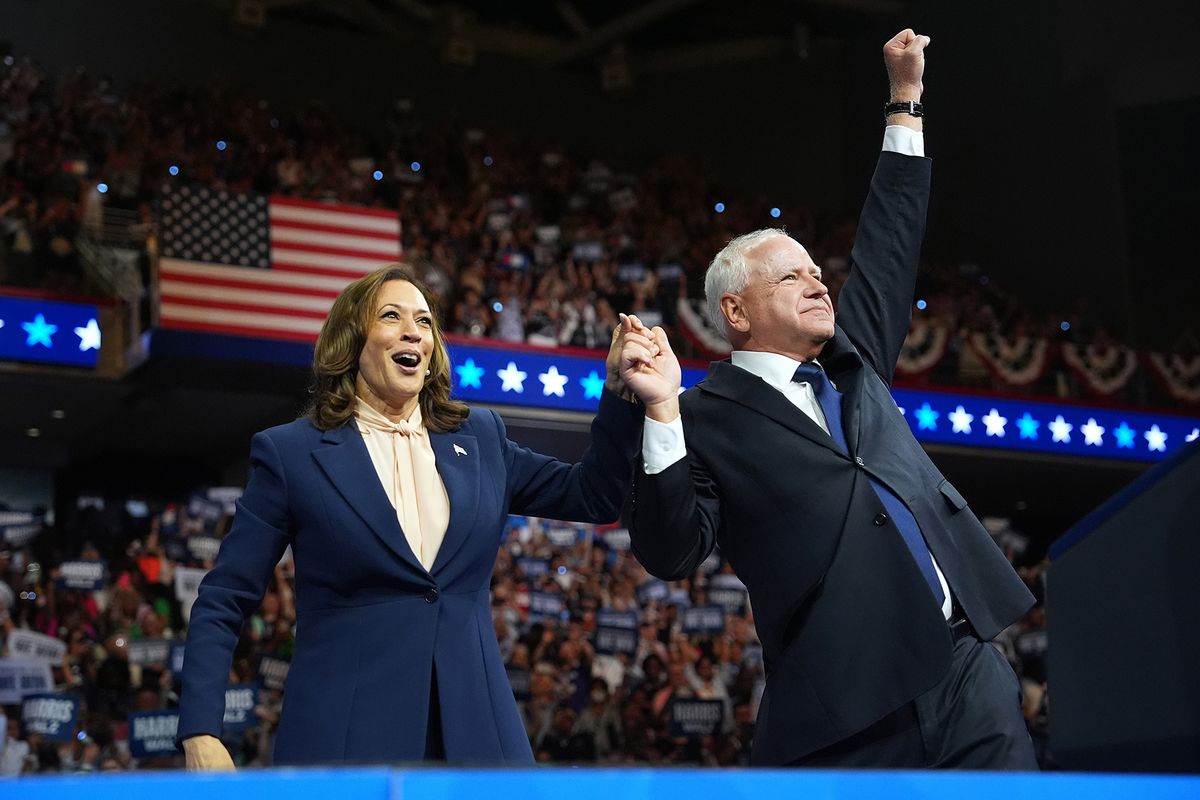

PHILADELPHIA — Democrats packed a Philadelphia basketball arena to the gills on Tuesday, with more than 10,000 raucous supporters cheering on Kamala Harris and her newly named running mate, Tim Walz. In his first speech since becoming the presumptive vice presidential candidate, Walz roasted Donald Trump and J.D. Vance, as he declared that the next 91 days would not just be about winning the election, but doing it “with a sense of joy.”
The mood inside Temple University’s basketball arena was certainly joyful — ebullient even, bordering on orgiastic. Crowded together under enormous “Harris and Walz” signs and sporting light-up wristbands like the kind Taylor Swift gives out at the Eras Tour, Philadelphians helped Harris and Walz kick off a tour of their own: a five-day blitz through seven battleground states, starting with the most important one on the map for Democrats this November — Pennsylvania.
The pair walked out onstage together early Tuesday evening, just hours after a fleet of black SUVs converged on the Minnesota governor’s St. Paul residence early Tuesday morning and plunged him directly into the center of the 2024 election vortex, and one day after Harris clinched the top spot on the Democratic ticket. Addressing the throngs of screaming supporters, Harris introduced the world to Walz: a teacher, National Guard member, congressman, governor, and coach who helped take a high school football team from a winless season to state championship.
When it was Walz’s turn to speak, he told the crowd that it was his students who inspired him to get into politics. “They encouraged me to run for office. They saw in me what I was hoping to instill in them: a commitment of common good, a belief that one person can make a difference,” Walz said. “And because high school teachers are super optimistic, I was running in a district that had one Democrat since 1892.”
Walz went on to draw a contrast between the work he did when he arrived in Congress — on the Veterans Affairs committee and on behalf of rural communities — with Trump’s priorities as president, and the Republican Party at large.
“Some of us are old enough to remember … when the Republicans were the party of freedom,” Walz said. “It turns out now what they meant was the government should be free to invade your doctor’s office. In Minnesota, we respect our neighbors and their personal choices that they make — even if we wouldn’t make the same choice for ourselves. There’s a golden rule: Mind your own damn business.”
He also, as he has done in the weeks leading up Harris tapping him as her running mate on Tuesday, went after Trump and Vance. “These guys are creepy and, yes, just weird as hell,” he said to huge applause. “That’s what you see. That’s what you see.”
Walz even joked about an unfounded rumor that Vance had sex with a couch. “I can’t wait to the debate the guy,” he said before waiting several seconds for the applause to subside. “That is if he’s willing to get off the couch and show up.”
If the crowd’s reaction was any indication, they approved of Harris’ choice in a running mate. The vice president had a historically truncated window to consider a decision after she emerged as the party’s choice to take on Trump when President Joe Biden decided to leave the race last month. She chose Walz over Pennsylvania Gov. Josh Shapiro, who was also on hand on Tuesday. Shapiro took the stage to thunderous applause, taking several beats to soak it up before telling the crowd, as if to preempt any accusations of hard feelings, “I love you Philadelphia — and you know what else I love? I love being your governor.”
Harris’ choice has been widely praised online, and certainly in Philadelphia on Tuesday, but even as Walz has received a warm welcome, some attendees at the rally admitted they weren’t well acquainted with Walz before his name began circulating in the veepstakes. Tameka Bates, a SEIU union member, was thrilled to see Harris. But as for Walz? “I don’t know much about him; I’ve just heard about him this morning,” she said.
Jan Ostroff said she had only learned of Walz in the past few weeks as his profile rose as he appeared on TV auditioning for the role of amiable attack dog. “I would have been happy with any of her choices for vice president, but I’m really happy with him, because this way we get to keep Josh Shapiro for ourselves for a little while longer,” Ostroff said.
The near-universal praise of Walz — from figures as far apart ideologically as Alexandria Ocasio-Cortez and Joe Manchin — stood in stark contrast to the Republican party’s reception of Vance just a few weeks before. Vance, who had a favorability of -5 percent when Trump asked him to join the ticket has only seen his standing tank to -14 percent as more Americans have gotten to know him, earning him the distinction of being the least-liked vice presidential pick in history. (It’s hardly surprising considering Vance’s three biggest media moments have revolved around that couch rumor, the ongoing damage control efforts around his 2021 attack on “childless cat ladies,” and a charming anecdote in which he told his son to “shut the hell up” while he was on the phone with Trump.)
Ahead of the lovefest at Temple University, Vance held his own appearance in Philadelphia, attended by a comparatively small smattering of supporters. The Trump campaign made the questionable decision of sending Vance on the road to hold an event in every city that Harris and Walz are set to appear in this week. The split screen in Philadelphia was stark: Vance struggled to fill a room with a one-tenth of the capacity of the arena in which the Democratic ticket appeared. He spoke in front of a banner that read “Kamala Chaos,” but it was hung too low, so seated event attendees blocked out “Chaos,” and at first glance it looked like Vance was at a Harris event.
Trump, meanwhile, is spending the week at Mar-a-Lago, where on Tuesday he met with a seat-sniffing Kick streamer, who may have violated FEC rules by gifting Trump both a Rolex and Cybertruck emblazoned with his image. He has just one appearance planned this week, in Montana.






War Is Peace: Trump’s Regime-Change Reversal
As American and Israeli rockets fly into Tehran, with the stated goal of regime change, anyone who bought into the self-evidently absurd idea of “Donald the Dove” ending America’s forever wars ought to be suffering from a bloody form of buyer’s remorse.
It was always bullshit. But that’s what the Trump team was selling hard. Take human ghoul Stephen Miller’s tweet days before the election: “Kamala = WWIII. Trump = Peace.”
The Trump team reads George Orwell’s 1984 like an owner’s manual and so of course “war is peace.” Their undermining of NATO and the dismantling of American alliances in favor of a “might makes right” foreign policy executed by a sycophantic kakistocracy is a guarantee of more war amid autocratic power grabs worldwide, with a side order of corrupt crony capitalism to profit from the chaos.
If you voted for Trump and believed him, this is on you. And that includes self-styled Palestinian peace activists who thought that Biden and Harris were the worst of all possible worlds and stayed home. We will no doubt see protests for the innocent lives lost in these strikes — but I’d have a lot more time for those folks if they were also seen protesting the estimated 20,000 to 30,000 Iranian lives snuffed out by murderous mullahs in the last few months alone.
The Islamic Republic of Iran has been despotic and dangerous from its inception. The Iranian people have been oppressed and denied basic freedoms for decades. But this is an extreme example of a war of choice. The American military strikes against Iran’s nuclear weapons facility last year were justified because Iran cannot be trusted with a nuclear weapon. That is true. But the much trumpeted total obliteration of those facilities is apparently not true — or so goes the justification for this war. And don’t forget that it was Trump who pulled the U.S. out of an Obama-era deal to stop Iran from developing weapons — arguing absurdly that the imperfect anti-nuke deal needed to be blown up to stop Iran from developing a bomb. Iran’s subsequent progress toward a bomb then created the rationale toward these strikes. This is a self-inflicted state of emergency. Peace is war and war is peace.
Pity the willful dupes in Congress who deluded themselves into thinking that Trump deserved the Nobel Peace Prize. They’ll probably rationalize that he would’ve been peaceful if he got the honor. Now it will be read as a cautionary tale for not sucking up. The chairman of the Board of Peace is now bored of peace. While Rand Paul remains admirably consistent, it’s Lindsey Graham who is pirouetting around the Senate floor while the Gimp Speaker Mike Johnson is unable to speak for the basic constitutional principles of separation of powers let alone authorization to go to war.
If you’re feeling shell-shocked trying to keep up with Operation Epstein Distraction, get ready for the inevitable next crisis — regime change without a plan for replacement. This is what the Trump administration did in Venezuela — kidnapping the socialist dictator Maduro but keeping his regime in place in exchange for crude oil access. The opposition is still in exile and its leader María Corina Machado gave her Nobel Peace Prize to Trump in exchange for exactly nothing.
One of the clear lessons of history is that if you don’t win the peace, you don’t win the war. The Saudis and their Sunni allies will back the U.S. and Iran because they hate the Shia Iranians (who, incidentally, are not Arabs), but beyond removing the Iranian regime, the plans for replacement and stabilization seem TBD — and with Trump’s inability to stay focused on anything beyond his immediate self-interest, solid plans are unlikely to emerge. Maybe a leader will come from the underground opposition; maybe it will be the Shah’s son, who has been living in the U.S. waiting for a restoration like many members of the diaspora. The upside is that Iran has a distinguished history and an accomplished Persian culture: The Islamists don’t represent the entirety of the people of Iran and never have.
But the path ahead will be messy at best. It will require concerted effort and civil commitment, not just an open call for private investment from Mar-a-Lago members. If the United States is now kidnapping and killing dictators without direct provocation, it establishes a dangerous precedent which will come back to bite us after demolishing our moral authority in the world.
It is the unexpected effects, the cascades of consequence where we cannot always plan ahead, that cause most responsible statesmen to try to keep the peace. But Trump has the carelessness of a rich-boy bully who can always buy or bluster his way out of trouble. He’s a con man who has found his ultimate mark in his followers, who fool themselves into thinking that a reflexive liar is the one man with the courage to tell the truth.
Perhaps the most prominent example is the vice president himself — a bright guy who not that long ago compared Trump to Hitler and a deadly narcotic but then convinced himself that careerism demanded an abrupt conversion. After all, he endorsed Trump less than two years ago with this very serious column headlined “Trump’s Best Foreign Policy? Not Starting Any Wars,” explaining, “He has my support in 2024 because I know he won’t recklessly send Americans to fight overseas.”