
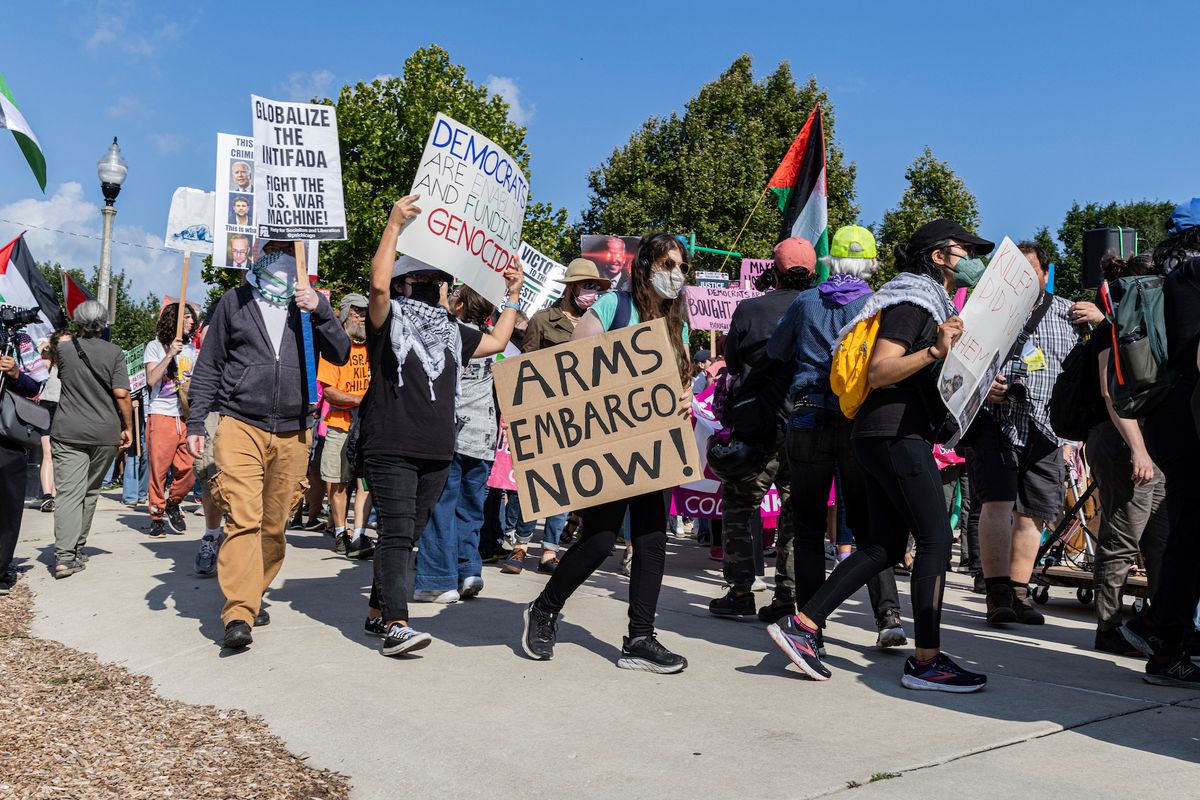
CHICAGO — In one of the most moving moments of the Democratic National Convention, on Wednesday night, the parents of Hersh Goldberg-Polin, a 23-year-old American who was kidnapped by Hamas on October 7, took the stage at the United Center and spoke of the anguish they’ve experienced over the 320 days since their son was taken hostage.
They called for the release of the other hostages, including 8 American citizens, and for a cease-fire deal that “ends the suffering of the innocent civilians in Gaza.”
But the DNC’s invitation to the family created an uncomfortable contrast with the party’s refusal to provide space on the main stage for a Palestinian-American or doctors who have worked in Gaza. On Wednesday night, following that speech, the DNC informed the leaders of the Uncommitted Movement that they would not be given the opportunity to put a Palestinian speaker on the main stage of the convention, to discuss the Israeli military has inflicted in Gaza, with the backing of the United States.
The Uncommitted Movement — representing the over 700,000 pro-Palestine voters who cast “uncommitted” votes during the Democratic presidential primary — had requested speaking time at the convention and a meeting with Vice President Kamala Harris’ campaign.
The DNC gave the movement space to speak at several untelevised forums. On Monday, a doctor shared harrowing stories from Gaza, where the Israeli military has led an unprecedented siege for 10 months, starting after Hamas’ October 7 attacks. The party refused to meet the Uncommitted Movement’s larger requests.
“I was working on it every day for the past week or more,” said James Zogby, who has held leadership positions in the Democratic Party for decades. “The campaign made a mistake — an unforced error. This didn’t have to happen the way it did and now needs to be fixed.”
The decision by the Harris campaign and the DNC threatens to torch the goodwill the campaign has enjoyed since Harris ascended to the top of the ticket. No significant protests have broken out inside the arena yet this week, and demonstrations outside have been smaller than expected. But already on Wednesday night that was starting to change. As delegates and convention attendees filtered out of the United Center, protesters with signs and bullhorns were reading the names of children killed in Gaza and encouraging passersby to turn back and join a 24-hour sit-in the leaders of the Uncommitted delegates had begun earlier that evening outside the arena.
“We are waiting for a phone call from Vice President Harris and the DNC to allow a single Palestinian-American speaker from the convention stage,” those delegates — Abbas Alawieh, June Rose, Sabrene Odeh — said in a statement. “Our party’s platform states that every life is valuable: whether American, Palestinian, or Israeli. We will conduct a moral act of sitting in at the convention to push our party to better align our actions, instead of just our words, with the notion that every life is valuable by simply allowing a Palestinian American to speak from the stage.”
Progressive Rep. Ilhan Omar (D-Minn.), one of two Muslim women serving in Congress, joined the Uncommitted sit-in Wednesday evening.
One Democratic lawmaker on Capitol Hill who’s been in Chicago this week tells Rolling Stone bluntly: “If we lose Michigan by a hair… it will be hard not to conclude that a reason why is because we did not treat these people with respect they deserve and instead just wished they’d go away and stop complaining.”
Two representatives for the DNC did not respond to requests for comment. A spokesperson for the Harris campaign declined to comment about the decision.
Rep. Ro Khanna (D-Calif.) said late Wednesday, “The Palestinian right to self determination was erased by the British with the Balfour declaration in 1917 which only mentioned civil and religious rights but not political rights for the Palestinian people. The Democratic Party, which aspires to be the party of human rights, must not in 2024 perpetuate this erasure of the Palestinian story.”
Rep. Alexandria Ocasio-Cortez (D-N.Y.), who declared onstage at the United Center on Monday that Harris is “working tirelessly to secure a cease-fire in Gaza,” responded to the DNC’s decision to exclude Palestinian voices on Wednesday.
“Just as we must honor the humanity of hostages, so too must we center the humanity of the 40,000 Palestinians killed under Israeli bombardment,” she wrote on X. “To deny that story is to participate in the dehumanization of Palestinians. The @DNC must change course and affirm our shared humanity.”



 The first day of the 2026 Republican National Convention at the American Airlines Center, on Sept. 9, 2026 in Dallas, Texas.
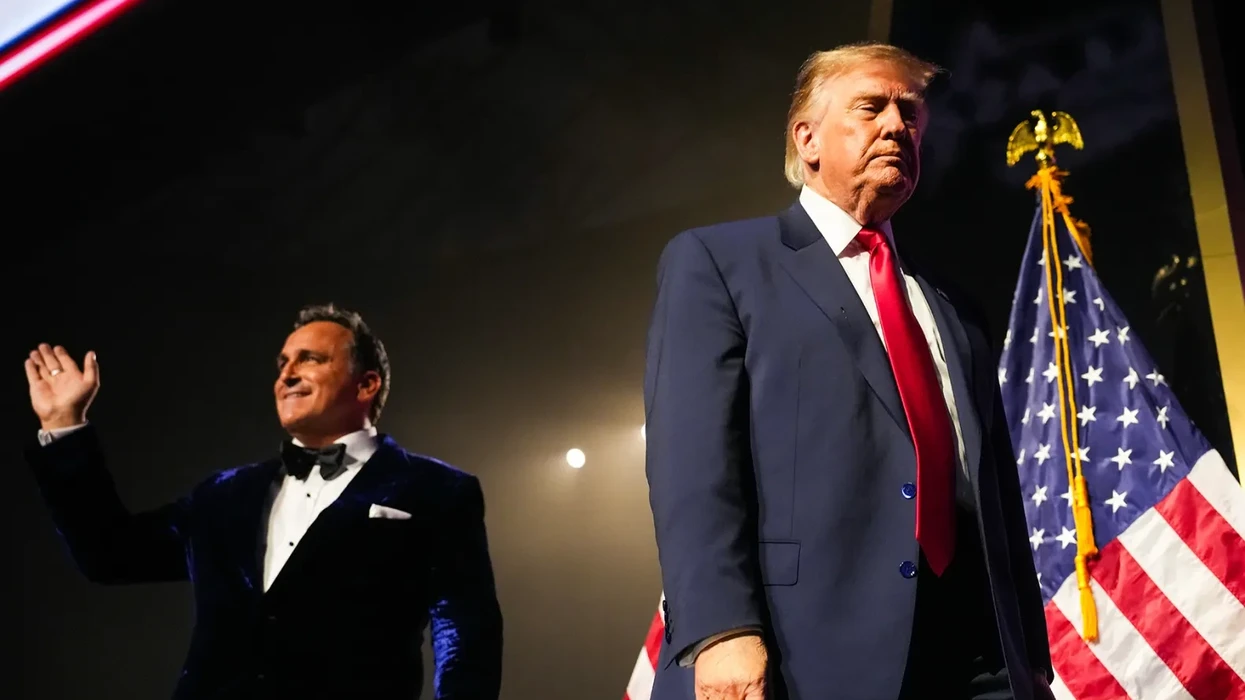
 People of all colors listen as Donald Trump speaks on the first day of the Republican midterm convention.
 Trump supporters at the Republican midterm convention.
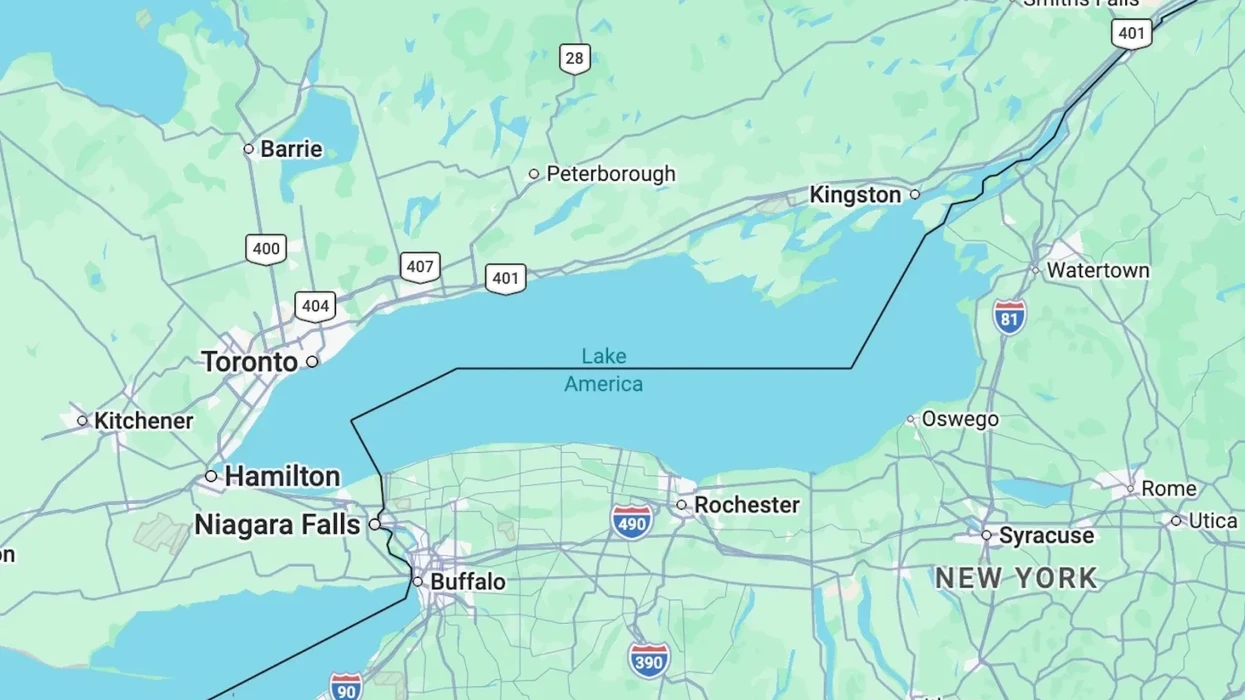
 Apple Maps, August 30, 2026
It’s Been 25 Years Since 9/11. Did the Terrorists Win?
I once had a conversation with Barack Obama about the nature of terrorism. This was during his second term, and he’d been going on for a few minutes about how Islamic terrorism wasn’t actually an existential threat to Americans, but rather a chronic and manageable risk. I was all too familiar with this argument, having conducted the interview with John Kerry in 2004, in which he said terrorism could be reduced to the level of a “nuisance” — a quote that blew up on him during the final weeks of the campaign. I found Kerry’s answer problematic then, and I had the same reaction when Obama said it. I asked him pointedly: What would have to happen for him to decide that terrorism was, in fact, existential? How about a suitcase nuke on a subway car? Then would he concede that terrorists were more than criminal gangs?
Obama didn’t hesitate. Terrorism would only reach the level of an existential threat, he told me, if Americans responded by abandoning their own values and turning on one another. There was nothing a bunch of homicidal zealots could do to destroy the most powerful country on Earth, but we could certainly destroy ourselves if we abandoned our constitutional protections in a fit of panic.
At the time, this struck me as something you might expect to hear from a constitutional-law professor, but not necessarily from the president of the United States. There was an intellectual fatalism about Obama I sometimes found disconcerting — a sense that he saw himself as a twig in the river of history, and it was up to the rest of us to change the current. I doubt he would dispute that assessment. But I thought often of that conversation a few years later, as the country careened into the Trump era. And as we pause now to reflect on the 25 years that have passed since the attacks of Sept. 11, I find myself thinking about it again.
Alternative histories are a tricky business, best left to novelists and sci-fi filmmakers. As a friend of mine in politics likes to say, mockingly, whenever such theories get floated: What if Hitler had won the Civil War? And yet, it’s hard not to see a direct line between the events of 2001 and where we are today — and to wonder how different the country might have looked had it never happened. On the eve of the devastating attacks on the World Trade Center and the Pentagon, George W. Bush’s young presidency seemed to be wobbling. Absent those attacks, he might well have been a one-term president, and he almost certainly would not have invaded Iraq. Nor would Democrats become backed into defending the entrenched war in Afghanistan as the “good war” — a way of differentiating their own response to 9/11 from Bush’s without sounding reflexively pacifist.
Without the economic shock of 2001, it’s unlikely that desperate policymakers would have looked the other way while lenders, underwritten by the government, turned the housing market into a casino, leading to the second massive blow of the decade: the market collapse of 2008. All of these things, in quick succession, destroyed what remained of the public’s faith in its governing establishment, leading directly to Obama’s stunning takeover of the Democratic Party and, later, to the election of Donald Trump.
The Trump I met in the late 1990s, while he was flirting with an independent run for president, held himself out as a centrist reformer, in the mold of Ross Perot. By 2015, when he started running as a Republican, Trump had fully embraced a reactionary, white-nationalist movement — a response to Obama, yes, but also to Bush, whose instinct in the months after 9/11 had been to speak out forcefully in defense of Muslim Americans, and whose support for liberalized immigration infuriated much of his party’s base. Trump’s core appeal then, as it is now, was rooted firmly in the nativist, anti-globalist backlash that emerged in 2001. (According to Pew Research, roughly 42 percent of Americans believe Muslims are having a negative impact on the country.) The animating idea of Trump’s second term is that white, English-speaking Americans are the only authentic Americans. It shouldn’t be controversial to say that he will twist or shred any page of the Constitution to enact this vision, since he really makes no effort to conceal it.
Nor is America’s hard turn away from pluralism and liberal democracy happening in a vacuum — far from it. In the past decade, similarly reactionary, anti-immigrant movements have rocked Britain and taken over Italy, and they now seem poised to wrest power in France and Germany. Maybe some of this would have happened without 9/11; the hollowing-out forces of globalization and automation were already fueling plenty of economic fury here and in Europe by the turn of the century, and the revolution in social media wasn’t far off. But there’s little doubt that the “War on Terror,” which became the first real foreign policy framework since the end of the Cold War, focused all of that anxiety toward an identifiable enemy, fracturing societies that had been held together by a 50-year consensus around personal liberties. If Obama were being honest, he’d probably say he told me so, and he’d be right.
IN THE MONTHS after 9/11 and before the invasion of Iraq, it was hard to get much perspective, and genuine patriotism mixed — as it always does — with a series of mindless gestures and clichés. Flag pins became mandatory even for reporters, peace songs were effectively banned, Republicans brought “freedom fries” and “freedom toast” into the lexicon to protest French misgivings about war. It became rote for politicians to say that the terrorists hated our way of life and we would never let them win. (To this day, when my dog snarls at some terrified Shiba Inu for no reason, I ask her why she hates freedom.)
Twenty-five years on, though, with the benefit of distance and experience, we can ask some questions we couldn’t ask then. And one of them is what the violent extremists who sent those suicide planes into our buildings really hoped to achieve. Did Osama bin Laden think he could win a holy war with America? Did we ultimately frustrate his script for the downfall of the West, or did we simply play our part?
Terrorism is, by its nature, asymmetrical. Whether it’s the Viet Minh under the French, or the IRA in Britain, or Al Qaeda, there’s an inherent understanding that the terrorist can’t win a conventional war against an obviously superior military force. What the terrorist seeks is destabilization of the status quo. His desperate act is an igniter in search of fuses; the goal is to set off a chain reaction inside the fortress that can’t be controlled, to disrupt order with chaos and see what shakes out. The terrorist knows this will likely cause his own people suffering in the short run, but that’s part of the point. He believes the occupier to be a soulless monster, and by reducing it to its basest instincts, he hopes to bare its nature to the world.
We’re seeing this play out, in real time, in Israel. The leaders of Hamas, their military options exhausted and their political goals slipping away, could not have been under any illusion that they would drive out the Israeli occupiers by savagely killing and mutilating more than a thousand innocent people. They must have hoped that Israel would react with blind fury and cruelty, resorting to the instinct for all-out annihilation that its leaders had long managed to suppress. Nearly three years later, Israel has tumbled from legitimatized power to international pariah, its politics riven by disunity, its moral authority in shambles. Do we think Hamas really cares that more than 70,000 of its own people have died in the carnage? Its repugnant leaders almost certainly consider that a cost worth paying in the broader context of history. What they have achieved, in political terms, has exceeded their most feverish dreams.
The Israelis should have looked across the Atlantic and learned something from our own experience. America on Sept. 10, 2001, was an unchallenged superpower at peace — vexed by social and economic divisions, yes, but still stable enough to survive a disputed election with its political consensus intact. A quarter century later, we find ourselves fighting a third unsuccessful war in the Middle East, our society more divided and our politics more poisoned than any time since the 1800s, a foundation of laws imperiled after 250 years of durability, immigrants hunted down like animals by masked agents, violence and extremism on the rise from both right and left, truth and intellectualism in retreat. This is not solely the fallout from Sept. 11, 2001, but it is the result of a series of events that, were you able to hit a rewind button and live it all again in reverse, would lead you directly back to that day. If bin Laden meant for his attack to be the first in a series of similarly epic crimes, then he was soundly defeated — no small achievement for American soldiers and spies. But if his goal was to destabilize America and bring out the worst of our nature, then he may have pulled off the most successful terrorist attack in history.
Over and over we told ourselves, in that agonizing moment, that the terrorists would never win. A quarter century later, it’s getting hard to argue they didn’t.