
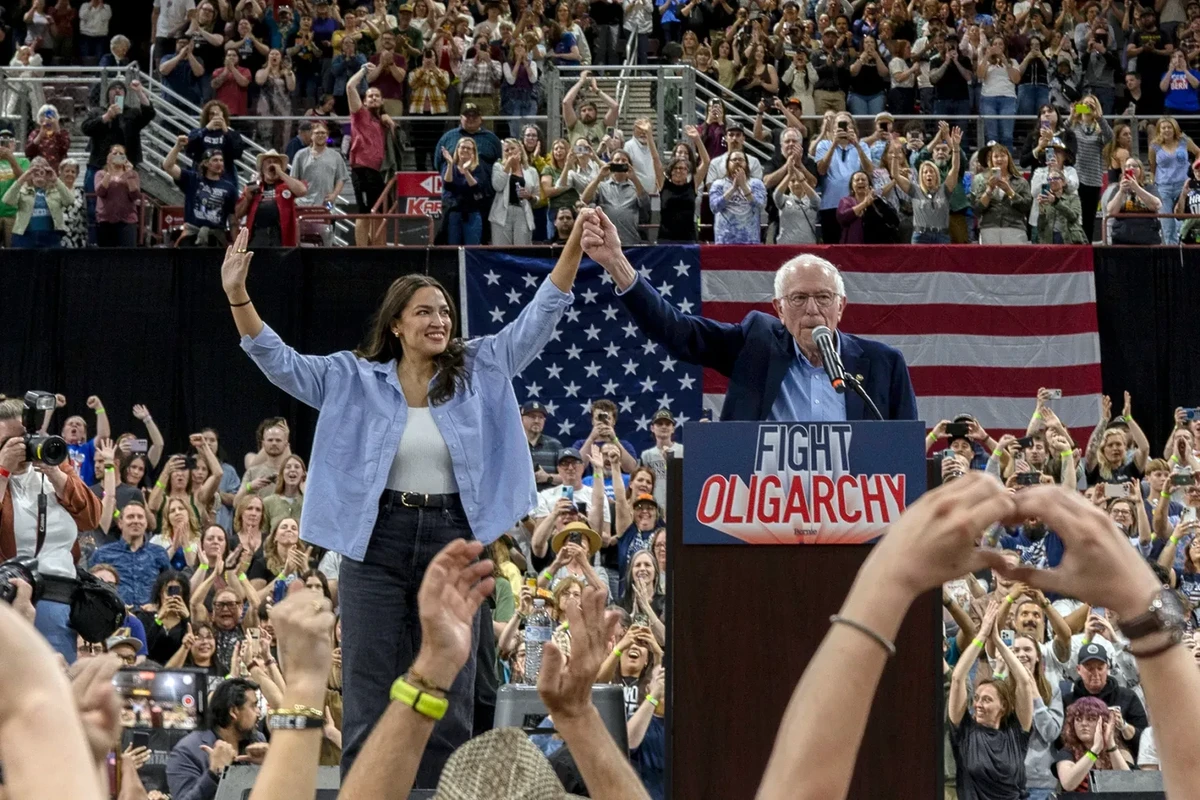

Senator Bernie Sanders and Representative Alexandria Ocasio-Cortez are announcing their support for two new AI bills aimed at putting a federal moratorium on the constructions of data centers. Sanders is introducing his bill, the AI Data Center Moratorium Act, on Wednesday.
“AI and robotics are creating the most sweeping technological revolution in the history of humanity. Congress is way behind where it should be in understanding the nature of this revolution and its impacts,” Sanders says in a statement to Rolling Stone. “We cannot sit back and allow a handful of billionaire Big Tech oligarchs to make decisions that will reshape our economy, our democracy and the future of humanity. We need serious public debate and democratic oversight over this enormously consequential issue.”
The legislation aims to slow down the development of AI, and to give Congress a chance to catch up with proper regulation. Sanders is calling for an immediate federal moratorium on AI data centers until national safeguards are in place to ensure that AI is safe and effective and won’t harm “health, privacy, civil rights and the future of humanity.” The bill also calls for regulation to ensure that the economic gains of AI will benefit workers “not just the wealthy owners of Big Tech,” as well as laws to protect the environment and prevent increased electricity prices for communities.
On Tuesday night, Sanders spoke on the Senate floor for half an hour about AI risks, impacts, and the oligarchs running tech companies. At one point he brought up the impact AI has on the environment, and addressed how AI requires large data centers which require a massive amount of electricity and water.
“For example, Meta is building a data center in Louisiana, the size of Manhattan, that will use as much electricity as 1.6 million homes,” said Sanders. He stood in front of a sign stating that wholesale electricity costs have increased up to 267 percent in areas near data centers in the last five years. “This increased demand will drive a massive expansion of fossil fuels when we are already seeing the devastating impacts of the global crisis of climate change.”
As Rolling Stone reported in November, an Amazon data center in Oregon worsened a water pollution problem in the state that’s been linked to cancer and miscarriages. Nearly 3,000 data centers are under construction or planned across the U.S., with 4,000 already in operation.
Sanders told CNN’s State of the Union in December, “Frankly, I think you have got to slow this process down.”
“If there are no jobs and humans won’t be needed for most things, how do people get an income to feed their families, to get healthcare or to pay the rent?” said Sanders. “There’s not been one serious word of discussion in the Congress about that reality.”
Ocasio-Cortez has been vocal about the harms of AI as well, continuing to fight for passage of her DEFIANCE Act, which provides civilian recourse for survivors of deepfake AI abuse. Similar to how the data center moratorium bill is structured, DEFIANCE was introduced in both the Senate and the House as a bicameral bill. It has passed the senate but has yet to pass the house.
On Wednesday afternoon at 4 p.m., Sanders and Ocasio-Cortez are set to talk about the legislation, which Sanders will take the lead on sponsoring in the Senate. Ocasio-Cortez will follow-up Sanders’Senate bill with a similar bill in the House of Representatives.


Donald Trump takes a good look at Jon Husted's backside during a rally in Youngstown, Ohio, on Oct. 12.
The Last Tour for Our Horny, Mad King
Donald Trump wants you to know he’s not attracted to men.
“I don’t like young, handsome men,” Trump said during a speech at the Board of Peace back in February, while acknowledging Panamanian President Santiago Peña. “Women… I like. Men, I don’t have any interest.”
And yet, if you watch almost any of Donald Trump’s midterm elections rallies, it’s pretty easy to get the wrong idea.
“The two guys that came up here, the people I watched today… you wanted to give them a big kiss,” Trump said during a rally in Durant, Oklahoma, on October 1. “I’m not at all physically attracted to them, although they’re very handsome people — they’re two handsome guys.”
“I don’t do this with men very often,” Trump said about Ohio Senator Jon Husted, a former college football player, during an October 12 rally. “I started examining his body because I didn’t know he was a great athlete. And I looked — I watched up, and down, I looked at his ass, and I looked at the whole…”
“I examined his ass,” Trump added of Husted a few days later in Kentucky. “I never did that with a man before. And then I looked at his shoulders, I looked at his feet, and then I looked at his jawline — studying. I patted him on the shoulder and it was like a piece of steel.”
Are these the words of a man who doesn’t have “any interest” in men? Ultimately, it’s not for us to say. But what’s clear now is that in what may be the beginning of the end for Trump’s political reign, the king is focused on the things that matter to him most: ambition, aesthetics, and of course, asses. It’s a curious fixation for a president who should be desperate to resonate with voters who appear enormously dissatisfied with his performance in office. But squint your eyes a little and see the man for who he is. Trump’s homoerotic, horn-dog vibe is both a genuine expression of self and a strategy to drum up support from the only fans he has left — the ones who hang on to his every word and think he is the greatest entertainer on earth.
Case in point: most of the quotes above have been played as laugh lines in Trump’s stump speeches on the trail. Trump is in on the joke, but he still can’t help himself from immediately commenting on how handsome the men he interacts with.
“All these handsome guys, they’re always great looking, these four-star guys,” Trump said during a rally in Kansas on October 19, referencing a meeting with military leaders. “I don’t know if they get the job by their look?”
There are tropes Trump comes back to repeatedly. “Central casting” is one descriptor he’s been using for years to describe people — usually men — who fit into the mold of traditional masculinity and strength he seems to admire. He’s used the phrase to describe everyone from Chinese President Xi Jinping to Mike Rogers, the Republican candidate for Senate in Michigan. He values height, repeatedly remarking on how tall certain men are, often in stories in which they appear to pay him fealty. And he loves kisses: sometimes given, sometimes received, sometimes demurely declined — but always mentioned in the story.
“‘President, I’d love to kiss you,’” Trump said in a press conference on October 20, referring to an interaction with a steel factory owner on the campaign trail. “This is a very powerful man. I don’t want to be kissed by that man — but he’s a very powerful, strong man.”
It’s all ripe for armchair psychoanalysis: Trump is self-conscious about his own aging body, Trump values the superficial and material above all other things, Trump sees validation from the strong and tall and beautiful as evidence that what he is doing is good and just. What’s more important is looking at why these moments have become so common on the current campaign trail, where Trump has again and again commented on the physical attributes of the men he’s arrived in town to promote.
Trump has done well over a dozen rallies in the past month alone, bouncing around at least 15 different states in order to prop up candidates in midterm battlegrounds. Part of the issue in campaign blitzes like this is that half the time Trump seems to barely know who he’s talking about. Sometimes he explicitly references the fact that he just learned about a minor House candidate or other down-ballot official in the car on the way to the event. So what else does he have to go on? The man is an old-school businessman whose entire being runs on a potent combination of chauvinism and bravado. When you meet him, he’s going to judge you on your handshake, the cut of your suit and, it seems, the overall tightness of your ass.
Trump seems to choose the candidates less for their political acumen or policy proposals than for exhibiting a very specific Trumpian set of qualifications. The Republican primaries this election cycle were a bloodbath, in which Trump flexed his power as the GOP’s most important endorsement to kneecap several incumbents — like Kentucky Representative Thomas Massie and Texas Senator John Cornyn — who he accused of disloyalty to the MAGA movement. In their place, Trump endorsed Ed Gallrein and Ken Paxton, respectively, both candidates who openly grovelled for his endorsement and pledged to never break from his will. This pattern repeated around the country, with Trump tapping his preferred candidates based on his own notions of value: fealty to the Trump brand, for one, with a “central casting” look being icing on the cake.
“And he is central casting — stand up,” Trump told Mike Collins, the Republican challenger for Jon Ossoff’s Senate seat in Georgia, during a rally on October 16. “If I’m casting a movie for a senator, I like the white hair, I like the big strong build — that’s what I want.”
The list goes on and on. He calls Giants quarterback Jaxon Dart a “male model,” says Ted Nugent’s son is a “beautiful looking guy.” He remarks on how the White House is “allowed to have big, strong, handsome soldiers now.” By my count, now, he has told the Husted ass story at least three times on the stump, most recently saying “His ass, shit, it’s like a pile of muscle,” to a diminished crowd of supporters in North Carolina.
Some Republicans have absorbed this. Speaker of the House Mike Johnson, for instance, did a literal Trump impression when praising the physical attributes of Tano Tijerina, the Republican candidate for Texas’s 28th Congressional District, at a campaign event earlier this month.
The horniness, then, is contagious.
In some ways, you can see why — parts of it are undeniably fun. Trump’s casual objectification of everyone around him is a lot more charming when it’s directed at politicians lining up to lick his boots, rather than the many, many women he’s been accused of harassing and assaulting over the years. He knows these interactions will create clips and get laughs — it’s why he comes back to them over and over again.
It’s tempting to say that the reason we’re seeing them now is that our president’s mind is regressing to an addled state of perpetual titillation, but I’m not sure that’s exactly what’s going on. Trump, these days, isn’t giving his base very much to laugh about, with sky-high gas prices and a pointless war raging in the Middle East. When he gets on the stump the arenas are half-empty. He can tout his achievements, but even the MAGA faithful can read the prices at the pump. What he has left is his charm, his quirks, that intangible greatness on the mic that kick-started one of the most powerful and destructive political movements in American history.
But that alone isn’t enough to offset the damage his actual policies have done — and maybe that’s why all he’s doing now is kissing ass.