
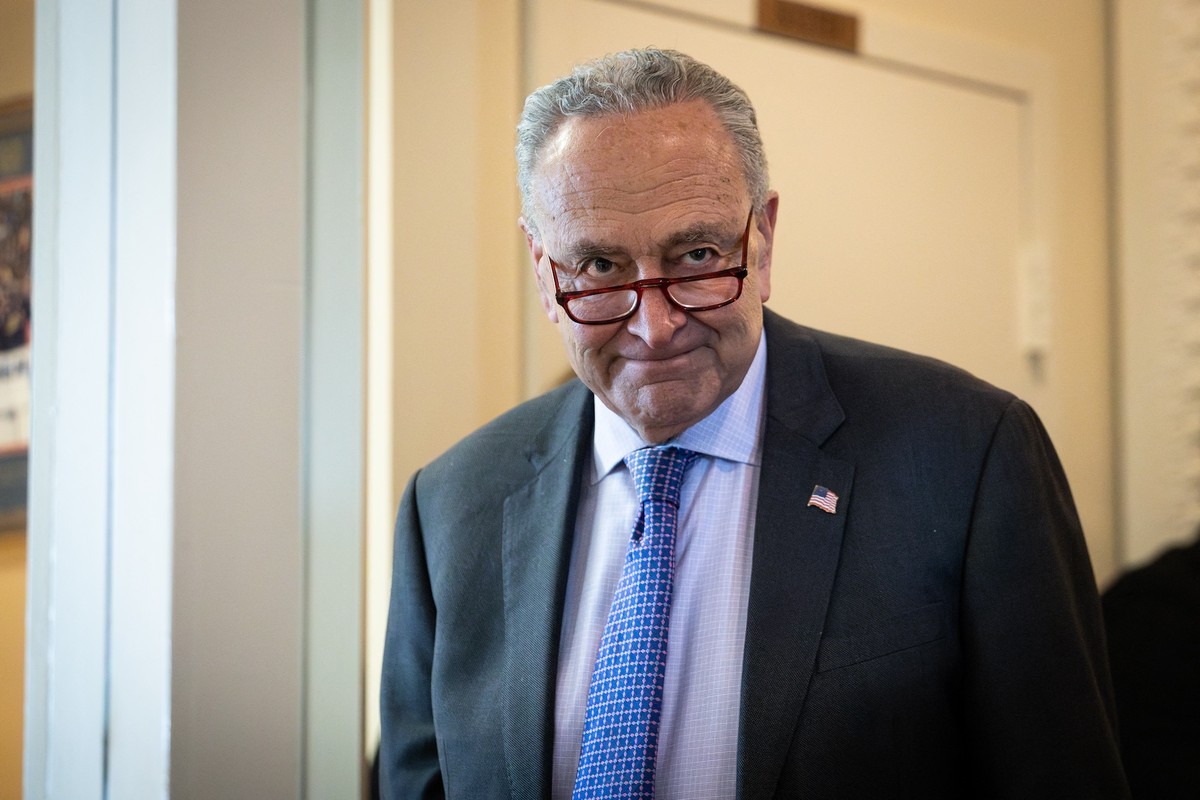

Donald Trump may be regretting his choice of running-mate and wondering “Why did I pick this guy?” according to Senate Majority Leader Chuck Schumer. Over the past few weeks since Trump announced his decision, the narrative that Sen. J.D. Vance is “weird” has gained traction, and Schumer speculated that may have the former president considering replacing him.
“Every day, it comes out Vance has done something more extreme, more weird, more erratic,” Schumer said. “Vance seems to be more weird and erratic than President Trump, and I’ll bet President Trump is sitting there, scratching his head, and wondering, ‘Why did I pick this guy?’”
The Democratic senator added, “The choice may be one of the best things [Trump] ever did for Democrats.”
It’s true that the news cycle around Vance has been, well, weird, and Democrats as well as celebrities opposed to Trump have pounced on that messaging.
Take, for example, a 2021 Tucker Carlson interview where Vance said that America was being influenced “by a bunch of childless cat ladies who are miserable at their own lives and the choices that they’ve made, and so they wanna make the rest of the country miserable, too.” He added, “You look at Kamala Harris, Pete Buttigieg, AOC, the entire future of the Democrats is controlled by people without children.”
Harris has step-children with her husband, Second Gentleman Douglas Emhoff. Later in 2021, Buttigieg and his husband Chasen welcomed twins, a daughter and son.
Jennifer Aniston clapped back at Vance, writing on Instagram, “I truly can’t believe this is coming from a potential VP of The United States. All I can say is… Mr. Vance, I pray that your daughter is fortunate enough to bear children of her own one day.”
“To put it in women-hating words you’d understand,” comedian Chelsea Handler quipped, “You’re being hysterical.”
In another strange move, Vance previously proposed the bizarre idea of giving all children a vote in America and handing “control over those votes to the parents of those children.” He has also floated the idea of a “federal response” to prohibit women living in red states like his home state of Ohio from traveling to obtain an abortion post-Roe. “I’m pretty sympathetic to that [idea],” he said. In 2022, Vance said he “would like abortion to be illegal nationally.”
Vice President Kamala Harris’ campaign has played into the Vance is weird narrative by calling him a “creep” in a statement Friday with the headline: “J.D. Vance is a Creep (Who Wants to Ban Abortion Nationwide).” In an email sent Friday, the Harris campaign wrote, “J.D. Vance is weird. Voters know it — Vance is the most unpopular VP pick in decades.” Also on Friday, per Politico, Harris campaign spokesperson Serafina Chitika stated that Vance “spent all week making headlines for his out-of-touch, weird ideas.”
It’s also odd how Vance, once a self-described “never Trumper,” has pivoted to becoming one of his most fervent supporters. While in public, Vance used to call Trump an “idiot” and “reprehensible.” In private, he reportedly likened him to Adolf Hitler. But Vance sought and secured Trump’s endorsement during his 2022 Senate race.
And then there’s the couch rumor. A viral tweet falsely claimed that Vance wrote in his book, Hillbilly Eligy, about masturbating using a latex glove between two sofa cushions. Although that allegation has been disproven (Vance never wrote anything like that in the book) the damage was already done in the form of memes and jokes that continue to propagate across the internet.
Will all of this lead Trump to dump his vice presidential nominee ahead of Ohio’s Aug. 7 ballot deadline? Schumer thinks it’s possible, although it’s worth pointing out that doing so would likely require Trump to at least tacitly admit he was wrong — something he rarely does.
“Now [Trump] has 10 days before the Ohio ballot is locked in,” Schumer said. “He has a choice: Does he keep Vance on the ticket, where he already has a whole lot of baggage — he’s probably going to be more baggage over the weeks because we’ll hear more things about him — or does he pick someone new? What’s his choice?”








War Is Peace: Trump’s Regime-Change Reversal
As American and Israeli rockets fly into Tehran, with the stated goal of regime change, anyone who bought into the self-evidently absurd idea of “Donald the Dove” ending America’s forever wars ought to be suffering from a bloody form of buyer’s remorse.
It was always bullshit. But that’s what the Trump team was selling hard. Take human ghoul Stephen Miller’s tweet days before the election: “Kamala = WWIII. Trump = Peace.”
The Trump team reads George Orwell’s 1984 like an owner’s manual and so of course “war is peace.” Their undermining of NATO and the dismantling of American alliances in favor of a “might makes right” foreign policy executed by a sycophantic kakistocracy is a guarantee of more war amid autocratic power grabs worldwide, with a side order of corrupt crony capitalism to profit from the chaos.
If you voted for Trump and believed him, this is on you. And that includes self-styled Palestinian peace activists who thought that Biden and Harris were the worst of all possible worlds and stayed home. We will no doubt see protests for the innocent lives lost in these strikes — but I’d have a lot more time for those folks if they were also seen protesting the estimated 20,000 to 30,000 Iranian lives snuffed out by murderous mullahs in the last few months alone.
The Islamic Republic of Iran has been despotic and dangerous from its inception. The Iranian people have been oppressed and denied basic freedoms for decades. But this is an extreme example of a war of choice. The American military strikes against Iran’s nuclear weapons facility last year were justified because Iran cannot be trusted with a nuclear weapon. That is true. But the much trumpeted total obliteration of those facilities is apparently not true — or so goes the justification for this war. And don’t forget that it was Trump who pulled the U.S. out of an Obama-era deal to stop Iran from developing weapons — arguing absurdly that the imperfect anti-nuke deal needed to be blown up to stop Iran from developing a bomb. Iran’s subsequent progress toward a bomb then created the rationale toward these strikes. This is a self-inflicted state of emergency. Peace is war and war is peace.
Pity the willful dupes in Congress who deluded themselves into thinking that Trump deserved the Nobel Peace Prize. They’ll probably rationalize that he would’ve been peaceful if he got the honor. Now it will be read as a cautionary tale for not sucking up. The chairman of the Board of Peace is now bored of peace. While Rand Paul remains admirably consistent, it’s Lindsey Graham who is pirouetting around the Senate floor while the Gimp Speaker Mike Johnson is unable to speak for the basic constitutional principles of separation of powers let alone authorization to go to war.
If you’re feeling shell-shocked trying to keep up with Operation Epstein Distraction, get ready for the inevitable next crisis — regime change without a plan for replacement. This is what the Trump administration did in Venezuela — kidnapping the socialist dictator Maduro but keeping his regime in place in exchange for crude oil access. The opposition is still in exile and its leader María Corina Machado gave her Nobel Peace Prize to Trump in exchange for exactly nothing.
One of the clear lessons of history is that if you don’t win the peace, you don’t win the war. The Saudis and their Sunni allies will back the U.S. and Iran because they hate the Shia Iranians (who, incidentally, are not Arabs), but beyond removing the Iranian regime, the plans for replacement and stabilization seem TBD — and with Trump’s inability to stay focused on anything beyond his immediate self-interest, solid plans are unlikely to emerge. Maybe a leader will come from the underground opposition; maybe it will be the Shah’s son, who has been living in the U.S. waiting for a restoration like many members of the diaspora. The upside is that Iran has a distinguished history and an accomplished Persian culture: The Islamists don’t represent the entirety of the people of Iran and never have.
But the path ahead will be messy at best. It will require concerted effort and civil commitment, not just an open call for private investment from Mar-a-Lago members. If the United States is now kidnapping and killing dictators without direct provocation, it establishes a dangerous precedent which will come back to bite us after demolishing our moral authority in the world.
It is the unexpected effects, the cascades of consequence where we cannot always plan ahead, that cause most responsible statesmen to try to keep the peace. But Trump has the carelessness of a rich-boy bully who can always buy or bluster his way out of trouble. He’s a con man who has found his ultimate mark in his followers, who fool themselves into thinking that a reflexive liar is the one man with the courage to tell the truth.
Perhaps the most prominent example is the vice president himself — a bright guy who not that long ago compared Trump to Hitler and a deadly narcotic but then convinced himself that careerism demanded an abrupt conversion. After all, he endorsed Trump less than two years ago with this very serious column headlined “Trump’s Best Foreign Policy? Not Starting Any Wars,” explaining, “He has my support in 2024 because I know he won’t recklessly send Americans to fight overseas.”